Ten Satellites in One Shot


The ISRO had a nice launch this morning, via Press Trust of India:

India today created history, launching ten satellites in one go with its Polar launch vehicle carrying the heaviest payload of 824 kg.

The ten-pack launch of the Indian Space Research Organisation (ISRO) saw the 230-tonne Polar Satellite Launch Vehicle (PSLV-C9) put into orbit an Indian Mini Satellite and eight foreign nano satellites besides the Cartosat-2A remote sensing satellite.

This is for the first time that ISRO has put ten satellites into orbit in a single launch.

A Russian rocket last year delivered 16 satellites in the outer space but the Russian launch vehicle carried a lesser payload of only around 300 kg.

However, ISRO Chairman G Madhavan Nair told reporters that Russia had tried to launch 13 satellites in a single launch.

"We have showed the world we can have multiple launches carried out in a precise manner. We have set a record. Only Russia had so far tried to launch 13 satellites in a single launch and I am not sure whether that was successful," he told reporters here.

He said there was some anxious moments due to some unusual weather condition over the Bay of Bengal off Andaman coast. "Only at 11 pm last night we decided to go ahead with the launch." Nair expressed happiness that all the mission objectives were achieved with precision and all systems functioned very well.

During the press announcement, the ISRO revealed they’re planning for a manned mission:

India will be in a position to carry out a manned space mission within seven years from now, said a top official of the Indian space agency in Sriharikota on Monday.

Addressing the media after the successful launch of 10 satellites in one go, Indian Space Research Organisation (ISRO) chairman G Madhavan Nair said: "The government has given us pre-project funding of Rs 950 million (for the manned mission) and we have initiated necessary activities."

Asked about the need for a manned mission when tests could be conducted remotely, he said: "Today the US, Russia and China have a capability to have a manned mission. We cannot be left behind in the space race. Further, man’s presence is absolutely necessary in a spacecraft for conducting some experiments."

The manned mission will be in ISRO’s second and more powerful rocket geo synchronous launch vehicle (GSLV).

"We have to study issues like crew module, emergency escape system, provision of all-round outside view from the spacecraft for the crew. These are complex systems that ISRO has to tackle," said K Radhakrishnan, director of the Vikram Sarabhai Space Centre, on the complexities involved.

ISRO will first put out three unmanned rockets to test the systems before sending a rocket with a man.

Here’s the launch video:
 

DIY Friday: Payload into Space

Maker Faire, arguably the preeminent DIY event of the year, is next weekend in San Mateo, CA. In honor of Maker Faire and Make’s contributions to our Friday segments, let’s bring back one of their best’s – the video space podcast:

Make: is going to space! Have you ever wanted to go up into space? Well, you don’t have to win a golden ticket, be a millionaire, or an astronaut… you can send your own payload into space!

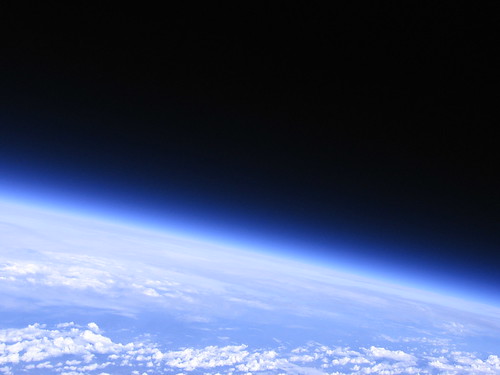
We’re using weather balloons to go up to approximately 100k feet armed with 4 cameras… 20 megapixels of camera! We’ll be taking shots every 7 seconds for two hours and measuring the temperature with the Make: controller and thermistors!

It took 16 people working on this, countless cases of mountain dew, lots of take-out food, and a lot of sleepless nights, and we intend to fly Sunday!

Cloud cover, snow, and mechanical failure may postpone the launch, but we’re ready to give it our best shot this weekend.

In this Make: Video Podcast, you’ll learn all the details of how to put a weather balloon up into space! The weather balloon will make it up to about 100,000 feet. That’s almost 20 miles up and more than twice the height of being in an airplane. It’s high enough that the sky is black and you can see the curvature of the earth.

Not exactly your average, weekend DIY project. From what I can tell from their wiki, they succeeded in getting the balloon to 109,242 feet, but since their batteries died, they have no way to track where the payload landed (and where they can acquire their photos).

Thankfully someone else made a similar trip – and brought back lots of pictures and some great video.

If you actually want to tackle this, start by buying the weather ballon. Then add-on all the gadgets and cameras you want.

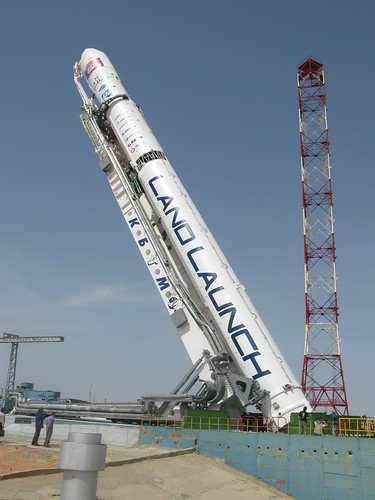
Amos & Land Launch


There are only eight countries that build communications satellites: France, Germany, Japan, the U.S., India, China, Russia and Israel. Yes, Israel. Who knew?

Built by IAI, the Amos-3 satellite is scheduled to launch on Friday, 25 April 2008, according to Tsenki:

На космодроме Байконур завершаются работы по подготовке к пуску ракеты космического назначения "Зенит-3SLБ" с разгонным блоком "ДМ-SLБ" в качестве третьей ступни и коммуникационным космическим аппаратом Amos 3.

The Amos satellite system is operated by Spacecomm, also based in Israel. Launch service is provided by Land Launch, which uses essentially the same rocket as Sea Launch, only from Baikonur.

The Jerusalem Post is reporting the launch was delayed by 24 hours:

The expected launching of Israel’s Amos 3 communications satellite, which was slated to take place at approximately 8:00 a.m. Thursday in Kazakhstan, was called off due to technical difficulties. The Israel Aerospace Industries (IAI) announced that the launch would be put off by at least a day after a failure was detected in the satellite’s launching system.

As a result of the postponement Beit Hanassi canceled a large reception that was to be hosted by President Shimon Peres to commemorate the launch.

No word yet whether this launch will be webcast, but the launch window opens at 02:00 GMT.

Interesting mission:

AMOS-3 will be deployed to the 4°W orbital slot, where it will join the AMOS-1 and AMOS-2 satellites, eventually replacing AMOS-1. AMOS-3 will offer additional capacity, coverage areas, and advanced capabilities such as two wideband Ka-band beams of up to 500 MHZ each and 12 Ku band 72MHZ transponders with steerable beams for global coverage.


New Mexico Voters Approve Spaceport Tax


You’ve heard about Obamamania. Now rocket mania is sweeping voters, at least in New Mexico.

Voters in Sierra County in the Land of Enchantment have approved a quarter-cent tax to help fund New Mexico’s Spaceport America. The vote, following on the heels of an earlier approval by residents of neighboring Dona Ana county, means that Spaceport America is a go.

We’ve been closely following the race to build a new commercial spaceport to meet the expected needs of space tourism since 2006. (See also this news on Spaceport America from last year.) The results from the tax election in Sierra County virtually guarantee that Spaceport America will be the first new commercial spaceport to open its doors in the United States since the race began for the space tourists’ dollars.

That’s bad news for Spaceport Sheboygan, the Wisconsin spaceport effort that is being heavily promoted by the Great Lakes Aerospace Science and Education Center, among others.

Virgin Galactic will be Spaceport America’s anchor tenant. It’s already in use by the likes of Lockheed Martin, who love Spaceport America’s convenience:

 Spaceport America has launched two unmanned commercial rockets and touts plans for space tourism, but some secret rocket research also is being done.

Lockheed Martin Corporation is now using the spaceport to advance some of its less-publicized technology.

This prototype of Lockheed Martin’s new spacecraft is only one-fifth the size the future vehicle would be.

It looks a bit like the space shuttle and would fly to space and return the same way.  But even the big version would not carry people, just satellites…

For Lockheed Martin Spaceport America in southeastern Sierra County offers the perfect venue for research like this.

"To be able to have a spaceport located down here where we can come in and almost just drop right in, do our thing and then be able to go back home and review the data and then be able to schedule and come back, that is very key for us," Simpson said.

A video of the report on Lockheed Martin at Spaceport America can be seen here

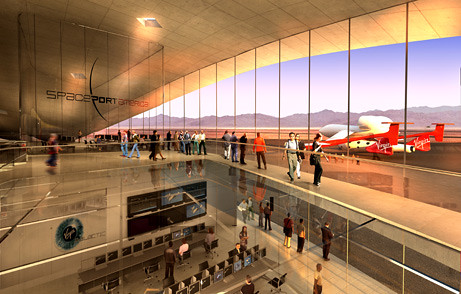
An artist’s conception of the inside of Spaceport America’s terminal:


Nagging in Space?

Ballistic re-entry, again. Yes, that’s the story here. But there’s more: did Anatoly Perminov, head of the Russian Federal Space Agency, really say what was attributed to him?

You know in Russia, there are certain bad omens about this sort of thing, but thank God that everything worked out successfully. Of course in the future, we will work somehow to ensure that the number of women will not surpass [the number of men]. This isn’t discrimination. I’m just saying that when a majority [of the crew] is female, sometimes certain kinds of unsanctioned behaviour or something else occurs, that’s what I’m talking about.


Does this imply the women were ganging up on the guy to "just get us home," or something? Unsanctioned behavior — could include "nagging," but I kind of doubt that. 

They experienced 8 to 10 times the forces of gravity, which is very serious, according to the next astronaut from Australia:

The steeper-than-normal angle of re-entry subjects the crew to enormous gravitational force, up to 10 times that which is experienced on the ground.

Nik Halik, an Australian adventurer and entrepreneur, has experienced such forces during his cosmonaut training at Star City, near Moscow.

"The force in your chest, it’s incredible," he said.

"It’s like a boa constrictor is just squeezing you and squeezing and you can hardly breathe.

"That’s why we do training here to make sure that our bodies can cope with the actual stresses because they are very, very excessive."

Mr Halik lives in a room on the floor below the quarantine area where the cosmonauts have been held since their return to Earth.

He has wanted to travel in space since he was four years old and he will soon get his wish. He graduates as a cosmonaut in September after five years of study and training.

Already, he’s been named as the back-up crew member for the next Soyuz mission, currently known as TMA-13.

"The back-up historically has the primary spot, the following flight, which in this case will be the spring of ’09 flight," he said.

"It’s incredibly exciting for an Australian civilian."

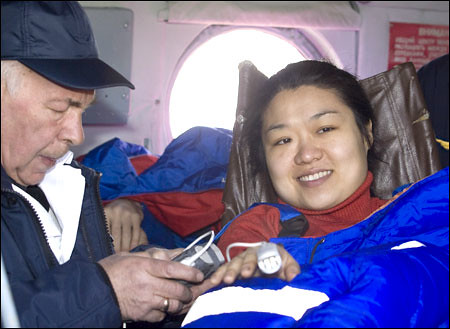
Astronaut Yi is recovering in a Moscow hospital and is expected back in South Korea next week:

When she was salvaged from the charred Soyuz space on the Kazahkstan steppe, Yi looked so exhausted that she was not able to walk by herself. “There was a shock during landing, and I’m having trouble with my sense of direction,” she told SBS TV as she was waiting to be airlifted by a military helicopter. Veteran crewmates Peggy Whitson of the United States and Yuri Malenchenko of Russia also looked worn out.

In a press conference held at the Kustanaj airport in Kazakhstan a few hours later, the 29-year-old Korean seemed to have regained some of her energy and cheerfulness. When asked about the most difficult part of her 12-day trip to the International Space Station, she said nothing was harder than the training she received on the ground.

“I have always said the spinning chair was most difficult for me,” she said in English. “Otherwise, it was all exciting and fantastic. The most impressive thing was flying in outer space, so now I’m little bit confused whether I can fly or not.”


Earth Day!

Since it’s a nice day, I’ve had too much coffee, and I feel like dancing (with my usual lack of rhythm), we’re going to kick off the Earth Day post with a little Kanye West, Earth Day-style:

I’m a big Earth Day fan, maybe because it reaches back to my Wisconsin roots. In September 1969, Gaylord Nelson, a U.S. Senator from the Dairy State, proposed a nationwide demonstration focused on the environment for the following spring. Senator Nelson’s idea to put the environment on the national political agenda means that, today, Earth Day is being observed by millions of people in over 170 countries.

With Global Warming an urgent concern (to me, at least), Earth Day has more significance than ever. NASA reports that 2007 was tied as Earth’s second-warmest year:

Climatologists at the NASA Goddard Institute for Space Studies (GISS) in New York City have found that 2007 tied with 1998 for Earth’s second warmest year in a century.

“It is unlikely that 2008 will be a year with truly exceptional global mean temperature,” said Hansen. “Barring a large volcanic eruption, a record global temperature clearly exceeding that of 2005 can be expected within the next few years, at the time of the next El Nino, because of the background warming trend attributable to continuing increases of greenhouse gases.”

The eight warmest years in the GISS record have all occurred since 1998, and the 14 warmest years in the record have all occurred since 1990.

Goddard Institute researchers used temperature data from weather stations on land, satellite measurements of sea ice temperature since 1982 and data from ships for earlier years.

This year (beyond the Kanye video), lots of attention is being paid to alternative energy options, particularly with rising gas prices. Wired has an article on how eSolar—with backing from Google’s philanthropic foundation, Google.org—is working on using sunlight-reflecting mirrors to generate steam:

For proof, look no further than the fat $130 million investment scooped up by eSolar, a company whose basic solar power strategy — using sunlight-reflecting mirrors to generate steam — was all but abandoned in the 1980s, and has recently recently caught investors’ attention again.

The money, from Google’s philanthropic arm, Google.org, and venture capital firms Idealab and Oak Investment Partners, will go towards the construction of eSolar’s first functioning solar power plant.

“ESolar’s long term is to become a viable replacement for all fossil fuel,” said Robert Rogan, a Cal Tech Ph.D. and eSolar’s executive vice president for corporate development. “The reason Google invested in us is that they saw the potential of this technology to beat the cost of using coal.”

The company’s core technology is an implementation of concentrating solar power, which uses mirrors to turn liquid into steam that drives standard electricity-generating turbines. CSP, also sometimes called solar thermal, is considered a promising replacement for fossil fuel power plants, particularly the coal plants that generate more than half of U.S. electricity. It’s been around for decades, last seeing popularity in the early 1980s, when oil hit an inflation-adjusted price of $82 per barrel. Higher oil prices make fossil fuel plants more costly, making it easier for alternative technologies to compete. (Oil is currently trading for more than $115 a barrel, its highest level ever.)

Branson to Marry First Space Couple


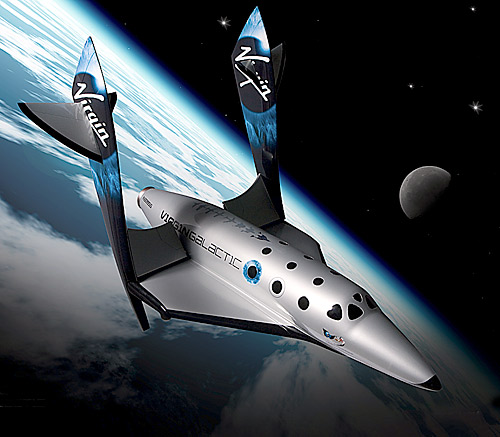
Caption: The matrimonial limo of the future?

We’ve long been proponents of space tourism, and its potential to lead humanity to new levels of experience.

But we’re the first to admit that we hadn’t thought space tourism would lead so quickly to the wedding altar.

The Daily Mail

Virgin Galactic boss Sir Richard Branson is planning to set yet another record – by becoming the first man to marry a couple in space.

The 58-year-old billionaire intends to conduct a ceremony 70 miles above the Earth on the first Galactic sub-orbital flight next year.

He has already officiated at one wedding in mid-air. Last year he was ordained for the day in an online church to marry Virgin America marketing director Dimitrios Papadognonas and Coco Jones on a Virgin flight from San Francisco to Las Vegas….

A spokesman for Virgin Galactic told The Mail on Sunday: "We have had two bookings involving marriage, one to get married in space and the other for the couple to have their honeymoon in space.

"It is possible that Richard could obtain a licence to conduct the marriage."

The couple who have booked in for a honeymoon on the £100,000-a-ticket maiden flight are Virgin Galactic adviser George Whitesides and his new wife, Loretta Hidalgo.

The Virgin Galactic space project is progressing at a dramatic rate and customers will take part in the first test flights this summer.

We suppose we should have seen this coming, what with the rise in popularity of destination weddings. Not to mention the Mile High Club.

But how will they keep the cans from falling off the back of SpaceShipTwo

Perhaps we’re being too flippant. The respected French scientific writer Pierre Kohler might tsk tsk us for our snark. "The issue of sex in space is a serious one," he says:

"The experiments carried out so far relate to missions planned for married couples on the future International Space Station, the successor to Mir. Scientists need to know how far sexual relations are possible without gravity."

He cites a confidential Nasa report on a space shuttle mission in 1996. A project codenamed STS-XX was to explore sexual positions possible in a weightless atmosphere.

Twenty positions were tested by computer simulation to obtain the best 10, he says. "Two guinea pigs then tested them in real zero-gravity conditions. The results were videotaped but are considered so sensitive that even Nasa was only given a censored version."

Censored guinea pigs? It just gets better and better.

The guinea pigs caught the attention of quite a few internet surfers, who, we’re told, spend an inordinate amount of time looking for such things. 

We’re reminded of what futurist Arthur C. Clarke once speculated about the future of mankind in space. "Weightlessness will bring new forms of erotica," he said. "About time, too.”  

DIY Friday: Wireless Internet Cantenna

For those of you who are unaware, a Cantenna is “a directional waveguide antenna for long-range Wi-Fi used to increase the range of (or snoop on) a wireless network.” WiFi antenna designs are almost limitless – you can use a mineral water bottle, a cable antenna, a pringles can, a fire extinguisher, a kitchen steamer, or a cooking strainer and thumbdrive. Leave me a comment if I missed something.

The most common design utilizes a simple tin can, an N-Female chassis mount connector, and some thick wire. Instructions are available here, but the process is fairly simple: “1. Collect the parts; 2. Drill or punch holes in your can to mount the probe; 3. Assemble the probe and mount in can.” If you want to optimize different size cans, the (somewhat complicated) math is described here.

For a good overview of WiFi antennas, check out this excellent episode of Systm:

But, since Really Rocket Science tries to push the DIY-limits (and since we really like satellite dishes), try “hot-rodding” a basic can-Cantenna by adding an old satellite dish. Instructions are available here – let’s just say it takes a fair amount of creative ingenuity. It’s for the DIY-expert.

And, as usual, you could just be lame and buy one.


Rumble in the Jungle

Lancement ce soir (launch tonight). There’s going to be a big rumble in the jungles of French Guiana tonight when an Ariane 5 ECA rocket is scheduled to blast off, launching two geo satcoms into space later today. Roll-out yesterday:
Arianespace today rolled out the Ariane 5 for its second mission of 2008, clearing the way for a final countdown to its liftoff tomorrow evening with the Star One C2 and VINASAT-1 telecommunications satellites.
The heavy-lift Ariane 5 ECA emerged from its Final Assembly Building at 10:45 a.m., and arrived in the Spaceport’s ELA-3 launch zone at 12:00 noon.
This transfer utilized a 2.8-km. section of the dual-rail system that links the Spaceport’s major launch infrastructure elements. The Ariane 5 rode atop one of two mobile launch tables developed for the workhorse vehicle.
Star One C2 and VINASAT-1 will be deployed during the Ariane 5’s 31-minute-long flight, with liftoff from French Guiana scheduled at the 7:17 p.m. opening of a 1-hour, 7-min. launch window.


Live broadcast in Vietnam  on VTV-1. The launch will be available via webcast beginnging at 21:57 GMT. Launch window opens at 22:17 GMT.

Vinasat-1 will be owned and operated by VNPT and Star One C2 by Embratel’s satellite operator. Interesting. From the jungles of French Guiana, satellites covering the jungles of Southeast Asia and the Amazon.
La Revue d’Aptitude au Lancement (RAL) s’est déroulée le mercredi 16 avril à Kourou et a autorisée les opérations de chronologie pour le Vol Ariane 5 ECA – STAR ONE C2 & VINASAT-1. Pour son 2ème lancement de l’année, Arianespace mettra en orbite deux satellites de télécommunications : STAR ONE C2 pour l’opérateur Brésilien Star One, dans le cadre d’un contrat clés en main avec Thales Alenia Space et VINASAT-1 construit par Lockheed Martin Commercial Space Systems (LMCSS) pour le compte de l’opérateur Vietnamien Vietnam Post and Telecommunications Corporation (VNPT). Le lancement sera effectué depuis l’Ensemble de Lancement Ariane n° 3 (ELA 3) à Kourou en Guyane française. Le décollage du lanceur Ariane 5 ECA est prévu le plus tôt possible dans la fenêtre de lancement suivante:
GMT : de 22h17 à 23h24, le 18 avril 2008
PARIS : de 00h17 à 01h24, le 19 avril 2008
HANOÏ : de 05h17 à 06h24, le 19 avril 2008
KOUROU : de 19h17 à 20h24, le 18 avril 2008
RIO DE JANEIRO : de 19h17 à 20h24, le 18 avril 2008

Space Tug Gets Entangled

"Amid a flurry of legal wranglings, charges and countercharges, a North Salt Lake company and three former associates are in a tug-of-war over nuclear-powered space tugs, with perhaps billions of dollars at stake," the Salt Lake Tribune reports:

IOSTAR and its founder and CEO have filed suit against the three former associates, alleging theft of corporate secrets in order to develop competing satellites. In a counterclaim, the three allege that the CEO has misappropriated millions of dollars and violated tax and securities law.

To date, no satellites have been developed, let alone launched. IOSTAR has seen its board of directors implode through dismissals or resignations. And a tangled web of companies and current and former officers is caught in the legal crossfire. 

IOSTAR’s dream of a nuclear-powered satellite that could serve as a tug pulling other satellites from a low orbit, where it’s cheaper to launch them into their proper orbits, is shared by many companies. Last December, Loral wanted in on the Space Tug proposal:

The Space System/Loral-team would use the company’s proven 1300-series satellite bus as a refuelable space tug that would remain in orbit for as long as 10 years. After docking with and escorting an essentially dumb cargo vessel to the [International Space Station], the vehicle would also remove it from the station and allow it to be deorbited over an ocean. 

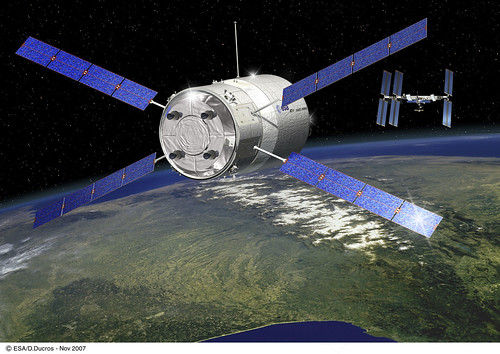
While the space tug legal wranglings work themselves out in Utah, the ESA’s Automated Transfer Vehicle (ATV) — the "most powerful space tug ever built" — is proving to be an indispensable ISS supply ship.


Approximately every 17 months, ATV is scheduled to carry 7.7 tonnes of cargo to the Station 400 km above the Earth. An onboard high precision navigation system will automatically guide ATV on a rendezvous trajectory towards ISS, where it will dock with the Station’s Russian service module Zvezda.

We blogged about ATV’s launch last month. The ISS is getting good use out of the ATV, as today’s status report from the ISS indicates. ATV1 is scheduled to undock from the ISS in August of this year.