Author Archive

GPS for Gangs

Monday, May 8th, 2006

It works for finding lost pets and kids out past curfew, so it makes perfect sense to use GPS in fighting crime. I’ll be interested to see how California’s plan to track gang members using GPS works out.

 Under an arrangement between prison officials and San Bernardino, high-risk parolees known to belong to street gangs will be released from custody on the condition that they wear a GPS bracelet on their ankles at all times.

They appear as moving dots on a map and if they try to remove the anklet or enter unauthorized areas the device sends an alert to a base station monitored by law enforcement officials. 

I suppose it’s nothing new. According to the article, it’s already used by some California counties to monitor sex offenders. But when you combine that story with the ability to track wandering teenagers (or spouses) via GPS, it starts to sound like an episode of Wild Kingdom. It’s just that the tag is on a tasteful bracelet instead of being fastened to an ear. 

One question arises in my mind, however. How secure is this tracking system? In the cases of people who might be subject to retaliation or other attacks if identified — like sex offenders and gang memvers — how easy would it be for someone with enough technical knowledge, and an intent to do harm, to hone in on their tracking device and  locate them?

More Robots

Tuesday, May 2nd, 2006

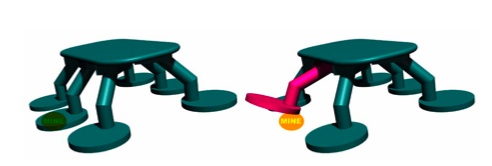
While we’re on the subject of robots, how’d you like to strap these to your feet and stroll through a minefield? 

That’s what developers at Singapore’s BioMedical Research Centre have in mind. But before you decide, you should know these shoes are designed to keep you from stepping on a landmine. There’s a research paper (in PDF format) about them, that has more technical lingo than I can decipher. Fortunately Robot Gossip has translated it all into laymen’s terms. 

The shoes have six short legs under each of your feet. The pods on each of the little legs has a metal detector. If one of the robot-shoe legs senses a trigger of a mine then it releases so that it can move up out of the way without setting off the mine. You would be supported by the other five legs on the shoe. When you step forward the leg locks in place again.

Also, everyone’s talking about Genibo — the robot dog that replaced AIBO — but there’s yet another robo-dog making the scene: the X-Cybie, which is an updated version of the iCybie. The X-Cybie is already available for order on Amazon, for $149, and will ship on May 4th. 

There aren’t any pictures the X-Cybie just yet, but word on the iCybie forum is that it’s basically the same as the iCybie (pictured below) except that this model has a fur coating that will come in a variety of colors. I can only imagine the fur would make the X-Cybie more fun to pet, but I can’t help wondering if it sheds. 


Another Robot Race

Tuesday, May 2nd, 2006

Last month I posted about the Great Robot Race. Well, the folks at DARPA at it again. Only this time robots will make their way through city streets, instead of the desert, during Grand Challenge

The Pentagon said Monday that a third Grand Challenge competition would be held to foster research and development into advanced robot vehicles.

In contrast to the previous contest, which took place in the desert on the border between California and Nevada, the new competition will be carried out in a mock urban area. Robots will be required to obey traffic laws while merging into traffic, as well as negotiating traffic circles, busy intersections and obstacles. The event is scheduled for Nov. 3, 2007.

First prize for successfully completing the 60-mile course in less than six hours will be $2 million. Second prize will be $500,000 and third prize is set at $250,000.

But if you want to participate, you’d better hurry. There’s already an Urban Challenge Participants Conference scheduled for May 20th, in Reston, Virginia. You can register at the Grand Challenge website. After that, you’ll have a bit more time (but not much), depending on which track you choose

DARPA also will make funding available for contenders before the finals, through two tracks:

  • Teams could submit detailed proposals for up to $1 million in technology development funds, with the government obtaining limited licensing rights to the resulting technologies. The selected teams would proceed to a semifinal known as the National Qualification Event.
  • Teams could participate in a series of qualifying tests, just as competitors did in the 2004 and 2005 DARPA Grand Challenges. The teams selected for the National Qualification Event would get $50,000, and the teams that are successful at that event will get $100,000 and a spot in the November 2007 finals.

Track A proposals are due on June 23rd, and Track B proposals on October 5th.

Science Mythbusting

Monday, May 1st, 2006

Over on Newsvine, I came across an interesting post by someone who claims to be busting the myths about science, and found a couple of interesting items on the list.

Myth 2. The Great Wall of China is the only manmade structure visible from space

There are several variations on this folkloric statement, and they’re all quantifiably false. Astronauts can spot the Great Wall from low-Earth orbit, along with plenty of other things like the Giza pyramids and even airport runways. But they can’t see the Wall from the Moon. 

Myth 12. There is no gravity in space

Blame the term "zero-gravity" for this common misconception. Gravity is everywhere, even in space. Astronauts look weightless because they are in continuous freefall towards the Earth, staying aloft because of their horizontal motion. The effect of gravity diminishes with distance, but it never truly goes away. It is also untrue that space is a vacuum. There are all kinds of atoms out there, albeit sometimes far apart. 

I don’t know about the gravity question (any physicists out there?), but apparently our mythbuster is dead on about the Great Wall.

“You can see the Great Wall,” Lu says. But it’s less visible than a lot of other objects. And you have to know where to look.

In fact stretches of the wall aren’t even visible from China. They’ve been buried by sand for centuries. NASA has used space-based radar to map out hidden parts of the ancient structure. [Astronaut Ed] Lu is trying to get a picture of it, too, with a digital camera. 

I don’t know if Lu every got his picture, but I did track down the pictures NASA took with its "space-based radar." 

The mythbuster also takes on some common myths about asteroids.

DIY Friday: DIY Energy

Friday, April 28th, 2006

A belated happy Earth Day to all. We went kinda "off the grid" last Friday, in honor of Earth Day, and thus found it somewhat difficult to get a DIY Friday post published. We had it all ready to go, but that whole smoke signals set up didn’t quite work. So, here’s our belated DIY Friday post, as the clock ticks down on Earth Day afterglow.

This first bit isn’t exactly a DIY project,  but having a solar generating briefcase last Friday — like the one we spotted on ProductDose recently —  might have helped get the DIY Friday post published. It’s handier than a gas generator, and so much less fossil fuel dependent. Besides, it generates more than enough electricity to power a laptop, so we could have charged up the iPod while we were at it. 

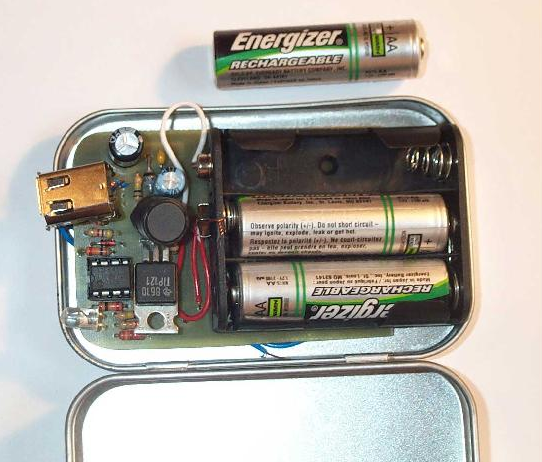
Speaking of iPods, this Altoid tin hacked into an iPod charger sounds like a good idea, if only the inventors could get it working. They cite a couple of reasons why it doesn’t, which I’ll post here in hopes that someone will be able to help them out. 
There are (at least) two reasons this charger _does not_ work:

1. The transistor doesn’t let enough current flow to fully charge the inductor.  The other option is a FET, but a FET needs a minimum of 5 volts to switch fully on. This is discussed in the SMPS section.

2. The inductor is simply not big enough. The charger doesn’t produce nearly enough current for the iPod.  We didn’t have an accurate way to measure the iPod charging current (save cutting apart the origional charging cable) until our parts arrived from Mouser.  The inductors recommended are nowhere near large enough for this project.  A suitable substitution might be the coil Nick de Smith uses on his MAX1771 SMPS.  Its a 2 or 3 amp coil from digikey:

[ http://www.desmith.net/NMdS/Electronics/NixiePSU.html#bom ]

This device can provide a small amount of power to a USB or firewire device, but not enough to charge an (3G) iPod.  It WILL power, but not charge, a totally dead 3G iPod.

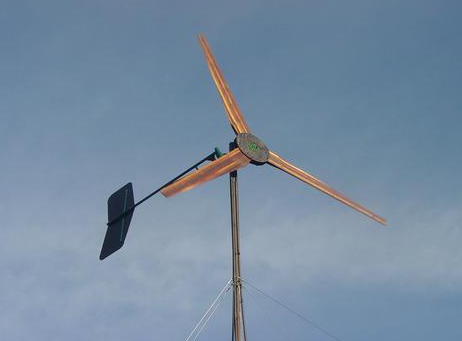
Meanwhile, as long as we’re on the subject of power, this homebrew wind turbine sounds like a pretty good idea. I don’t know how much power it generates, but I bet it will power a laptop and an iPod (probably) as the builder says he’s seen "3800 watts from it in a high wind." I’m not sure how much power that is, but he says he’s a bit more than he can use. 

The guy who made the wind turbine would probably do well to team up with the David Mears — a professor of Bioresource Engineering at Rutgers University —  who managed to hack his entire house into such an energy efficient mode, with adjustments including a woodstove and a solar enabled greenhouse (pictured above),  that he and his family went 25 years without getting a heating bill. That’s also 25 winters of not burning fossil fuels to heat the house.  That’s not just good for the pocket book, but good for the earth too. And that makes for a happy (though belated) Earth Day.

The Big Break-Up

Friday, April 28th, 2006

Everybody’s talking about the big break-up. No, I don’t mean Nick and Jessica. I’m talking about Schwassmann-Wachmann, a comet that supposed to swung by earth next month, after it — according to one report — broke up for no apparent reason ten years ago. 

In 1995, Comet 73P/Schwassmann-Wachmann 3 did something unexpected: it fell apart. For no apparent reason, the comet’s nucleus split into at least three "mini-comets" flying single file through space. Astronomers watched with interest, but the view was blurry even through large telescopes. "73P" was a hundred and fifty million miles away.

No apparent reason? Not exactly. 

Naturally, I’m not the guy with the answers on this. (Again, I refer you to the screen name.) But Phil over at Bad Astronomy has what seems like a reasonable explanation to me. 

The exact cause is a mystery, though there are plenty of reason why a comet would fall apart. Comets are made of rock and ice. When they get near the Sun, the ice sublimates– turns directly into a gas — and flows into space, which is why comets look fuzzy in pictures. The actual nucleus, the solid part, is very small, but the coma, the fuzzy part, can be thousands of miles across.

It makes sense that after repeated passes of the Sun, enough ice is lost to venting that the structure of the comet can be fragile, since the ice in a way is holding the comet nucleus together. Once enough ice is gone, a breakup could occur if the sublimating ice builds up enough pressure to disrupt the structure. But that is just one explanation. The famous comet Shoemaker-Levy 9 broke apart because of the immense tidal forces of Jupiter’s gravity. Most comets don’t break apart; look at comet Halley, which has been circling the Sun for a long, long time (it was seen in ancient times). It goes to show that some comets are very fragile, and some are not.

OK, so it’s just one possible explanation, but it’s one more than I could come up with on my own. But just for the sake of argument, what other explanations could there be? Unless Bruce Willis or Morgan Freeman had an hand in it, I’ll take Phil’s explanation for now. (HubbleSite has the pics.)

mobTV Happens in Vegas

Monday, April 24th, 2006

Here’s an interesting tidbit from behind the Wall Street Journal’s subscription wall. MobTV is getting another foothold stateside.

Satellite operator SES Global S.A., seeking to find a place in the burgeoning wireless-entertainment arena, today is expected to announce it is joining with a start-up company that controls a big swath of mobile broadcast spectrum across the U.S.

The anticipated technical and marketing alliance between SES Americom, the U.S. unit of Luxembourg’s SES Global, and closely held Aloha Partners LP of Providence, R.I., is intended to demonstrate the business case and consumer appeal of beaming digital music and high-resolution video to cellphones and other consumer hand-held devices. But the initiative also illustrates broader efforts by satellite-services companies to participate in the fast-changing media landscape, particularly at the convergence of television and

… A yearlong test is planned to begin this fall in Las Vegas, though negotiations with programmers and leading cellular providers still have to be worked out.

The plan is the most ambitious yet to test such a system using fewer transmitters, or towers, to simultaneously distribute as many as 40 higher-resolution video channels directly to handsets. Implementing the concept would end up costing a small fraction of the estimated billions of dollars necessary to build out rival networks relying on less-powerful broadcast signals and thus requiring towers spaced closer together.

Multichannel News has a bit more, no subscription required. 

It’s encouraging news, after my previous post on mobTV spreading in Korea, across Europe, and into Canada and North America. It’s also encouraging that, after re-reading my post on how mobTV works, I think I get how the Las Vegas project is gonna work out.  I’m guessing the involvement of a satellite company means using a satellite signal to cut down on spectrum issues like the ones covered in my previous post. 

So, this sounds like a wish fulfilled. I just hope that the tag line from those edgy and ubiquitous Las Vegas tourism commercials doesn’t hold true for  this latest stateside foray into mobTV.

ER on the Moon?

Friday, April 21st, 2006

Back to robots for just a minute. I mentioned the pregnant robot earlier, the one used to help train medical students without the need for human guinea pigs. I also blogged about the challenge of meeting medical needs in space. Well, those topics have come together in a pretty interesting way. With help of a NASA robot, emergency surgery in space may have just gotten a lot easier. 

Using a cramped undersea laboratory off Florida’s Atlantic coast, NASA astronauts and medical experts have teamed with an experimental robot to demonstrate long-distance surgical procedures that might one day save the life of a critically injured explorer on the moon or Mars.

The mission to evaluate a new branch of health care called telemedicine and the use of robots in surgery will draw to a close today when the three-man, one-woman crew leaves the research facility 62 feet below the water’s surface where they have lived since early this month.

During their stay aboard the 43-foot-long Aquarius, submerged among the coral reefs off Key Largo, Fla., physician Tim Broderick and three astronauts — Dave Williams, Ron Garan and Nicole Stott — assisted as Canadian surgical researchers 1,250 miles away sent commands to a robot inside the laboratory.

Responding to those commands, the portable robot sutured a badly damaged vein in the wounded arm of a patient simulator, a lifelike medical teaching aide constructed of rubber and fabrics that mimic human tissue and contain bloodlike fluid.

"Patient simulator"? "Lifelike medical teaching aide"? Is it me or does that sound like a robot doing surgery on a robot? I guess it’s better that way, as long as they’re experimenting, but I supsect they won’t get any notes about cold hands or bedside manner from a "lifelike medical teaching aide."  

Via Mars Blog.

Space Junk

Wednesday, April 19th, 2006

No, I don’t mean the song by Devo. But there’s gonna be some more junk up there, do you need to get one of those hats the band used to wear back in the day, on the off chance that some of that junk finds it’s way back down here? Apparently the FCC ruled that U.S.-licensed satellites launched after March 22, 2002 have to go into disposal orbit when they’ve beamed down their last signal. The latest is the Spacenet 4 satellite, which was launched in 1985.

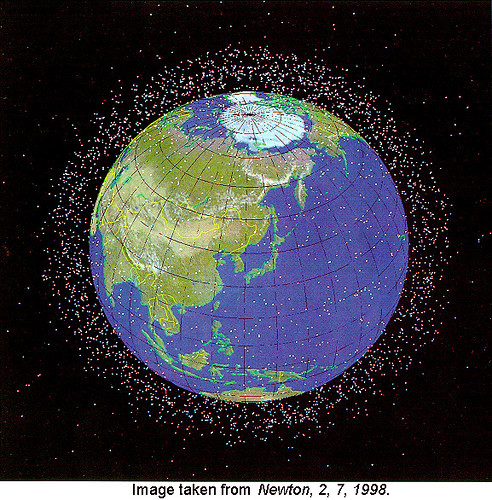
I’ve blogged about the satellite graveyard before, and apparently we’ve left a lot of stuff up there in the past 25 years or so; more than 9,000 man-made objects, which can break into little pieces and cause problems for current space missions. It looks something like this.

Space Junk

I’ve also blogged before about how stuff gets knocked around up there. And it’s not all that unusual for some of it to fall to earth. It can land in your garden, or even on you. Don’t believe me? Ask Devo

She was walking all alone
Down the street in the alley
Her name was sally
She never saw it
When she was hit by space junk

At least now we know why they wore these. 

Space Helmet

Either wear a helmet or practice catching the stuff

I’ll enjoy the latter for now. In the meantime can someone tell me, now that this stuff is up there what are the chances it’s gonna stay up there?

Pregnant, Swimming Robots

Tuesday, April 18th, 2006

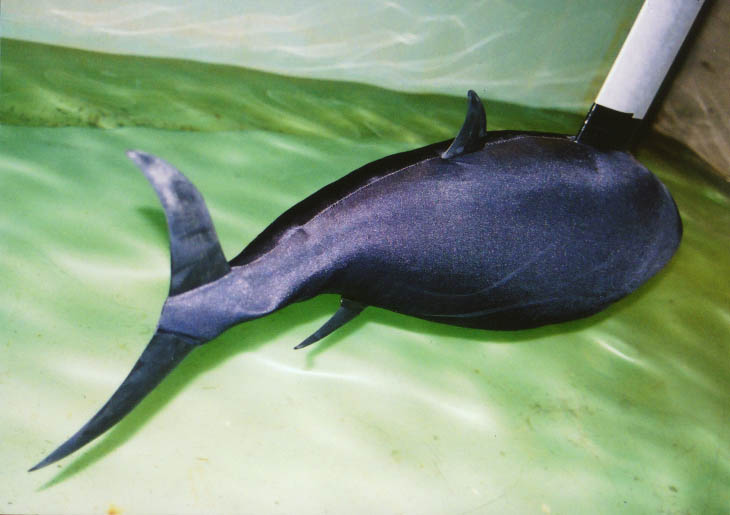
Wanna buy a robot fish? How about a pregnant robot? I don’t think the first one’s for sale, but the last one is gonna cost ya about $20,000. These were two of the robot-related items that landed in my news reader this morning; the former casued me to ask "why would someone build this?", while the latter had me asking "why not?"

RoboTunaNotes from the Technology Underground clued me in to the existance of MITs’ RoboTuna, and pointed me to  Pink Tentacles’ post about a robotic carp recently turned loose in a Japanese aquarium.  While it seems like a pretty cool thing to invent, and maybe it will help scientst learn more about the "phsyics of swimming" as Bill puts it at Notes, I’m kinda left wondering what the point of the whole exercise is, other than invention for inventions sake. (Not that there’s anything wrong with that.) 

The pregnant robot, found via The Raw Feed (which also links to the robot’s instruction manual), is probably stranger the RoboTuna, but the reasons for building it are easier for me to grasp. 

NoelleThe full-sized, blond, pale mannequin is in demand because medicine is rapidly abandoning centuries-old training methods that use patients as guinea pigs, turning instead to high-tech simulations. It’s better to make a mistake on a $20,000 robot than a live patient.

… Noelle, from Miami-based Gaumard Scientific Co. Inc., is used in most of Kaiser’s 30 hospitals nationwide, and other hospitals are putting in orders. The Northwest Physicians Insurance Co. is sponsoring similar training programs in 22 hospitals in Oregon and Idaho, rolling out Noelle initially at five of them.

Other companies make lifelike mannequins to train paramedics in emergencies, but Noelle appears to be the only high-tech, pregnant model available.

Not a bad idea. A robot will probably not react to hearing an "Oops" during deliver in the same way an actual person would. I’ll say it again; people build the craziest things, and for reasons I don’t always get but that sometimes end up making sense.