Author Archive

Hey Buddy, Nice Suit

Friday, February 3rd, 2006

Call it orbital recycling:

Thanks to an innovative Russian recycling program, amateur radio fans expect to be hearing from a new recruit in orbit when an old spacesuit gets a new life as a satellite this week.

Beginning on Friday, SuitSat should be on the air, broadcasting on FM 145.990 MHz.

Rather than being launched, this satellite will just get tossed into orbit by the International Space Station crew during a spacewalk slated to begin on Friday evening…..

The old suit was destined for the trash bin until it came to the notice of an international team of amateur radio buffs, said Orlando, Florida, resident Lou McFadin of the Radio Amateur Satellite Corp., or AMSAT.

A Russian colleague attending an AMSAT meeting in 2004 came up with the idea of putting a radio inside a soon-to-be decommissioned spacesuit and having astronauts boot it out the hatch. The all-volunteer effort, aided by corporate donations of equipment and by Moscow, is largely educational.

Space station flight engineer Valery Tokarev will do the honors, with assistance from U.S. astronaut and current space station commander Bill McArthur….

The suit is expected to drift away from the station and begin its short life as a radio satellite.

It will not take calls, but only relay prerecorded messages and transmit an as-yet mysterious digital picture. Batteries will power SuitSat’s radio and electronic gear for up to 90 hours, McFadin said.

Eventually, the suit will be pulled into Earth’s atmosphere and be incinerated.

Satsuit! Now that’s pretty cool.

I myself have got a couple of suits that should be incinerated. They transmit a not-so-secret message of tackiness.

Black Holes: The Other Side of Denver

Wednesday, February 1st, 2006

If you’re in or near Denver, the Denver Museum of Nature and Science has released a cool new film at the Gates Planetarium, Black Holes: The Other Side of Infinity:

In this Museum-produced show, zip through other-worldly wormholes, experience the creation of the Milky Way Galaxy, and witness the violent death of a star and subsequent birth of a black hole. Mathematical equations, cutting-edge science, and Einstein’s theories fill in holes along the way, providing the most complete picture yet on this mysterious phenomenon.

A Windows Media trailer of the film is available here.

(Via the Bad Astronomy Blog.)

Star Kicked Out of Magellan Cloud

Tuesday, January 31st, 2006

No, we’re not talking about a petulant singer and a rock band (though we’re familiar with the type); we’re talking about an unusual astronomic event captured by the European Southern Observatory:

Using ESO’s Very Large Telescope, astronomers [1] have recorded a massive star moving at more than 2.6 million kilometres per hour. Stars are not born with such large velocities. Its position in the sky leads to the suggestion that the star was kicked out from the Large Magellanic Cloud, providing indirect evidence for a massive black hole in the Milky Way’s closest neighbour. These results will soon be published in the Astrophysical Journal Letters [2].

“At such a speed, the star would go around the Earth in less than a minute!”, says Uli Heber, one of the scientists at the Dr. Remeis-Sternwarte (University of Erlangen-Nürnberg, Germany) and the Centre for Astrophysics Research (University of Hertfordshire, UK) who conducted the study.

The hot massive star was discovered in the framework of the Hamburg/ESO sky survey far out in the halo of the Milky Way, towards the Doradus Constellation (“the Swordfish”).

“This is a rather unusual place for such a star: massive stars are ordinarily found in the disc of the Milky Way”, explains Ralf Napiwotzki, another member of the team. “Our data obtained with the UVES instrument on the Very Large Telescope, at Paranal (Chile), confirm the star to be rather young and to have a chemical composition similar to our Sun.”

The data also revealed the high speed of the star, solving the riddle of its present location: the star did not form in the Milky Way halo, but happens to be there while on its interstellar – or intergalactic – travel.

“But when we calculated how long it would take for the star to travel from the centre of our Galaxy to its present location, we found this to be more than three times its age”, says Heber. “Either the star is older than it appears or it was born and accelerated elsewhere”, he adds.

Be sure to check out an artist’s rendering of the star here.

Rocket Bike

Monday, January 30th, 2006

Here’s a cool version of rocket science, as reported by CNN. Call it rocket science on the cheap:

For rocket designer Tim Pickens, a rocket on two wheels is the next best thing to a spaceship.

“At heart we’re a bunch of guys wanting to go to space, and we can’t afford it,” says Pickens of himself and his rocket-scientist brethren, most of whom never get to ride their own creations. “Basically it’s my own subscale space program.”

Pickens, president of rocket-design firm Orion Propulsion, created his first rocket bike with fellow speed enthusiast Glenn May by bolting a 35-pound-thrust rocket engine to Pickens’s bike — enough power for a gentle push down the road.

That project didn’t kill anyone, so Pickens got himself another bike and stepped it up, attaching a 200-pound-thrust engine capable of blasting him from 0 to 60 miles an hour in five seconds — fast enough to beat a Porsche in a drag race.

The rocket bike employs the same hybrid rocket technology as the suborbital rocket plane SpaceShipOne, whose propulsion system Pickens helped design.

Man, we would have done anything to have that bike when we were twelve.

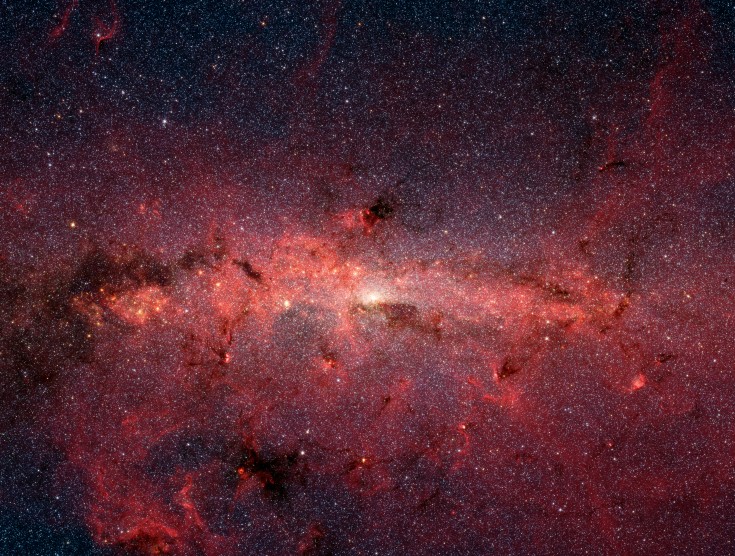
Stars of the Galactic Center

Thursday, January 12th, 2006

That’s the title of NASA’s Astronomy Picture of the Day today:

It’s a cool site, worth bookmarking.

Rules for Space Tourism Released

Tuesday, January 10th, 2006

First it was the XPrize. Then it was news that Virgin Galactic is building a commercial spaceport in New Mexico. Now, private space flight has taken yet another step closer to reality with news that the FAA has drafted a report proposing rules and regulations for commercial space flight. We’re not sure if your nail clippers will be permitted, but Darlene Superville reports on some of the new rules for the AP:

More than 120 pages of proposed rules, released by the government Dec. 29, regulate the future of space tourism. This don’t-forget list touches on everything from passenger medical standards to preflight training for the crew.

Before the trip, companies would be required to inform the “space flight participant” — or passenger — of the risks. Passengers also would be required to provide written consent before boarding.

Legislation signed a year ago by President Bush and designed to help the space industry flourish prohibits the Federal Aviation Administration from issuing safety regulations for passengers and crew for eight years, unless specific design features or practices cause a serious or fatal injury.

Physical exams for passengers are recommended, but will not be required, “unless a clear public safety need is identified,” the FAA says in the proposed regulations.

Passengers also would have to be trained on how to respond during emergencies, including loss of cabin pressure, fire and smoke, and how to get out of the vehicle safely.

To release the belt, lift up etc….

Laws governing private sector space endeavors, such as satellite launches, have existed for some time. But there had been no legal jurisdiction for regulating commercial human spaceflight.

Public comment on the proposed rules are allowed through Feb. 27, and final rules are expected to be announced by June 23.

Showing Photographs of the Trees You Love

Monday, December 12th, 2005

If the 12 drinking days of Christmas have you behind on your holiday shopping, consider purchasing a tree in the Amazon rainforest. A British company is promoting the conservation measure with a cool satellite twist:

This ‘go green for late Christmas presents’ idea is promoted by secure email provider, Link Information Systems, which is looking to save 1,000,000 trees before 31 December, 2005…

Amazon rainforest trees make a highly unusual but considerate gift. On the Greenmail website, the trees cost £1 each and as few as five can be bought at any time. In other words, the cost isn’t much more than a Christmas card, which actually uses up paper and therefore reduces trees. The recipient gets a certificate of ownership and can view their trees by satellite.

Viewing the tree by satellite– a vast improvement over the certificate of ownership I have for my property on the moon….

Marines’ Turkey Day Mission: Find a Television and Satellite Dish

Wednesday, December 7th, 2005

Stars and Stripes reports on the Thanksgiving expedition of the troops from Lima Company, 3rd Battalion, 6th Marine Regiment, who are stationed in Iraq on the Syrian border. Top of their shopping list? Not turkey or stuffing, but a satellite dish to help them bring home a little closer:

With nearly a dozen televisions lining the upper shelves, an 18-year-old Iraqi store clerk wielded a large calculator, pointing to individual TV sets and punching in prices — in U.S. dollars — for the Marines to consider.

They finally settled on a 21-inch LG brand TV for $140. The Marines were less picky about the satellite dish, receiver and connection cords they would need to complete the project….

“All we gotta do is go back … and link up,” Virts said, holding out one of the ubiquitous satellite-image maps of the city that Marines here use for navigation and planning….

The television will add dramatically to the Marines’ quality of life here. Since their arrival two weeks ago, they’ve had no running water, only one hot meal a day and no telephone or Internet service. A mail truck arrived for the first time last week.

Receiving American televisions stations in this far-flung outpost may be difficult, but the Marines expect at the least to receive AFN, which offers a mix of domestic sports and news shows.

Several Marines spent much of the afternoon struggling to decipher the Arabic language instructions that came with the satellite dish.

Read the full story here.

Blog Development Thread

Wednesday, November 30th, 2005

Use this thread to discuss issues with the development and deployment of the blog.

Dishing It Out

Wednesday, November 30th, 2005

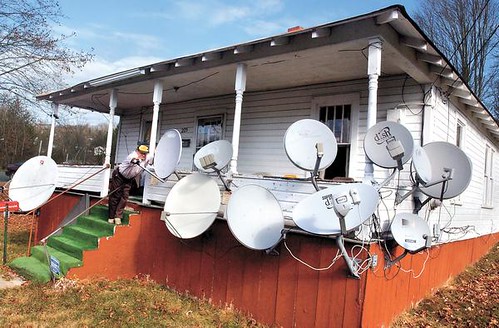
For some satellite aficionados– or sat nuts– one dish is not enough.

The Register-Herald of Bethany, West Virginia reports how Al Jessup’s fascination with satellites changed his life– and his house:

Are 20 movie channels on demand just not enough?

Do constant reruns of “I Love the ’80s” on VH1 have you ready to gouge out your eyeballs?

Then come to Al Jessup’s house — where his 5,000-plus radio and television stations from around the world beamed in by his 12 satellite dishes are bound to keep you entertained somehow.

Since 1998, the Beckley resident has amassed a collection of 12 dishes around his James Street home. He said he first just began subscribing to Direct TV and Dish Network, but he later learned that by purchasing special satellite receivers he could receive “free to air” programming from several different satellites swirling the globe. The information on how to adjust a dish and set up a receiver to pick up programming from these stations such as Galaxy 10, AMC 2 and Telestar 5 is included with these receivers.

“Up in the sky, there’s lots of free stuff,” he said.

Over the years, the 54-year-old disabled former ice cream salesman collected more and more dishes so he could pick up more and more “free to air” channels. Neighbors, he said, never complained about his large display of dishes in front of his house. In fact, some of his dishes were hand-me-downs from his neighbors.

The last time he counted, he received more than 5,000 channels.

Read the entire article here.