Author Archive

World’s Fourth Space Tourist Forced to Scrub Mission, First Woman May Go Instead

Wednesday, August 23rd, 2006

Daisuke Enomoto (a.k.a. Dice-K), a former executive at LiveDoor, Japan’s leading internet service provider and web portal, had to cancel his plans to fly with two Russian cosmonauts in a on Expedition 14 to the International Space Station, which was set to lift off on Sept. 14, 2006.


Russian Federal Space Agency Spokesmen Igor Panarin said that Enomoto "was deemed not ready to fly for exclusively medical reasons," but also hinted that the he might be able to join a later mission in the future. Had Enomoto gone on the flight, he would have been the world’s third space tourist and the first, self-funded tourist from Japan and Asia. According to Wikipedia, television journalist Toyohiro Akiyama who flew on Soyuz TM-11 in 1990 was the first Japanese or Asian space tourist, although, because the Tokyo Broadcasting System (TBS) funded the trip, he is more prevelantly regarded as the world’s first space business traveller.

Enomoto’s most likely replacement would be Iranian-born U.S. businesswoman Anousheh Ansari, President, Founder, and CEO of telecom technologies inc. If she makes this flight, Ansari would be the first female space tourist; if she does not, a third Russian cosmonaut will most likely take the open seat.

Satellite Tops Cable in Customer Satisfaction

Thursday, August 17th, 2006

According to survey results recently released by J.D. Power and Associates, you’re more likely to be satisfied with satellite than cable television. As Multichanel News points out, DirecTV and EchoStar Communications did extreamly well in customer satisfaction throughout the country, while the nation’s largest cable provider, Comcast, ranked below average in every region in the United States. Steve Donehue reports:

"J.D. ranked DirecTV as the best pay TV company overall, with the direct-broadcast satellite provider receiving the top rankings in overall satisfaction; performance and reliability; cost of service; billing; image; offerings and promotions; and customer service."

But it wasn’t all bad news for cable companies. According to the same J.D. survey, digital cable penetration rose by 11% since last year, with 41% of all cable using households using the digital option. Moreover, while the average satellite bill has risen $3 over the past year — to nearly $61 — the average cable bill has dropped a $1 since 2005 to $58 a month, a change most likely due to the bundling of television, voice, and internet services modern cable companies are able to provide.

Air Force Guardian Challenge This Week

Thursday, August 17th, 2006

This week, the yearly battle between American space warriors is taking place at Peterson Air Force Base, Colorado. Known as the Guardian Challenge this competition "pits the best-of-the-best space warfighters against each other, determining the top space wing teams in the Air Force." But what do you get if you win the Air Force’s only space wing competion? The Airforce has the scoop:
"Awards are presented to the best Space squadron Wing Team team in in each mission area on the final day of the competition. The Blanchard Trophy is presented to the Best Space ICBM Wing Team; the O’Malley Trophy goes to the best Space Warning Team; the Arnold Trophy goes to the best Space Surveillance Team; the Aldridge Trophy goes to the Best Space Operations Wing Team; and the Best Space Launch Wing Team receives the Schriever Trophy."

Top Gun awards also go to the best Missile Operations Crew, best Space Operations Crew (selected from among the best Space Warning, Space Surveillance, and Satellite Operations crews), and best Spacelift Operations Crew. Additionally, functional area awards are presented to the best maintenance, security police, communications, helicopter, code controller and chef elements."

Not only does the Challenge represent a great place for space warriors to test their meddle in combat-like situations, but, according to U.S. Space Commander, Air Force Gen. Kevin Chilton, these soldiers probably need as much training as we can throw at them. According to Chilton, military satellite-based "eyes" and "ears" are major assets in modern conflicts and, in the future, may prove to be major targets for opponents looking to "level the playing field."  Knowing that — Good luck with the Challenge, guys!

ArianneSpace To Launch Two Satellites Tonight

Friday, August 11th, 2006

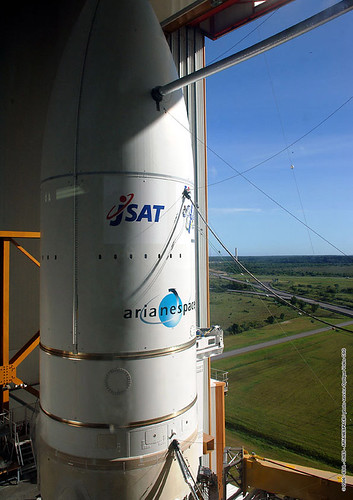
European commercial space transportation company Arianespace is launching not one but two satellites into orbit this evening. From Europe’s space center, the Guiana Spaceport in Kourou, French Guiana, Arianespace’s Ariane-5ECA will take to the skies for its 28th time, marking the 172nd mission for the Ariane fleet, at some time between 6:15 pm and 7:52 pm EST. The launch can be watched starting 20 minutes before launch time, at Arianspace’s Video Corner.
The Ariane-5ECA is 50.5 meters tall and will weigh in at about 780 tons at lift off, requiring over 400 tons of fuel to ramp the beast up to over 2900 pounds of fource to lift-off.

The payload, a Japanese television (JCSAT-10) and French military communications (SYRACUSE 3B) satellites, is expected to be in operation for between 15 and 12 years, respectively.

For those looking for even more information, download the launch kit in English or French and you’ll have more data on this evening’s than you ever thought you wanted.

Creating “Test Bed” Spectrum

Thursday, August 10th, 2006

Yesterday the Federal Communications Commission (FCC) began its most recent auction of radio spectrum, a move that could bring over $15 billionFCCLogo into Federal coffers and, potentially, major advancements to tomorrow’s communications devices, including new high-speed internet offerings from satellite television providers, more vivid video on mobile phones, better cell coverage, and rapid advances in IPTV.

But while opening up more of the nation’s airwaves might bring greater access to better gadgets, it also could limit spectrum space for engineers and scientists looking to experiment with and develop new technologies.

(Currently, only a tiny fraction of the radio frequency spectrum is unlicensed (e.g. the 2.4 gighertz band used for cordless phones, baby monitors, and Wi-Fi).)

To leave space for future experimentation, the National Association of Broadcasters (NAB) and The Association for Maximum Service Television (MSTV) are lobbying the FCC for the creation a band of frequencies specifically for testing purposes.

If approved, new "test bed" frequencies would serve as a virtual sandbox for those looking to develop devices that might otherwise endanger the frequencies of other, more established devices. 

It’s a Bird, It’s a Plane, It’s a… WiFi Balloon?

Wednesday, August 9th, 2006

Across the pond, The University of York is reporting that an effort to bring wireless through the skies to people in areas that typically don’t have access to the super-fast Internet is near completion.

By the end of October, researchers on York’s CAPANINA project — which uses everything from solar powered, unmanned aircrafts to giant ballons and airships to relay wireless signals back to planet Earth — will finish its main research and present their findings a couple of week’s later during the University’s conference on High-Altitude Platforms (HAP), York HAP Week.

According to a press release the school put out about the research, the system developed could bring low-cost broadband speeding along at rates 100 times faster than ADSL networks to remote regions of the world and high-speed trains. As the project’s lead scientist, Dr. David Grace says:

"The potential of the system is huge, with possible applications ranging from communications for disaster management and homeland security, to environmental monitoring and providing broadband for developing countries. So far, we have considered a variety of aerial platforms, including airships, balloons, solar-powered unmanned planes and normal aeroplanes — the latter will probably be particularly suited to establish communications very swiftly in disaster zones."

The CAPANINA project may rely upon the "paint-on" antenna technology we mentioned a few weeks ago, and clearly indicates a growing interest in looking to the skies to solve connectivity issues that plague many of the world’s least connected and least connectible areas.