Archive for the ‘Astronomy’ Category

Hu, Putin Orbit Around Mars

Tuesday, March 27th, 2007


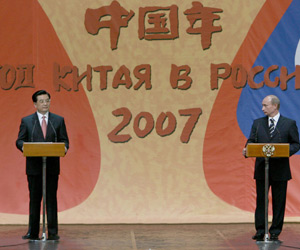
We blogged about the Chinese-Russian mission to Mars last August, so this isn’t really news to us. But during Chinese President Hu Jintao’s visit to Russia the other day, a formal announcement was made about a mission to Phobos, a Martian moon. Here’s the story from People’s Daily:

A Chinese satellite is expected to orbit Mars in 2009, thanks to an agreement the country signed with Russia on Monday

During President Hu Jintao’s current visit to Moscow, the two countries agreed to stage a joint unmanned mission to the red planet and one of its moons in two years, the China National Space Administration said yesterday in Beijing.

The agreement represents a "milestone" in the history of space cooperation between the two neighbors, the agency said in a statement.

"It indicates the two sides have taken a key step forward to working together on a large space program."

According to the agreement, a micro-satellite developed by China will be launched along with "Phobos Explorer", the Russia spacecraft, atop a Russian rocket in 2009.

A timetable was not mentioned, but earlier Russian reports said the launch window for the 10-11 month voyage to Phobos, a Martian moon, will be October 2009.

Phobos became a satellite of Mars millions of years ago, so studying material from the asteroid will give scientists information on the origins of the solar system and of Earth, the Russian news agency RIA Novosti cited Russian Academy of Sciences member Mikhail Marov as saying.

After entering Mars’ orbit, the Chinese micro-satellite will be detached from the Russian spacecraft, and probe the Martian space environment, according to the statement.

The "Phobos Explorer" spacecraft, with some equipment developed by the Hong Kong Polytechnic University, will land on the Martian moon and return to Earth with soil samples.

Monday’s agreement was signed by the China National Space Administration head Sun Laiyan and the Russian Federal Space Agency chief Anatoly Perminov and witnessed by the two countries’ presidents.

Last year, the Russian space chief revealed that his country would work "closely" with China on lunar exploration.

Youriy Nosenko, deputy chief of the Russian space agency, told a press conference in Beijing last November that Russia regards China as a "partner" in space exploration, and the two sides have shown interest in a lunar project.

China has started a three-stage moon exploration project, including sending a lunar orbiter some time this year, followed by a soft landing in 2012 and the return of lunar samples in another five years.


Unlike NASA, a civilian agency,  the China National Space Administration falls under the supervision of the Commission of Science Technology and Industry for National Defence. But hey, the Taikonauts have their fans.


Falcon 1 Rocket Launch OK, then…

Tuesday, March 20th, 2007


SpaceX’s second demo flight was a success, reaching 300 km in altitude. The first stage went well, but then contact was lost. As always, SpaceFlightNow.com gave us the news as it unfolded:

Some quotes from the media briefing with Elon Musk following tonight’s launch:

Question: what is the fate of the second stage?

"We didn’t achieve the desired orbit. But at this point I don’t exactly know the fate of the second stage. We got to 300 km. That’s about all I know at this point."

"All that I can say for sure right now is it’s not in the intended orbit. The likelihood is that it re-entered after probably half an orbit or so."

"The roll-control anomaly did cause the second stage to shut off prematurely. So that’s not achieving the intended orbit. However, I would say we’ve retired probably in excess of 90 percent of risk associated with the rocket. And it is worth noting, this was a test launch not a satellite launch."

Elon Musk‘s brother said it best via this blog post. More photos here.


He’s right: entering space is a success — all the riskiest aspects were well done. They’ll probably learn much from this experience and the next one will be perfect. Hey, they might even be able to recover the first stage and use it again!


Google Selling Ads on Dish Network

Monday, March 12th, 2007

We blogged about what Google may have up its sleeve before, so naturally we were intrigued by what VentureBeat.com picked up from The Wall Street Journal last Saturday:

Google is about to sign a deal with Dish Network, the nation’s second largest satellite TV company, to deliver ads for Dish’s network, VentureBeat is hearing.

We haven’t been able to confirm the rumor (Google has not yet responded to a request for comment).

In an effort to extend its growing advertising empire to television, Google has already started a pilot project in Concord, Calif. to deliver ads to cable television subscribers, it was revealed in yesterday’s WSJ.

The latest reports are significant because they suggest Google may be on its way to cracking the huge television market, to deliver a very different kind of ad to peoples’ living rooms. Dish is the nation’s leader in high definition and interactive TV programming. Google’s TV ads, like the ones Google distributes already to Internet sites, would be delivered more efficiently — targeted more closely to the content of the TV programming being watched, and more relevant to the people actually watching it — or at least, that is Google’s intent.

The Mountain View search engine is already making more than $10 billion from online ads. The U.S. television advertising market is about $55 billion, and so is a juicier target than even the Web.

According to the WSJ Saturday, Google has begun a test run serving up TV commercials to cable subscribers of Astound Broadband in Concord, Calif. In this deal, as in the one with Dish, Google is expected to purchase TV spots in advance, and then insert its own advertising — supplied by its advertising clients — so that it looks much like it does today. The difference is, Google would be the powerbroker.

It is unclear, however, how Google would access information about TV households in order to target its ads, without raising significant privacy concerns. But a Dish partnership is notable because of how interactive the Dish experience has become. Users already use keywords to search for programming, choose themes they like and create custom guides — all indicators of personal taste. Dish and Google might be able to obtain permission from users to exploit such information. Google could then work with any number of technology providers to help it automatically insert relevant ads into the programming.

Read more about this concept of "mass personalization" on the ITVT blog. Once you get into the details, I think you’ll agree this is not Spotrunner, which sounds more like a buying agency.

Dish Network & DirecTV Team Up with Google, Intel, Skype and Yahoo!

Tuesday, March 6th, 2007

Very interesting twist to the upcoming spectrum auctions. Breaking story via Multichannel News:

DirecTV and EchoStar Communications formed an alliance with Google, Intel, Yahoo and Skype in support of a national licensing plan for a pending federal spectrum auction expected to take in at least $10 billion, according to draft of the plan obtained by Multichannel News Tuesday. The formation of the alliance doesn’t mean that the companies are going to bid together in the auction, which, by law, has to begin by Jan. 28, 2008. Instead, each alliance member has an interest in seeing that the Federal Communications Commission permits bidders to aggregate enough licenses to cover substantially all of the United States. The 60 megahertz of spectrum up for auction is returning to the FCC as a result of TV broadcasters’ transition to digital-only transmission. Broadcasters won’t require the same amount of bandwidth in total because digital signals are spectrally more efficient than analog airwaves.

Every full-power TV station is required to terminate analog TV service no later than Feb. 17, 2009. The analog cutoff would also allow public-safety entities to obtain 24 MHz of former analog-TV spectrum.


Satellite Radio’s Competition

Tuesday, March 6th, 2007

Sirius CEO Karmazin went up The Hill last week where he used the argument that satellite radio competes with not only over-the-air AM/FM radio, but also Internet radio and iPods. Well, it looks like the Internet radio folks are bracing for a fight. Check this from Wired:

Royalty Hike Panics Webcasters

Internet radio companies big and small are revving up for a fight with the Copyright Royalty Board that could lead to the halls of Congress and — some fear — the end of streaming music stations in the United States.

The panicked preparation follows last Friday’s buzz-killing bombshell: As 50 million or so online radio listeners geared up for their weekends, the board released new royalty rates representing a potential tenfold increase webcasters would have to pay out.

In the old, percentage-based fee system, webcasters paid SoundExchange — the Recording Industry Association of America-associated organization that pushed the Copyright Royalty Board to adopt the new rates — between 6 percent and 12 percent of their revenue, depending on audience reach. The new system charges all webcasters a flat fee per song per listener; for instance, in 2007, streaming companies would owe $0.0011 per song per listener (rates change based on year).

That amount may not sound like much, but it adds up quickly. Consider, for instance, AOL Music, with its average of 210,694 listeners for November 2006. According to calculations made by the Radio and Internet Newsletter, or RAIN, AOL retroactively owes about $1.65 million in sound-recording royalties for that month alone (and that doesn’t include songwriting royalties). By the end of this year, according to RAIN, the company could owe roughly $20 million — unless the rates are overturned by the board or by Congress, which is still a possibility.

Larger services that offer thousands of channels, such as the free Pandora, are also facing a huge spike in royalty costs. Kurt Hanson, publisher of RAIN and CEO of AccuRadio, went so far as to speculate that Pandora, which is based in the United States, could "disappear" as a result of the new rates. Overseas competitors like Last.fm, which is based in London and removed from the board’s restrictions, could easily claim Pandora’s market share. If Pandora has to pay the annual $500 minimum for each channel, Hanson said, its sound-recording royalty bill for 2006 alone would be capped at about $2 billion (based on the service’s 300 million registered users, each of whom gets to create up to 100 unique channels).

"The rates are disastrous," says Joe Kennedy, CEO of Pandora. "I’m not aware of any internet radio service that believes it can sustain a business at the rates set by this decision."

The situation for smaller webcasters isn’t any better. And for the likes of Bill Goldsmith, who runs Radio Paradise, it’s far worse: "This royalty structure would wipe out an entire class of business, small independent webcasters such as myself and my wife. Our obligation under this rate structure would be equal to over 125 percent of our total income."

The smallest webcasters, who use services such as Live365 for their shows, will likely vanish as well unless the rates are overturned. RAIN pegs Live365’s royalty obligation for 2006 at approximately $4.2 million — and that’s not counting the minimum $500 it could owe annually for thousands of its channels. Again, that’s in addition to other royalty fees. (The site, like most others, already pays songwriter royalties to performing rights organizations BMI, ASCAP and SESAC.)

Live365 did not respond to e-mail and phone queries from Wired News in time for publication, and Yahoo declined to comment. SoundExchange also failed to respond.

Hanson, who testified at the hearings on behalf of small webcasters, said he doesn’t "think the people actually running the record labels want to see internet radio shut down," but that SoundExchange’s lawyers had planned "an aggressive, win-all-you-can battle in Washington. I think they were more successful than they expected to be."

Pandora’s Joe Kennedy believes the board’s decision will not stand — it’s simply too extreme. He wrote to Wired News, "The only reason the (online streaming) services are not shutting down today is the belief that rationality will ultimately prevail here, either through appeal or congressional intervention." (A third option, according to Hanson, is that SoundExchange could choose to continue licensing music as a share of revenue, as it did before the Copyright Royalty Board decision.)

Only webcasters that were involved in the original Copyright Royalty Board decision-making process (Yahoo, AOL, Live365 and a few smaller webcasters including Radioio, Ultimate80s and Accuradio) will be able to file an appeal, and they have 15 days to do so.

The House Commerce Committee’s telecommunications subcommittee is holding a hearing on March 7 to hear testimony on the current and future radio industry. Witnesses will include Mel Karmazin from Sirius, Peter Smith from broadcaster Greater Media and Bob Kimball from RealNetworks.

If the new rates stick, online music fans may come to expect far less innovation, variety and quality when it comes to internet radio. Some industry experts fear that even more users could be driven to illicit services that pay no royalties or those that operate from other countries.

Satellite Distributed Movies Set to Emerge in 2007

Monday, March 5th, 2007

While the technology has been talked about for years, many experts are positioning 2007 as the year that digital movies and satellite distribution of box-office blockbusters take flight. Working in conjunction with Warner Bros. Entertainment and Universal Pictures, Digital Cinema Implementation Partners (made up of big name theater companies AMC, Cinemark and Regal) is working to "use satellite and broadband delivery systems to beam digital films directly to theaters, rather than have them copied onto hard drives and delivered by hand, as they usually are now."

While the theater chains and studios are looking at the technology as a great way to decrease the likelihood of piracy (the theory being that encrypted satellite transmissions would mean fewer hands are on the prints), it could also mean improved access to popular films and big screen showings of smaller films that struggle for an audience large enough to usually get them. As the AP article about the technology notes that satelite distribution,

"would give U.S. theater operators the flexibility to put a popular movie on an extra screen as quickly as the demand arises… At the same time, theater operators could stop showing a surprisingly unpopular film and even book an art-house film with a small but devoted audience for a day or two."

While Variety and Hollywood are explicitly concerned with the digital cinema’s implications for the US market, the Hindustan Times points out that the technology may be even more welcome throughout the developing world where, although movie theaters are plentiful (with over 12,500 movie houses throughout India alone), the relatively small number of "prints" (sometimes only 500) available of any given film arbitrarily limits distribution.

Anti-Jamming Technology Goes Commercial

Tuesday, February 27th, 2007

The Times reported yesterday that Boeing is looking to put anti-jamming technology previously reserved only for the military on commercial satellites used by business and the communications industry. According to the article,

"Anti-jamming technology is already used by military and spy satellites, but proposals to install similar protection in the 250 large satellites in commercial operation have been prompted by the threat of disruption.

The successful jamming of video, data, or voice signals by individuals or groups could jeopardise the millions of dollars spent on just a handful of satellites, operators fear.

Such jamming of government navigation satellites has already occurred, according to Lieutenant General Robert Kehler of the US Air Force, ‘as has jamming of commercial telecommunications satellites.’"

Space.com has a great background report on Spy Satellites for those who want to know a little bit more about the technology and the American Military and Intelligence communities uses of the technology. While Spy Satellites have been used for quite a long time, even the latest anti-jamming technologies are unable to prevent detection, the spy satellite holy grail. While satellite project, such as MISTY, have been able to avoid detection by laser and microwave radar, none has been able to completely avoid visible detection, a limitation which has prompted the emergence of a small, but strong spy satellite monitoring enthusiast community.

Oh, and for those of you who might be worried about the commercial anti-jamming technologies making it into the wrong hands, it looks like your not alone. While Boeing seems confident that they’ll win it, the U.S. government does have to approve the use of the "top secret" anti-jamming technology on commercial satellites before the company can start introducing it on products sold to foreign customers.

Boring Press Releases

Sunday, February 25th, 2007

I’m so glad we have journalists around to make the news interesting. Imagine if we only had press releases.  B-O-R-I-N-G !

Just look at all these releases surrounding the Satellite 2007 show in Washington last week. Open your eyes wide and read these exciting excerpts:

"…released two new software options to their industry leading product lines that extend their already unique ability to…"

"This flexibility makes the product line more accessible to the networking requirements of government, military, and commercial customers who increasingly value high uplink and downlink speeds at a node and desire to blend terrestrial solutions with their satellite backhaul."

"The company’s DVB-RCS/S2 solutions are the only multiple-access satellite solutions capable of delivering data transfer rates of up to 80 Mbps for downloads and up to 8 Mbps for uploads at each remote terminal, or enough bandwidth to support a variety of users such as a small business or battalion unit to an entire community/military base from a single remote terminal."

And this quote is typical from apparently happy customers:

“We are looking forward to working with X on the development of this next generation intelligent network. Significant improvements can be made to future VSAT systems with the addition of artificial intelligence to the network. These capabilities offer the promise of enhanced performance and economic gains which will allow us to offer new and more cost effective services to our customers.”

I think it’s time we put some excitement in our "realeases" and start making some real news. I’ve noticed NASA’s public affairs people are putting some fun into their work and coming up with some very creative angles over the past year or so — just take a look at this "Camping on the Moon" release. Brilliant!

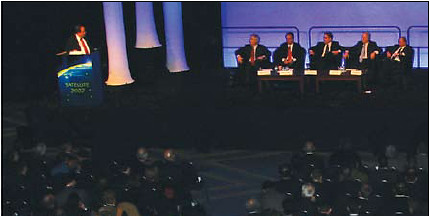
Opening General Session at Satellite 2007

Wednesday, February 21st, 2007

Here’s the write up of Tuesday’s Opening General Session by Mark Holmes in the Satellite 2007 Daily:

FSS operators Seek Ways To Capitalize on Growth Patterns

The satellite industry finds itself in a strong position, top executives said at the SATELLITE 2007 opening session, but there was an undercurrent of caution in their comments.

Overall, the panel was increasingly optimistic about the growth prospects for the satellite industry. “I think we see an industry that is healthier every day,” said Intelsat CEO David McGlade.. We see economies improving around the world. It is a great time to be in the industry. In 2004, the industry was not as healthy as it was today. It is improving even in areas like Asia.”

There was also a sense of renewed optimism in traditional market segments such as broadcasting with new direct-to-home (DTH) operators springing up throughout the world as well the move to high definition (HD) which is increasing capacity demands.
 
“People are going back to basics,” said Giuliano Berretta, CEO of Eutelsat. “TV is picking up very strongly. There is a resurgence in the TV business. For example, I think SES is becoming more traditional when you look at their recent divestments. In our most recent results, 70 percent mof revenues were derived from broadcasting. There are new countries which want pay TV.”

The optimism also extended to new market opportunities and the opportunities for satellites to play an increased role in areas such as mobilebroadcasting, broadband and other areas. McGlade spoke of the need of making “small, smart, bets” when going into new areas. “When you see a take-up you grow with it. You have to seed some new activities. I feel there is the right kind of climate for responsible growth. Huge bets have been taken before, but we won’t be doing that again.”

Romain Bausch, CEO of SES Global, said there are strong growth opportunities for satellite manufacturers and launch providers, but admitted the industry “could be in trouble” if companies do not move quickly when attacking new markets and consolidating positions in existing markets.

Bausch admitted he was concerned of the impact players such as Deutsche Telekom (DT) could have on satellite players. “We need to make sure the satellite solution is developed further to compete with terrestrial solutions,” he said. “You look at someone like DT who is going into the video business, this may be dangerous for us, because of the vertical integration of such players.”

Changing landscape

The satellite landscape has changed since these CEOs gathered at SATELLITE 2006. In recent weeks, Eutelsat has announced new shareholders, SES has done a deal with GE to divest certain assets and repurchase stock, Loral and Telesat have hooked up. Unsurprisingly, all the executives painted a bright picture of these moves.

Bausch made the point that divesting certain assets was almost as important as acquiring new assets. “When we bought New Skies, we got new assets in Asia and Latin America. It allowed us to divest in minority of assets such as AsiaSat and StarOne,” he said. “Divestiture is also a key trend. It is removing the overhang and having a currency to use in the future. It is a rationalization of assets. It is clear with overlapping footprints you have to rationalize. From a strategic perspective, we are now built on three 100 percent-owned companies. This will allow us to be more aggressive and in control of our developments.”

McGlade said Intelsat believed in a different approach. “I do not believe as much as the regional entities standing alone,” he said. “We have put more people out into the field. I think the integration process has transformed us and been a tool to bring us forward. There are many areas of growth. I think broadband will continue to grow. We have an investment in WildBlue and that has done well. When I look at video, HDTV has reached an inflexion point. Once that trend starts to accelerate you will see many programmers go to HD both for offensive and defensive reasons. There are new DTH platforms being launched. As we see liberalization of regulatory regimes there are growth opportunities in every sector.”

Michael Targoff, CEO of Loral Space & Communications, said his company’s acquisition of Telesat was vital for the operator to be a long-term player in the market and would help Loral compete more effectively with the big guns in the industry.

“You need to offer the customer a sense of capability,” Targoff said. “It was clear to Loral when we sold assets to Intelsat we did not have a sustainable position in the long term. By buying Telesat, we believe we can compete. We are comfortable it provides us with the mass to compete. I don’t just see it as a step along the way.”

In terms of how he views new opportunities for Loral and other operators, “We will be using satellites to deliver video to handheld nphones,” Targoff said. “We will use satellites to deliver broadband where there is not broadband infrastructure. There will be a role of satellites. While there is clear strength in the traditional services, it is also clear the future the role of satellites is how we participate in the way people access content now.”

Besides competing with the other satellite players, Berretta called for more cooperation within the satellite industry as they look to compete against other infrastructures and operators.

His views were shared by McGlade. “I think an association together could make a lot of sense and add a lot of value,” he said. “… “We are such a small fish in the media and telecoms pond. We need to look at how we can spur growth. We can do more. When we look overall, we have to look at what is happening with customers as well as our competitors. We are moving the industry forward, but we could do more. We are not doing enough.”

Mobile satellite services

Andy Sukawaty, CEO of Inmarsat and the lone Mobile Satellite Services (MSS) representative, told the session that some of the plans being offered by the low-Earth orbit (LEO) operators are “deeply flawed”.

Sukawaty warned that the investment community may not have learned from its previous efforts in funding LEO constellations if investors believe there was so much money to be made from the MSS industry. “In the 1990s, $15 billion was lost by investors that invested in this business,” he said. “We have instilled a capital discipline. It is capital intensive business. I think that is where investors need to focus. If you look at the fund raising at the MSS sector people are looking to raise $12 billion over the next five years. I don’t think there is $12 billion of business out there.”

Sukawaty saved his strongest comments for some of the LEO operators. He said in a blistering attack on some of the players, “To spend $2 billion on a LEO constellation will not work. They have a distinct competitive disadvantage. That thinking is deeply flawed. That cannot compete against GEO systems.”

However, Sukawaty was optimistic about his own company’s growth prospects. While price erosion on the voice side means revenue growth is difficult despite volume growth, data applications could be the key to a successful future for the operator. “Historically, we have had targeted a 3 percent growth rate, but now we want to accelerate that to 6 [percent] to 8 percent growth,” he said. “That will be driven by data applications. Data applications will provide double digit growth. The question is who captures that double-digit growth."


Ed’s “What’s Next?” Speech

Tuesday, February 20th, 2007

SES AMERICOM CEO Ed Horowitz was the guest speaker at the Washington Space Business Roundtable’s Flagship Lunch and Silent Auction on Tuesday, 20 February 2007.

We don’t have a podcast or video available, so here’s the text of the speech:

“What’s Next?”

I appreciate this chance to speak with you today in this beautiful new facility. Not long ago, as many of you remember, this spot was part of a run down community — which has obviously been brought back to life.

It’s changed.

And — in the midst of the good change around us, I feel it is appropriate to ask, “What’s Next” for our  business and for us?

Where will we be in 20 years?

Will we be in 20 years?

I subscribe to Stanford’s “Growth Theory” economist Paul Romer’s view that growth occurs whenever people take resources and rearrange them in ways that are more valuable”.

To know what is “more valuable” is a matter of vision.

At the Twenty-second Communist Party Congress in 1961, Soviet Premier Nikita
Khrushchev’s vision was that within 20 years the Soviet Union would out-produce the United States in all the traditional sectors of industrial might — coal, steel, cement, fertilizer and so on.

In 1981, that vision was indeed fulfilled: that year the Soviet Union outdid America in every one of those industries.

They successfully reproduced a late 19th, century manufacturing based industrial economy…while the US was inventing a 21st Century chip, computer and information based economy.

A new world happened, shaped by a furious and unplanned burst of technological, cultural and economic force. 

The Soviet vision of the future was as over-confident, but more importantly it was simply — over.

Nikita Khrushchev saw the future through the wrong end of a telescope where the moment seemed larger than it was — and the horizon smaller. He believed he could outwit history with a good plan built on dedicated incrementalism which had one gear — sideways.

As we meet today and at other conferences persistently speaking —to each other —my fear is that we might be inclined to use Nikita’s telescope to envision what’s next for us.

The satellite industry, including SES, has dictated broad global changes in other businesses from entertainment to defense; from detection and GPS to secure communication.

Today, the satellite business is producing reliable earnings for our shareholders. But undeniably, there are changes on the horizon dictated, if nothing else, by the changing worlds of our customers…. And they expect us to “get it”. They expect us to anticipate needs.

What the future holds is an exciting mystery. But, we are better off addressing possibilities while we have a chance to invest in them; to own them —-rather than to ignore or possibly be displaced by them. That’s what we will talk about today.

What we know is that the future will be vastly different.

It is estimated that within the next 25 years, science and technology will advance by a factor of 4 – 7x beyond the advancements over the last 25 years.

While we may hear this in stride — it is absolutely stunning in its business and social implications.

It means that where we stand today on the technology and science scale versus where we will be in the next 25 years — is a moment equivalent to being in the year 1650.

Think about it …1650!

Of course the 25 years from 1650 – 1675 saw their own dramatic developments. The English started drinking tea. Cromwell dissolved Parliament, and the first bank note was issued in Sweden.

During this time the world population expanded to 500 million, which is about one-third the size of India today.

Isaac Newton began experiments with gravity and Cheddar Cheese was invented.

The great Plague of London commenced and the English settled in Charlestown, Virginia.

Ice cream was invented and La Grand Vetel, a famous French chef killed himself because Louis the 14th didn’t like the dinner La Grand had prepared.

You could say a lot happened in those 25 Years…But, the world had seen nothing yet.

1650 was 225 years before the phone was invented and…a century and a half before the ratification of the US Constitution.

It was 200 years before Edison was born.  It was 200 years before the US population would reach 23 million and China’s population then — was almost the same number as China Mobile’s cellular customers today (about 350 million).

1650 was 307 years before Sputnik and 315 years before the first satellite.

We are all familiar with the advances made in the satellite industry through compression. Well, get ready for the advances in history made by an unprecedented compression of knowledge in the next 25 years.

We’re about to enter “The Great Compression”.

We are looking at the equivalent change of the last 315 years — about to be compressed into the next 25 years.

What does this mean?

It means — for example — that if you are in the transportation business — the worst four words you could imagine for your business — may actually be heard in the next 25 years…The four words? — “Beam me up Scotty”.

The odds that the massive changes coming in the “Great Compression” will leave the satellite industry untouched — are zero. Change will come to us whatever we choose to do or not to do.

What will we be doing when it comes?

While technology is a “business”, it is also a force not to be controlled even by the best of intentions.

The genie is out of the bottle and the question is whether the genie is working for us or are we working for the genie?

Let’s spend a little time today on some broad issues of concern to our industry and to our customers:

1. U.S. Government business…

2. The commercial and media business…

3. The ramifications of change in both worlds and lastly …

4. I want to discuss a looming talent deficit as we face the  coming “Great Compression”.

The US government business is, as you all know, changing rapidly. Saddam Hussein invaded Kuwait in August, 1990 and the US and Coalition forces liberated it in January of 1991.

During the 5 ½ months between Hussein’s invasion and ours, the American military was caught without the satellite capacity to track and mount the offensive.

They scrambled to acquire the needed transponders and didn’t have time for emergency appropriations to acquire them, so the costs were guaranteed —- by Private Citizen Ted Turner.

It was no coincidence that Turner’s CNN had the best and for a time the only video from Desert Storm.

The US military will never be caught like that again. Six months after our troops landed, DISA was created to make sure it wouldn’t happen again.

In the intervening years between Desert Storm and 9/11, the US military changed. 

When 9/11 came, the military was ready with a system in place to fund $78 million dollars worth of contracts to provide the satellite and communications services needed. The contracts were in large part for bundled solutions in addition to the broadband commodity.

We learned then that in the future we need to leverage what only satellites can provide — advanced mobile communications and high speed internet access — while on the move —-anywhere in the world — via aircraft, boat, humvee or on foot.

What the military needs is megabytes, not megahertz. The military expects a ground and mobile capacity consistently capable of facial recognition.

Increasingly, the US government wants net-centric bundled solutions as well as broadband and they are calling upon us to be creative about it.

There is a demand for specific megabyte capacity per war fighter and we also know that this demand will only grow over time.

Increasing our military business means persistently increasing capacity and solutions.

For example, there is an ever expanding need for video teleconference capability (VTC) — for commanders in the field, in Washington, and for soldiers on the ground.

The invasion of Iraq was witnessed live on multiple screens in the White House Situation Room. Decisions could be made in real time with real data. Before that it was almost like Abraham Lincoln waiting for a telegram telling him that Grant had taken Richmond.

Soldiers on the ground also have growing “human terrain” needs in addition to VTC — also things like  IM and secure chat capability.

Remember, in five years … 50% of the military will be Gen X and Y. They grew up in a digital world. The military has to grow with them – and so do we.

Whenever we speak of high speed mobile communications we must, in the same breath, speak of advanced development of “in-orbit” flexibility and new antennae development.

Satellites must increasingly have capabilities for re-direction and re-programming in space.

We must advance efforts to change frequencies and footprints in orbit.

We look over our shoulders for our competitors and can’t see some of them because they’re in front of us. They may not even be in our business.

For example, let’s look for a moment at the world of Nano-technology, once viewed as science fiction, but today may represent the “key enabling technology” of the 21st century.

Nano- technology is the “purposeful creation, manipulation and use of matter, physical structures and engineered devices with previously unimaginable dimensions”.

Nano-technology is starting to impact chemistry, biology, applied physics and medicine. The inevitable applications to the space and satellite world are just beginning to be imagined.

But, one way to think of it, knowing that a nanometer is one billionth of a meter, is to see every person as a nano-unit in a world with six billion people. That is the level of services and connection we must contemplate.

What are some of the ramifications of these great changes for our customers and for our business?

One ramification could be friction with our current customers and we have to think about that.

Many of our major customers are in the commercial media world — where things are also changing at a furious pace.

You Tube, MP3, file sharing and a host of  other technological and social changes are threatening old business models like “Beam me up Scotty” would threaten transportation.

Our media customers are losing control of their customers who are increasingly less dependent on mass packaged media which we reliably deliver.

User generated and niche media (nano media) are replacing mass media.

Remember the 1998 Jim Carrey movie, “The Truman Show” where an unsuspecting insurance salesman’s life was made into a 24/7 movie for the entertainment of the town’s people?

Everyone in his fabricated town, his mother included, made a fool of him everyday — in their controlled entertainment world.

It was all run out of a network studio from which Truman eventually escaped– heartbroken.

Now think of The Truman Show in reverse where the insurance salesman watches everyone and anyone all day and all night, as he chooses.

Imagine control gone from the entertainment business into the hands of Truman… and the walls of the entertainment and media world come tumbling down.

That’s where we’re headed — along with our customers. User generated content and demand is going to turn the media world upside down.

Control will shift and it will be a new challenge to make an honest buck for the old institutions.

What is the response of the media and entertainment business to this creative destruction threat?

A recent book called “Wikinomics” – gives one example of how the media world is responding in the field of music… and I quote:

“Rather than embracing MP3 and adopting new business models, the industry has adopted a defensive posture. Obsession with control, piracy, and proprietary standards on the part of large industry players has only served to further alienate and anger music listeners…If your invention can be replicated at no cost, why should anyone pay?…Today a new economic model of intellectual property is prevailing”.

What is our response?

In the commercial and media world, let’s look at two business prospects on extreme ends of the continuum.

On one end, is the real prospect for business in the under and un-developed world. Half the world does not participate in the global economy in any way shape or form.

The developed world is increasingly understanding the value of changing this through governmental, private and NGO enterprises. It is not strictly a charitable exercise but a way to grow demand and markets.

The economy cannot be called global until this succeeds on a much greater scale. Central to these prospects are enterprises within our expertise. The sooner undeveloped countries have access to the information and communication revolution which, in many ways we can steer, the sooner there will be unprecedented growth and demand not evident in mature economies.

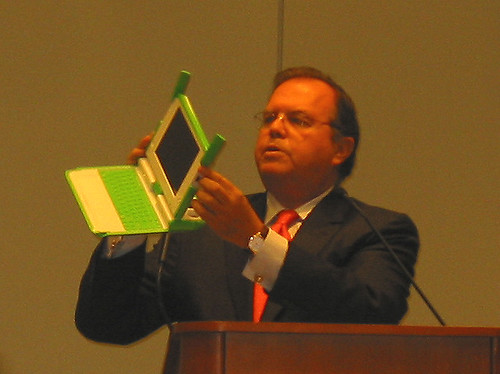
An example of how we extend the reach into being  called “truly global” may be characterized by SES’ support of One Laptop Per Child (OLPC) Initiative.

OLPC is designed to put into the hands of children around the world the capacity of accessing information and connectivity with others ranging from people in their village or nearby villages, anywhere in their country and potentially around the world.

On the other end of the continuum are the possibilities in the media world with the disruption of old models.

But before we go any further, let’s make something clear. When we say “user generated content” we all think of You Tube or something like it. But You Tube makes no money and never has — except for its original creators who profited handsomely when they sold to Google. 

When Google purchased You Tube and was asked how they intended to monetize it, the answer was: “we’ll figure that out later.”

Let’s be honest. You tube content is dominated by really, really bad material —and the most frequently viewed material inclines toward quality production and content.

But, as you have seen, Viacom is now demanding that You Tube remove all of its Viacom material. Others will surely follow. And You Tube’s offerings will begin to diminish.

Then there is Current TV, Vice President Gore’s effort, which is totally user-generated content. But it’s still part of the standard Dish and cable mass media package.

It’s user-generated content but it’s still part of the old business model for the system providers.

From our point of view, the revolution may have little to do with user generated content and everything to do with user “dictated” content.

I’m talking about free enterprise — for real.

Very recently, an outfit called Virtual Digital Cable in Illinois, has started a service to deliver cable programming without cable — by using only the internet.  No trench digging or coaxial cable or fibre placement… no local franchise or fees. Naturally,
the legal challenges to VDC are blocks long but the point is Disruption for our customers and for us — is inevitable.

Product development and innovative bundled Solutions like IP Prime are important targets. But how do we most effectively and most profitably adapt to the new net-centric content world?

One answer is to consider what I called “My Geosynchronous Media” but someone told me that MGM was taken. Then I tried “My TV” but of course, MTV was taken. So for now let’s just call it “My TV Station”.  “MTVS”

MTVS is a niche media for one; a nano niche.

It is the creation of a net-centric and net- neutral, trusted third party content aggregator designed as “My TV Station” which runs exactly what you want, when you want it on whatever device you choose.

The customer pays only for the exact content they want… whether it’s sports or Friends re-runs, all CSI or whatever. MTVS delivers it and pays the content provider — as a trusted 3rd party must.

Unlike cable and traditional satellite mass programming where you pay for things you never watch, MTVS gathers exactly and only what one person wants to watch when they want to watch it.

This direction means we would become a “Relationship Management” business in addition to our conventional business.

It also means we would, to an unavoidable extent, be in competition with our current customers.

Does that matter? Of course it does. But, these are the kinds of questions we need to face now before it’s too late to do anything about it.

My last issue is “People”. Are the Human resources and talent out there? Can we keep what we have and get what we need? What about the Demographic Wall?

Business Week Magazine recently advised new professionals to stay away from the space business because it offered “no future”. The engineering and science expertise that is the fundament of our industry is aging and this means on one hand that many are near retirement with a thin bench of possible replacement.

On the other hand, those who choose to stay in the business, and we need them desperately,  are making it hard for new people we do attract to move up —- and also difficult to make change.

The truth is that as we move forward, this is not your “Father’s Satellite” world.

When it comes to attracting talent, you could say, we have an image problem natural to a maturing industry and …we have an advancement opportunity problem for the ambitious new engineer we do attract.

It is the science and invention that makes us grow. There is a clear shortage on the horizon.  It is also true that as an industry, we have very poor public communication and we tell no exciting stories which we need to attract talent.

Just as the American military will be 50% composed of X and Y Gen soldiers who grew up in a digital world, my fondest hope for our industry is that we can say the same. If we can’t –then the future will be a lot harder to face.

I have shared some things to think about with you today and I appreciate your listening to them. I’m glad to hear your ideas as well — any time.

But for now, I see my time is up so I guess all I can say is Thank You and…“Beam Me Up — Frank ”.

Thank you very much.