Archive for the ‘Astronomy’ Category

Satellite Launched at Sea

Thursday, April 13th, 2006

The word from the rocket scientists in Japan is good:
 

JSAT Corporation ("JSAT"; Head office: Chiyoda-ku, Tokyo; President and CEO: Kiyoshi Isozaki) is pleased to announce that today it has successfully launched JCSAT-9 communications satellite. JCSAT-9 lifted off at 08:30 a.m. (Japan Standard Time) from a launch platform at 154º West Longitude on the Equator (approximately 2,240km south of Hawaii on sea). After this launch, JCSAT-9 was also successfully separated from its launch vehicle.


Sea Launch, an international consortium of Ukrainian, Norwegian, Russian and U.S. companies, does a great job of describing the launch sequence. And an even better job of broadcasting it (watch the video presentation).

Boeing Orbital Express Passes Major Milestones

Friday, April 7th, 2006

SpaceDaily reports:

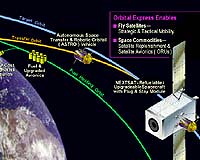
 The Boeing Orbital Express system, a Defense Advanced Research Projects Agency (DARPA) program aimed at demonstrating fully autonomous on-orbit satellite servicing, last month completed two major test milestones.

The program completed its Baseline Integrated System Test (BIST) of the Autonomous Space Transport Robotic Operations (ASTRO) spacecraft and a series of electromagnetic interference and compatibility tests to verify component operation in the spacecraft’s actual electromagnetic environment….

 The Orbital Express System consists of two satellites: Boeing’s ASTRO servicing spacecraft and NextSat, a prototypical, modular next-generation serviceable client satellite developed by Ball Aerospace.

The Orbital Express launch is scheduled for October, when the system will demonstrate for the first time: fully autonomous rendezvous out to 7 km with a capability that could support rendezvous at separation distances up to 1,000 km; soft capture and sub-meter range autonomous station-keeping; on-orbit refueling and component replacement as well as other robotic operations. Upon a successful demonstration, Orbital Express will provide the foundation for developing an operational system that can provide routine on-orbit servicing of existing and future space assets.

The full article can be found here

Space Symposium Kicks Off in Colorado

Wednesday, April 5th, 2006

The 22nd National Space Symposium opened its doors in Colorado Springs, Colorado yesterday.

The Symposium, sponsored by the Space Foundation, is an annual space industry conference that brings members of the global space industry and the military together.

Space.com reports:

“In terms of intellectual content, this Symposium is clearly our most exploration-focused and most commercial-entrepreneurial focused ever, said Elliot Pulham, President and Chief Executive Officer of The Space Foundation… 

Local station KKTV looks at what’s of interest to the general public:

This year’s show features a robot who can dance and entertain named "Sprockit." It also features NASA’s Crew Exploration Vehicle, or C.E.V. NASA says the C.E.V. will replace the shuttle and sit four to six people.

The C.E.V. is a refined version of the old Apollo vehicle. They say it’s safer than a shuttle and more economical. 

 More stories can be found here. You can also check out photos from the symposium and even check out the live webcam of the exhibit hall (in the left hand column).

 Organizers expect more than 7,500 people to attend the symposium, which runs through tomorrow at the Broadmoor Hotel.


A Hard Knock Life for Satellites

Friday, March 31st, 2006

I’m probably giving away my age when I say this, but I remember when our television had a "rabbit ear" antenna, and adjusting the picture just meant moving the "ears" around. Later we had an antenna on the roof. Adjusting the picture meant someone had to climb a ladder to the roof, while someone else yelled out of a window until the picture was clear. Then there was cable. If we lost the signal, we called the cable company and waited.

Now we have satellite TV, and we rarely lose a the signal — except for occasionally during a storm, when it flickers on and off briefly before returning. If we have snow, it can interrupt the signal if it piles up on the dish, but that just means a quick trip to the back yard to brush it off. The dish in the back yard, however, is just a receiver; pointing at at a satellite so high up that a ladder on the roof doesn’t begin to do the trick. So, what happens if a satellite gets bonked by an asteroid or other random space junk?

Well, you lose the signal, which is what happened to a lot of Russians this week when a telecom satellite failed after a "sudden impact" shut down its thermal control, causing it to end up in space disposal orbit.  (Yeah. I didn’t know what that meant either. Apparently there’s a whole part of space where satellites go to die. Who knew?)  New Zealand had an outage too, due to loss of pointing control.  (Another hard knock?) A European satellite got bonked in 1993 when the earth passed through a trail of comet dust. 

So, what to do? Some people are trying to predict problems, and others are working on better materials. (What can withstand getting smacked by an asteroid?) And some are focusing on better monitoring and forecasting of sunspots and space weather (space weather?), which apparently can also cause problems for satellites. 

I can’t say how it all works. I just hope it keeps working. I don’t want to miss any of my favorite shows, and I don’t want to have to climb any higher than the roof.

TV: To-Go vs. Terrestrial

Wednesday, March 15th, 2006

Imagine for minute that you want to watch, say, the Super Bowl or some other big television event. But it’s only available on your phone.  That’s right. None of the "terrestrial" networks are carrying it. Hard to imagine?  It happened in South Korea

Cable TV and other media that are considered as "non-mainstream" are threatening the realm of conventional terrestrial TV.

The latest case was a challenge made by a one-year-old sports channel Xports, which is buying up broadcasting rights for matches of the South Korean national team.

On Wednesday night, Xports exclusively aired the national team’s match with Syria. It was the first time a national team match was not shown on the three terrestrial TV channels _ KBS, SBS and MBC. Adding insult to injury was the fact that the Korea-Syria match was also viewed on versatile mobile phones with satellite DMB functions, another emerging medium of entertainment.

Satellite TV on a cell phone? Evidently, it’s spread so widely in other parts of the world that it’s starting to rival traditional — "terrestrial" — TV. Well, it’s here. And though you may not find it’s your only option for some television events, it’s set to offer more options. It’s expanding into Europe and other countries, through companies like Pantech and Samsung. It’s also coming to Canada and Latin America. Now, I find out that my wireless carrier launched its own video service a week ago, along with two new phones to go with it. 

Boy, am I behind. I haven’t even gotten a video iPod yet.  Now my phone is outdated, and have to choose which new phone to get; never mind deciding what to watch once I get it.

Rocket Launch Tonight

Thursday, March 9th, 2006

Arianespace is launching two satellites: HOT BIRD 7A and SPAINSAT. I plan to watch it live — on Saturday night.
 
Launch window opens 22:05 GMT  on 11 March 2006 (7:05 p.m. local time in Kourou, French Guiana; 5:05 p.m. in Washington, D.C.). Webcast begins 20 minutes prior.

Kourou is known as Europe’s Spaceport. First settled by the French in 1604, French Guiana was the site of notorious penal settlements (see Devil’s Island) until 1951.

Looking For Work?

Friday, February 24th, 2006

Space.com’s Leonard David is reporting this afternoon that Scaled Composites is hiring people from “various backgrounds” to come help build spaceships. Yes, that Scaled Composites headed by Burt Rutan that won the Ansari X Prize.

It seems work has started on SpaceShipTwo, and they are looking for help.

You can read Leonard’s article at www.space.com and you can submit your resume at www.scaled.com/careers.