Archive for the ‘Cool Stuff’ Category

Weekend Roundup

Wednesday, July 5th, 2006

We hope everyone enjoyed the long holiday weekend.

The big non-event of the weekend was the expected near-miss between 2004 XP14 and Earth on Monday:

A large asteroid hurtled harmlessly past the Earth early Monday at a distance of about 269,000 miles – slightly farther away than the moon.

Residents with telescopes in the United States and Canada had the best view of 2004 XP14, which appeared as a streaking dot in the northern sky.

Astronomers tracking the space rock’s path since its discovery in 2004 had determined that it would pose no risk to Earth during the encounter nor in the next 100 years. Judging by its brightness, 2004 XP14 was estimated to be a quarter-mile to a half-mile wide.

An asteroid that size, if it smashed into Earth, would probably cause regional destruction. Scientists have said it would take a mile-wide or larger asteroid to cause widespread devastation that could threaten civilization. 

The big event that finally happened– on July 4th, no less–  was the successful launch of space shuttle Discovery yesterday:

The liftoff, right on schedule at 2:38 p.m., was the start of a 13-day flight that is the first in a year for the diminished shuttle fleet as NASA continues its efforts to resume more frequent human spaceflight.

The Discovery is to rendezvous on Thursday with the International Space Station, where it is carrying equipment, supplies and a fresh astronaut for the station’s crew.

But this is also considered the second and final test flight for the shuttle fleet since the loss of the Columbia and its seven astronauts in 2003, and the Discovery’s ascent was scrutinized for the kind of liftoff debris that caused that disaster.

At 2 minutes 53 seconds into the flight, an onboard camera showed numerous pieces of debris appearing to fall away from the external fuel tank. They fluttered away and did not appear to strike the shuttle, carrying a crew of seven.

N. Wayne Hale Jr., NASA’s shuttle program chief, said the pieces had fallen "after the time we are concerned about," after the air becomes so thin that debris usually floats harmlessly away.

A piece of debris that broke off later in the ascent did appear to strike the midbody of the orbiter, NASA officials said. But they added that it probably did not do any damage.

In all, officials said, insulating foam broke away from five spots on the external fuel tank and a solid rocket booster, some with several pieces of foam.

We’ll be bringing you updates of the space shuttle’s 13-day mission over the next two weeks. 

 

Your Phone, Your Brain & Your Nose

Friday, June 30th, 2006

There have been some pretty interesting stories circulating about mobile phones this week, and now seems like a good time to encapsulate them all in one place (especially considering the one that landed in my inbox this morning). 

You’ve probably heard about the alleged connection between mobile phones and brain cancer (And who can forget the Canadian University that banned wifi because of health concerns?) Well, the FDA says there’s no clear connection between (pun intended?) the two, but new research from Italy suggests that your cellphone may be stimulating a part of your brain

Cellphone OKDr. Paolo Rossini of Fatebenefratelli hospital in Milan and colleagues used Transcranial Magnetic Stimulation or TMS to check brain function while people used these phones.

They had 15 young male volunteers use a GSM 900 cell phone for 45 minutes. In 12 of the 15, the cells in the motor cortex adjacent to the cell phone showed excitability during phone use but returned to normal within an hour.

The cortex is the outside layer of the brain and the motor cortex is known as the "excitable area" because magnetic stimulation has been shown to cause a muscle twitch.

The science blogger over at Retrospectacle mentions a Japanese study that yielded similar results, and notes that the motor cortex is affected (and temporarily at that, according to both studies) but not the sensory cortex where the visual, auditory, and olfactory (site, sound, and smell) regions of the brain reside. 

That might be true, but according to another set of researchers chatting on your cellphone while driving (even with hands-free accessories) makes you just as impaired as a drunk driver.  And just as dangerous too.

The researchers used a driving simulation device for their study, published in the summer 2006 issue of Human Factors: The Journal of the Human Factors and Ergonomics Society.

They studied 40 volunteers who used a driving simulator four times — while undistracted, using a handheld cell phone, using a hands-free cell phone and while intoxicated to a 0.08 percent blood-alcohol level — the average legal level of impairment in the United States — after drinking vodka and orange juice.

Three study participants rear-ended the simulated car in front of them. All were talking on cellphones and none was drunk, the researchers said.

Motorists who talked on either handheld or hands-free cell phones drove slightly more slowly, were 9 percent slower to hit the brakes, and varied their speed more than undistracted drivers.

Drivers with an 0.08 percent blood-alcohol level drove a bit more slowly than both undistracted drivers and telephone users, yet more aggressively.

And if your cellphone isn’t distracting enough when you’re driving, imagine how much more distracting it might be if there were smells coming from your cellphone. I kid you not. Trendhunter led me to this article about some researchers working to turn your cellphone into a smellphone

Engineers have already developed a system that can record smells of various fruits, such as apples, oranges, melons and bananas, on to a system of 15 microchips in a handheld device.

Each microchip is an electronic ‘nose’, containing a chemical sensor which can pick up different traces in the odour.

The Japanese inventors of the system say these sensors can come up with thousands of different combinations.

The proportions of each odour are carefully noted by the microchips and when the ‘recording’ is played back they recreate them from 96 manmade chemicals. 

I can’t help wondering if the scientists involved in this project have really thought this through. There may be an actual use for this, but I can also think of some good reasons not to put the capability of recording and transmitting odors via cellphone into the hands of at least some people. Can’t you?

Oh, Say Can You See

Thursday, June 29th, 2006

The 4th of July in the U.S. is almost always celebrated with a fireworks display, ideally with proper supervision by responsible adults.  Here’s a display up in the sky that’s definitely overseen by responsible rocket scientists, captured via telescope in Betzdorf, Luxembourg.

We recently got word a new satellite has come into service at ASTRA. Launched in April, the ASTRA 1KR satellite underwent a rigorous in-orbit testing before arriving on-station at 19.2° East, which it shares with several other satellites. Ever wonder what that looks like? We’ve got the video.

If you’re an amateur astronomist, you can try this at home. If the skies are dark enough and you have a telescope, you can spot some of the satellites in the Clarke Orbit, a.k.a. the geostationary ring, 36,000 kilometers (23,600 miles) above the Earth.

Most geostationary satellites are really geosynchronous. For radio and television broadcasting, this is essential. With mean motions between 0.9 to 1.1 revolutions per day, these satellites drift across a 45-square-kilometer “box” before corrections are made by spacecraft controllers on the ground via on-board thrusters. Anomalies in the Earth’s gravitational field causes this “drift,” as atmospheric drag is irrelevent at this altitude. The Moon’s gravitational pull provides an out-of-plane force as well, gradually increasing the orbital inclination towards that of the Moon around the Earth (which itself varies between 18 and 29 degrees).

So the satellite’s track tends to resemble a figure-eight track. In the ASTRA 1KR video, we get to see a small portion of this eventual figure-eight. Allowed to go on unchecked, a satellite’s orbit becomes more inclined. Some satellites are purposefully directed towards an inclined orbit, thus providing better coverage of the polar regions. Antarctic research stations rely on these satellites for communications.

Unlike objects in low Earth orbit, geostationary satellites are visible throughout every night of the year, entering the Earth’s shadow for up to 70 minutes per day. During the same period the satellite tends to brighten over several days, twice a year (equinox, +/- one week), when the satellites’ orientation toward the Sun causes “flares,” the most spectacular of which comprise the Iridium system (check this site for predictions). Two line elements can be obtained for nearly all these satellites via Dr. T.S. Kelso’s site.

Robot Roach Patrol

Wednesday, June 28th, 2006

Forget Raid. Forget Orkin. When you’re facing an infestation of pests, in this case roaches, your best bet might be a robot. This isn’t a new story, from what I can tell, but it’s popped back up in the last couple of days. And it’s an interesting one. Given that you can now have a robot keeping your house clean, why not have one keeping it roach-free?

In a breakthrough for the battle against mankind’s most diehard enemy – the cockroach – European scientists have hoodwinked a group of them into congregating in a place where they can be stamped on easily.

The kick in the mandibles comes from a Belgian-led team who spent three years developing a mini robot that can convince cockroaches to creep out of dark holes and gather in light places. The InsBot looks more like a pencil sharpener than a household pest, but it smells like a cockroach. Most importantly, the InsBot can pass for a Periplaneta Americana (American cockroach).

OK. Maybe you should keep the insecticide handy, since this model apparently just herds the roaches together for easier spraying/stamping. Still, as Technovelgy points out, it has interesting implications for creating more innovative forms of artificial intelligence. Technovelgy also has an interesting post up about a roach-controlled robot. And for good measure, here’s a link to the project itself.

Laptop Go Boom!

Tuesday, June 27th, 2006

We can’t vouch for the veracity of this, but it amused us to no end:

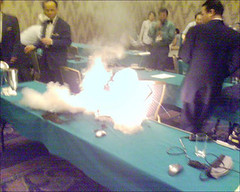
 AN INQUIRER READER attending a conference in Japan was sat just feet away from a laptop computer that suddenly exploded into flames, in what could have been a deadly accident.
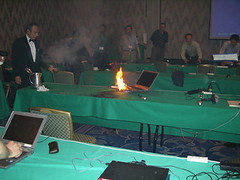
Gaston, our astonished reader reports: "The damn thing was on fire and produced several explosions for more than five minutes"….

"It is only a matter of time until such an incident breaks out on a plane," he suggests.

Our witness managed to catch all the action in these amazing pictures.

"Fire extinguishers leave a mess on your suit and belongings; pack your stuff (if you can) and leave, leave, leave!" he advises.

We don’t have any further details of the model of the computer in question. In light of the evidence, however, we’d suggest you avoid actually using a laptop on your lap. 


The after-photo:


Bots on the Brain

Wednesday, June 21st, 2006

More robot-related news.

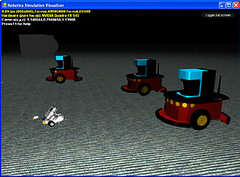
CNet has a gallery of screenshots from Microsoft’s just-announced Robotics Studio.

Robotics Studio

Meanwhile, Wired has write-up on RoboGames, which ends with a quote that sums up the point of getting kids to build robots and bang them into each other.

For [Dan] Albert, as with many of the roboticists who spoke to Wired News, events like RoboGames are about getting kids interested in science and technology. “You start kids out with entertainment, and they gravitate toward engineering as they want more control over their world,” he says.

Finally, though not specifically bot-related, Retrospectacle has an interesting post up about brain-machine interfaces. (Hint: think brain-powered space flight.)

Microsoft Does the Robot

Tuesday, June 20th, 2006

Speculations, theories and predictions abound in the wake of Bill Gates’ announcement that he’s quitting his day job in a couple of years. Among the ideas being bandied about the blogosphere, the predicted end of software is the second most interesting.

Here’s the dilemma for Microsoft. It knows that the Webtop is coming. It knows that desktop applications and Web applications are going to become more and more indistinguishable. And it is making a play for that future with Windows Live and Office Live. But as an organization, it’s heart is just not in it. And why should it be?

Why? Well, I don’t know, but it’s a great lead-in to the first most interesting hint on Microsoft’s direction in a post-Gates world: robots.

Microsoft will announce today that it is launching a new effort to dominate the robot world. They will offer a software platform that could provide a foundation operating environment for robots.

Their motivation for the efforts,according to an announcement letter from Tandy Trower, General Manager, Microsoft Robotics Group,is, "We think robotics is poised to take off rapidly, and there are solid indications that this is true! With component hardware costs coming down and computational capabilities increasing, the robotics industry appears to have the right conditions to really grow quickly."

OK. So Microsoft isn’t building robots (yet?), but launching an effort to help people build robots is an interesting direction, and maybe a feasible one since there isn’t a "webtop" application for that. (Is there?)

Check out the Robot Gossip link for more info on what Microsoft’s up to (like funding a Center for Innovative Robotics at Carnegie Mellon) and specs on Robotics Studio.

Video Shows Meteoroid Hitting the Moon

Monday, June 19th, 2006

"There’s a new crater on the Moon. It’s about 14 meters wide, 3 meters deep and precisely one month, [sixteen] days old," NASA reports:

NASA astronomers watched it form: "On May 2, 2006, a meteoroid hit the Moon’s Sea of Clouds (Mare Nubium) with 17 billion joules of kinetic energy—that’s about the same as 4 tons of TNT," says Bill Cooke, the head of NASA’s Meteoroid Environment Office in Huntsville, AL. "The impact created a bright fireball which we video-recorded using a 10-inch telescope."

Lunar impacts have been seen before–"stuff hits the Moon all the time," notes Cooke–but this is the best-ever recording of an explosion in progress.


"The video plays in 7x slow motion; otherwise the explosion would be nearly invisible to the human eye. "The duration of the fireball was only four-tenths of a second," says Cooke.

DIY WiFi

Friday, June 16th, 2006

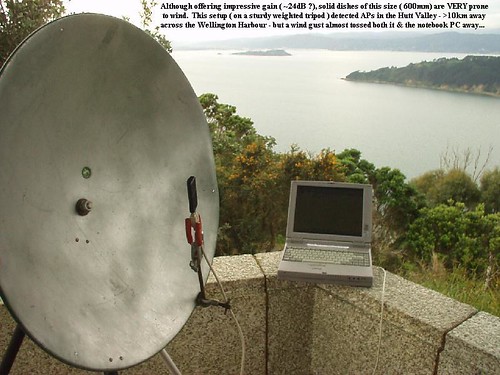
Here’s a few interesting bits about how to build your own antenna, for a DIY Friday. The first one, from Geekcorps Mali, is all about how to build your own antenna with a plastic bottle, using a design based on waveguide theory. Another offers even more detailed instructions. But I was still trying to figure out what one might use these antennae for (and what waveguide theory is) when I stumbled upon some well illustrated instructions on how to build "the poor man’s wifi."


I’m not sure I’ll ever try these instructions, but I had fun looking at the pictures of various wifi access devices made from little more than a USB adaptor and some Chinese cookware. 

Hawking: We Gotta Get Out of This Place

Wednesday, June 14th, 2006

Blaring in an above-the-fold headline on the Drudge Report yesterday and making its way around the blogosphere today is world-renowned astrophysicist Stephen Hawking’s statement during a press conference that humans must colonize space to survive. The AP reports:

 Humans could have a permanent base on the moon in 20 years and a colony on Mars in the next 40 years, the British scientist told a news conference.

"We won’t find anywhere as nice as Earth unless we go to another star system," added Hawking, who arrived in Hong Kong to a rock star’s welcome Monday. Tickets for his lecture planned for today were sold out.

He added that if humans can avoid killing themselves in the next 100 years, they should have space settlements that can continue without support from Earth.

"It is important for the human race to spread out into space for the survival of the species," Hawking said. "Life on Earth is at the ever-increasing risk of being wiped out by a disaster, such as sudden global warming, nuclear war, a genetically engineered virus or other dangers we have not yet thought of.”

The 64-year-old scientist — author of the global bestseller A Brief History of Time — uses a wheelchair and communicates with the help of a computer because he suffers from a neurological disorder called amyotrophic lateral sclerosis, or ALS.

Hawking said he’s teaming up with his daughter to write a children’s book about the universe, aimed at the same age group as the Harry Potter books.