Archive for the ‘Front Page’ Category

Another Robot Race

Tuesday, May 2nd, 2006

Last month I posted about the Great Robot Race. Well, the folks at DARPA at it again. Only this time robots will make their way through city streets, instead of the desert, during Grand Challenge

The Pentagon said Monday that a third Grand Challenge competition would be held to foster research and development into advanced robot vehicles.

In contrast to the previous contest, which took place in the desert on the border between California and Nevada, the new competition will be carried out in a mock urban area. Robots will be required to obey traffic laws while merging into traffic, as well as negotiating traffic circles, busy intersections and obstacles. The event is scheduled for Nov. 3, 2007.

First prize for successfully completing the 60-mile course in less than six hours will be $2 million. Second prize will be $500,000 and third prize is set at $250,000.

But if you want to participate, you’d better hurry. There’s already an Urban Challenge Participants Conference scheduled for May 20th, in Reston, Virginia. You can register at the Grand Challenge website. After that, you’ll have a bit more time (but not much), depending on which track you choose

DARPA also will make funding available for contenders before the finals, through two tracks:

  • Teams could submit detailed proposals for up to $1 million in technology development funds, with the government obtaining limited licensing rights to the resulting technologies. The selected teams would proceed to a semifinal known as the National Qualification Event.
  • Teams could participate in a series of qualifying tests, just as competitors did in the 2004 and 2005 DARPA Grand Challenges. The teams selected for the National Qualification Event would get $50,000, and the teams that are successful at that event will get $100,000 and a spot in the November 2007 finals.

Track A proposals are due on June 23rd, and Track B proposals on October 5th.

Science Mythbusting

Monday, May 1st, 2006

Over on Newsvine, I came across an interesting post by someone who claims to be busting the myths about science, and found a couple of interesting items on the list.

Myth 2. The Great Wall of China is the only manmade structure visible from space

There are several variations on this folkloric statement, and they’re all quantifiably false. Astronauts can spot the Great Wall from low-Earth orbit, along with plenty of other things like the Giza pyramids and even airport runways. But they can’t see the Wall from the Moon. 

Myth 12. There is no gravity in space

Blame the term "zero-gravity" for this common misconception. Gravity is everywhere, even in space. Astronauts look weightless because they are in continuous freefall towards the Earth, staying aloft because of their horizontal motion. The effect of gravity diminishes with distance, but it never truly goes away. It is also untrue that space is a vacuum. There are all kinds of atoms out there, albeit sometimes far apart. 

I don’t know about the gravity question (any physicists out there?), but apparently our mythbuster is dead on about the Great Wall.

“You can see the Great Wall,” Lu says. But it’s less visible than a lot of other objects. And you have to know where to look.

In fact stretches of the wall aren’t even visible from China. They’ve been buried by sand for centuries. NASA has used space-based radar to map out hidden parts of the ancient structure. [Astronaut Ed] Lu is trying to get a picture of it, too, with a digital camera. 

I don’t know if Lu every got his picture, but I did track down the pictures NASA took with its "space-based radar." 

The mythbuster also takes on some common myths about asteroids.

New in Sunnyvale: A VW Jet Car Putting Out 1450 h.p.

Monday, May 1st, 2006

A VW New Beetle with 1450 horsepower? Ya gotta see this video 

SF Chronicle’s Michael Taylor spent some time with the builder of this machine, Ron Patrick of Sunnyvale, California:

"You drive the car up to about 90 miles an hour and you spool up the jet, then hit it W.O.T. (wide-open throttle)," he said, fondly recalling one of his rides. "It’s one of the finest feelings you can have in your life. In the rear view mirror, all you see is light and hear the thunder of the jet. It’s like you’re going down the largest hill you’ve ever been on."


Jet cars aren’t new. This is how close the VW Bug and jet cars have come together, a Walt Arfons Jet Car driven by Paula Murphy (a.k.a. "the Flying Housewife" and "Miss STP") at Bonneville Salt Flats in 1963 (note the Bug in the background):

Drag racing VW Bugs aren’t just for Herbie any more. The VW Drag Racing Club cites one old Bug that can do a quarter-mile in 10.5 seconds @ 125 m.p.h. — and it’s driven to and from the track!


DIY Friday: DIY Energy

Friday, April 28th, 2006

A belated happy Earth Day to all. We went kinda "off the grid" last Friday, in honor of Earth Day, and thus found it somewhat difficult to get a DIY Friday post published. We had it all ready to go, but that whole smoke signals set up didn’t quite work. So, here’s our belated DIY Friday post, as the clock ticks down on Earth Day afterglow.

This first bit isn’t exactly a DIY project,  but having a solar generating briefcase last Friday — like the one we spotted on ProductDose recently —  might have helped get the DIY Friday post published. It’s handier than a gas generator, and so much less fossil fuel dependent. Besides, it generates more than enough electricity to power a laptop, so we could have charged up the iPod while we were at it. 

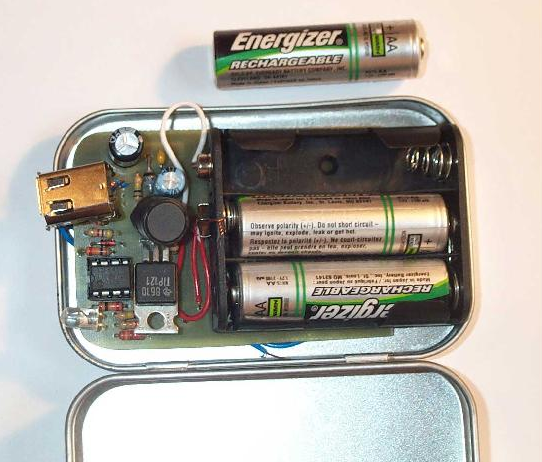
Speaking of iPods, this Altoid tin hacked into an iPod charger sounds like a good idea, if only the inventors could get it working. They cite a couple of reasons why it doesn’t, which I’ll post here in hopes that someone will be able to help them out. 

There are (at least) two reasons this charger _does not_ work:

1. The transistor doesn’t let enough current flow to fully charge the inductor.  The other option is a FET, but a FET needs a minimum of 5 volts to switch fully on. This is discussed in the SMPS section.

2. The inductor is simply not big enough. The charger doesn’t produce nearly enough current for the iPod.  We didn’t have an accurate way to measure the iPod charging current (save cutting apart the origional charging cable) until our parts arrived from Mouser.  The inductors recommended are nowhere near large enough for this project.  A suitable substitution might be the coil Nick de Smith uses on his MAX1771 SMPS.  Its a 2 or 3 amp coil from digikey:

[ http://www.desmith.net/NMdS/Electronics/NixiePSU.html#bom ]

This device can provide a small amount of power to a USB or firewire device, but not enough to charge an (3G) iPod.  It WILL power, but not charge, a totally dead 3G iPod.

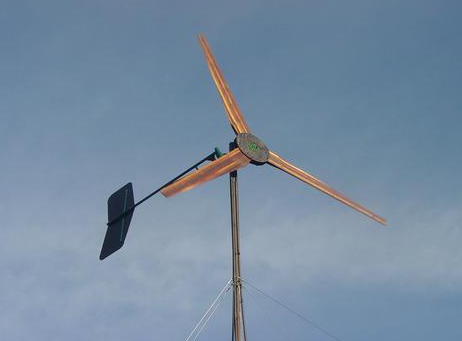
Meanwhile, as long as we’re on the subject of power, this homebrew wind turbine sounds like a pretty good idea. I don’t know how much power it generates, but I bet it will power a laptop and an iPod (probably) as the builder says he’s seen "3800 watts from it in a high wind." I’m not sure how much power that is, but he says he’s a bit more than he can use. 

The guy who made the wind turbine would probably do well to team up with the David Mears — a professor of Bioresource Engineering at Rutgers University —  who managed to hack his entire house into such an energy efficient mode, with adjustments including a woodstove and a solar enabled greenhouse (pictured above),  that he and his family went 25 years without getting a heating bill. That’s also 25 winters of not burning fossil fuels to heat the house.  That’s not just good for the pocket book, but good for the earth too. And that makes for a happy (though belated) Earth Day.

European Hams Hear Signals from the Edge of Space

Thursday, April 27th, 2006

This one gets filed under "cool stuff," for sure:

Hams in Germany received signals from American spacecraft Voyager 1 March 31 using a 20 meter parabolic antenna of a radio telescope on a frequency of 8.4 GHz….

A team of hams at AMSAT-DL/IUZ Bochum (The Institute for Environmental and Future Research at Bochum Observatory) using Doppler shift and sky positioning, received the signal from a distance of 8.82 billion miles (14.7 billion km). That’s roughly 98 AUs, or 98 times the distance from the Sun to Earth. This is the first recorded reception of signals from Voyager 1 by radio amateurs….

Voyager 1 was launched in September 1977 to conduct close-up studies of Jupiter and Saturn, Saturn’s rings and the larger moons of the two planets. Originally built to last only five years, the probe will continue to send back astronomical information to NASA and the JPL until at least 2020. Voyager 1 will continue to study ultraviolet sources among the stars, and the fields and particles instruments aboard will continue to search for the boundary between the Sun’s influence and interstellar space. Communications will be maintained until the nuclear power sources can no longer supply enough electrical energy to power critical subsystems. 

 The achievement by the German hams makes Satellite Radio seem déclasse.

mobTV Happens in Vegas

Monday, April 24th, 2006

Here’s an interesting tidbit from behind the Wall Street Journal’s subscription wall. MobTV is getting another foothold stateside.

Satellite operator SES Global S.A., seeking to find a place in the burgeoning wireless-entertainment arena, today is expected to announce it is joining with a start-up company that controls a big swath of mobile broadcast spectrum across the U.S.

The anticipated technical and marketing alliance between SES Americom, the U.S. unit of Luxembourg’s SES Global, and closely held Aloha Partners LP of Providence, R.I., is intended to demonstrate the business case and consumer appeal of beaming digital music and high-resolution video to cellphones and other consumer hand-held devices. But the initiative also illustrates broader efforts by satellite-services companies to participate in the fast-changing media landscape, particularly at the convergence of television and

… A yearlong test is planned to begin this fall in Las Vegas, though negotiations with programmers and leading cellular providers still have to be worked out.

The plan is the most ambitious yet to test such a system using fewer transmitters, or towers, to simultaneously distribute as many as 40 higher-resolution video channels directly to handsets. Implementing the concept would end up costing a small fraction of the estimated billions of dollars necessary to build out rival networks relying on less-powerful broadcast signals and thus requiring towers spaced closer together.

Multichannel News has a bit more, no subscription required. 

It’s encouraging news, after my previous post on mobTV spreading in Korea, across Europe, and into Canada and North America. It’s also encouraging that, after re-reading my post on how mobTV works, I think I get how the Las Vegas project is gonna work out.  I’m guessing the involvement of a satellite company means using a satellite signal to cut down on spectrum issues like the ones covered in my previous post. 

So, this sounds like a wish fulfilled. I just hope that the tag line from those edgy and ubiquitous Las Vegas tourism commercials doesn’t hold true for  this latest stateside foray into mobTV.

ER on the Moon?

Friday, April 21st, 2006

Back to robots for just a minute. I mentioned the pregnant robot earlier, the one used to help train medical students without the need for human guinea pigs. I also blogged about the challenge of meeting medical needs in space. Well, those topics have come together in a pretty interesting way. With help of a NASA robot, emergency surgery in space may have just gotten a lot easier. 

Using a cramped undersea laboratory off Florida’s Atlantic coast, NASA astronauts and medical experts have teamed with an experimental robot to demonstrate long-distance surgical procedures that might one day save the life of a critically injured explorer on the moon or Mars.

The mission to evaluate a new branch of health care called telemedicine and the use of robots in surgery will draw to a close today when the three-man, one-woman crew leaves the research facility 62 feet below the water’s surface where they have lived since early this month.

During their stay aboard the 43-foot-long Aquarius, submerged among the coral reefs off Key Largo, Fla., physician Tim Broderick and three astronauts — Dave Williams, Ron Garan and Nicole Stott — assisted as Canadian surgical researchers 1,250 miles away sent commands to a robot inside the laboratory.

Responding to those commands, the portable robot sutured a badly damaged vein in the wounded arm of a patient simulator, a lifelike medical teaching aide constructed of rubber and fabrics that mimic human tissue and contain bloodlike fluid.

"Patient simulator"? "Lifelike medical teaching aide"? Is it me or does that sound like a robot doing surgery on a robot? I guess it’s better that way, as long as they’re experimenting, but I supsect they won’t get any notes about cold hands or bedside manner from a "lifelike medical teaching aide."  

Via Mars Blog.

The Kon-Tiki Sails Again!

Friday, April 21st, 2006

"Nearly 60 years after Thor Heyerdahl’s Pacific Ocean crossing aboard the balsa raft Kon-Tiki, a Norwegian team is in Peru putting final touches on a new vessel to repeat the journey," the AP reports.


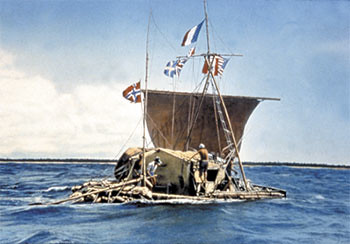
                                                    The original Kon-Tiki in 1947.

"I think we are mentally prepared and we are really, really anxious to put this raft in the ocean," said Olav Heyerdahl, 28, the adventurer’s grandson and one of the six-member crew.

Behind him in a dry-dock in Lima’s port of Callao loomed the balsa raft Tangaroa — named for the Polynesian god of the ocean — which is scheduled to set sail April 28.

The expedition had been set for last year, but was postponed after key sponsors diverted funds to help victims of the 2004 Southeast Asian tsunami.

In 1947, Thor Heyerdahl and his team sailed their primitive raft 5,000 miles from Peru to Polynesia in 101 days to support Heyerdahl’s theory that the South Sea Islands were settled by ancient mariners from South America. Heyerdahl, who died in 2002 at age 87, documented his voyage in the best-selling book "Kon-Tiki" and in an Oscar-winning documentary film.

The adverturer’s 67-year-old son, Thor Heyerdahl Jr., came to Peru to see the new vessel and cheer on his own son. "I’m very happy for him that he gets this opportunity," he said.

The new 56-foot vessel is larger than the Kon-Tiki, with eight crossbeams lashed to 11 balsa logs from Ecuador and covered by a bamboo deck. Atop a hardwood cabin, the crew fitted a thatched-reed roof made by Aymara Indians.

The Kon-Tiki carried only the most basic equipment, even by 1947 standards. But the Tangaroa features abundant modern technology, including solar panels to generate electricity and satellite navigation and communications gear.

We’re not sure if the expedition has Internet access while adrift in the South Pacific, but it is possible if they contacted Connexion by Boeing, which uses SES-Americom’s AMC-23 satellite, which is the only satellite that they can use for Internet based on their route.

Consider that a modern factoid for an ancient journey.

The Kon-Tiki Sails Again!

Friday, April 21st, 2006

"Nearly 60 years after Thor Heyerdahl’s Pacific Ocean crossing aboard the balsa raft Kon-Tiki, a Norwegian team is in Peru putting final touches on a new vessel to repeat the journey," the AP reports.

The original Kon-Tiki in 1947.

"I think we are mentally prepared and we are really, really anxious to put this raft in the ocean," said Olav Heyerdahl, 28, the adventurer’s grandson and one of the six-member crew.

Behind him in a dry-dock in Lima’s port of Callao loomed the balsa raft Tangaroa — named for the Polynesian god of the ocean — which is scheduled to set sail April 28.

The expedition had been set for last year, but was postponed after key sponsors diverted funds to help victims of the 2004 Southeast Asian tsunami.

In 1947, Thor Heyerdahl and his team sailed their primitive raft 5,000 miles from Peru to Polynesia in 101 days to support Heyerdahl’s theory that the South Sea Islands were settled by ancient mariners from South America. Heyerdahl, who died in 2002 at age 87, documented his voyage in the best-selling book "Kon-Tiki" and in an Oscar-winning documentary film.

The adverturer’s 67-year-old son, Thor Heyerdahl Jr., came to Peru to see the new vessel and cheer on his own son. "I’m very happy for him that he gets this opportunity," he said.

The new 56-foot vessel is larger than the Kon-Tiki, with eight crossbeams lashed to 11 balsa logs from Ecuador and covered by a bamboo deck. Atop a hardwood cabin, the crew fitted a thatched-reed roof made by Aymara Indians.

The Kon-Tiki carried only the most basic equipment, even by 1947 standards. But the Tangaroa features abundant modern technology, including solar panels to generate electricity and satellite navigation and communications gear.

We’re not sure if the expedition has Internet access while adrift in the South Pacific, but it is possible if they contacted Connexion by Boeing, which uses SES-Americom’s AMC-23 satellite, which is the only satellite that they can use for Internet based on their route.

Consider that a modern factoid for an ancient journey. 


Atlas V Rocket to Launch ASTRA 1KR Today

Thursday, April 20th, 2006

ASTRA’s newest satellite will be launched into geosynchronous orbit and will become part of a system that provides television reception to 107 million households in Europe. Launch window opens at 4:27 p.m. EDT (20:27 GMT), and remains opens until 7:16 p.m. (23:16 GMT). Watch the launch live via webcast from launch complex 41 at the Cape Canaveral Air Force Station in Florida. Broadcast begins at 4:05 p.m. (20:05 GMT). Here’s how you can receive it directly via satellite:
 
In North America, AMC-4, transponder 17, C-band analog, 101 degrees West, downlink frequency 4040 MHz (vertical).

In Europe, on ASTRA, transponder 116 on ASTRA 1G at 19.2E with following reception parameters: downlink frequency: 12669.50 MHz / downlink polarization: vertical / transponder transmission rate: 22 MB/s QPSK FEC 5/6; Service name: ASTRA VISION 3

Test signals begin about 3:45 p.m. EDT (19:45 GMT).

If you are not able to watch it, then you can follow it via live text updates.