Archive for the ‘Front Page’ Category

Space Archaeology?

Thursday, February 16th, 2006

Who knew that NASA did archaeology? Unless someone’s sifting through the sands of some distant planet for signs of ancient intelligent life, I’ve always thought of archeology as the earthbound realm of the Discovery Channel and maybe Indiana Jones. That is, at least until I read that NASA helped uncover lost Maya ruins in the Central American jungle. 

Remains of the ancient Maya culture, mysteriously destroyed at the height of its reign in the ninth century, have been hidden in the rainforests of Central America for more than 1,000 years. Now, NASA and University of New Hampshire scientists are using space- and aircraft-based “remote-sensing” technology to uncover those ruins, using the chemical signature of the civilization’s ancient building materials.

NASA archaeologist Tom Sever and scientist Dan Irwin, both from NASA’s Marshall Space Flight Center in Huntsville, Ala., are teaming with William Saturno, an archaeologist at the University of New Hampshire, to locate the ruins of the ancient culture. Saturno discovered the oldest known intact Maya mural at the site in 2001.

… Sever has explored the capacity of remote sensing technology and the science of collecting information about the Earth’s surface using aerial or space-based photography to serve archeology. He and Irwin provided Saturno with high-resolution commercial satellite images of the rainforest, and collected data from NASA’s Airborne Synthetic Aperture Radar, an instrument flown aboard a high-altitude weather plane, capable of penetrating clouds, snow and forest canopies.

These resulting Earth observations have helped the team survey an uncharted region around San Bartolo, Guatemala. They discovered a correlation between the color and reflectivity of the vegetation seen in the images – their “signature,” which is captured by instruments measuring light in the visible and near-infrared spectrums – and the location of known archaeological sites.

My first thought was that if it’s possible to be an archaeologist without having to tromp around deserts and rain forests, I might start considering a new line of work. (Those mummy-related specials on Discovery and TLC inspire me.) I did a little searching online and found a bit more information about the research team and their research in Petén, Guatemala. Turns out, it’s still archaeology, so they still had to hack through the jungle — using satellite images to guide them — to “ground test” the data. They uncovered a series of ancient sites, right where the data and images predicted they’d be. 

So much for doing archaeology from a nice, air conditioned, indoor space — which I’m guessing were the conditions at the National Space Science and Technology Center, where Sever and Irwin conducted their space-based research before heading out into the field. Sever and Irwin can use satellites to lead them to ancient ruins, and I’ll wait for the same to beam their findings down to my living room.
3-D Imaging with Lasers

Tuesday, February 14th, 2006

Japan’s National Institute of Advanced Industrial Science and Technology has developed free-standing three-dimensional displays, using a laser to make the gases in the air emit light in a 3-meter cube.

You can read more about it here.


One of These Days, Alice: POW! To The Moon!

Thursday, February 9th, 2006

In today’s announcement on space tourism, U.S. DOT  Secretary Mineta is looking for feedback. Maybe Jeff Bezos will reveal more of his plans for space.


I think there was a typically-comprehensive piece in the New York Times, reprinted elsewhere, which got into who’s behind private space tourism.


The iPod of Satellites?

Wednesday, February 8th, 2006


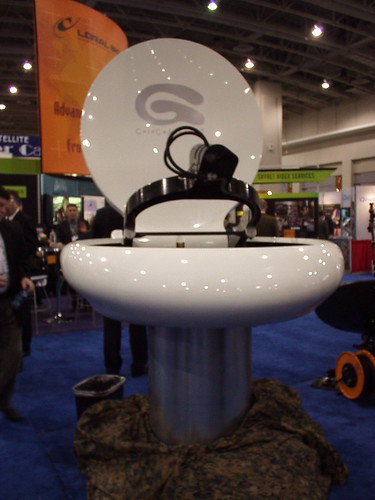
The iPod of Satellites

I don’t know what to say about this, also spotted at Satellite2006, except that it’s exceptionally cool. Design-wise, it reminded me of an iPod right away.  Gigasat seems to have absorbed some design sensibility from the iPod phenomenon. Their sleek driveway antennas won’t fit on in your pocket, but the right one might look good on your SUV.

Satellite2006: StealthRay

Monday, February 6th, 2006

I’m not exactly what anyone would call a “car guy.” As long as it has four wheels, a radio, and A/C (a necessity in the South), I don’t need to know much more. But when I saw a car at the Sattelite2006 exhibit hall, I figured it must have something to do with satellite radio. Besides, if it involves any sort of gadgetry, that’s enough to get my attention as long as I don’t have to look under the hood.

This particular car was sitting at the RaySat booth, and the woman there was nice enough to take minute off from her setup supervising to give me permission to snap a picture and ask a question. (Just one question. She was kind of busy.) It wasn’t until I read the literature I grabbed when I walked away that I was a bit off in my satellite radio assumption. I needed to aim higher.

The car pictured above, according to the RayStat rep. I chatted with briefly, is going to get outfitted with a product called StealthRay, a “low-profile antenna” (i.e. so flat it looks like a roof-mounted spaceship) designed to bring high-speed internet to moving vehicles (among other things). Like I said, I’m not a “car guy,” but RaySat also has a product that brings high-speed internet to trains. If they could get something like that working on the D.C. subway system, I’d be forever grateful. And I wouldn’t even blame them when inevitably miss my stop while surfing the web.

A Tattered Suit?

Saturday, February 4th, 2006

Yesterday we wrote about SuitSat, the old Russian space suit stuffed with radio and electronics gear that was slated to be kicked out of the International Space Station. For a few days, SuitSat would serve as a satellite for amateur radio enthusiasts, before its batteries ran out and the pull of gravity brought it back into the mesophere, for prompt incineration as it fell back to earth.

The “launch” of SuitSat yesterday made big news; MSNBC has a video of astronauts giving the suit the boot here.

But is that suit still in fashion? Australian ABC reports that SuitSat has gone off air:

Plans to use an old Russian spacesuit launched from the International Space Station as a make-shift radio satellite have been short-lived.

American astronaut William MacArthur and Russian cosmonaut Valery Tokarev released the make-shift satellite, dubbed SuitSat, at the start of a six-hour spacewalk.

But before they were back inside, SuitSat’s mission was over.

NASA’s Mission Control Centre in Houston, Texas, says the transmitter ceased operating very quickly after its deployment.

An international team of ham radio enthusiasts who organised the educational project and built the hardware had expected SuitSat to last at least a few days.

The SuitSat website currently has a more optimistic– if guarded– report:

Current thinking is SuitSat is transmitting, but far weaker than expected. Several reliable reports of short snatches of the voice and SSTV signals have been reported. It is recommended that you continue to listen during passes over your area. Please report any positive contact only.

To find a map of SuitSat’s orbit, click here.

World Wide Wireless

Friday, February 3rd, 2006

It’s funny sometimes, how often the rest of the world “gets it” on on issues where the U.S. doesn’t. I couldn’t help thinking of that when I saw a post over at Personal Democracy Forum, about the free book Wireless Networking in the Developing World.

The massive popularity of wireless networking has caused equipment costs to continually plummet, while equipment capabilities continue to increase. By applying this technology in areas that are badly in need of critical communications infrastructure, more people can be brought online than ever before, in less time, for very little cost. We hope to not only convince you that this is possible, but also show how we have made such networks work, and to give you the information and tools you need to start a network project in your local community.

This book was created by a team of individuals who each, in their own field, are actively participating in the ever-expanding Internet by pushing its reach farther than ever before. Over a period of a few months, we have produced a complete book that documents our efforts to build wireless networks in the developing world.

Why does anyone want to build wireless networks in the developing world? I imagine that’s the first question that will come to mind for a lot of Americans, because to a large extent we still see internet access — and particularly wireless internet access — as luxury. The prevailing sentiment could be summed up as “If you want internet access, buy a computer and pay for the service. And if you can’t afford that, then you have more important needs anyway. The developing world is, after all developing, right. So, maybe there are more urgent needs than making sure “more people can be brought online than ever before,” right?

Well, maybe not. The PDF post about WNDW reminded me of a piece I saw in AlterNet last week that underscored how accessible wireless networking has empowered people in other countries which are way ahead of us on that frontier.

In the not-so-distant-future, broadband will be an indispensable part of economic, personal, and public life. Those countries that achieve universal broadband are going to hold significant advantages over those who don’t. And so far, the United States is poised to be a follower — not a leader — in the broadband economy.

… The economic ramifications are profound. “Asians will have the first crack at developing the new commercial applications, products, services, and content of the high-speed-broadband era,” writes Bleha. Already, South Korea, which leads the world in the percentage of its businesses and homes with broadband, is the number one developer of online video games — perhaps the fastest-growing industry today. What’s more, societies in which broadband use is near-universal will adapt to its uses much more quickly than those where access is available only to the well-to-do few.

The countries surpassing the United States in broadband deployment did so by using a combination of public entities and private firms.

Meanwhile, in the states we’re paying a lot more than citizens in other countries for significantly slower broadband and wireless, while our own government subsidizes corporations and DSL providers for maintaining high rates and slow service while also cutting the legs from under their competitors by denying them access to lines. In other words,  no matter who your ISP is, it all comes through lines owned by one telecom corporation or another, which calls to tune to which everyone else dances.

We’ve had some isolated success stories despite this state of affairs. Philadelphia, which has been working towards citywide wireless for over a year, just finalized a 10 year contract with Earthlink to provide the service by next year. Cambridge and MIT are teaming up to provide free wireless to the city. Milwaukee is planning its own wireless network. But much more could happen much faster with the right kind of institutional support.

So, why is it important? Well the Korean and Japanese examples from the AlterNet article draw a pretty good picture of the economic benefits. But there’s another reason, as well as a pretty believable reason why community wireless is slow to take off stateside.

Community Internet could revolutionize and democratize communications in this country. But the major obstacle to universal, affordable broadband access for all Americans is not economic or technical. It’s political.

… Community Internet has the potential to revolutionize and democratize communications in this country. And that may be the reason why big cable and telephone companies and their political allies have launched a sophisticated misinformation campaign.

The political implications are also clear to see in countries like Lebanon and Korea where citizens have used ubiquitous internet access to challenge stagnate media institutions and topple corrupt governments. Therein may lie the reasons why we remain more wired that some of our fellow world citizens.

And that may also be the key to the advantage developing countries enjoy; the lack of powerful, entrenched, state subsidized opposition to community wireless. Whether they’ll continue to enjoy that advantage, if community wireless becomes more available and word of it reaches powerful ears in high places, remains to be seen. But we can hope, and perhaps learn by example in the meantime.

Hey Buddy, Nice Suit

Friday, February 3rd, 2006

Call it orbital recycling:

Thanks to an innovative Russian recycling program, amateur radio fans expect to be hearing from a new recruit in orbit when an old spacesuit gets a new life as a satellite this week.

Beginning on Friday, SuitSat should be on the air, broadcasting on FM 145.990 MHz.

Rather than being launched, this satellite will just get tossed into orbit by the International Space Station crew during a spacewalk slated to begin on Friday evening…..

The old suit was destined for the trash bin until it came to the notice of an international team of amateur radio buffs, said Orlando, Florida, resident Lou McFadin of the Radio Amateur Satellite Corp., or AMSAT.

A Russian colleague attending an AMSAT meeting in 2004 came up with the idea of putting a radio inside a soon-to-be decommissioned spacesuit and having astronauts boot it out the hatch. The all-volunteer effort, aided by corporate donations of equipment and by Moscow, is largely educational.

Space station flight engineer Valery Tokarev will do the honors, with assistance from U.S. astronaut and current space station commander Bill McArthur….

The suit is expected to drift away from the station and begin its short life as a radio satellite.

It will not take calls, but only relay prerecorded messages and transmit an as-yet mysterious digital picture. Batteries will power SuitSat’s radio and electronic gear for up to 90 hours, McFadin said.

Eventually, the suit will be pulled into Earth’s atmosphere and be incinerated.

Satsuit! Now that’s pretty cool.

I myself have got a couple of suits that should be incinerated. They transmit a not-so-secret message of tackiness.

Black Holes: The Other Side of Denver

Wednesday, February 1st, 2006

If you’re in or near Denver, the Denver Museum of Nature and Science has released a cool new film at the Gates Planetarium, Black Holes: The Other Side of Infinity:

In this Museum-produced show, zip through other-worldly wormholes, experience the creation of the Milky Way Galaxy, and witness the violent death of a star and subsequent birth of a black hole. Mathematical equations, cutting-edge science, and Einstein’s theories fill in holes along the way, providing the most complete picture yet on this mysterious phenomenon.

A Windows Media trailer of the film is available here.

(Via the Bad Astronomy Blog.)

Rocket Bike

Monday, January 30th, 2006

Here’s a cool version of rocket science, as reported by CNN. Call it rocket science on the cheap:

For rocket designer Tim Pickens, a rocket on two wheels is the next best thing to a spaceship.

“At heart we’re a bunch of guys wanting to go to space, and we can’t afford it,” says Pickens of himself and his rocket-scientist brethren, most of whom never get to ride their own creations. “Basically it’s my own subscale space program.”

Pickens, president of rocket-design firm Orion Propulsion, created his first rocket bike with fellow speed enthusiast Glenn May by bolting a 35-pound-thrust rocket engine to Pickens’s bike — enough power for a gentle push down the road.

That project didn’t kill anyone, so Pickens got himself another bike and stepped it up, attaching a 200-pound-thrust engine capable of blasting him from 0 to 60 miles an hour in five seconds — fast enough to beat a Porsche in a drag race.

The rocket bike employs the same hybrid rocket technology as the suborbital rocket plane SpaceShipOne, whose propulsion system Pickens helped design.

Man, we would have done anything to have that bike when we were twelve.