Einstein was right again. There is a space-time vortex around Earth, and its shape precisely matches the predictions of Einstein’s theory of gravity.
Researchers confirmed these points at a press conference today at NASA headquarters where they announced the long-awaited results of Gravity Probe B (GP-B).
“The space-time around Earth appears to be distorted just as general relativity predicts,” says Stanford University physicist Francis Everitt, principal investigator of the Gravity Probe B mission.
“This is an epic result,” adds Clifford Will of Washington University in St. Louis. An expert in Einstein’s theories, Will chairs an independent panel of the National Research Council set up by NASA in 1998 to monitor and review the results of Gravity Probe B. “One day,” he predicts, “this will be written up in textbooks as one of the classic experiments in the history of physics.”
Time and space, according to Einstein’s theories of relativity, are woven together, forming a four-dimensional fabric called “space-time.” The mass of Earth dimples this fabric, much like a heavy person sitting in the middle of a trampoline. Gravity, says Einstein, is simply the motion of objects following the curvaceous lines of the dimple.
If Earth were stationary, that would be the end of the story. But Earth is not stationary. Our planet spins, and the spin should twist the dimple, slightly, pulling it around into a 4-dimensional swirl. This is what GP-B went to space in 2004 to check.
Global satellite machine-to-Machine (M2M) service revenues to reach $1.7B by 2017 according to new Gobal Industry Analysts report. [San Francisco Chronicle – 04/15/2011]
U.S. Defense Information Systems Agency wants to lease a single commercial satellite for 15 years for $440M, meeting 78% of U.S. Central Command’s requirements in Afghanistan and Iraq while dramatically cutting costs. [Next Gov – 04/15/2011]
Cheetah “Morale Satellite” system provides free phone calls home and fast Internet connectivity for soldiers in Afghanistan. [DIVIDS – 04/15/2011]
Comtech receives $1.2M satellite ground station equipment order from a large integrator for a military requirement in a Latin American country. [Your Industry News – 04/15/2011]
Senators Pat Roberts (R-Kan) and Ben Nelson (D-Neb) in an open letter ask fellow senators to call on FCC to stop LightSquared from deploying its nationwide LTE network until it proves service does not interfere with GPS services. [Fierce Wireless – 04/15/2011]
Space Data Association announces full operational capability of its Space Data Center, established by commercial satellite operators to improve the safety and efficiency of space operations. [SatNews – 04/14/2011]
United Launch Alliance Atlas V rocket carries National Reconnaissance Office’s L-34 secret satellite payload aloft from Vandenberg. [SatNews – 04/14/2011]
New way to cool military satellite payloads to be tested by Northrop Grumman Corporation with an experiment on the International Space Station. [SatNews – 04/14/2011]
Newtec extends invitation to all to join their 2011 Business Seminar “How to Keep Satellite Services Profitable” in Miami May 11 and 12, with first day capped by leisurely cruise and dinner. [SatNews – 04/14/2011]
ITT successfully concludes Critical Design Review for imaging payload for the Worldview-3 Earth observation satellite being built for DigitalGlobe. [SatNews – 04/14/2011]
Iridium excecutive states that the biggest opportunity ever for placing hosted payloads aboard telecommunications satellite system (the 66-satellite next generation Iridium system) may be lost because of slow-moving government bureaucracies. [Space News – 04/14/2011]
Gilat’s SkyEdge II Broadband Satellite Network selected by Telecom Namibia to provide hundreds of locations throughout Namibia with VOIP and Internet services. [SatNews – 04/14/2011]
New satellite to be launched from Kodiak Alaska, TACSAT-4, will carry UHF payload in highly elliptical orbit that will allow soldiers to communicate from deep canyons rather than out in the open, saving lives, though only available 6-7 hours a day. [National Defense – 04/14/2011]
Advantech Wireless signs contract with Hoje Telecom of Brazil to provide VSAT upgrade hub, RF equipment, and more than 1,000 remote terminals. [SatNews – 04/14/2011]
Globalstar Europe Satellite Services, in conjunction with Globalstar Avrasya of Turkey, provisioned to cover all of European sub-continent as well as northern Africa, Middle East, and most of Mediterranean and eastern Atlantic ocean maritime region. [SatNews – 04/14/2011]
U.S. Air Force awards Integral Systems $6.99M contract for Rapid Attack Identification, Detection, and Reporting System to provide near real-time detection, characterization, geolocation, and electromagnetic Interference reporting for critical satellite communication systems. [SatNews – 04/14/2011]
Dynetics and Pratt & Whitney join Rocket City Space Pioneers team competing for Google $30M Lunar X Prize to be awarded to first team to build and launch to the moon a privately funded spacecraft capable of completing a series of exploration and transmission tasks. [SatNews – 04/14/2011]
MDA signs contract worth more than $40M to provide technology support for satellite communications and information service for a confidential customer. [Windsor Star – 04/14/2011]
92,708 total registered attendees for 2011 NAB show in Las Vegas, with 25,691 international attendees and 1,314 news media, beating 2010 final attendance of 88,044. [SatNews – 04/13/2011]
German aerospace contractor approved for taking lead role in designing European data relay satellite to promptly relay images of Earth from orbiting spacecraft back to ground stations. [Spaceflight Now – 04/13/2011]
Top Azerbaijani official says country will launch communications satellite in 2012. [RFE/RL – 04/13/2012]
Russia plans to test a next-generation spacecraft, build a new cosmodrome and even consider a manned mission to Mars after 2035. [R&D Magazine – 04/13/2011]
China Academy of Launch Vehicle Technology announces launch of eighth satellite of the Beidou-2 global navigation system aboard a Long March 3A rocket on April 10, 2011. [Examiner – 04/13/2011]
RRSAT grows global broadcast network to over 590 channels featuring SD, HD, and 3D formats and increased number of playout centers in Israel and U.S. [PR Newswire – 04/13/2011]
Arqiva will launch dedicated DVB-S2 MPEG-4 shared platform at Los Angeles teleport, affording broadcasters and mobile providers access to 100% of U.S. cable headends via SES WORLD SKIES’ AMC-10 satellite. [TMCnet – 04/13/2011]
Raytheon leads team bidding on U.S. Air Force Launch and Test Range System (LTRS) Integrated Support Contract (LISC). [Defense – Aerospace – 04/13/2011]
Canadian Radio-television and Telecommunications Commission approves merger of XM Canada and Sirius Canada. [Satellite Today – 04/13/2011]
SES ASTRA Platform Services opens new playout centre near Munich, significantly expanding capabilities to provide broadcasters and production houses around the world with state-of-the-art playout and platform services. [SatNews – 04/12/2011]
SES WORLD SKIES announces AMC-3 C-band capacity deal with Weigel Broadcasting to deliver new digital ME TV channel to broadcast stations and viewers across U.S. [Business Wire – 04/12/2011]
TeleCommunications Systems selected as participant in FCSA contract allowing government agencies to procure services from commercial satellite services providers. [Market Wire – 04/12/2011]
NSR press release – Revenues for Broadband Satellite Satellite Services to Exceed S$9 Billion by 2020. [NSR – 04/12/2011]
Maiden voyage of Ocean Star Pacific, first ship of the first national cruise line based in Mexico, to offer MTM satellite communications VSAT, crew calling, and Internet services. [PR Newswire – 04/11/2011]
Qatar plans early 2013 launch of its high-powered communications satellite Es’Hail, being built under joint investment with Eutelsat. [Gulf Times – 04/11/2011]
TerreStar GENUS satellite-enabled cellular smartphone provides expanded voice and data roaming coverage for mobile users. [SatNews – 04/10/2011]
Iran’s claims about satellite service raise difficult question for ITU – “Can regulators refuse to accept word of sovereign nation about its own assets even if they are convinced it is lying?” [Spacenews – 04/08/2011]
NSR Report “Broadband Satellite Markets” – VSAT networking and broadband access continue gains; a turning point for IP trunking. [NSR – May 2011]
NSR Report “Global Satellite Manufacturing and Launch Markets” – 109 payloads were carried by 74 launch missions worldwide over the past 12 months, down from 2009 by 6.5%. [NSR – May 2011]
Raytheon seeks new applications for System designed to communicate with deeply submerged swiftly moving submarines using satellites and underwater communications systems tied to buoys, since Navy has yet to come to decision on deployment. [National Defense Magazine – May 2011]
NSR upcoming – HTS and KA-SAT: “Changing the European Telecom Landscape” – An Interview with Eutelsat. [gotomeeting – May 24, 2011]
Looks pretty tight in there, comrade. I figure the thrill of orbiting Earth in the ISS is worth the cramped quarters while getting there — and back. Welcome home, Soyuz TMA-01M.
Outgoing Expedition 26 commander Scott Kelly, Soyuz TMA-01M commander Alexander Kaleri and flight engineer Oleg Skripochka undocked from the International Space Station Wednesday, plunged back into the atmosphere and descended to a snowy touchdown in Kazakhstan to close out 159-day mission. With Kaleri at the controls in the descent module’s center seat, flanked by Kelly on his right and flight engineer Skripochka to his left, the Soyuz TMA-01M undocked from the Poisk compartment atop the station’s Zvezda command module at 12:27 a.m. EDT (GMT-4).
After testing repairs to the Soyuz avionics system, Kaleri monitored a four-minute 17-second rocket firing starting at 3:03:17 a.m., slowing the ship by 258 mph to begin the fall to Earth.
The three modules making up the Soyuz TMA-01M spacecraft separated as planned just before atmospheric entry, and the central crew module carrying Kaleri, Skripochka and Kelly lined up for a fiery descent to a parachute- and rocket-assisted touchdown at 3:54 a.m. near Arkalyk in north central Kazakhstan.
Braving blowing snow, brisk winds and temperatures in the 20s, Russian recovery crews and flight surgeons, along with a NASA support team, were standing by to help the astronauts out of the cramped Soyuz descent module.
“The search and recovery forces still working to extract the crew from the Soyuz capsule, which landed safely and on its side, dragging its parachute for what I would consider to be about 25 years or so before it came to rest on its side,” said NASA spokesman Rob Navias, on the scene with recovery crews in Kazakhstan. “The crew reported to be in good shape.”
A few minutes later, Kaleri, Kelly and Skripochka had been pulled from the capsule and carried to reclining chairs. Grainy video from the landing site showed support crews bundling the crew members in blankets as they began their re-adaptation to gravity.
Because of the brutal winter conditions, the recovery team planned to fly the trio to nearby Kustanai for initial medical checks and a traditional Kazakh welcoming ceremony.
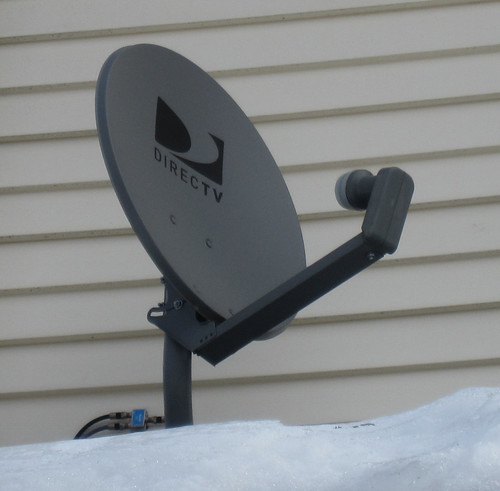
I had cable TV for many years, then switched to Dish Network for a few. Along comes HDTV and I went back to cable just so I could get MSG-HD (Let’s Go Rangers!). Dolan says forget you (check the Cee Lo Green song for proper pronunciation), so I get a deal on DirecTV bundled with Verizon Phone+DSL. Waiting for FiOS-TV, thought that would be a good idea. That’s not happening in my neighborhood, and DirecTV’s signal attenuation (rain fade) was driving me nuts, so back to DISH I west. Brilliant move as they’re now splitting the U.S. up into and East & West scheme: east coast capacity is at 61.5 West, and the west coast is using 129 West et. al. Better look angle for me and the signal is super — no loss at all and plenty of HD content. Price is right, too.
With the Captain America movie set to release this summer (Hollywood’s run out of ideas again), it was inevitable somebody would get to taking an old dish and making it into a shield, via Instructables contributor seamster…
I’m not really into comics and the like, but I had been wanting to make a Captain America shield for some time.
I originally tried using an old plastic sled, but it gave me all sorts of grief. The type of plastic would not take paint very well (not even Krylon Fusion for plastics), or any type of adhesive that I tried.
I eventually came across a used satellite dish, and with a little bit of modifying this turned out to the be best option for a Captain America shield. It will make a great gift for someone this year.
If you are interested in making one of these, you may have to do a bit of searching and asking to find a used satellite dish. I’ve seen them show up at thrift stores from time to time. Keep your eyes open, and you should be able to find one.
That may or not have been Karen Murphy’s sentiment when she balked at paying B-Sky-B that much to show English soccer matches in her pub in Southern England, The Red White & Blue. You’d have to sell a lot of draught beer & ale to make ends meet, mate.
So she did what many Europeans do: get a satellite receiver from another country and watch their channel for the content you want. It’s true some go further and pay a one-time purchase and get a black-market decoder card and watch thousands of channels, FTA and premium, for nothing, forever (or until they change their encryption). I’ve seen it myself; happens all the time.
She gets a satellite receiver from Greece, points her antenna at Eutelsat’s Hotbird location (13° East) and that’s where she found Nova Sports, the channel with Premier League broadcast rights in Greece. Good move as the signal’s pretty hot in Southern England. B-Sky-B and the Premier League got pretty hot themselves and she was fined quite a few quid. She decides to take them to court — in Luxembourg.
Not exactly a Luxembourgish court, rather the European Court of Justice, which happens to be located there. Who else is based there? Why, ironically, it’s SES S.A., owners of the ASTRA Satellite System and arch rival to Eutelsat. Oh, and you should know, they also became as successful as they are today thanks to B-Sky-B, the anchor tenant on the 28.2 East orbital location. You’ll also recall B-Sky-B owes their success to gaining the exclusive rights to Premier League broadcasts in the U.K.
The legal opinion, prepared by a senior ECJ figure known as an Advocate General, is submitted in advance of a court ruling that usually follows several months later. The ruling will serve as a guideline for how European law should be applied to the case.
The announcement Thursday could have big implications for BSkyB, which has become Britain’s biggest pay-TV operator by owning the exclusive rights to show live Premier League matches in the U.K.
"In the view of Advocate General [Juliane] Kokott, territorial exclusivity agreements relating to the transmission of football matches are contrary to European Union law," the ECJ said in a statement.
"European Union law does not make it possible to prohibit the live transmission of premier league matches in pubs by means of foreign decoder cards."
Orbital Sciences signs systems integration and test contract with Thales Alenia Space, prime contractor for Iridium NEXT. [SatNews – 01/28/2011]
Avanti wins two new contracts to further develop and demonstrate technology to deliver fideo to the edge of terrestrial networks using its HYLAS 1 satellite. [SatNews – 01/28/2011]
Boeing successfully conducts first over-the-air ground test of Ka-band satellite communications phased-array antenna system for enabling wideband SATCOM on aircraft. [SatNews – 01/28/2011]
Russian unmanned cargo spacecraft lifts off, bound for international space station. [SatNews – 01/28/2011]
DigitalGlobe collaborates with Satellite Sentinel Project to deliver first images of evolving situation in Sudan following historic vote on independence. [SatNews – 01/28/2011]
Ziplink announces that OmniGlobe has deployed its advanced optimization technology to reduce bandwidth requirements while improving customer’s satellite broadband performance. [SatNews – 01/28/2011]
MSCI’s announcement of 78+ satellite constellation "COMMStellation" of 12Gb per satellite for global broadband reminiscent of ambitious LEO plans of the past – is the plan justified by the numbers? [NSR – 01/27/2011]
LightSquared ambitious plan for nationwide terrestrial/satellite LTE mobile network gets] boost with FCC decision to allow use of handsets that are not satellite-capable. [The Register – 07/27/2011]
ViaSat is awarded first Defense Security Service Award of Excellence in Counterintelligence. [SatNews – 01/27/2011]
Japanese unmanned robot cargo ship arrives at international space station. [Space.com – 01/27/2011]
International Datacasting receives contract from Canadian Department of National Defence for continued operation of Canadian Forces Radio and Television. [SatNews – 01/27/2011]
Russian astronomers predict slim possibility of Earth strike by asteroid Apophis on April 13, 2036. [SatNews – 010/27/2011]
Tesacom receives Iridium certification for maritime satellite communication and tracking system. [PR Newswire – 07/27/2011]
Orange Business Services to provide and manage a VSAT satellite system developed for marine communications for the diving support vessels of Crest Subsea. [Satellite Spotlight – 07/27/2011]
Air Force awards Raytheon and Lockheed Martin contracts to provide designs for new "Space Fence" radar system that can detect much smaller satellites and debris than present system. [Information Week – 07/27/2011]
KVH promotion offers free small screen HDTV to boat owners purchasing certain marine satellite HDTV systems. [SatNews – 01/27/2011]
Russian space experts point to gross underfunding of space programs and advocate teaming up with India and Kazakhstan. [SatNews – 01/27/2011]
US Air Force Academy’s FalconSAT-3 satellite provides unique joint service with United States Military Academy at West Point, New York. [SatNews – 01/26/2011]
Blue Sky Network introduces HawkEye 5300, a dual-mode asset tracking device using both GSM and Iridium satellites for 100% global coverage. [Trucking Info – 01/26/2011]
TVN signs with Teracom to supply headend technology for Sweden’s roll-out of DVB-T2 scheduled for the end of 2012. [Satellite Today – 01/26/2011]
ITT announces successful completion of environmental tests of the next-gen weather satellite instrument for the GOES-R program. [SatNews – 01/26/2011]
Shaanxi Broadcast & TV Network Intermediary Company begins trials of Irdeto’s Cloaked CA, a conditional access system to be part of transitioning two million subscribers from analog to digital services. [SatNews – 01/26/2011]
SES WORLD SKIES announces order from Artel under U.S. FCSA program to provide C-band capacity in support of government initiatives. [Business Wire – 01/26/2011]
Economics of Earth Observation market distorted by reliance on a few large users – government and military organizations. [NSR – 01/25/2011]
New MST-100M man-pack satellite terminal from Agile Communications features fully motorized platform with auto-acquisition. [EON – 01/25/2011]
LightSquared CEO Sanjiv Ahuja attempts to reassure authorities that modification of its license to allow terrestrial as well as satellite offerings will not interfere with GPS services. [telecoms – 01/25/2011]
Orbit wins US follow-on order worth $7.2m to install dozens of its OrSat Ku-band systems on the undisclosed customer’s fleet of ships. [Globes – 01/25/2011]
NASA announces contest for best images of currently orbiting NanoSail-D solar sail. [SatNews – 01/25/2011]
Lockheed Martin plans to increase affordability and efficiency of space system development with new advanced technology and virtual simulation facility, Collaborative Human Immersive Laboratory. [SatNews – 01/25/2011]
Broadpoint signs new contracts with global shipping company V.Ships Offshore to provide Ku- and C-band services for the company’s worldwide operations. [SatNews – 01/25/2011]
Non-profit Space Data Association announces offering of conjunction assessment processing to a majority of all operational geosynchronous satellites. [Satellite Spotlight – 01/24/2011]
Airborne is awarded contracts for solar array panels for first 14 satellites of the Galileo program. [SatNews – 01/24/2011]
Surrey Satellite Technology Limited to conduct an experiment, launching a smartphone into orbit to see what it is capable of. [Satellite Spotlight – 01/24/2011]
Hughes Communications dominant stakeholder Apollo appoints Barclays Capital to begin sales process. [Fierce Telecom – 01/22/2011]
Global Navigation Satellite System industry faces challenges in using multiple systems interchangeably as number of satellites is projected to far exceed the "optimal intersection" of 70 postulated by head of Galileo Operations and Evolution department of ESA. [Inside GNSS – January/February 2011]
The vision that was IP-PRIME is now being preached by none other than Cisco. Is it real or just a dream at CES? Everything you want in video and communications. Delivered everywhere, any time.
What the Internet did to the telephone? Dude.
The details…
For consumers, Videoscape delivers:
Immersive experiences. Access to vast entertainment content sources, including broadcast channels, pay TV and the Web, integrating the Internet, social media, communications and mobility. The result is an experience that offers:
Ease of use. Videoscape provides easier access from multiple devices to content from multiple sources.
More entertainment possibilities on-screen, as content is delivered from a greater range of sources, including broadcast channels, on-demand TV, DVR and the Web.
More social and interactive features that integrate popular social networking websites and Cisco Telepresence video conferencing technology to allow you to show, share and engage with others through the TV.
More choices for content on the go, enabling consumers to take their TV experiences with them, viewing multiple forms of content over a wide range of mobile devices and smart phones.
Cisco quality-of-experience. Videoscape has network intelligence built in to enhance Internet video on the TV and to deliver the premium quality necessary for a higher-resolution experience instead of "best-effort" quality.
For service providers, Videoscape offers:
Expanded business models. Videoscape differentiates service provider video offerings from the competition and extends service opportunities for revenue generation. New models could include capabilities such as application delivery, home Telepresence, in-video e-commerce and more.
Extended service reach. Videoscape enables service providers to monetize activities outside their own network or traditional device footprints. For example, a service provider can offer a branded and personalized experience to its customers, regardless of their location or method of accessing content.
Enhance Internet video? Forget it, Mr. Phelps. That’s just impossible.
IP-PRIME was killed by SES two years ago. Was that a smart move or not? Talk to the people out in the field and they think it could have worked. It was a solid technological solution to many video service providers in "the fly-over states." So you think the other remaining big IPTV enablers are making their "bucket lists" these days? Not quite.
Avail-TVN recently announced a deal with Verizon FiOS TV, so their wholesale model has gotten stronger over the last couple of years. As for FiOS TV, they apparently have stopped their fiber build-out altogether, focusing instead on turning up service for their current market of homes-passed. That doesn’t include neighborhood, unfortunately. No problem: I dumped DirecTV for DISH Network and I love the new offering from the 61.5 West orbital location.
So what’s FiOS TV up to? How will they expand? The likely answer is wireless. Not on their current CDMA network, but rather on the new LTE service, being turned up on Sunday. As it won’t be for phone traffic, figure it will eventually carry IPTV. Considering the Seattle market is expected to benefit from a 16 Mbps throughput, that’s just about perfect for HDTV channels (MPEG-4 H.264). Hey, they’re switched at the C.O., so why not? Customers don’t care whether it’s satcom, coax, fiber or wireless — as long as the signal comes through in HD, they’re good to go.
Perhaps Verizon has it right in stopping fiber builds and focusing instead on using LTE for video services. Hey, if DISH Network can stream live TV to iPads today, the future can surely rely on wireless.
Spacecraft re-entry over the South Pacific? Sorry, that won’t happen any time soon. Eutelsat’s W3B spacecraft, launched on 28 October 2010, developed a huge propellant leak and was rendered useless soon thereafter. Instead of a planning scuttling into the South Pacific Ocean, that Spacebus 4000C3 will be in orbit for decades. Via Space News…
The Eutelsat W3B satellite declared a total loss less than 24 hours after its Oct. 28 launch because of a leak in its propulsion system will spend the next 20 to 30 years in its parking orbit following ground teams’ inability to guide it into a controlled atmospheric re-entry, satellite manufacturer Thales Alenia Space said Nov. 5.
The company said that it has rendered the satellite inert to the extent possible — emptying its helium pressurization tank and whatever fuel remains in liquid state and can be discharged, as well as draining its batteries — to minimize the likelihood that W3B explodes on contact with any orbital debris it may encounter in its elliptical orbit.
Too bad they couldn’t ram it into Galaxy 15, the world’s favorite zombie satellite.
But seriously, this is a real bummer for all the people who worked on this mission for years at Eutelsat, Ariane and Thales. I remember Astra 1K and it was depressing. Reminds us that this rocket science business is very complex and carries high risks across the board.
I was saddened to hear of Dean’s passing the other day. He accomplished much for the satellite business in the U.S. and he did alot for me as a marketing person.
SES reaches two major milestones that are hugely significant for the long-term growth and success of SES. SES AMERICOM signs a multi-year agreement, leasing long-term satellite capacity to EchoStar’s DISH Network, creating a strategic partnership that links North America’s largest satellite operator with the U.S.’s largets DTH network. EchoStar would eventually lease up to three entire satellites in the AMERICOM fleet.
He did the deal to buy Americom from GE Capital, becoming its CEO. I met him as the deal was announced in Washington and found him to be articulate, technologically-brilliant and well-grounded.
He hired some really good people, raising Americom’s performance to a level that, some would argue, embarrased senior managers in Luxembourg. Here’s what started it all…
Dean Olmstead, President and CEO of SES AMERICOM, speaking today at the Satellite Entertainment 2002 conference in Monterey, California, said: "These television services will be provided via a new satellite that we intend to launch into the 105.5° West Longitude orbital slot. Another new SES AMERICOM satellite, at the adjacent 105° W.L. slot, will enable us to provide high-speed broadband connections to U.S. residences. All of these services — TV and broadband — will be available to U.S. consumers who purchase a single, small satellite dish and related equipment, into which the latest twoway digital technologies will have been incorporated."
SES AMERICOM intends to offer the new platform, named AMERICOM2Home®, using a license granted to its affiliate by the Government of Gibraltar, relating to an orbital location over the United States at 105.5¼ W.L. This slot falls directly between orbital positions used by DirecTV and EchoStar at 101¼ and 110¼, respectively. Both AMERICOM2Home® and the existing satellites use frequencies in the 12.2-12.7 GHz range, which is set aside internationally for direct broadcasting to the home. SES AMERICOM also holds FCC licenses for both Ku-band and Ka-band satellites at the 105¼ W.L. location. Olmstead explained that the new AMERICOM2Home® system will be different from the current satellite television services offered by EchoStar and DirecTV. Unlike these providers, SES AMERICOM itself will not offer any retail services to consumers. Instead, Olmstead explained, "We will create a best-in-class DBS satellite platform, on which we expect a wide variety of content providers — large and small, established and start-up, mass market and niche, advertisingsupported and pay-per-view – will lease capacity in order to offer their programs and interactive entertainment directly to American consumers."
It was one of Americon’s "master plans," to build spacecraft and fully lease them to DTH operators using new spectrum filed via the ITU over the U.S. How did Dean sell it? He ran into Charlie Ergen in the hallway at a Sky Forum event at The Grand Hyatt in New York. "Hey Charlie: we gotta talk," said Dean. To which Charlie replied "yeah, we do." That exchange really got the ball rolling — and I eventually got to meet Charlie when he visited New Jersey.
Thanks, to Dean, we developed and executed the Americom2Home, WorldSat, and HD-PRIME branding campaigns, most of which resulted in major long-term contracts.
I was looking forward to seeing EchoStar’s FSS business succeed against SES, ironically using their leased capacity for occasional use, IPTV, et. al.