Archive for the ‘Observation’ Category

Get The Shovel Ready

Monday, March 16th, 2009


I don’t know whether this new service announced by CTC and AlphaStar is a project that’s as "shovel ready" as the economic stimulus package requires — or whether we should get the shovel out to bury it.

Here’s the pitch:

AlphaStar International, Inc. and Computers & Tele-Comm, Inc., (CTC) announced today a unique joint venture to provide very high speed WiMAX 4G services for any area anywhere across the entire USA. According to CTC President, Graeme Gibson, "The Digital Divide just got smaller. Today with this announcement, rural areas with no access to broadband fiber finally have a solution to getting connected at 4G speeds. Our mutually developed hybrid model takes advantage of the AlphaStar Teleport, a facility originally built by the U.S. government as part of President Reagan’s Star Wars initiative. AlphaStar (tour) can track any area of the USA including Hawaii and US territories to deliver true 4G speeds. Costs are contained by using the satellite primarily for the backhaul of Internet bandwidth." Bandwidth is then relayed by ground based WiMAX transmitters although the system can also serve to supply Metro WiFi systems or be used for mobile and maritime applications as well as Disaster Recovery and homeland security purposes. Low cost radios can be used rather than a two-way satellite receiver at customer locations. The Teleport can also deliver video and audio streaming. By caching the AV streams and large portions of the internet locally at the WiMAX transmitter performance is dramatically improved at affordable cost.

Great idea and I hope the pricing is right, but I’ve got my doubts. AlphaStar uses AMC-6 (according to their less-than-ideal Web site), which does not cover Alaska and Hawaii. Perhaps my old friends at Americom can persuade them to use AMC-21, which does cover all 50 states (and the Caribbean, which is a bonus).

Excellent combination of technologies for rural broadband and I hope it works out for them.


Bella Lancio di Razzi

Monday, October 27th, 2008


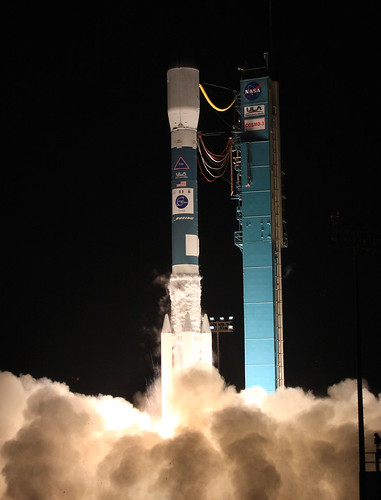
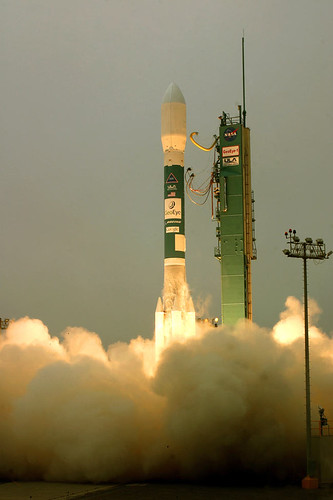
Yes, the Delta rocket is still working. This time for the Italian COSMO/SKYMED-3 and the United Launch Alliance:

A United Launch Alliance Delta II rocket, on behalf of Boeing Launch Services, successfully launched the third Italian-built Constellation of Small Satellites for Mediterranean Basin Observation or COSMO-SkyMed 3 satellite at 7:28 p.m., October 24. ULA successfully launched the first two Cosmo satellites on Delta II vehicles June 7, 2007 and Dec. 8, 2007.

"ULA is pleased to have successfully launched the third of four critical Earth observation systems in this series for Boeing and Thales Alenia Space," said Jim Sponnick, ULA vice president, Delta Product Line. "With this 43rd successful commercial launch, the Delta II system continues its record of mission success, which is unparalleled in the U.S. space industry. This achievement is due to the hard work of our professional engineers and technicians along with the tremendous support we receive from our government, industry, and supplier mission partners. We look forward to many more Delta II launches in the years ahead."

Blasting off from Space Launch Complex 2, it marked the fifth successful Delta II vehicle launch procured by The Boeing Company through its commercial launch business. The ULA Delta II 7420-10 configuration vehicle featured an ULA first stage booster powered by a Pratt & Whitney Rocketdyne RS-27A main engine and four Alliant Techsystems (ATK) strap-on solid rocket boosters. An Aerojet AJ10-118K engine powered the second stage. The payload was encased by a 10-foot-diameter composite payload fairing.

ULA began processing the Delta II launch vehicle in Decatur, Ala., nearly two years ago. In February, the 1st stage arrived from Decatur followed by the 2nd stage in August. The vehicle was erected on its stand at the pad Sept. 16, with solid rocket booster installation completed Sept. 19. Hundreds of ULA technicians, engineers, and management worked to prepare the vehicle for the COSMO-3 mission.

Developed by Thales Alenia Space, Italia for the Italian Space Agency and the Italian Ministry of Defense, COSMO-3 is the third of the four COSMO-SkyMed satellites. Each satellite is equipped with a high-resolution Synthetic Aperture Radar operating in X-band and is one of a constellation of four radar satellites. The overall objective of the program is global Earth observation and relevant data responding to the needs of the military and scientific community, as well as to the public demand for environmental control.

Here’s a nice video:


And here’s one shot on-site, from a distance:


WorldSpace Ch. 11

Wednesday, October 22nd, 2008

No, we’re not talking about WorldSpace channel 11 ("Radio Voyager") here. We’re talking about Case Number 08-12412, the Chapter 11 bankruptcy filing by WorldSpace, the pioneering satellite radio service available in Africa and Asia. The board of directors voted unanimously to file for it.


In the U.S., we’ve all heard about Sirius XM Radio and their 18 million subscribers. Turns out WorldSpace has yet to break a million, according to the Wall Street Journal report:

The company, which broadcasts its satellite radio services to more than 170,000 paid subscribers in 10 countries throughout Europe, Africa and Asia, sought Chapter 11 protection in the U.S Bankruptcy Court in Wilmington, Del. It listed assets of $307.4 million and liabilities of $2.12 billion.

The bulk of that debt, some $1.8 billion, is a contingent obligation under a royalty deal if the company’s pretax earnings reach a certain level, according to company spokeswoman Judith Pryor.

In court papers, Chief Executive Noah A. Samara said the company was forced to file for bankruptcy after seeking four forbearance agreements with its noteholders since June.

In addition, WorldSpace has failed to pay some of its workers for two months, causing "significant employee attrition," Mr. Samara said. The company owes 50 "critical employees" $1.35 million in back pay.

"As a result of WorldSpace’s growing concern regarding its inability to make timely payments to critical employees and other essential creditors, WorldSpace determined that it is in its best interests and the best interests of its subsidiaries and stakeholders to file these chapter 11 proceedings," said Mr. Samara, one of the key figures in the early stages of XM Satellite Radio Holdings Inc.

The company, which intends to sell off its assets or recapitalize the business, is seeking court approval of a $13 million bankruptcy loan provided by a group of hedge funds to continue operating while under bankruptcy-court protection.

Worldspace was founded in 1990 with the intent to provide satellite radio services to the emerging markets of Asia and Africa. The company has two satellites currently in orbit and a third in storage.

Among the WorldSpace’s so called first-day motions the company is asking to secure the bankruptcy loan and use some of that funding to pay its employees. The company is also seeking the continued use of its bank accounts.

Without the bankruptcy financing, the remaining critical employees will likely depart, which would "impair" WorldSpace’s ability to operate the satellites and continue as a going concern, Samara said.

Yenura Pte. Ltd., a Singapore-based company controlled by Mr. Samara, is WorldSpace’s largest unsecured creditor, owed $55.2 million. Number 2 is Micronas GmbH, owed $18.2 million, and Fraunhofer Institute for Integrated Circuits, owed $4.4 million.

Mr. Samara is the largest shareholder of the Silver Spring, Md. company, owning 47.15% of the firm. Aletheia Research & Management Inc., owning 37% percent, and Natixis Asset Management Advisor LP, owning 5.25%, are the other major shareholders of WorldSpace.


170,000 subscribers? And they’ve paid to build and launch two satellites? AfriStar launch in 1998, so I’m wondering how they could have kept going for the last ten years on so few paying subscribers.  Probably the dedication of Noah Samara, their CEO and founder. His speech before the African Development Forum in 1999 tells you something about what moved him (it’s so good I need to present it all):

The urgent imperative of our time and of this continent is the creation of an affluent African Information Society. I will speak to this need today. And I will be brief.

Over the past 15 years, we have seen the industrialized world shift its focus from connecting people to connecting nodes of information which people can universally access, share and grow. Focus on convergence technologies has brought unprecedented benefit and wealth resulting from net media or, if you will, information affluence.

In contrast, the developing world has focused on teledensity and lines per 1000 in its quest for universal access. The focus has been universal access to telephony and not to the electronic consciousness of mankind, more popularly known as the Internet. Accordingly, the progress in teledensity has not yielded the corresponding benefits and wealth which information affluence has created for the industrialized world.

Indeed, the information gap between nations is going through a quantum leap. It is volatile and threatens to explode into an irreparable gulf between rich and poor nations.

Developing efficient and effective ways to create information-affluent societies is the need for every need. I have pursued this vision with a sense of purpose and urgency; it animates my being and instructs my energies. Information affluence is, in my humble opinion, the sine-qua-non to development. Have it and wealth and development will follow. Without it, our attempt to alleviate poverty, bring health, wealth and education – indeed our attempt to create a sustainable, compassionate, civilization will be without success.

Information is the predicate to everything we know. It is ubiquitous. It is the building block behind the human DNA, the chair you are sitting on, the building you are in, the car you drive.

Look behind the wealth of nations and of individuals and — again — you will find information. Information about processes, techniques and organizations.

Look behind the poverty of individuals and nations and you will find ignorance.

The state of global information is the best allegory for the state of our planet. The gap between poor and rich has been made starker, not better, by the power of information and communications technologies.

While these technologies have liberated lives, created stock market miracles and improved economies, they have only touched a fraction of the world’s population.

An abyss is in the process of formation.

Nearly 2.5 billion people have never made a phone call; yet Manhattan alone has more phones than all those combined in sub-Saharan Africa. While there is a radio station for every thirty thousand people in most OECD countries, on average there is one radio station for every two million people in most of the developing world. There are more Internet hosts in Estonia than all of sub-Saharan Africa. The hardware disparity between poor and rich nations is not nearly as troubling as the scarcity of information which directly undermines the ability of a nation to not only keep its citizens informed and educated, but to simply keep them alive. 11 million people will die of AIDS this year in Sub-Saharan Africa. 40 million children will be orphaned. Either one of those numbers, by any definition, represents the population of an entire country. This is horror we do not really comprehend.

Asked about concerns he might have at the loss of thousands of citizens, Stalin is said to have once remarked that a single death is a tragedy; but a million a mere statistic.

Stalin was a bad man. We all agree he was ruthless, unmoved by human suffering. But does his comment reflect on him or is his an insight about all of us?

Consider the story of Yaguine Koita and Fode Tounkara – two boys from Guinea, ages 14 and 15. Eight weeks ago they tried to escape the turmoil and poverty of their homeland by sneaking on board the landing gear of a Sabena airliner. They died somewhere between Conakry and Brussels in the unpressurized compartment where the temperature at that altitude is 55 degrees below zero.

A letter they were carrying in their clothing read:

"Help us. We suffer a lot in Africa. We have no rights as children. We have no food. We have war and illness. We have schools but lack education. We want to study so we can be like you, in Africa. "

Their story was carried in every newspaper throughout Europe. It even made the Washington Post where I read about it.

A single death is a tragedy. Eleven million people will die this year from AIDS alone in Africa. How many thousand people do you think died in the few minutes I’ve been standing before you? Does it matter? It is after all a statistic!

But Yaguine and Fode’s death – that is eloquent. To me it is more than poignant.

You see, I was born in Africa and left when I was 17, like Yaguine and Fode, in search of education. I did so weeks before a revolution, a period of terror, in Ethiopia killed many of my close friends.

But for the Grace of God, I could have gone the way of my friends.

Instead, I stand before this august assembly of distinction and achievement to speak on the urgency of creating information affluence for the dispossessed. What can I tell you that the death of Yaguine and Fode has not already conveyed? This is an imperative we must address. It is the same imperative that led me to founding WorldSpace fewer than 10 years ago.

The vision of founding WorldSpace was partly driven by a desire to stem the spread of AIDS in Africa. I felt that an efficient, cost effective system could be developed to deliver a variety of information across a whole continent, clearly and consistently. After sketching this idea, literally, on the back of a napkin, I went to my wife to tell her I was quitting my job as an up and coming legal and business advisor in the communications and satellite industry. "Right, Like hell you will" she said.

I said, no, no, no, no; this is important. I want to launch a satellite over Africa," I told her. She obviously thought I was crazy.

So in the hope of getting her consent, I told her this would be a piece of cake — easy and straightforward. You see all you have to do is:

  • Start a company
  • Apply for licenses
  • Raise capital
  • Get 130 countries to allocate frequencies
  • Get great engineers to design the system
  • Get great companies to build/launch the system
  • Get more companies to make/distribute millions of receivers

Needless to say, it took longer than I thought and it cost more than I thought. But we did start the company; got licenses; got 130 countries to allocate the choicest part of the radio spectrum globally for the service; and raised the money needed to build and launch the system. Starting this month, world brand manufacturers are distributing the receivers throughout Africa.

This is the first satellite ever launched specifically to cover Africa — something I am particularly proud of. The service is also the first of its kind and is being introduced in Africa two years before it gets to America.

The second satellite will be launched in a few months over Asia; soon after a third will cover Latin America in the largest footprint for a direct broadcast service ever created by a single company.

Simply stated, these satellites will broadcast 60 plus channels or radio stations directly to a new generation of receivers. No satellite dish is necessary; just a simple antenna on the receiver.

The receivers can also be connected to a computer to deliver a full-blown, internet-like multimedia content. This is important because the growth of internet-capable PC’s in the developing world is outstripping the capacity of the telephone infrastructure. The WorldSpace system can deliver gigabytes of information to computers without the need of a phone, direct via the receiver.

The service will carry music, information and entertainment. And we are dedicating capacity to carry content addressing women’s issues, environmental initiatives, health advisories and distance education. The system’s data delivery capability can be used to :

  • broadcast the entire school curriculum of a whole nation or an entire continent;
  • reach health professionals on a regular basis with information on pandemics, epidemics and share experiences of successes and failures;
  • telecommute agriculture extension programs;
  • reach women with solutions that address their needs in family planing or entrepreneurial training;
  • reach societies at large to think creatively about their environment and its input on the delicate balance of our planet; and
  • help the youth to reach their counterparts with initiatives, with their dreams.

We believe information is the key to change stark realities that are facing the peoples of the developing world.

WorldSpace is a business with a mission: namely, to create an infrastructure that will provide hundreds of millions of people with access to information. WorldSpace realizes there are 20 million households across Africa that are able to afford and utilize its system for a fee here and a fee there that soon adds up to real money.

But we cannot and will not be oblivious to the fact that more than 350 million people on this continent will not be able to access any information unless we do something about it.

At the end of the day, life is somewhat digital. You have either done something, or you have not. The word trying is a euphemism. In the harsh reality of existence the gray dissipates into a stark relief of black and white. I will not belabor the struggle, the lonliness, the humiliation and the failures we faced at WorldSpace throughout this decade-long journey.

But I can unequivocally tell you that I never doubted – even for an instant – that Africa had to have, indeed deserved, an infrastructure specifically tailored to meet its needs.

In the Book of Ecclesiastes it is written that "The race is not to the swift, nor the battle to the strong, neither yet bread to the wise, nor yet riches to men of understanding." In the end life and what we make of it comes down to human will.

It is in our power to bring information affluence to Africa. It is in our hands to make it happen.

Consider the following proposal: Every constituency in this august hall decides to work on a single initiative and this is the initiative: We put 5 million internet terminals in 5 million villages and neighborhoods in 5 fast-paced years. These terminals will have the capacity to deliver primary-to-college education; teach women to become bread-winners for their homes; teach health professionals how to address the pressing health needs in their areas. Maybe the system might even engender understanding between the variagated peoples of this, our beloved continent. It can be done if we want it so badly that we decide to work tenaciously and with a singularity of purpose.

We are doing just that at WorldSpace. We have embarked on a study with the Ethiopian Media Agency to put receivers in every school and attach these receivers to computers and printers. In addition to delivering the curriculum for each school, the units would address the needs of the other constituencies attached to the schools: like women, health professionals, farmers etc…. Each such unit may thus touch the lives of over 200 people — improving their physical well-being, their mental capabilities and their spiritual lives. We are interested in carrying this initiative to other countries in Africa. I once read that Mother Teresa said, "God doesn’t require us to succeed; He only requires that we try." You know she is right. Because in his boundless mercy, the God of big and small things sees into our hearts and souls and judges us by our intent as well as our actions.

History, by contrast, has no compassion whatsoever. Our attempts, and our intent mean nothing to history. Our well-intentioned efforts will not even earn us a footnote.

I am here to speak for industry at this august opening ceremony. Instead, permit me to speak to industry, to governments and to civil society. My message is simple: creating social and economic development in Africa is not about me and it’s not about you. It’s about getting it done. The Prime Minister hit it on the nail at our opening ceremony: by providing for the future of the dispossessed, we will secure our own and that of our families.

Our technology is digital and so is our task. It’s zero or one; we are either on or off; we have gotten it done or we have not.

Here’s what we might see if we get it done, however. Yaguine and Fode’s death will not happen in the next millennium. They would not have to leave their home in search of education. They would find it in the comfort of their village or their homes.

Why can’t we all come together on an initiative that would put us much closer in saying Yaguine and Fode will not die in the next millennium?

We should agree to act, believing that we have a lot more power to effect change, both individually and collectively. I for one have learned never to underestimate where a napkin, a handful of people and commitment can take you.

The great anthropologist Margaret Mead once said: Never doubt that a small group of thoughtful, committed people can change the world. Indeed, she says, "It is the only thing that ever has."

Rainer Maria Rilke said it differently, beautifully:

Again and again in history some special people wake up
They have no ground in the crowd
They move to broader laws
They carry strange customs with them, demand room
        for bold and audacious actions
The future speaks ruthlessly through them
They change the world!

Change, commitment, resolve all center around the courage that affirms our lives or ideas in spite of all that threatens our lives or ideas! True courage or conviction is neither an opinion nor deterred by one. Rather it is a state of being.

I have no fear to stand alone in my conviction that change towards a compassionate sustainable civilization is not only possible, but inevitable. But I know there is a group of us out there and in this room that are rooted in the conviction that the shortest road to our goal is the creation of an information-affluent African society. Together we will honor our ancestors by creating the greatest of patrimony for our progeny.

The question for you, your excellencies, ladies and gentlemen, is not whether the inevitable will happen; but whether your fingerprint will be among that small group of thoughtful, committed people who actually changed the world.

Just as moving today as it was nearly a decade ago. Let’s hope there’s some way this company can right itself and continue on with its noble mission. Maybe they’ll get some help from O3b Networks.
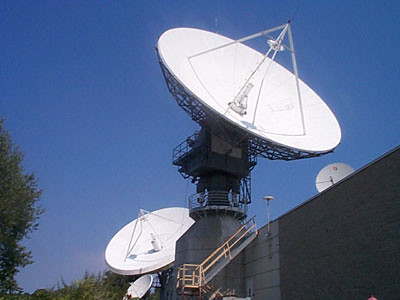
Ethan Zuckerman called him "…one of the most charming and inspiring men I’ve met in recent years" on his My Heart’s in Accra blog last June.

Gunter’s Space Page tells us more about the spacecraft they use, an Alcatel payload using an Astrium bus:

Broadcasters have access to the satellite, via either a small individual station, or a central hub station. Leading edge techniques are used to transmit the digital and compressed programmes to the satellite. The satellite will send these programs directly to the public. Each satellite carries an innovative payload that implement baseband processing – appearing for the first time in a commercial programme – and a more conventional and "transparent" payload.

The dual payload carried by WorIdSpace satellites has been designed by Alcatel Space at its Toulouse premises to supply the highest possible digital broadcasting performance and the highest level of reliability throughout the satellites lifetime. On board base-band processing Authorizes direct satellite access to a multitude of individual stations on one-third of the planet, without having to contribute to costly links towards an access “hub”. Thus, a small local station in Africa can broadcast throughout the continent. The conventional payload enables major radiobroadcasters to pool their resources and reduce operating costs.

The high L band power is achieved by a pair of 150 watt traveling wave tube amplifiers (TWTA) operating in parallel. The ability to set frequencies, in both reception and transmission, makes the System very flexible. In orbit antenna reconfiguration allows antenna coverage optimization and enables one satellite to replace another whenever necessary.


Bread & Satellites

Wednesday, October 15th, 2008

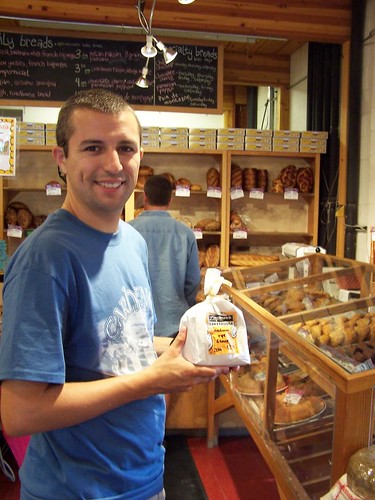
If you’ve spent some time in Ann Arbor, Michigan, you may have come across a Zingerman’s — a host of specialty foods delis, restaurants and related businesses. They’re known for having one of the best mail-order breads in the U.S.


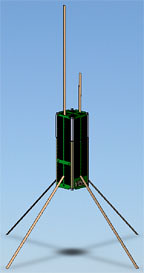
The University of Michigan’s Student Space Systems Fabrication Laboratory is working on a micro-satellite about the size of a loaf of bread. The story, via Space Daily, gives us more:

U.S. scientists say they are developing a satellite about the size of a loaf of bread that will be deployed to study space weather.

The National Science Foundation-funded project called Radio Explorer, or RAX, is being led by the University of Michigan and the SRI International Corp., a California independent research and technology development organization.

The satellite, called CubeSat, is to be the first free-flying spacecraft, and will be built, in part, by members of the university’s Student Space Systems Fabrication Laboratory.

CubeSats are approximately 4-inch cube-shaped devices that launch from inside a P-Pod — a special rocket attachment developed by California Polytechnic State University and Stanford University.

The RAX satellite will essentially be made of three CubeSats and will measure the energy flow in the Earth’s ionosphere, where solar radiation turns regular atoms into charged particles.

"This project will help us better understand space weather processes, how the Earth and sun interact and how this weather produces noise in space communication signals — noise that translates to lower quality telecommunications capabilities and error in GPS signals," said Assistant Professor James Cutler, a co-principal investigator with physicist Hasan Bahcivan of SRI.

The grants from the National Science Foundation, who use a less-imaginative "half gallon carton of milk" metaphor, hopes to develop more student interest in space, too:

The National Science Foundation (NSF) has awarded a grant to SRI International, an independent non-profit research and development organization based in Menlo Park, Calif., to carry out the first space weather CubeSat mission.

CubeSats are tiny satellites with dimensions of 10��10��10 centimeters, weighing about 1 kilogram, and typically using commercial off-the-shelf electronics components.

Developed through joint efforts, California Polytechnic State University and Stanford University introduced CubeSats to academia as a way for universities throughout the world to enter the realm of space science and exploration.

According to atmospheric scientists, CubeSats have the potential to be excellent platforms for technology development and small science missions, and promote student involvement in design, fabrication and flight missions.

"One of the goals is to help train future space scientists and aerospace engineers," said Therese Moretto Jorgensen, program director in NSF’s Division of Atmospheric Sciences. "CubeSats will also help answer questions in space weather such as the cause of disturbances in the ionosphere, and the rise and decay of the Earth’s radiation belts during geomagnetic storms."


SRI International’s team will include many, including support from NASA:

“SRI is excited about the NSF contract, and working in collaboration with the University of Michigan,” said Hasan Bahcivan, research physicist at SRI International. “This program provides a cost effective way to support space weather and atmospheric research. It is also well positioned to provide excellent training opportunities for students that hope to become engineers or scientists. We expect 20 to 30 students to take significant roles in the design, development, and science operations of the satellite.”

The project’s mission is designed to remotely explore small-scale ionization structures in the form of plasma turbulence that occurs in response to intense electrical currents in the space environment. The structures can adversely impact communication and navigation signals by perturbing the refractive index along the signal propagation paths. By utilizing signals from powerful transmitters on the ground and receiving the scattered signals in space, researchers are achieving effective and powerful space-based radar to probe these structures, which would be expensive to accomplish via a stand-alone satellite radar. 

"We have a multidisciplinary, cross-departmental team working on the project, that includes several engineers and faculty, and a large number of undergraduate and graduate students," said James Cutler, an assistant professor in the Aerospace Engineering Department at the University of Michigan. "My research laboratory will be partnering with several space-related classes and the Student Space Systems Fabrication Laboratory (S3FL) to build and fly RAX."   

The first launch opportunity for the NSF satellite program will be with the Department of Defense Space Test Program, and is scheduled for December 2009 aboard a Minotaur-4 launch vehicle out of Kodiak, Alaska. Commissioning and launch support for the mission will be provided by NASA Goddard Space Flight Center Wallops Flight Facility.

This is the kind of government support we need to develop the future of rocket science.


Looks Like Kutztown

Friday, October 10th, 2008


Copyright © 2008 GeoEye


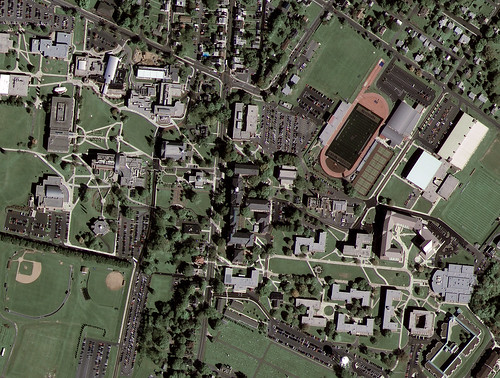
GeoEye-1’s first image released of Kutztown University in Pennsylvania:

GeoEye, Inc. (NASDAQ: GEOY), a premier provider of satellite, aerial and geospatial information, released today the first, color half-meter ground resolution image taken from its GeoEye-1 satellite. The satellite has been undergoing calibration and check-out since it was launched on Sept. 6 from Vandenberg Air Force Base in Calif. The Company will begin selling GeoEye-1 imagery products later this fall.

The Kutztown University image shows the campus, which includes academic buildings, parking lots, roads, athletic fields and the track-and-field facility. The image was collected at 12:00 p.m. EDT on Oct. 7, 2008 while GeoEye-1 was moving north to south in a 423-mile-high (681 km) orbit over the eastern seaboard of the U.S. at a speed of four-and-one-half miles per second. GeoEye-1 was built by General Dynamics Advanced Information Systems in Gilbert, Ariz. The imaging system was built by ITT in Rochester, NY.


Smile For The Satellite

Thursday, October 2nd, 2008

Chelyabinsk is one happy town. They’ve come a long way from being "the most contaminated spot on the planet."

Here’s an interesting story from Slashdot:

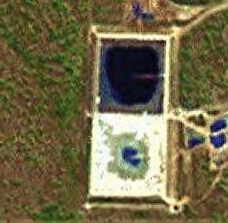
Citizens of the Russian town Chelyabinsk calculated when the satellite, QuickBird, which takes images for Google Earth and Google Maps, would cross above their city and used people to make a giant smiley face. A rock concert on the main square attracted many people and everyone got a yellow cape. It looks like someone at Google was quicker than usual to put up the new data. Maybe Google likes the idea of an entire town working hard to get its 15 minutes of fame. The article has a screenshot of Google Maps and images taken directly at the event."

They did pretty good:


This isn’t the first time that Google Earth or Google Maps has captured something interesting from space. Longtime readers of Really Rocket Science will recall the Ipod that fell to Earth, which we wrote about way back in March of 2006:


But there’s more to be seen than "Ipods" and smiley faces in the world of Google Earth. GoogleSightSeeing.com — whose tag line is "Why Bother Seeing the World for Real?" has a great series of blog posts on cool sights that you can see right from your computer desk. Be sure to check out this map of global points of interest.

Here’s a clip on Chelyabinsk:


Airborne Broadband Bacchanal

Wednesday, October 1st, 2008


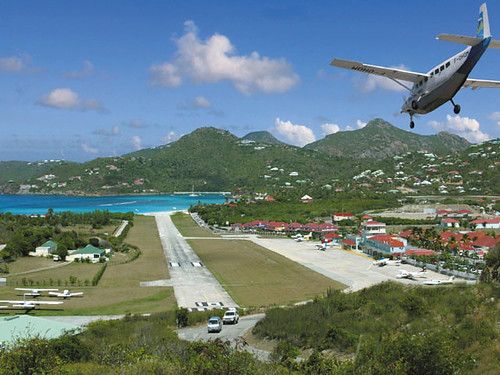
About a week after Labor Day, ARINC introduced new Caribbean coverage for SKYLink, an in-flight broadband service for business jets:

The new Caribbean coverage area means users of the SKYLink network will be able to fly from Europe to North America, across the Caribbean, and on to Central and South America, without losing access to important e-mail or Internet applications. To encourage customers to take part in the coverage tests, ARINC Direct suspended roaming charges in the new region through July 21, 2008. Customer feedback was used to adjust satellite coverage and to map signal strength across the region.

The new coverage includes the Bahamas, Jamaica, Cuba, Haiti, the Dominican Republic, Puerto Rico, the Lesser Antilles, Trinidad-Tobago; Belize, Guatemala, Honduras, El Salvador, Nicaragua, Costa Rica, Panama, Colombia, Ecuador, northern Peru, northern Bolivia, Venezuela, Guyana, and part of Surinam.

eXchange with service by SKYLink is the only communications system for business jets offering true broadband Internet speeds—as high as 3.5 Mbps to the aircraft. Customers have access to e-mail, corporate intranet (VPN), the Web, flat-rate Voice over IP (VoIP) global telephone service, and videoconferencing. eXchange also provides e-mail and data capability for personal Wi-Fi enabled smartphones in the cabin.


Really cool how Rockwell-Collins integrates it all:

Business travelers will experience real-time, two-way broadband connectivity with secure access to e-mail services, Internet browsing, access to Virtual Private Networks (VPN), and options for Voice over IP (VoIP) telephone service and videoconferencing. eXchange also enables data connectivity to select Wi-Fi enabled smartphones, such as RIM’s Blackberry models 8320 and 8820, providing travelers with access to e-mail and other smartphone data services.

Thanks to the AMC-21 satellite’s dedicated Caribbean Ku-band beam — and new mobile platform — local satcom Internet companies like Caribbetech and mobile services like KVH have new opportunities to pursue.

Pentagon’s BASIC Approved

Wednesday, September 17th, 2008

Via the AP:

 The Pentagon has approved plans to buy and launch two commercial-class imagery satellites to complement its classified constellation of spy satellites.

The Pentagon will also increase the amount of imagery purchased from private companies operating similar satellites already in the sky.

The decision last week caps months of wrangling between the Air Force, the National Reconnaissance Office, and the National Intelligence Directors Office and the Office of the Secretary of Defense over which agency would buy the satellites for about $1.7 billion. The satellites are to be launched around 2012. The NRO will head satellite acquisition, according to Pentagon documents obtained by The Associated Press.

But critics of the program say the Pentagon is spending billions to recreate and compete with private companies like GeoEye of Dulles, Va., and DigitalGlobe of Longmont, Colo., which are expected to put four new satellites into orbit by 2013. On its face the decision conflicts with the president’s national security space policy, which directs the government to buy as much commercial imagery as possible to help the companies withstand competition from subsidized foreign satellite companies.

Purchasing the imagery from the companies may also be less expensive. The GeoEye 1 satellite was launched on Sept. 6 for $502 million, including the satellite, launch, insurance and four ground stations, according to company spokesman Mark Brender. It is expected to begin taking 16-inch resolution imagery this weekend.

The Pentagon may decide to turn over operation of the new satellites to the private companies, the internal document notes.

The new satellites will comprise the Broad Area Space-Based Imagery Collection satellite system, or BASIC. They will also have 16-inch resolution. They could be used to spy on enemy troop movements, spot construction at suspected nuclear sites or alert commanders to militant training camps. Their still images would be pieced together with higher resolution secret satellites into one large mosaic.

The new satellite system is meant to bridge what intelligence agencies fear will become a gap caused by the cancellation in September 2005 of a major component of the Future Imagery Architecture system overseen by the National Reconnaissance Office. The primary contractor, The Boeing Co., headquartered in Chicago, ran into technical problems developing the satellite and spent nearly $10 billion, blowing its budget by $3 billion to $5 billion before the Pentagon pulled the plug, according to industry experts and government reports.

A single satellite can visit one spot on Earth once or twice every day. BASIC’s additional satellites will allow multiple passes over the same sites, alerting U.S. government users to potential trouble, humanitarian crises or natural disasters such as floods.


Maybe now we’ll be able to see license plates from space.


3 Billion New Internet Users on the Way?

Tuesday, September 9th, 2008

A start-up company, backed by some big names, is seeking to add 3 Billion new Internet users from poor, remote countries.

On Tuesday, O3b Networks Ltd., founded and run by 38-year-old telecommunications entrepreneur Greg Wyler, is expected to announce plans to launch as many as 16 satellites that could provide service to Africa, the Middle East and parts of Latin America by the end of 2010.

The undertaking, expected to cost about $650 million, has initial backing of about $60 million from investors that include HSBC Holdings PLC, Allen & Company, and Liberty Global Inc., in addition to Google.

Of course, the blogs are abuzz with the news that Google is launching 16 new satellites, especially after yesterday’s post about the GeoEye-1, but Google is only anteing up $20 million for the project.

The bigger news is about O3b, whose young CEO, Greg Wyler, has pulled together an impressive list of funders to tackle a very lofty goal.

This isn’t the first time that Wyler has launched an aggressive project to bring Internet access to the developing world. He also paired up with the Rwandan government in an effort to connect schools, government institutions and homes with low-cost, high-speed Internet service. The fate of that project contains some warnings for this venture. Rwandan officials say Wyler didn’t follow through on his promises:

Wyler says he sees things differently and that he and the Rwandan officials will probably never agree on why their joint venture has been so slow to get off the ground. But Terracom’s tale is more than a story about a business dispute in Rwanda. It is also emblematic of what can happen when good intentions run into the technical, political and business realities of Africa.

The technology behind the latest venture is a low-earth orbit system, built by Thales Alenia Space.

Side Note: O3b is headquartered in St. John, Jersey, Channel Islands. Never heard of it? Officially the "Bailiwick of Jersey”, it’s located in the English Channel, off the coast of France.

Google Maps is about to get even better

Monday, September 8th, 2008


The GeoEye-1 satellite – the world’s highest resolution, commercial Earth-imaging satellite – was launched on Saturday.

You’ll soon be able to check out the satellite’s images for yourself:

ars technica In return for undisclosed terms, Google got two considerations: its logo on the side of the launch vehicle, and exclusive use of the mapping images that the satellite produces.

The satellite maker, General Dynamics Advanced Information Systems, says the GeoEye-1 cost $500 Million to build and launch and its imaging services could be sold for anything from environmental mapping to agriculture and defense. Funding for the project came from commercial satellite company GeoEye and the Defense Department’s National Geospacial-Intelligence Agency