Archive for the ‘Satellites’ Category

The Kon-Tiki Sails Again!

Friday, April 21st, 2006

"Nearly 60 years after Thor Heyerdahl’s Pacific Ocean crossing aboard the balsa raft Kon-Tiki, a Norwegian team is in Peru putting final touches on a new vessel to repeat the journey," the AP reports.

The original Kon-Tiki in 1947.

"I think we are mentally prepared and we are really, really anxious to put this raft in the ocean," said Olav Heyerdahl, 28, the adventurer’s grandson and one of the six-member crew.

Behind him in a dry-dock in Lima’s port of Callao loomed the balsa raft Tangaroa — named for the Polynesian god of the ocean — which is scheduled to set sail April 28.

The expedition had been set for last year, but was postponed after key sponsors diverted funds to help victims of the 2004 Southeast Asian tsunami.

In 1947, Thor Heyerdahl and his team sailed their primitive raft 5,000 miles from Peru to Polynesia in 101 days to support Heyerdahl’s theory that the South Sea Islands were settled by ancient mariners from South America. Heyerdahl, who died in 2002 at age 87, documented his voyage in the best-selling book "Kon-Tiki" and in an Oscar-winning documentary film.

The adverturer’s 67-year-old son, Thor Heyerdahl Jr., came to Peru to see the new vessel and cheer on his own son. "I’m very happy for him that he gets this opportunity," he said.

The new 56-foot vessel is larger than the Kon-Tiki, with eight crossbeams lashed to 11 balsa logs from Ecuador and covered by a bamboo deck. Atop a hardwood cabin, the crew fitted a thatched-reed roof made by Aymara Indians.

The Kon-Tiki carried only the most basic equipment, even by 1947 standards. But the Tangaroa features abundant modern technology, including solar panels to generate electricity and satellite navigation and communications gear.

We’re not sure if the expedition has Internet access while adrift in the South Pacific, but it is possible if they contacted Connexion by Boeing, which uses SES-Americom’s AMC-23 satellite, which is the only satellite that they can use for Internet based on their route.

Consider that a modern factoid for an ancient journey. 


Good Job: Atlas V Rocket Launches ASTRA Satellite

Thursday, April 20th, 2006

This afternoon’s launch was a complete success.

Lift-off occurred at 4:27 p.m. EDT and initial contact with the satellite, called acquisition of signal, was confirmed at 5:43 p.m. EDT from a satellite tracking station in Uralla, Australia.

Atlas V launches from The Cape

Some really nice photos are on the SpaceFlightNow.com site. 

The video footage is impressive.

Atlas V Rocket to Launch ASTRA 1KR Today

Thursday, April 20th, 2006

ASTRA’s newest satellite will be launched into geosynchronous orbit and will become part of a system that provides television reception to 107 million households in Europe. Launch window opens at 4:27 p.m. EDT (20:27 GMT), and remains opens until 7:16 p.m. (23:16 GMT). Watch the launch live via webcast from launch complex 41 at the Cape Canaveral Air Force Station in Florida. Broadcast begins at 4:05 p.m. (20:05 GMT). Here’s how you can receive it directly via satellite:
 
In North America, AMC-4, transponder 17, C-band analog, 101 degrees West, downlink frequency 4040 MHz (vertical).

In Europe, on ASTRA, transponder 116 on ASTRA 1G at 19.2E with following reception parameters: downlink frequency: 12669.50 MHz / downlink polarization: vertical / transponder transmission rate: 22 MB/s QPSK FEC 5/6; Service name: ASTRA VISION 3

Test signals begin about 3:45 p.m. EDT (19:45 GMT).

If you are not able to watch it, then you can follow it via live text updates.

Space Junk

Wednesday, April 19th, 2006

No, I don’t mean the song by Devo. But there’s gonna be some more junk up there, do you need to get one of those hats the band used to wear back in the day, on the off chance that some of that junk finds it’s way back down here? Apparently the FCC ruled that U.S.-licensed satellites launched after March 22, 2002 have to go into disposal orbit when they’ve beamed down their last signal. The latest is the Spacenet 4 satellite, which was launched in 1985.

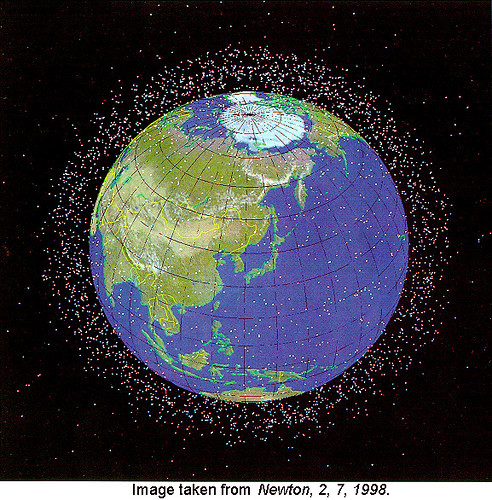
I’ve blogged about the satellite graveyard before, and apparently we’ve left a lot of stuff up there in the past 25 years or so; more than 9,000 man-made objects, which can break into little pieces and cause problems for current space missions. It looks something like this.

Space Junk

I’ve also blogged before about how stuff gets knocked around up there. And it’s not all that unusual for some of it to fall to earth. It can land in your garden, or even on you. Don’t believe me? Ask Devo

She was walking all alone
Down the street in the alley
Her name was sally
She never saw it
When she was hit by space junk

At least now we know why they wore these. 

Space Helmet

Either wear a helmet or practice catching the stuff

I’ll enjoy the latter for now. In the meantime can someone tell me, now that this stuff is up there what are the chances it’s gonna stay up there?

NASA Working on Antimatter Rocket for Missions to Mars

Monday, April 17th, 2006


Is science fiction destined to become just science

Most self-respecting starships in science fiction stories use antimatter as fuel for a good reason – it’s the most potent fuel known. While tons of chemical fuel are needed to propel a human mission to Mars, just tens of milligrams of antimatter will do (a milligram is about one-thousandth the weight of a piece of the original M&M candy)….

The NASA Institute for Advanced Concepts (NIAC) is funding a team of researchers working on a new design for an antimatter-powered spaceship that avoids this nasty side effect by producing gamma rays with much lower energy….

When antimatter meets matter, both annihilate in a flash of energy. This complete conversion to energy is what makes antimatter so powerful. Even the nuclear reactions that power atomic bombs come in a distant second, with only about three percent of their mass converted to energy.

Antimatter rockets have significant advantages over nuclear-powered spacecraft, including improved safety, efficiency and speed:

The Reference Mission spacecraft would take astronauts to Mars in about 180 days. "Our advanced designs, like the gas core and the ablative engine concepts, could take astronauts to Mars in half that time, and perhaps even in as little as 45 days," said Kirby Meyer, an engineer with Positronics Research on the study.

Advanced engines do this by running hot, which increases their efficiency or "specific impulse" (Isp). Isp is the "miles per gallon" of rocketry: the higher the Isp, the faster you can go before you use up your fuel supply. The best chemical rockets, like NASA’s Space Shuttle main engine, max out at around 450 seconds, which means a pound of fuel will produce a pound of thrust for 450 seconds. A nuclear or positron reactor can make over 900 seconds. The ablative engine, which slowly vaporizes itself to produce thrust, could go as high as 5,000 seconds.

Although one of the drawbacks to antimatter rockets is its high cost of development, we wonder if that can’t be mitigated by passing the hat around to the millions of science-fiction fans around the world, who have dreamed of anti-matter-powered rockers for years.

(Via Rawstory.) 


COSMIC Launch

Monday, April 17th, 2006

COSMIC— the Constellation Observing System for Meteorology, Ionosphere and Climate– was successfully launched from Vandenberg Air Force Base in California on Friday night. The AP reports:


Six weather satellites successfully reached orbit and were ready to begin their five-year mission to track hurricanes, monitor climate change and study space weather, it was announced Saturday.

"Ground stations have received signals from all six satellites," according to an update on the Web site for the project’s manager, University Corporation for Atmospheric Research in Boulder, Colo.

The satellites were launched on a rocket booster Friday evening from this Central Coast base. They were placed into orbit about 500 miles above Earth, where they separated to form a chain.

The satellites will take about 2,500 daily measurements by using global positioning receivers to track radio signals passing through the atmosphere, scientists said.

The information gathered will be used to enhance research and improve weather forecasting. Scientists hope the data will help them better track storms and monitor long-term climate change.

The COSMIC web page can be found here


Forecast: 200-mph Acid Winds

Friday, April 14th, 2006


The European Space Agency released their first images from the Venus Express mission, including our first view of the south pole.

Composite, false-colour view of Venus south pole captured by VIRTIS 12 April 2006 onboard Venus Express.

As reported by the AP’s Melissa Eddy in The Sun Herald (Biloxi, Miss.):

"We can see there is a swirl here that is similar to the one we know from the north pole," said Horst Uwe Keller, who leads the team operating the craft’s wide-angle camera – one of seven instruments aboard the Venus Express.  

Using infrared technology that allows the camera to peer though the clouds, scientists hope to be able to determine how the sulfuric acid that swathes the planet was formed, and pinpoint the cause of the high-speed winds that sends it swirling in massive clouds.


The ESA has some really cool images and 3-D videos on their site, too.


GPS Tracking for Parents

Thursday, April 13th, 2006

Before I had a kid of my own, I used to shake my head at parents who used "tethers," that looked like old fashioned telephone cords, to keep their toddlers from toddling off in public. Three years into parenthood, I haven’t succumbed to the "urge to tether" yet, but I’m a little less judgmental about the whole thing.

I have enough trouble keeping up with my three-year-old now. I’m already wondering how I’m going to keep up with him when he’s a teenager with enough subway fare to go where he wants. The answer is simple than I thought: GPS. If it can help find lost pets, it ought to work with kids too. So, though my little one isn’t big enough for a cell phone yet, I was relieved to read on Mobile Wireless News that Sprint just rolled a GPS-driven kid locator service for parents.

Using the Global Positioning System, the service allows parents to track up to four cell phones over the Internet or on their own wireless device. Parents can periodically ask the service to find the child’s phone, displaying the location on a road map.

Parents can also set alerts, automatically warning the parent if the child isn’t at a certain place, such as school or soccer practice, at a specific time.

The child’s phone also displays a text message, letting the child know they’ve been searched for and found.

Of course, there are other uses, like keeping track of elderly parents (as the article notes) or keeping tabs on a wandering spouse, which leads to charges that Big Brother is in the house.  I guess there’s two sides to every technology, and whether it’s used benevolently or not depends on whose pushing the buttons. But, as a parent, if kids can’t remember to be in the house when the streetlights come on, this seems like a pretty good way to remind them, when yelling down the street isn’t an option.

Satellite Launched at Sea

Thursday, April 13th, 2006

The word from the rocket scientists in Japan is good:
 

JSAT Corporation ("JSAT"; Head office: Chiyoda-ku, Tokyo; President and CEO: Kiyoshi Isozaki) is pleased to announce that today it has successfully launched JCSAT-9 communications satellite. JCSAT-9 lifted off at 08:30 a.m. (Japan Standard Time) from a launch platform at 154º West Longitude on the Equator (approximately 2,240km south of Hawaii on sea). After this launch, JCSAT-9 was also successfully separated from its launch vehicle.


Sea Launch, an international consortium of Ukrainian, Norwegian, Russian and U.S. companies, does a great job of describing the launch sequence. And an even better job of broadcasting it (watch the video presentation).

First Light For SETI Optical Telescope

Wednesday, April 12th, 2006

The Planetary Society and Harvard physicist Paul Horowitz pointed a giant telescope at the sky for the first time yesterday, beginning a systematic search for light signals from an alien civilization. Science A-Go-Go reports:

Housed beneath a retractable roof situated high atop a wooded ridge in Harvard, the telescope isn’t what most people would expect when they visualize a powerful optical telescope. But what may look like a mish-mash of metal bars and mirrors to the uninitiated represents a truly ambitious project that would make Planetary Society founders Bruce Murray, Carl Sagan, and Louis Friedman, Executive Director of the Planetary Society, extremely proud….

[T]he powerful 72-inch SETI optical telescope pointed its giant mirror at the sky for the first time on April 11, and began a systematic search for light signals from an alien civilization.

The telescope has some impressive computer muscle behind it, with the developers claiming that it can process the equivalent of all books in print in a second. Its optical detectors are cutting edge as well, with a sensitivity that can detect a billionth-of-a-second flash of light. The formidable technology driving it should allow the new telescope to scan the entire northern hemisphere sky over the course of a year.

The Planetary Society says that the observatory represents the biggest SETI project it has ever sponsored… [D]espite many years of scanning the skies for radio signals, there has been little in the way of any definitive ET activity, hence the Society’s interest in the visible spectrum. "We have been listening for alien signals for decades," said Friedman, "it’s time we started to watch for signals as well."

It is now common among SETI advocates to argue that alien civilizations are just as likely to communicate with light signals as they are with radio waves, and not without good reason, as there are a number of advantages to using light as a form of interstellar communication. Unlike radio waves, a laser-like beam suffers little interference as it travels through space, not to mention the vast amount of data that can be transmitted using such a beam. Additionally, a laser’s unidirectional quality coupled with its brightness – capable of reaching intensities 10 times greater than the sun – make it easier for receivers to both see and track the beam to its source. And aside from the initial outlay, the optical SETI project is simpler, cheaper and will cost far less to maintain than its radio counterparts.

But one of the project’s major strengths is also one of its biggest weaknesses, because unless an extraterrestrial beam is pointed our way it is unlikely that it will be detected. But despite this limitation, the Society are happy that they are now covering yet another possible avenue of communication in their search for alien civilizations.