Archive for the ‘Satellites’ Category

Rocket Launch Tonight

Thursday, March 9th, 2006

Arianespace is launching two satellites: HOT BIRD 7A and SPAINSAT. I plan to watch it live — on Saturday night.
 
Launch window opens 22:05 GMT  on 11 March 2006 (7:05 p.m. local time in Kourou, French Guiana; 5:05 p.m. in Washington, D.C.). Webcast begins 20 minutes prior.

Kourou is known as Europe’s Spaceport. First settled by the French in 1604, French Guiana was the site of notorious penal settlements (see Devil’s Island) until 1951.

GPS for Lost Pets

Tuesday, March 7th, 2006

Here’s a use for satellites I hadn’t thought of, but wish I had. No matter where you live, chances are you’ve seen "lost pet" signs stapled to telephone poles, stapled to streetlights, or tacked to grocery store bulletin boards. I always wondered if those signs really helped people find pets who’ve been struck with wanderlust. My guess is that it’s probably hit-or-miss. Via Gizmodo comes news of Global Pet Finder, which uses GPS and 2-way wireless technology to help customers find their lost pets. Their customer testimonials don’t mention any lost pets that have been found, but some owners have gotten pet location alerts via SMS, so my guess it that it’s probably more effective than posting signs all over town.

Satellites Track Climate Change

Thursday, March 2nd, 2006

Back in March of 2002, twin satellites launched called GRACE (short for Gravity Recovery and Climate Experiment) were launched by NASA to make detailed measurements of Earth’s gravity field and to the Earth’s natural systems.

Today, MSNBC reports that new data from the satellites reveal that global warming is causing ice loss in Antartica: 


 Joining the growing list of places on this planet that are melting, Antarctica is losing about 36 cubic miles (150 cubic kilometers) of ice every year, scientists reported Thursday.

For comparison, Los Angeles consumes roughly 1 cubic mile of fresh water a year.

The south polar region holds 90 percent of Earth’s ice and 70 percent of the total fresh water on the planet, so any significant pace of melting there is important and could contribute to an already rising sea….

"This is the first study to indicate the total mass balance of the Antarctic ice sheet is in significant decline," said Isabella Velicogna of the University of Colorado at Boulder.

More information on GRACE can be found here


Further Scenes from a Universe

Wednesday, March 1st, 2006

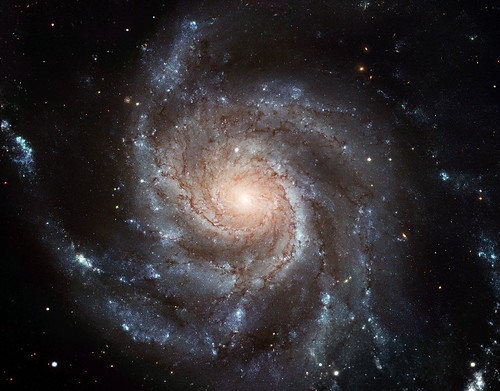
Pinwheel

This time it’s the Hubble telescope, bringing you the Messier 101 spiral galaxy (a/k/a the Pinwheel Galaxy) head-on, in just 51 exposures and coming in at a mere 16,000 by 12,000 pixels

Scenes from a Universe

Tuesday, February 28th, 2006

Gamma Ray BurstUniverse Today has a couple of posts up featuring some fascinting satellite imagery, and even a link to some pretty cool imagination. One features some images of Jupiter, Neptune and Uranus from NASA Astrobiology, while the other concerns a cosmic explosion seen by NASA’s Swift satellite

The Swift satellite, whose mission control center is in State College, has detected a cosmic explosion that has sent scientists around the world scrambling to telescopes to document this startling event. Gamma-ray radiation from the source, detected on 18 February and lasting about half an hour, appears to be a precursor to a supernova, which is the death throes of a star much more massive than the Sun. "The observations indicate that this is an incredibly rare glimpse of an initial gamma-ray burst at the beginning of a supernova," said Peter Brown, a Penn State graduate student and a member of the Swift science team.

The Penn State release also links to a pretty cool collapsing star animation, collapsing stars being one of the "leading contenders" for causing gamma ray bursts like the one Swift detected. Also check out the link to NASA’s Goddard Space Center for multimedia from Goddard TV

Bring a Little Stardust Home

Thursday, February 23rd, 2006

It hasn’t been long since NASA’s “Stardust”  returned to earth, but scientists are already slicing and dicing microscopic specks of comet dust collected by the space probe. We’re talking “dust” that’s as old as the solar system, verified comet matter, seen for the first time by NASA scientists. Interesting stuff. Fortunately, NASA scientists are letting the public in on the fun. 

Stardust@Home  appears to be modeled after SETI@Home, in the sense that you can volunteer your computer’s unused resources to help with the project by performing mathematical calculations, etc. There’s just one significant difference. They don’t just want your computer’s resources. They want your brainpower too.

First, you will go through a web-based training session. This is not for everyone: you must pass a test to qualify to register to participate. After passing the test and registering, you will be able to download a virtual microscope (VM). The VM will automatically connect to our server and download so-called “focus movies” — stacks of images that we will collect from the Stardust Interstellar Dust Collector using an automated microscope at the Cosmic Dust Lab at Johnson Space Center. The VM will work on your computer, under your control. You will search each field for interstellar dust impacts by focusing up and down with a focus control.

If that sounds exciting to you, and you think you can pass the test, go pre-register to help them out! 

Space Archaeology?

Thursday, February 16th, 2006

Who knew that NASA did archaeology? Unless someone’s sifting through the sands of some distant planet for signs of ancient intelligent life, I’ve always thought of archeology as the earthbound realm of the Discovery Channel and maybe Indiana Jones. That is, at least until I read that NASA helped uncover lost Maya ruins in the Central American jungle. 

Remains of the ancient Maya culture, mysteriously destroyed at the height of its reign in the ninth century, have been hidden in the rainforests of Central America for more than 1,000 years. Now, NASA and University of New Hampshire scientists are using space- and aircraft-based “remote-sensing” technology to uncover those ruins, using the chemical signature of the civilization’s ancient building materials.

NASA archaeologist Tom Sever and scientist Dan Irwin, both from NASA’s Marshall Space Flight Center in Huntsville, Ala., are teaming with William Saturno, an archaeologist at the University of New Hampshire, to locate the ruins of the ancient culture. Saturno discovered the oldest known intact Maya mural at the site in 2001.

… Sever has explored the capacity of remote sensing technology and the science of collecting information about the Earth’s surface using aerial or space-based photography to serve archeology. He and Irwin provided Saturno with high-resolution commercial satellite images of the rainforest, and collected data from NASA’s Airborne Synthetic Aperture Radar, an instrument flown aboard a high-altitude weather plane, capable of penetrating clouds, snow and forest canopies.

These resulting Earth observations have helped the team survey an uncharted region around San Bartolo, Guatemala. They discovered a correlation between the color and reflectivity of the vegetation seen in the images – their “signature,” which is captured by instruments measuring light in the visible and near-infrared spectrums – and the location of known archaeological sites.

My first thought was that if it’s possible to be an archaeologist without having to tromp around deserts and rain forests, I might start considering a new line of work. (Those mummy-related specials on Discovery and TLC inspire me.) I did a little searching online and found a bit more information about the research team and their research in Petén, Guatemala. Turns out, it’s still archaeology, so they still had to hack through the jungle — using satellite images to guide them — to “ground test” the data. They uncovered a series of ancient sites, right where the data and images predicted they’d be. 

So much for doing archaeology from a nice, air conditioned, indoor space — which I’m guessing were the conditions at the National Space Science and Technology Center, where Sever and Irwin conducted their space-based research before heading out into the field. Sever and Irwin can use satellites to lead them to ancient ruins, and I’ll wait for the same to beam their findings down to my living room.

Alphabet Soup

Tuesday, February 14th, 2006

One of the things I came away with at Satellite2006 (besides some pretty cool pictures) was a head full of acronyms that I still haven’t sorted out. I was reminded of that when I came across CNet’s “Wireless Alphabet Soup” post. I did a little poking around online, and found even more. I’m not sure how many of these I saw or heard at the conference, but it bears more than a passing resemblance to alphabet soup:

3G, 3GPP, BREW, BSS, CDMA, CDMA2000, CDPD, CME-CU, DVB-H, EDGE, ESS, EV-DO, FLO, GGSN, GPRS, GSM, HDML, HIPERLAN, HSCSD, HSDPA, HSUPA, IM1, MAC, MIMO, PKI, RAN, RASP, RU12, SGSN, TDMA, TD-SCDMA, UMTS, WAP, WCDMA, WEP, WIBRO, WIM, WLAN, WiMax, WTLS

I’m sure there are more that I’ve never even heard of before, but this is enough to wrap my brain around for now. If you know any that got left out, drop ’em in the comments. (And help a newbie out by throwing in a definition or two.)

Oh, and just for fun I made up a few of my own and tossed them in. Can ya find ’em? If so, good. Take notes. I have a feeling there might be a quiz of some sort later.

Satellite Used to Study Effects of General Relativity

Tuesday, February 14th, 2006

The Tartan Online, Carnegie-Mellon’s student newspaper, chooses Gravity Probe B as its "Experiment of the Week":

Gravity Probe B, a well-endowed NASA/Stanford satellite, is at this moment orbiting the Earth. The satellite’s main feature is its four perfectly spherical, shiny balls. These balls serve as the world’s most perfect gyroscopes, used in an extraordinarily complex and expensive experiment to observe the effects of general relativity…. Einstein’s theory predicts that a rotating massive body should slowly “frame-drag” space and time around with it. Over time, this dragging effect should push the gyroscope’s axis of rotation about 40 milliarc-seconds out of alignment. That’s the width of a human hair as seen from 10 miles. The probe intends to measure this to an accuracy of one percent.

Stanford University, which is working with NASA on the mission, has a mission status webpage that is worth checking out. Also be sure to check out the vehicle tour and the image gallery, featuring schematics of the satellite and pictures of the launch. What other satellite mission websites have you found? Post a link in the comment, or post your own blog entry, and we may promote your link to the homepage.

The iPod of Satellites?

Wednesday, February 8th, 2006


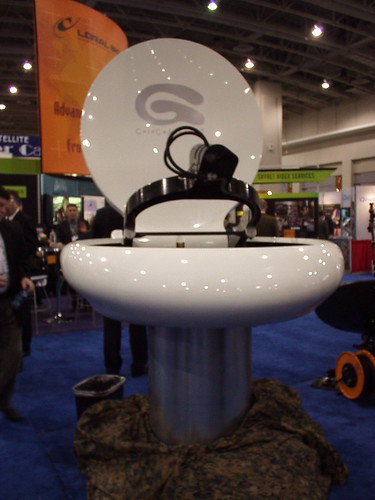
The iPod of Satellites

I don’t know what to say about this, also spotted at Satellite2006, except that it’s exceptionally cool. Design-wise, it reminded me of an iPod right away.  Gigasat seems to have absorbed some design sensibility from the iPod phenomenon. Their sleek driveway antennas won’t fit on in your pocket, but the right one might look good on your SUV.