
Helping Haiti


What can you do to help if you’re too busy? Text "Haiti" to 90999, and you’ll be billed $10 as a donation to the Red Cross.

GeoEye-1 spacecraft captured this image:
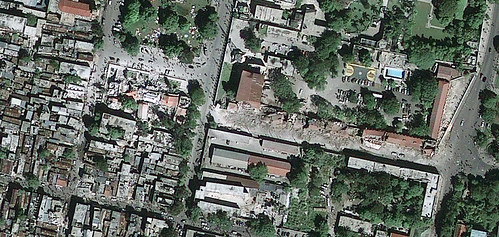
 

This half-meter resolution satellite image shows Port-au-Prince, Haiti after a 7.0-magnitude earthquake struck the area on Jan. 12, 2010. The image clearly shows extensive damage, roads covered with debris from collapsed structures, and people crowded in the streets and public places such as sports fields and stadiums. The white-colored National Palace shows damage along the roof line. The image was taken by the GeoEye-1 satellite from 423 miles in space at 10:27 a.m. EST on Jan. 13, 2010 as it moved from north to south over the Caribbean at a speed of four miles per second.


Here’s a little "Bible-thumping" effort in Haiti worth watching, if only to see how people live…


Real Hope For Haiti from Corrigan Clay on Vimeo.

;


One Comment

  • Rocco Fanucci says:

    SES is donating inventory on five satellites.

    The SES WORLD SKIES satellites involved in relief support are AMC-1 at 103 degrees West, AMC-6 at 72 degrees West, AMC-21 at 125 degrees West, NSS-7 at 338 degrees East and NSS-806 at 319.5 degrees East. The SES WORLD SKIES satellites provide inbound and outbound connectivity for the disaster zone as well as internal communication links. The first satellite-based networks for Haiti went live today.

    “Satellite networks play a quintessential role in disaster recovery, when speed is at essence,” states Rob Bednarek, President and CEO of SES WORLD SKIES. “We acted immediately, so our satellites could quickly provide the vital communication links for the benefit of the people of Haiti who have been struck by one of the worst natural catastrophes’ in history. SES WORLD SKIES is proud to donate its satellite capacity in support of the international relief efforts for Haiti.”

    Way to go, folks! It’s working, via USA Today:

    After the quake hit, phones in Haiti stopped working and e-mail was unreliable, so Terri Vruggink used a satellite Internet connection to tell family and friends back home in East Grand Rapids, Mich., that she was OK.


Leave a Reply