Nigeria’s NigComSat1 Launches in China

 Nigeria’s NigComSat1 (which we reported on just a couple of weeks ago) lifted off successfully from the Xichang Satellite Launch Center in southwest China’s Sichuan Province just after midnight this morning. The Nigerian paper The Guardian had some of the most extensive coverage of the launch:
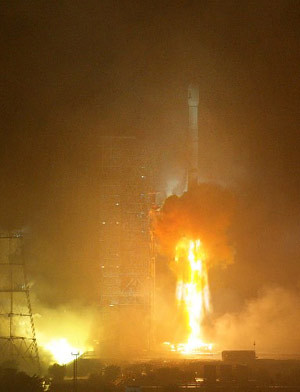
True to prediction, the much awaited launch of the Nigerian communication satellite, the first of its kind in Africa, took place and went on the 20 to 30 – minute trip into orbit where it is expected to provide robust and reliable satellite services to citizens in Africa and Europe.

The excitement at the site, according to Nigerian officials at the launch, was "electrifying."

Head of Corporate Affairs and Media at the National Space Research and Development Agency (NASRDA), Mr. Felix Ale, told The Guardian on phone that the launch was successful.

He quoted the agency’s Director General Prof. Robert Ajayi Boroffice, as saying that the 30-minute movement of the satellite went on without delay.

According to Ale, "Prof. Boroffice has also called President Olusegun Obasanjo to inform him of the success of the launch. The President was impressed and full of praises for NASRDA.

NASRDA is, of course, Nigeria’s national space agency, who, incidentally, also has a pretty cool PowerPoint presentation available about NigComSat1 online.

In addition to be the first communications satellite launched on behalf of an African country, the launch of NigComSat1 also marks a significant first for China, as the first time a foreign buyer has purchased a Chinese satellite and its launching service. The Chinese news service, Xinhua, also points out that the launch represents the culmination and beginning of a relationship between Nigeria and China that will likely continue throughout the life-span of the satellite (about 15 years)…

The satellite will be monitored and tracked by a ground station to be built in Abuja, the capital of Nigeria, by Chinese firm Great Wall Industry Corporation, and a ground station in Kashgar, in northwest China’s Xinjiang Uygur Autonomous Region.

The satellite’s ground facility in Abuja "had the potential of making Nigeria a major traffic hub in the west and central African region" and will prompt Nigeria and neighboring countries to "expand their switching facilities to be able to handle international traffic", according to a Nigerian communication official.

The Chinese company will offer support services and training for Nigerian technicians.

China was awarded the deal in 2004 after it outbid 21 international rivals to secure the 311 million U.S. dollar deal.

And also, may point to China’s expanding relationship with the developing world.

The satellite represents China’s wish to cooperate with developing countries in the peaceful use of outer space and to promote a closer relationship between China and African countries, observers say.

China has signed several cooperative contracts offering commercial launching services for foreign satellites, said an official on space development, citing a similar satellite contract with Venezuela in November 2005 and adding that China has been commissioned to send about 30 foreign satellites into space.

Want more info on NigComSat1? Check out the photo gallery over at Xinhua and the Google Map’s powered realtime tracking at n2yo.com.

4 Comments

  • Rocco Fanucci says:

    According to this New York Times piece, Nigeria is not on my list of places where I might want to work:

    Renewed Violence Limits Oil Production in Nigerian Region

    By JAD MOUAWAD

    The violence that has gripped Nigeria’s main oil region for the last year is again on the rise after weeks of an uneasy truce.

    Tensions have flared up in the Niger Delta, the site of much of the country’s oil production, after deeply flawed presidential elections last month. Dozens of foreign oil workers have since been kidnapped, at least three pipelines blown up, several supply vessels attacked and oil production curtailed.

    Chevron, one of the biggest producers in Nigeria, has begun evacuating hundreds of workers and suspending nonessential offshore activities in the after four workers were seized from a construction vessel last week. The company called the evacuations “a precautionary measure.”

    Earlier in the week, Chevron shut down its Ebite flow station, which produces 42,000 barrels a day in the western part of the delta, and the Funiwa oil field, which produces 15,000 barrels a day, after six workers were abducted. Chevron pumps about 360,000 barrels a day in Nigeria, about 15 percent of the country’s capacity.

    Chevron made its announcement as attacks on oil companies picked up again in the delta. The region had been quiet in recent weeks as Nigeria focused on presidential and gubernatorial elections. But according to international observers, the polls were marred by widespread irregularities, vote rigging and fraud. Ballot boxes were stolen, political activists killed and opposition leaders threatened.

    Now, rebels are putting new pressure on the government, two weeks before the transfer of power on May 29 from President Olusegun Obasanjo to his handpicked successor, President-elect Umaru Yar’Adua.

    In a separate incident, the Italian energy giant Eni declared a state of force majeure — an uncontrollable event that releases one from fulfilling a contractual obligation — for oil exports from its Brass terminal last week. Simultaneous attacks on its pipelines had forced the company to shut down 98,000 barrels a day of production.

    About a quarter of Nigeria’s oil output, which typically totals about 2.5 million barrels a day, has been out since January 2006. Local armed groups have demanded that a bigger share of the country’s oil wealth be distributed to the Nigerian states where the oil is in fact produced.

    The attacks, along with kidnappings of a nonpolitical nature, have helped force up world oil prices at a time when global supplies are constrained. Nigeria, the leading producer in Africa, is one of the largest suppliers of crude oil to the United States.

    On Friday, next-month crude oil futures settled on the New York Mercantile Exchange at $62.37 a barrel, up nearly 1 percent.

    The increase in violence could jeopardize plans by Royal Dutch Shell, the biggest oil producer in Nigeria, to restart production from its fields in the western part of the delta, which have been down for more than a year.

    A leading rebel group, the Movement for the Emancipation of the Niger Delta, has pledged that it would renew attacks against pipelines, platforms and workers to halt oil exports.

    “We promised to give the present Nigerian administration a shameful sendoff,” the group said in a statement on May 1 after a series of coordinated attacks on oil installations. “It is also a warning to the incoming government, which we view as an extension of the present. We will continue with our struggle for justice until we achieve all our goals without exception.”

    The Nigerian government was also criticized last week for starting a new auction round for oil-exploration licenses, granting preferential rights to Chinese and Indian companies. The auctions have come under fire from advocates of corporate transparency who are critical of attempts to hand over politically favorable licenses shortly before Mr. Obasanjo leaves office.

    The violence forced oil companies to bolster security and oil workers to hunker down in fortified compounds in the delta. But the measures seem to have had little effect.

    So far this year, 93 foreigners have been kidnapped, including nearly 30 since the elections on April 21. The number of kidnapped workers already exceeds last year’s, when 80 foreigners were seized in the region. Most are released unharmed in exchange for ransom payments.

  • Rocco Fanucci says:

    Nigeria’s new satcom does point to a few noteworthy trends. First and foremost is China’s cooperative stance toward Africa. Others include China’s commercial space capabilities and Nigeria’s economic advancement away from crude oil production. As captured by the Wall Street Journal (subscription):  

    But yesterday’s launch of the NIGCOMSAT-1, aboard a Long March 3B rocket, represented more of a commercial challenge,  Chinese officials said. The official Xinhua news agency said China secured the $311 million contract in 2004 in a bidding process in which 21 other companies took part.

    Wang Haibo, president of the Great Wall Industry Corp., told reporters earlier that the Nigerian contract ushers China onto the short list of countries that can build, launch and maintain a satellite for other nations. In the 1990s, China frequently launched satellites for other countries — but after they were manufactured elsewhere — and acquired a reputation for providing such services more cheaply than other launch-capable countries.

    In addition, the new launch was seen as a symbol of China’s broad network of economic relations with Africa. As its economy forges ahead, China has been particularly eager to establish commercial relations with oil-producing nations such as Nigeria.

    The launch was hailed by Nigerian officials as a breakthrough in getting away from exclusive reliance on oil. Hammed Rufai,  Nigeria’s managing director of the NIGCOMSAT-1 project, told Xinhua the satellite will help Nigeria move toward knowledge-based industries.

  • Rocco Fanucci says:


    Now Shell Oil is following Eni’s "force majeure" declaration, according to Business Day in Nigeria:

    Shell declares force majeure on 170, 000 bpd Bonny oil exports

    Oil giant, Shell yesterday declared a force majeure on its Bonny Light shipments after the company was forced to cut production due to an attack by villagers.
    EJIOFOR ALIKE With agency reports
    This pushed oil price in the world market to above $67 a barrel.

    Angry Ogoni youths occupied a major oil pipeline feeding the Bonny export terminal in a protest which began on May 10, forcing Shell to cut 170,000 barrels per day of production.

    The declaration of force majeure allows companies to suspend contractual obligations, such as deliveries of oil and gas, following unforseen events without incurring penalties.

    The move will affect May and June loadings, a Shell spokeswoman said.

    The occupation was triggered by a dispute between Shell and the K-Dere community in Ogoni, an area of the Niger Delta where Shell suspended oil production 14 years ago.

    According to BBC, insiders said the protest was triggered by Shell’s plan to resume production in the area after 14 years.

    The action comes after a prominent militant group called for a month of "mayhem" in the oil producing region in the wake of last month’s elections which gave the ruling party a landslide victory.

    The federal government has warned Shell to resume oil production in Ogoni land or risk having its oil prospecting licence for oil blocs in the area revoked.

    The new government is due to take office on May 29, and militants see the transition as an opportunity to extract concessions for the neglected region.

    The pipeline feeds Shell’s Bonny export terminal, which normally exports about 400,000 barrels a day.

    The closure takes to 880,000 barrels a day the volume of oil production hit by militant attacks and sabotage since February 2006, representing about 30 percent of the country’s capacity of three million barrels a day.

  • Rocco Fanucci says:

    Via This Day in Nigeria:

    NigComSat and Nigeria’s Interest

    09.04.2007

    With last month’s approval for the privatisation of the Nigerian Communications Satellite (NigComSat) by the Federal Executive Council (FEC), the federal government may soon relinquish 59 percent of its stake in the establishment retaining  only 41 percent.

    The privatisation of this strategic outfit, although partial, demonstates government’s seeming  insensitivity to the security and tactical implications of its plan.  The major argument so far advanced by the proponents of this sale is the need to achieve greater efficiency and profitability for NigComSat. Anyone conversant with the mediocre performance and outright failure of most public institutions in the country would appreciate that concern.

    However, financial gain must not be the sole motive behind every endeavour, particularly specialised agencies whose services have direct bearing on national security and  sovereign interests. This is why accountable governments around the world identify such sensitive areas and take responsibility for them accordingly. Ours should not be an exemption.

    In the United States of America , for instance, the government has continued to shoulder the bills of the National Aeronautics and Space Administration (NASA ), in spite of the daunting capital and logistic requirements of the agency.

    In making crucial decisions on NigComSat, the government should take a cue from the handling of such facilities elsewhere and adapt it to suit domestic peculiarities. To begin with, NigComSat was originally conceived as a catalyst for the rapid development of the country and indeed the rest of Africa . It was designed to be a pathway to worldwide information and communication network via the internet. It also envisaged the enhancement of broadcasting, telecommunication, demography monitoring and the surveillance of critical but vulnerable assets like  petroleum pipelines. Not to add its anticipated overall positive impact on the nation’s economy. Equally remarkable is the fact that NigComSat 1 was the first satellite to beam the unique Ka-Band -suitable for intercontinental connections- over the African continent. And the satellite’s L-Band possesses the capacity to deconstruct even sophisticated security systems like America’s.

    All these advantage can easily be undermined by private ownership, no matter how controlled. This fear is validated by the philosophy of business itself. Profit remains the overridding motivation for investment. And investors would take just any measure they deem fit to effect that cardinal objective. In this case, such steps could even be detrimental to the very purpose for establishing the agency.       

    Also, a situation whereby supposed buyers actually front for entities that may not even be mindful of Nigeria’s interests cannot be ruled out here. In a world  full of perfidious and conflicting causes, the possibility of mortgaging the public good in the pursuit of productivity and returns must not be ignored. While the desirability of project sustainability is not debatable, attempting to realise that through a short route, albeit potentially disastrous, would be really unfortunate.

    Granted the government may have considered some of these factors in settling for the fractional privatisation of NigComSat and rejecting the earlier proposal for complete  sale. But it should now do the right thing by altogether rescinding its decision to sell part of its holding.   With well-mapped out commercialisation plans and a formidable, visionary management structure to implement them, the satellite provider, the nation’s pride at the moment, csan also establish itself as a tool for enviable scientific accomplishments. The government should, therefore, reconsider its  intention and adequately superintend over this chance for national self-actualisation.

Leave a Reply