Archive for 2006

Music via Wifi

Tuesday, August 8th, 2006

I haven’t listened to the radio regularly in years, but I’ve spent a bit of time lately covering the goings-on in the world of satellite radio, including the latest lawsuit-inducing players. I haven’t yet been convinced to replace my trusty iPod with such a set-up. That is until I saw a couple of items that caught my eye with the ability to deliver music via wifi.

Gizmodo has a tantalizing review (including video) of the new personal communicator from Sony, which (among other things) let’s users wirelessly stream music to other users in the area if there’s a wifi hotspot nearby.

MyloCompared to most Sony gear we’ve seen over the past few years, the mylo is a breath of fresh air. The media player does MPEG-4, digital audio, and pictures. But it also has a WiFi connection and a QWERTY keyboard, for chatting on Google Talk and Yahoo Messenger (No AIM support, sorry.) Wait, wait, wait! It also works as a wireless Skype phone! And it has an Opera browser. And it can wirelessly stream music to other mylo owners in the area, ala iTunes. Without cellular connectivity, its not going to best a Hiptop, but we love the open standard support. Full Stats and a video review after the jump.

Sounds tempting. Yet, there’s more. I’m not the kind person who requires a lot of arm twisting to go out and buy the latest gadget, but coming across this wifi music delivery meme twice in one day seems like the universe is trying to tell me something. After reading the Gizmodo piece I happened across the June issue of OMMA, "the magazine of online media, marketing & advertising," and thumbed through their article on "10 Sites Worth Watching." That’s where I learned about Music Gremlin, which OMMA describes as follows:

Music Gremlin uses web intelligence and storage to deliver music through wifi hotspots to consumers in real time. Better yet, the stream is so smart it can customize stream to a user, in effect creating a personal radio station.

Gremlin offers its own player, but you can also use the service with other players. (The article also mentions that Sirus.Com and XMRadio.Com have become popular music content destinations in their own rights, as users sample both sites’ streamed content.)

Like I said before, I haven’t been a regular radio listener in years; since I bought my first Walkman, really. My attitude has been that I’d rather listen to what I want to hear than what they want to play. But with all the satellite and wifi-capable players ready to stream customized music to me, I might be in for an attitude adjustment in the near future.

Parking Robot Gone Wrong

Tuesday, August 8th, 2006

Every think it might be cool to have a robots take over some of the mundane tasks of life, like parking your car? Sounds good, at least in theory, right? And maybe it is when it works. But if the robot’s software has a glitch, or the owner neglects to renew the software license? Well, then it’s not pretty.

Car Parking RobotThe robot that parks cars at the Garden Street Garage in Hoboken, New Jersey, trapped hundreds of its wards last week for several days. But it wasn’t the technology car owners had to curse, it was the terms of a software license.

The garage is owned by the city; the software, by Robotic Parking of Clearwater, Florida.

In the course of a contract dispute, the city of Hoboken had police escort the Robotic employees from the premises just a few days before the contract between both parties was set to expire. What the city didn’t understand or perhaps concern itself with, is that they sent the company packing with its manuals and the intellectual property rights to the software that made the giant robotic parking structure work.

The Hoboken garage is one of a handful of fully automated parking structures that make more efficient use of space by eliminating ramps and driving lanes, lifting and sliding automobiles into slots and shuffling them as needed. If the robot shuts down, there is no practical way to manually remove parked vehicles.

It took a few days to iron everything while car owners pined for the imprisoned vehicles, but the city and the software company came to an agreement for a three year software license. (If I were a car owner who parked in that garage, I’d mark the date on my calendar.) It’s an amusing story if you didn’t have a car in that garage, but it underscores that with new technology comes issues that earlier adopters — both cities and citizens — may not have fully considered in their rush to embrace the new tech. Sometimes for every old problem solved a new one is created.

Google Watching You Watch TV?

Monday, August 7th, 2006

Sebadoh posted on Friday about Google getting into the satellite radio business. Well, it looks like Google is also making forays into television. Not producing, mind you, but monitoring what you watch and producing related internet content.

In a research paper presented last week at interactive television conference Euro ITV in Athens, Greece, Google researchers Michele Covell and Shumeet Baluja propose using ambient-audio identification technology to capture TV sound with a laptop PC to identify the show that is the source of the sound and to use that information to immediately return personalized Internet content to the PC.

"We showed how to sample the ambient sound emitted from a TV and automatically determine what is being watched from a small signature of the sound—all with complete privacy and minuscule effort," Covell and Baluja write on the Google Research Blog. "The system could keep up with users while they channel surf, presenting them with a real-time forum about a live political debate one minute and an ad-hoc chat room for a sporting event in the next."

… According to Boralv, the system wouldn’t be that intrusive. She writes, "If you were watching the news and wanted to delve deeper, this type of system could allow you to do that easily by automatically collecting related material and Web links for you. The beauty of the system that Michele and Shumeet describe is that it wouldn’t be a distraction. If you don’t want it you can ignore it and the PC browser will quietly update pages without bothering anyone—no input required and no audible output to form a distraction."

Those appalled by the prospect of Google tapping your television take heart: The proposal suggests user privacy would be respected. "[O]ur approach will not ‘overhear’ conversations," the paper says. "Furthermore, no one receiving (or intercepting) these statistics is able to eavesdrop, on such conversations, since the original audio does not leave the viewer’s computer." Perhaps there’s a lesson here for the National Security Agency.

Creepy? Or just the next step in increased synergy between new media and old? I can’t decide, but the Interactive TV Today blog describes in a bit more detail how Google might "overhear" what you’re watching.

[The system] would use a PC microphone to sample the ambient sound emitted by a television set and automatically determine what is being watched on that set from a small signature of that sound. The system would then use the data thus gathered to automatically present the viewer–in real time on his or her Web browser–with contextually relevant information, and with ad-hoc services that would enable social interaction around programming: thus, if the viewer were watching a sporting event, the system might present him or her with an ad-hoc fan forum; and if the viewer were to switch to a movie, it might present him or her with maps of the locales featured in the movie or with a bio of the actor currently appearing on the TV screen.

The system is composed of three distinct components: "a client-side interface, an audio-database server (with mass-media audio statistics), and a social-application Web server," the three scientists write in the paper’s introduction. "The client-side interface samples and irreversibly compresses the viewer’s ambient audio to summary statistics. [Note: the authors note that this irreversible mapping would serve to protect the viewer’s privacy.] These statistics are streamed from the viewer’s personal computer to the audio-database server for identification of the background audio (e.g., ‘Seinfeld’ episode 6101, minute 3:03). The audio database transmits this information to the social-application server, which provides personalized and interactive content back to the viewer."

One more question. How does this relate to Google partnering with Viacom to test sharing ad revenues from web videos? Is there a possible tie-in here? Maybe Google monitors what you’re watching and turns up related web videos? Clips from other shows you might be interested in, from Google’s ad partners?

Blast from the Past: Hotbird 8

Monday, August 7th, 2006

We’ve got another rocket launch for you. This time it’s one from the more recent past. The HOT BIRD 8 broadcast satellite was place into orbit on Friday via a Proton Breeze M launch vehicle, and we’ve got the video.

We’ve also got a blog post from the HOT BIRD 8 team describing the launch.

We are thrilled to have a successful return to flight for Proton M Breeze M. After a long and sleepless night, 9 hours, 11 minutes, and 20 seconds after lift-off, spacecraft separation was confirmed and the HOT BIRD 8 SC was acquired by the Eutelsat ground stations. The Eutelsat team started the process of opening the solar arrays and beginning health checks of the SC, before flying her to her final destination. After having been up all night, we headed back to the hotels to catch a quick nap and freshen up before the post-launch festivities.

See the press release for more information.

Google, XM to Share Ad Inventory

Friday, August 4th, 2006

As new technologies continue to break down the old barriers in the media business — we watch TV on our cell phones, as the saying goes, and make telephone calls through our cable company — there will be new mergers and deals between once-disparate companies as businesses look for new ways to expand their reach and customer base in a transformative media landscape.

Among the most creative and forward-looking companies is, of course, Google — and now they’re getting involved in the satellite radio business as a means of expanding their advertising reach: 

Google and XM Satellite Radio today announced an agreement that hints at the future of not only radio, but also television advertising. Under the terms of the deal the two companies will help each others advertisers reach the other’s audience–including letting Google advertisers place targeted radio spots within XM channels.

Inventory on XM’s non-music channels will be available to Google’sadvertising base through dMarc’s media network (www.dmarc.net). As part of the deal, Google advertisers will be able to reach XM’s millions of subscribers nationwide and XM will have access to Google’s large and small advertisers to offer relevant, targeted messages to their subscribers.

The dMarc platform, acquired by Google in January 2006, simplifies the sales process, scheduling, delivery and reporting of radio advertising, enabling advertisers to more efficiently purchase and track their campaigns on terrestrial radio, and now on XM Satellite Radio. For XM, Google’s technology automatically schedules and inserts advertising across XM’s non-music commercial channels, helping to increase revenue with a wealth of new advertisers, while decreasing the costs previously associated with processing advertisements.

After months of trials, the new platform is now in full production for dMarc advertisers. Google AdWords’ customers will be able to place terrestrial and satellite radio spots when the dMarc platform is integrated into AdWords targeted for fourth quarter of this year. 

Our industry observers tell us that Google is still working on ways to improve the CTR of radio ads, which remain stuck at a disappointing  0%. 

DIY Friday: Convert Your Primestar Dish to 802.11

Friday, August 4th, 2006

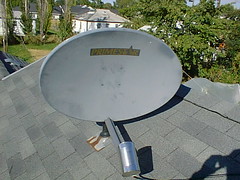
What do you do if you need to get WiFi access in a relatively remote location — say, a distant outbuilding? Waiting for WiMAX might mean waiting a long time in rural areas. Why not just grab an old Primestar dish, a tin can, and some coaxial cable, and rig up your own WiFi antenna?
A student at Walla Walla College explains: 

 It is easy to make a surplus Primestar dish into a highly directional antenna for the very popular IEEE 802.11 wireless networking. The resulting antenna has about 22 db of gain, and is fed with 50 ohm coaxial cable. Usually LMR400 or 9913 low loss cable is used if the source is more than a few feet from the antenna. The range using two of these antennas with a line of sight path is around 10 miles at full bandwidth. I must stress the line of sight part though. Leaves really attenuate the signal.

The "things you need" can be found easily by any aspiring MacGyver:

   1.  A Primestar dish.  (You may use any old dish, but if it is bigger than the Primestar the gain will be higher, and it may not be within the Federal Communications Commission rules for use within the United States.  In fact I have come to find out that there seem to be several different dishes that Primestar used, and I am only sure that the one I used, pictured above, used with the ordinary Wavelan or Airport transceiver card is within the effective radiated power limits given by the FCC.)
   2. A juice can (about 4 inches in diameter and at least 8 inches long).
   3. A chassis mount N connector.
   4. You will also need a "pigtail" connector which has the proprietary Lucent connector (for the PCMCIA card) on one end and an N connector on the other. The pigtail can be obtained from a number of online stores for $35 to $40.

Once assembled, you’ll want to brace the highly directional antenna securely against the wind. 


Goodbye Static!

Thursday, August 3rd, 2006

I drive an old pick-up truck most of the time– a rock-bottom barebones 1996 Mazda B2300 with something like 135,000 miles on it– and when it comes to listening to music I have only three options: AM, FM, or trying once again to dislodge the copy of The Cure’s Disintegration, which has been stuck in the casette player since about 2003.

To put satellite radio or an MP3 player in the poor beleagured truck would be like dressing up a pig in pearls. Why bother?

But for those who drive newer vehicles, an iPod- and satellite-connected vehicle will soon be de rigeur

In the latest boost to its dominance in portable music players, Apple Computer Inc. is teaming with General Motors Corp., Ford Motor Co. and Mazda Motor Corp. to integrate the iPod into car audio systems.

GM and Ford are the nation’s No. 1 and No. 2 automakers, and the new alliances mean the iconic audio gadget will now be compatible with more than 70 percent of the new 2007 model vehicles sold in the United States, Apple said Thursday….

Demand for built-in satellite radio features has also prompted Ford to expand its relationship with Sirius Satellite Radio Inc. VanDagens said more than 90 percent of Ford and Lincoln Mercury cars will offer satellite radio by the 2008 model year.

What will be truly interesting is the impact that standardized satellite radio availability will do to the market share of local radio stations. They don’t call the peak listening hours "drive time" without reason. As more drivers tune out the radio and tune in their favorite satellite station or MP3 playlist, the over-the-air radio industry will be forced to undergo transformative change– or face the same decline that cable brought to the Big 3 Networks.


Launching the Coke/Mentos Rocket

Thursday, August 3rd, 2006

Being rocket scientists and all, we couldn’t help but be fascinated by the latest craze lighting up the blogosphere: instructions and videos on how to combine Mentos with Diet Coke to create and launch your own home-made bottle rocket.

This particular launch  is one of the top videos on YouTube, with nearly half a million viewings in the past six weeks:

An explanation on how it’s done can be seen here:

Of course, being rocket scientists (and, for some of us, parents as well) we must provide a caveat– bottlerockets are inherently dangerous, no matter how they’re constructed. We direct you to Newton’s Second Law of Motion for further explanation.


City Wi-Fi, Green Wi-Fi

Wednesday, August 2nd, 2006

It’s been a long time since I blogged about my enthusiasm for municipal wi-fi, but news from Boston brought the subject back to mind again.

Wi-FiBoston’s plan to create a citywide wireless Internet network entered a new phase yesterday as Mayor Thomas M. Menino named former high-tech executive Pamela Reeve to lead the search for a non profit corporation to build the network.

Reeve, a member of the mayor’s Wireless Task Force and a former chief executive of software company Lightbridge Inc., also will talk to businesses, foundations, universities, and hospitals in an effort to raise between $16 million and $20 million for the project.

The money would be used to blanket city neighborhoods with fiber-optic cable and radio transmitters that would beam WiFi signals, enabling laptops, handheld computers, cell phones, and other portable devices to connect to the Internet at high speeds anywhere in the city.

As noted at GigaOm, this model is unlike any other in blending resources from government, business and non-profits. Can it work? Who knows, but if it does the next step might be to combine it with an idea like One Laptop Per Child movement, but with a domestic focus. Nigeria just ordered (and payed for) 1 million of the wireless-equipped laptops. It could happen in the U.S. too — wi-fi access and low-cost wireless laptops opening up new opportunities for a lot of kids.

And as long as cities are launching wi-fi networks, the might want to consider making them green too.

Green Wi-FiThe technical concept behind the Green Wi-Fi network is fairly simple. Each node in the network consists of a battery-powered router and a solar panel to charge the battery. The nodes are mounted on rooftops, and the network’s Wi-Fi signals are transferred over a grid using a wireless network standard known as 802.11b/g.

The first seed money has arrived, enough to produce and test prototype nodes. It came from the One Laptop Per Child initiative (OLPC), which aims to construct a $100 laptop to be distributed to children in developing countries. OLPC showed immediate interest in the Wi-Fi initiative, Pomerleau said.


We Got Your Rocket Scientsts Right Here

Wednesday, August 2nd, 2006

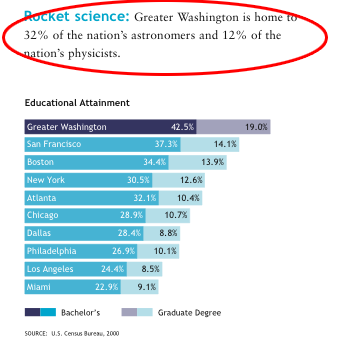
Here’s an interesting tidbit. Here in DC, I’m surrounded by rocket scientists. OK, not surrounded but it turns out the metro-DC area is home to a large percentage of the rocket scientist population. Higher than most cities, I bet.

The latest issue of The Washingtonian pulls some data from the Greater Washington Initiative’s latest regional report, which puts the percentage of rocket scientists in the area at 32% of the population. (12% of the nation’s physicists).

Rocket Scientists in DC

Impressive. But that’s only about a third of the country’s rocket scientists. Where are the rest of them? Where are most of them?