Archive for 2006

Sixteen Candles for Hubble

Tuesday, April 25th, 2006

Remember Sixteen Candles, the 1984 John Hughes film featuring Molly Ringwald and Anthony Michael Hall? Hilarity ensued, as they say, when Ringwald’s film family forgot her sixteenth birthday.

We’re thinking of the film as we realize we missed an important date yesterday– the sixteenth anniversary of the  launch of the Hubble Telescope aboard the space shuttle Discovery on April 24, 1990.


To celebrate the birthday, NASA and the European Space Agency (ESA) have released a "mosaic image of the magnificent starburst galaxy, Messier 82 (M82). It is the sharpest wide-angle view ever obtained of M82, a galaxy remarkable for its webs of shredded clouds and flame-like plumes of glowing hydrogen blasting out from its central regions."

The image can be seen here. Or click here to view a series of other images captured during Hubble’s long life, such as the one above. (This one is  our particular favorite.)
 

mobTV Happens in Vegas

Monday, April 24th, 2006

Here’s an interesting tidbit from behind the Wall Street Journal’s subscription wall. MobTV is getting another foothold stateside.

Satellite operator SES Global S.A., seeking to find a place in the burgeoning wireless-entertainment arena, today is expected to announce it is joining with a start-up company that controls a big swath of mobile broadcast spectrum across the U.S.

The anticipated technical and marketing alliance between SES Americom, the U.S. unit of Luxembourg’s SES Global, and closely held Aloha Partners LP of Providence, R.I., is intended to demonstrate the business case and consumer appeal of beaming digital music and high-resolution video to cellphones and other consumer hand-held devices. But the initiative also illustrates broader efforts by satellite-services companies to participate in the fast-changing media landscape, particularly at the convergence of television and

… A yearlong test is planned to begin this fall in Las Vegas, though negotiations with programmers and leading cellular providers still have to be worked out.

The plan is the most ambitious yet to test such a system using fewer transmitters, or towers, to simultaneously distribute as many as 40 higher-resolution video channels directly to handsets. Implementing the concept would end up costing a small fraction of the estimated billions of dollars necessary to build out rival networks relying on less-powerful broadcast signals and thus requiring towers spaced closer together.

Multichannel News has a bit more, no subscription required. 

It’s encouraging news, after my previous post on mobTV spreading in Korea, across Europe, and into Canada and North America. It’s also encouraging that, after re-reading my post on how mobTV works, I think I get how the Las Vegas project is gonna work out.  I’m guessing the involvement of a satellite company means using a satellite signal to cut down on spectrum issues like the ones covered in my previous post. 

So, this sounds like a wish fulfilled. I just hope that the tag line from those edgy and ubiquitous Las Vegas tourism commercials doesn’t hold true for  this latest stateside foray into mobTV.

ER on the Moon?

Friday, April 21st, 2006

Back to robots for just a minute. I mentioned the pregnant robot earlier, the one used to help train medical students without the need for human guinea pigs. I also blogged about the challenge of meeting medical needs in space. Well, those topics have come together in a pretty interesting way. With help of a NASA robot, emergency surgery in space may have just gotten a lot easier. 

Using a cramped undersea laboratory off Florida’s Atlantic coast, NASA astronauts and medical experts have teamed with an experimental robot to demonstrate long-distance surgical procedures that might one day save the life of a critically injured explorer on the moon or Mars.

The mission to evaluate a new branch of health care called telemedicine and the use of robots in surgery will draw to a close today when the three-man, one-woman crew leaves the research facility 62 feet below the water’s surface where they have lived since early this month.

During their stay aboard the 43-foot-long Aquarius, submerged among the coral reefs off Key Largo, Fla., physician Tim Broderick and three astronauts — Dave Williams, Ron Garan and Nicole Stott — assisted as Canadian surgical researchers 1,250 miles away sent commands to a robot inside the laboratory.

Responding to those commands, the portable robot sutured a badly damaged vein in the wounded arm of a patient simulator, a lifelike medical teaching aide constructed of rubber and fabrics that mimic human tissue and contain bloodlike fluid.

"Patient simulator"? "Lifelike medical teaching aide"? Is it me or does that sound like a robot doing surgery on a robot? I guess it’s better that way, as long as they’re experimenting, but I supsect they won’t get any notes about cold hands or bedside manner from a "lifelike medical teaching aide."  

Via Mars Blog.

The Kon-Tiki Sails Again!

Friday, April 21st, 2006

"Nearly 60 years after Thor Heyerdahl’s Pacific Ocean crossing aboard the balsa raft Kon-Tiki, a Norwegian team is in Peru putting final touches on a new vessel to repeat the journey," the AP reports.
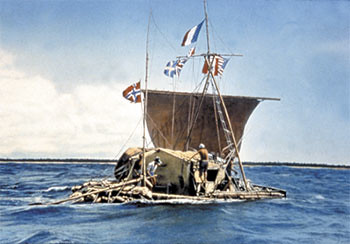


                                                    The original Kon-Tiki in 1947.

"I think we are mentally prepared and we are really, really anxious to put this raft in the ocean," said Olav Heyerdahl, 28, the adventurer’s grandson and one of the six-member crew.

Behind him in a dry-dock in Lima’s port of Callao loomed the balsa raft Tangaroa — named for the Polynesian god of the ocean — which is scheduled to set sail April 28.

The expedition had been set for last year, but was postponed after key sponsors diverted funds to help victims of the 2004 Southeast Asian tsunami.

In 1947, Thor Heyerdahl and his team sailed their primitive raft 5,000 miles from Peru to Polynesia in 101 days to support Heyerdahl’s theory that the South Sea Islands were settled by ancient mariners from South America. Heyerdahl, who died in 2002 at age 87, documented his voyage in the best-selling book "Kon-Tiki" and in an Oscar-winning documentary film.

The adverturer’s 67-year-old son, Thor Heyerdahl Jr., came to Peru to see the new vessel and cheer on his own son. "I’m very happy for him that he gets this opportunity," he said.

The new 56-foot vessel is larger than the Kon-Tiki, with eight crossbeams lashed to 11 balsa logs from Ecuador and covered by a bamboo deck. Atop a hardwood cabin, the crew fitted a thatched-reed roof made by Aymara Indians.

The Kon-Tiki carried only the most basic equipment, even by 1947 standards. But the Tangaroa features abundant modern technology, including solar panels to generate electricity and satellite navigation and communications gear.

We’re not sure if the expedition has Internet access while adrift in the South Pacific, but it is possible if they contacted Connexion by Boeing, which uses SES-Americom’s AMC-23 satellite, which is the only satellite that they can use for Internet based on their route.

Consider that a modern factoid for an ancient journey.

The Kon-Tiki Sails Again!

Friday, April 21st, 2006

"Nearly 60 years after Thor Heyerdahl’s Pacific Ocean crossing aboard the balsa raft Kon-Tiki, a Norwegian team is in Peru putting final touches on a new vessel to repeat the journey," the AP reports.

The original Kon-Tiki in 1947.

"I think we are mentally prepared and we are really, really anxious to put this raft in the ocean," said Olav Heyerdahl, 28, the adventurer’s grandson and one of the six-member crew.

Behind him in a dry-dock in Lima’s port of Callao loomed the balsa raft Tangaroa — named for the Polynesian god of the ocean — which is scheduled to set sail April 28.

The expedition had been set for last year, but was postponed after key sponsors diverted funds to help victims of the 2004 Southeast Asian tsunami.

In 1947, Thor Heyerdahl and his team sailed their primitive raft 5,000 miles from Peru to Polynesia in 101 days to support Heyerdahl’s theory that the South Sea Islands were settled by ancient mariners from South America. Heyerdahl, who died in 2002 at age 87, documented his voyage in the best-selling book "Kon-Tiki" and in an Oscar-winning documentary film.

The adverturer’s 67-year-old son, Thor Heyerdahl Jr., came to Peru to see the new vessel and cheer on his own son. "I’m very happy for him that he gets this opportunity," he said.

The new 56-foot vessel is larger than the Kon-Tiki, with eight crossbeams lashed to 11 balsa logs from Ecuador and covered by a bamboo deck. Atop a hardwood cabin, the crew fitted a thatched-reed roof made by Aymara Indians.

The Kon-Tiki carried only the most basic equipment, even by 1947 standards. But the Tangaroa features abundant modern technology, including solar panels to generate electricity and satellite navigation and communications gear.

We’re not sure if the expedition has Internet access while adrift in the South Pacific, but it is possible if they contacted Connexion by Boeing, which uses SES-Americom’s AMC-23 satellite, which is the only satellite that they can use for Internet based on their route.

Consider that a modern factoid for an ancient journey. 


Good Job: Atlas V Rocket Launches ASTRA Satellite

Thursday, April 20th, 2006

This afternoon’s launch was a complete success.

Lift-off occurred at 4:27 p.m. EDT and initial contact with the satellite, called acquisition of signal, was confirmed at 5:43 p.m. EDT from a satellite tracking station in Uralla, Australia.

Atlas V launches from The Cape

Some really nice photos are on the SpaceFlightNow.com site. 

The video footage is impressive.

Atlas V Rocket to Launch ASTRA 1KR Today

Thursday, April 20th, 2006

ASTRA’s newest satellite will be launched into geosynchronous orbit and will become part of a system that provides television reception to 107 million households in Europe. Launch window opens at 4:27 p.m. EDT (20:27 GMT), and remains opens until 7:16 p.m. (23:16 GMT). Watch the launch live via webcast from launch complex 41 at the Cape Canaveral Air Force Station in Florida. Broadcast begins at 4:05 p.m. (20:05 GMT). Here’s how you can receive it directly via satellite:
 
In North America, AMC-4, transponder 17, C-band analog, 101 degrees West, downlink frequency 4040 MHz (vertical).

In Europe, on ASTRA, transponder 116 on ASTRA 1G at 19.2E with following reception parameters: downlink frequency: 12669.50 MHz / downlink polarization: vertical / transponder transmission rate: 22 MB/s QPSK FEC 5/6; Service name: ASTRA VISION 3

Test signals begin about 3:45 p.m. EDT (19:45 GMT).

If you are not able to watch it, then you can follow it via live text updates.

CloudSat and Calipso to Blast Off Early Friday AM

Thursday, April 20th, 2006

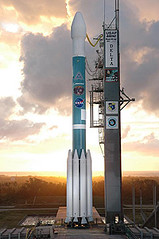
A Delta II rocket will launch a pair of atmospheric research satellites for NASA early Friday morning.


The AP gives a summary: 

A Delta 2 rocket carrying the CloudSat and Calipso satellites will blast off shortly after 3 a.m. Friday [from Vandenberg Airforce Base.]

CloudSat and Calipso are equipped with instruments to study the formation of clouds and microscopic airborne particles called aerosols in unprecedented detail.

Observations from the satellites should help scientists improve weather and climate forecasts.

CloudSat and Calipso are managed by NASA’s Jet Propulsion Laboratory in Pasadena.

Live launch coverage on the web (for all you night owls and early risers) is available here. Also be sure to check out the NASA website for more information about CloudSat and Calipso.

More Space Junk

Thursday, April 20th, 2006

If you read NooBee’s post about SpaceNet 4’s retirement (below) yesterday, then you know that space– or at least the Earth’s orbit– is full of junk.

But now there’s something you can do about it. Sort of. At least, there’s a cool way you can spend some time (or a great deal of time, depending on how highly you rate the things you should be doing at work) learning about the wide range of space junk floating in the earth’s orbit: by playing this free online game

The junk is out there.

Space Junk

Wednesday, April 19th, 2006

No, I don’t mean the song by Devo. But there’s gonna be some more junk up there, do you need to get one of those hats the band used to wear back in the day, on the off chance that some of that junk finds it’s way back down here? Apparently the FCC ruled that U.S.-licensed satellites launched after March 22, 2002 have to go into disposal orbit when they’ve beamed down their last signal. The latest is the Spacenet 4 satellite, which was launched in 1985.

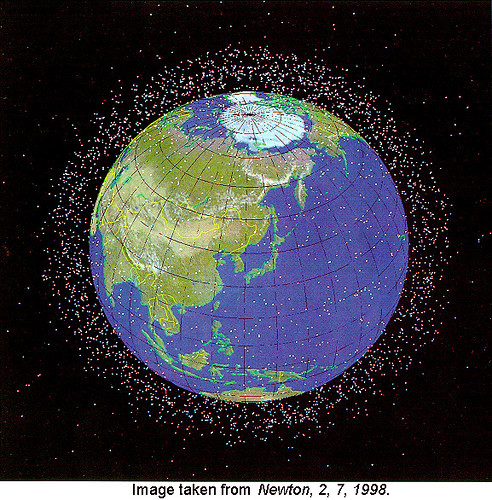
I’ve blogged about the satellite graveyard before, and apparently we’ve left a lot of stuff up there in the past 25 years or so; more than 9,000 man-made objects, which can break into little pieces and cause problems for current space missions. It looks something like this.

Space Junk

I’ve also blogged before about how stuff gets knocked around up there. And it’s not all that unusual for some of it to fall to earth. It can land in your garden, or even on you. Don’t believe me? Ask Devo

She was walking all alone
Down the street in the alley
Her name was sally
She never saw it
When she was hit by space junk

At least now we know why they wore these. 

Space Helmet

Either wear a helmet or practice catching the stuff

I’ll enjoy the latter for now. In the meantime can someone tell me, now that this stuff is up there what are the chances it’s gonna stay up there?