Teaming Up WiMAX and Satcom

You’d be excused for believing that WiMAX and satcom don’t play well together.

After all, studies (as well as anecdotes) have shown that WiMAX technology interferes with the reception of satellite transmissions in C-Band: 

The trade group says that the results of the testing showed that the WiMAX transmit signal could cause significant problems to a satellite digital signal well in excess of 12 km distance. At the extreme measurement distance, the video program was fully operational with the WiMAX carrier centered on the video carrier. However, the data BER was degraded from a nominal 10-8 to a BER of 10-4. This is an unacceptable quality of service in the digital telecommunications industry….

"The C-band is in many ways the lifeline of the satellite industry and protecting that spectrum from the threat of interference posed by sharing it with Broadband Wireless Access services is of paramount importance," said Robert Ames, SUIRG President. "The tremendous support of the SUIRG member companies and the industry as a whole in making this test a viable platform to aid decision makers at WRC-07 was extremely gratifying. The results of the test are a firm testament to the need for clearly defined spectrum allocation."

That interference has caught the attention of federal officials in the U.S., who worry that WiMAX deployment could interfere with crucial C-Band signals used daily by the Department of Defense and civilian agencies. 

Yet in the developing world, WiMAX and Satcom can play nicely together and provide leap-frog technology solutions for bringing the Internet to remote areas.

As we blogged last year, HughesNet in Brazil is combining the long-range wireless solution of WiMAX with Internet Protocol over Satellite (IPoS) to reach the most remote areas of the Amazon basin.

But new solutions bring new competition, and one can get around the C-band interference simply by using the Ku-Band, which Gilat uses extensively. 

Those two reasons explain why Gilat recently inked a deal with Airspan Networks, Inc., a major provider of WiMAX broadband wireless access networks:

Broadening its product offering to include WiMAX-based solutions, Gilat will distribute Airspan’s WiMAX solutions globally to its large base of existing customers as well as new customers, leveraging its core competencies including strong global sales, turnkey project delivery and local support capabilities. The new agreement will enable Gilat’s customers to address their broadband wireless access and satellite communications needs through a well integrated ‘one-stop-shop’ solutions provider.

"We are excited to enter into this partnership with Gilat, who has a global reach into the world’s high growth markets and which will allow us to further expand our distribution channels. It’s a win-win situation for both companies and highlights the synergies to be realized between shared customers and similar types of applications. Airspan continues to gain momentum and recognition as a leader in WiMAX in a very competitive market environment," commented Eric Stonestrom, Airspan’s President and CEO.

Not incidentally, Gilat also recently signed Petrobras in Brazil.
Spitzer’s New Look

This is not about my governor.

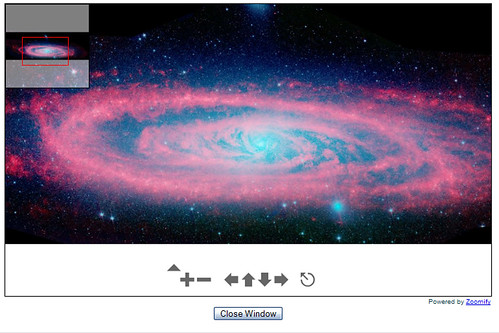
We’re talking about one of our favorite space instruments, the Spitzer Space Telescope. They’ve got a new feature on their site, one where you can zoom in and pan on some very cool space images.


Be sure the check out some of the animations. I like "Spitzer’s Delicate Ring Flower:"

NASA’s Spitzer Space Telescope finds a delicate flower in the Ring Nebula, as shown in this animation. The outer shell of this planetary nebula looks surprisingly similar to the delicate petals of a camellia blossom. A planetary nebula is a shell of material ejected from a dying star. Located about 2,000 light years from Earth in the constellation Lyra, the Ring Nebula is also known as Messier Object 57 and NGC 6720. It is one of the best examples of a planetary nebula and a favorite target of amateur astronomers.

The "ring" is a thick cylinder of glowing gas and dust around the doomed star. As the star begins to run out of fuel, its core becomes smaller and hotter, boiling off its outer layers.

Spitzer’s infrared array camera detected this material expelled from the withering star. Previous images of the Ring Nebula taken by visible-light telescopes usually showed just the inner glowing loop of gas around the star. The outer regions are especially prominent in this new image because Spitzer sees the infrared light from hydrogen molecules. The molecules emit infrared light because they have absorbed ultraviolet radiation from the star or have been heated by the wind from the star.

NASA called it a celestial valentine.

The candles are lit, the champagne is on ice. All you need now are flowers and a ring. This Valentine’s Day, NASA’s Spitzer and Cassini spacecraft provide you with both, in two engaging new images.

NASA’s Cassini-Huygens mission and Spitzer Space Telescope have captured images of Saturn’s rings and the Ring Nebula, respectively, to bring home spectacular views of two of the most looked-at objects in the sky. The Cassini image shows a detailed color mosaic of Saturn’s shimmering rings. Spitzer imaged the outer shell of the Ring Nebula, which looks surprisingly similar to the delicate petals of a camellia blossom. 


Dextre Heads to Space Tomorrow

The space shuttle Endeavour is set to liftoff tomorrow at 2:28 a.m. EDT on the STS-123 mission, which will deliver a key component of the Dextre (short for Special Purpose Dexterous Manipulator) robotic arm as well as the first section of the Japanese-built Kibo laboratory.

CTV has more on the Candian-built Dextre: 

A team of space-walking astronauts will assemble Dextre, which weighs about 1,560 kilograms, and attach it to the outside of the space station.

Dextre — 3.7 metres high and 2.4 metres wide — has two multi-jointed arms attached to its torso, a tool holder and a camera/light unit.

"Each arm has seven joints," Swanson said, adding the body can rotate. "It is a complicated arm to operate, but of course it gives you the ability to do all sorts of things with it."

Assembling Dextre will take three space walks of the five scheduled for the 16-day mission, but Swanson said it will take another two months of testing to make the robot fully operational.

Dextre is "is the third and final component of the Mobile Servicing System (MSS) developed by Canada for the International Space Station," the Canadian Space Agency writes on its website.

The Canadian Space Agency explains that:

[W]ith its two arms, Dextre will load and unload objects, use robotic tools, attach and detach covers and install various units of the Space Station. It will either be attached to the end of Canadarm2 or ride independently on the Mobile Base System and have Canadarm2 deliver equipment to it for servicing. It also has four cameras that will provide the crew inside the Station with additional views of the work areas.

Dextre is a huge accomplishment for the Canadian space industry, which has recently been embroiled in controversy over business-related changes to their prime space contractor.

Canada.com called the plans by U.S. firm Alliant Techsystems to purchase MacDonald, Dettwiler and Associates’ space and military assets for $1.325 billion "an affront," while the Ottawa Citizen and others have claimed it is vital to Canadian defence that the country maintain its own ability to launch and control its own satellites. (We’ve blogged about similar concerns about Canadian telecommunications and satellite independence.)

The Endeavour flight is commanded by Dominic Gorie, with Gregory H. Johnson serving as Pilot. The crew also includes Mission Specialists Rick Linnehan, Robert L. Behnken, Mike Foreman, Garrett Reisman and Japanese astronaut Takao Doi.

Doi is aboard to help with the Kibo Japanese experiment module — and word has it that he will be comfortably dressed

 [A] team from Japan Women’s University has developed "everyday spacewear," to make things more comfortable for astronaut Takao Doi during his stay on the station…

The team… has spent three years developing practical spacewear suited to a weightless environment.

They developed eight items, including long- and short-sleeved polo shirts, shorts, trousers, socks, underwear and a tracksuit top and bottoms….

Perhaps surprisingly, there is a lot of dirt on the space station, which means clothes get grubby easily.

The group created a polyester fiber-cotton blend fabric that allows sweat to be quickly absorbed and dried, which prevents dirt sticking to the garments.

The team also came up with ways to prevent the clothes interfering with electronic instruments onboard, such as interweaving them with a metallic fiber to prevent the buildup of static electricity.

Many of the everyday clothes worn by astronauts staying on the International Space Station are personal items bought from normal stores. But in a weightless environment, the hems and cuffs rise making them uncomfortable to wear–another problem overcome by the new items.

Kibo (meaning "hope" in Japanese) is the first manned facility made by Japan to be added to the ISS. The Pressurized Module of Kibo will be primarily used for experiments in a microgravity environment. 


As always, the launch will be webcast on NASA TV — with an additional live stream provided from Japan.

DIY Friday: Component Cable

Have an amplifier and speakers and just need some speaker wire to start the party? Instead of dropping $50-$100 bucks on Monster Cable, you might just want to bend a couple coat hangers into place:

Not only does it work, but there doesn’t seem to be an audio quality drop-off:

I’m so sorry, but I do not buy into 90% of the hype brought to us audiophiles by the commercial sector of our hobby and the home entertainment industry at large. My brother, an audio engineering whiz kid has proven to me what is real and what is not. Let me rehearse with you an example of how he does this.

We gathered up a 5 of our audio buddies. We took my “old” Martin Logan SL-3 (not a bad speaker for accurate noise making) and hooked them up with Monster 1000 speaker cables [ed. Monster Ultra Series THX 1000 Audio Interconnects] (decent cables according to the audio press). We also rigged up 14 gauge, oxygen free Belden stranded copper wire with a simple PVC jacket. Both were 2 meters long. They were connected to an ABX switch box allowing blind fold testing. Volume levels were set at 75 Db at 1000K Hz. A high quality recording of smooth, trio, easy listening jazz was played (Piano, drums, bass). None of us had heard this group or CD before, therefore eliminating biases. The music was played. Of the 5 blind folded, only 2 guessed correctly which was the monster cable. (I was not one of them). This was done 7 times in a row! Keeping us blind folded, my brother switched out the Belden wire (are you ready for this) with simple coat hanger wire! Unknown to me and our 12 audiophile buddies, prior to the ABX blind test, he took apart four coat hangers, reconnected them and twisted them into a pair of speaker cables. Connections were soldered. He stashed them in a closet within the testing room so we were not privy to what he was up to. This made for a pair of 2 meter cables, the exact length of the other wires. The test was conducted. After 5 tests, none could determine which was the Monster 1000 cable or the coat hanger wire. Further, when music was played through the coat hanger wire, we were asked if what we heard sounded good to us. All agreed that what was heard sounded excellent, however, when A-B tests occurred, it was impossible to determine which sounded best the majority of the time and which wire was in use. Needless to say, after the blind folds came off and we saw what my brother did, we learned he was right…most of what manufactures have to say about their products is pure hype. It seems the more they charge, the more hyped it is.

But some alert audophiles make a good point in this blog’s comments sections: if you are using cheap speakers and a cheap amplifier, high-quality speaker wire will have little effect. The audio snob mantra goes, “the sound quality of your system will never be stronger than its weakest link.”

If you join the monster-cables-are-a-rip-off crowd but aren’t ready to start bending your coathangers, try building your own component cables. Directions are here or just watch the guys at Systm tackle the project:

DISA Big Contract

The Defense Information Systems Agency (DISA), the communications support agency for the Department of Defense, has a pretty big RFP out there – $500 million/year for a new satellite services contract:

The Defense Information Systems Agency has kicked off a follow-on procurement for commercial satellite services that could be worth $500 million a year and may attract a large field of bidders, ranging from small businesses to large systems integrators.

The procurement, which could directly effect operations in Iraq and Afghanistan, is expected to be a pretty competitive process – continuing what they beleive to be an efficient public-private partnership:

The Defense Department has mandated that all the military services use DSTS-G, Cowen-Hirsch said, which leverages the department’s buying power. DISA’s cost for satellite services is 25 percent below the industry average. The agency said in its request for information for the Future Commercial Satellite Services Acquisition that it wants to maintain this "price competition, while ensuring maximum effectiveness by considering lessons learned, market evolution and anticipating future DoD needs."

It appears that a large pool of vendors stand ready to meet these requirements, and not just the small businesses that won the DSTS-G contracts in 2001. Eaton estimated that about 50 bidders submitted written responses to the new RFI, including his company and the two other DTTS-G incumbents, Artel Inc. and Spacelink, acquired by DRS Technolgies in 2006.

Rebecca Cowen-Hirsch is the director of DISA’s program executive office for satellite communications. In a recent interview before the follow-up procurement was announced, she was eager to defend the agency’s commercial partnerships:

There has been much debate over the advantages or perceived disadvantages of our primary contract vehicle for acquiring commercial SATCOM services. And yet it remains an incredibly successful tool in acquiring fixed satellite services, bandwidth for our customers. It continues to provide the warfighters great flexibility at some of the best prices in the industry. In fact, we have shown that the DSTS-G contract has provided service globally tailored to the unique needs of the warfighters with prices that are on average 25 percent lower than market averages. This value is derived principally by openly competing COMSATCOM requirements across the commercial marketplace and leveraging the benefits of competition, DoD’s buying power, and DISA’s strong partnership with the commercial satellite industry. We are able to procure very short duration leases, say on the order of a few days or a month, or long multiyear leases. The competition created by our vendors has been very beneficial to the department. Additionally, we have been able to add within the scope of our existing contract capabilities the warfighter values such as protection, access to commercial X-Band, portability, responsiveness and additional flexibilities.

While DSTS-G has been very effective is supporting the DoD, it will come to the end of its life cycle in 2011 [with all options exercised]. We are actively strategizing for our future services acquisition to build on our past experiences and to put in place the DoD’s next generation of commercial SATCOM services. We will continue to rely on DSTS-G while we plan for the future.

Despite the large-scale increase in capacity, some vendors think the procurement should be more expansive:

Tom Eaton, president of Arrowhead Global Solutions, one of the three vendors on DISA’s current Defense Information System Network Satellite Transmission Service-Global (DSTS-G) contract, said his company intends to bid on the follow-on procurement, known as the Future Commercial Satellite Services Acquisition. He said DISA should widen the scope of the procurement to include mobile satellite services as well as the fixed satellite services covered in the current contract, which expires in 2011.

Eaton said DISA also should consider bundling satellite terminal hardware into the Future Commercial Satellite Services Acquisition, along with mobile services, to cut down on administrative overhead and consolidate all commercial satellite communications requirements into one contract vehicle.

Eaton said that demand for satellite communications bandwidth far outstrips the capacity of military systems, a gap that can be filled by commercial satellite services.

DISA, by the way, is constructing a new building at Fort Meade in Maryland. The design contract was almost as much as this satellite procurement—$370 million—but it looks like the design firm knows what they’re doing.

Heavy, Heavy Jules Verne

  1. Led Zeppelin: "Stairway To Heaven"
  2. John Lennon: "Imagine
  3. Mika: "Grace Kelly" 
  4. Louis Armstrong: "What A Wonderful World"
  5. Avril Lavigne: "Girlfriend"

Those were the top five songs submitted by students from member states in the European Space Agency’s competition to determine which songs get included in a playlist being carried by the ESA’s Automated Transfer Vehicle (ATV). The songs will be download and enjoyed by the astronauts. Not sure if the RIAA let this one through. Here’s the winning playlist, sumitted by 14-year-old Therese Miljeteig of Norway:

The Beatles: "Here Comes The Sun" 
Frank Sinatra: "Come Fly With Me" 
Elton John: "Rocket Man" 
Joe Cocker and Jennifer Warnes: "Up Where We Belong"
John Lennon: "Imagine"
Irene Cara: "What A Feeling" (from Flashdance)
Dire Straits: "Walk of Life"
Celine Dion: "Fly"
Status Quo: "Rockin’ All Over The World" 
R Kelly: "I Believe I Can Fly"

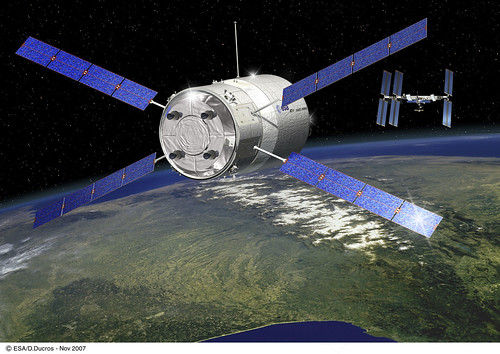
The ATV, the "Jules Verne," will also carry become the Ariane 5’s heaviest payload at 20.7 tons when it launches this weekend (9 March 2008) from Europe’s Spaceport in Kourou, French Guiana.

Wait a minute. Was that 20.7 tons?! That’s got to be double their heaviest payload ever. But if you think about it, the previous record was for launching into geosynchronous transfer orbit, which is much, much higher than the International Space Station’s.

According to yesterday’s piece in the New York Times, this increases the ESA’s ISS participation substantially:

Jean-Jacques Dordain, director general of the European Space Agency, said the inauguration of A.T.V. flights — along with last month’s delivery of the Columbus science module and activation of a European control center — cements Europe’s major new role in space.

"This makes us full partners and a significant player in the space station and space in general," Mr. Dordain said of his organization, which represents 17 European nations. The supply vehicle, Columbus laboratory and other components represent Europe’s investment of more than $7 billion in the station project.

Jules Verne and at least four spacecraft like it are to be launched to the station about every 18 months. Until now, American space shuttles and Russian Progress cargo ships have been the main lifeline to the station.

Michael Suffredini, NASA station program manager, noted that the European craft carries almost three times as much cargo as a Progress and will have an increasingly significant role. "It will be most important after 2010, when the space shuttle retires," he said.

The Jules Verne is the first fully automatic cargo spacecraft of its kind. After launch, it is designed to fly itself to the vicinity of the space station and use a unique system of laser-optical sensors to rendezvous and dock with no human assistance.

The ESA published a great video on the project. Enjoy:


Digital Test Drive

If—somehow—you have not seen the deluge of trade group tv ads, here’s the deal: millions of analog TV sets will no longer display broadcast TV signals unless they are connected to cable, satellite, or to a converter. Millions are being spent in easing this transition, including a free converter coupon program. Still, nervousness is spreading.

FCC Commissioner (and apparent theater fan) Michael Copps wants to schedule a practice:

"Broadway shows open on the road to work out the kinks before opening night," he wrote. "The DTV transition deserves no less."

Copps noted that other countries, like the United Kingdom, have made the shift in stages and that the "single transition date does not afford us the luxury of a built-in learning curve."

Martin, in a reply letter, said Copps had presented some "interesting ideas that I am in favor of pursuing, including switching a small number of test markets to all-digital service before February 17, 2009."

On Feb. 18, all full-power broadcast television stations will stop transmitting an analog signal. Viewers with cable or satellite television will not be affected. Over-the-air viewers will need a converter box, which the government will help pay for.

A test run would present challenges, Martin noted. It would require the "voluntary participation of an entire community or market." Martin said he will ask the agency’s digital transition task force to begin exploring how such field tests could be done.

Those annoying commercials have done their job – in the past year "2009 transition" awareness has almost doubled from 41 to 74 percent of consumers. But the education efforts are not over:

Washington — The Federal Communications Commission (FCC) on Monday issued a DTV Consumer Education Order requiring television broadcasters, multichannel video programming distributors (MVPDs), telecommunications carriers, retailers and manufacturers to promote awareness of the nation’s transition to digital television.

The FCC also said it will assist the National Telecommunications and Information Administration in ensuring that retailers are getting digital-to-analog TV converter boxes on shelves.

The mandated activities and reporting procedures for those efforts come after increased pressure from some members of Congress who want to ensure that consumers are aware of the upcoming analog TV broadcasting cutoff in time to make necessary adjustments. Previously, FCC chairman Kevin Martin had encouraged voluntary industry education efforts.

Britain – a space power?

Well, sort of. With a little investment, the Brits could be an important player in space exploration and business:

Britain can play an important role in space exploration by exploiting its skills in the satellite sector rather than joining the competition in manned space flights, according to David Williams, head of Avanti, a satellite communications company. "There aren’t unlimited resources – we have to prioritise in areas where we have an economic advantage," he said.

Britain should be creating the communications infrastructure that will be needed as exploration expands deeper into space, he said. Countries such as the US, China, India and Russia, as well as the European Space Agency, are working on deep-space exploration. "If mankind is going to exploit the resources of the solar system, you are going to have to travel over very long distances and you are going to have to communicate over very long distances and you will need a network of data-relay satellites. The UK has a big advantage. We have the opportunity to control the space internet, which is going to be this network of data-relay satellites."

As The Guardian explains, these hopes are part of the government’s space strategy, drawn up by the British National Space Centre, which aims to double the number of British companies involved in the space business by 2012. Unfortunately, a trip to the moon is NOT part of the plan:

However, many space enthusiasts will be disappointed to learn that the plan has little to say about long-held aspirations for a British astronaut, though officials are to launch a review of the costs and possible benefits of human spaceflight.

In the 1960s ministers opted out of all crewed space missions, a stance governments have maintained since, but last year several key groups of experts, including the Commons science committee and a panel commissioned by the BNSC, warned that Britain risked being left behind if it did not end its long-standing opposition.

The failure to back a British astronaut dismayed some experts who believe Britain has missed any chance of being involved in European and Nasa plans to send humans back to the moon.

"There’s no commitment at all from this strategy. We’re the only developed nation that doesn’t have an astronaut, despite the fact that we’re the fifth largest economy," said Nick Spall of the British Interplanetary Society, who has been leading a campaign for a British astronaut.

"The government has missed a huge trick in terms of being able to offer inspiration to young people. In particular the chances of the UK contributing to a return to the moon, from a human spaceflight point of view, are very limited now. If we don’t have an astronaut with spaceflight experience we won’t get a look in on either of those missions."

Instead of "catching up" with other national manned space programs, Britain is going to try to conquer what it beleives to be an emerging focus of space research – climate change and disaster warning/relief:

The threat of climate change to planet Earth is to become the cornerstone of Britain’s role in the heavens, following an extensive review of space policy. British experts will develop satellites and other sophisticated technology capable of gazing back at Earth and taking the pulse of the planet from orbit, by monitoring melting ice sheets, dying rainforests and violent storms, under plans to be published by the government today.

The satellites will help create an early warning system for natural disasters, including hurricanes and tsunamis, and help to police international carbon-cutting agreements, such as pledges to avoid deforestation in some of the world’s environmental hotspots.

The move is at the heart of the government’s space strategy, drawn up by the British National Space Centre, which aims to double the number of British companies involved in the space business by 2012.

Under the plans Britain will become home to a major new European Space Agency facility based at Harwell in Oxfordshire. It will be dedicated to understanding climate change from space and developing robotics for space exploration. Britain is the only major contributor to the ESA that does not yet have its own facility.

According to BNSC officials, Earth observation from space is prioritised to help Britain become a hub for expertise in environmental science and disaster relief. During the 1990s natural disasters killed half a million people and caused £380bn of damage. Some 80% of those disasters were weather related, the report states.

It says: "Global satellite-based monitoring systems underpin our understanding of the health of the planet, alert us to dangers and speed up our responses. Satellites have a significant role in accurately assessing changes in sea [level] and temperature, the melting ice caps, and the effects of solar activity on the Earth and its environment."

Kizuna: The Big Kahuna in Satcom Bandwidth


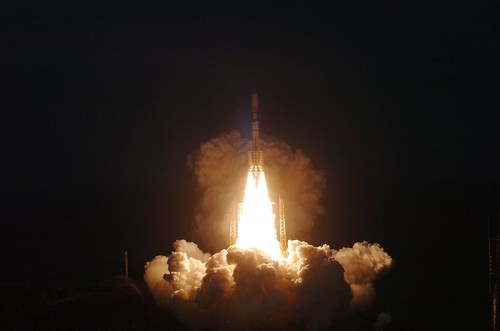
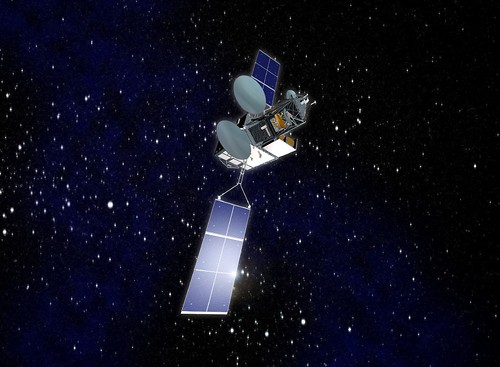
JAXA‘s new spacecraft, launched via an H-IIA rocket last week, promises 155-Mbps downlink and 6-Mbps uplink speeds:

It is expected that this information and telecommunications network’s speed and capacity will be much higher than anything achieved previously. KIZUNA satellite communication system aims for a maximum speed of 155Mbps (receiving) / 6Mbps (transmitting) for households with 45-centimetre aperture antennas (the same size as existing Communications Satellite antennas), and ultra-high speed 1.2 Gbps communication for offices with five-meter antennas.

In addition to establishing a domestic ultra high speed Internet network, the project also aims to construct ultra high speed international Internet access, especially with Asian Pacific countries and regions that are more closely related to Japan.

KIZUNA project is responsible for the demonstration of the validity and usefulness of technologies related to large-capacity data communications in our space infrastructure project, "i-Space," the purpose of which is to promote the use of satellites in such fields as Internet communications, education, medicine, disaster measures and Intelligent Transport Systems.

JAXA’s been working on this "i-space project" for a while now:

The Japanese Government announced in January 2001 that Japan becomes one of the most advanced countries in the world in the field of Information Technology (IT). They also set a ambitious target to launch an ultra-high speed Internet satellite (i.e. WINDS) by 2005 and completes verification testing of its function.

Recognizing the importance of this commitment toward an advanced information society and in response to a growing social demand to realize broadband communications environment and advanced mobile communications, JAXA proposes a new space project named "i-Space Project". The i-Space Project intends to make contribution to a revolutionized information society, and is accomplished by developing new space-based communication capabilities effectively integrated with ground communication infrastructure. It is also promoted by demonstrating an experiment(s) to prove its effectiveness in as many space-based application areas as possible.

Here’s the launch video:


DIY Friday: Spacecraft

So, you’re sitting at your desk thinking about the sci-fi movie you watched last night or a fantasy outerspace adventure. If you can’t wait for the weekend to make your futuristic dreams a reality (sort-of), start by building an Office Supplies Starship Enterprise. From your employer’s supply cabinet, grab one wall clip, two small paperclips, one large paperclip, one small pinch clip, some tape, and a black Sharpie. With a little ingenuity, you have a passable replica for some afternoon day-dreaming.

Now, for tomorrow’s task – build a cardboard spaceship out of two washer/dryer boxes. With a little paint it sure can look good — too bad it can’t fly.

Alfie Carrington, a construction worker from Michigan is a little more ambitious:

The construction worker spends his free time inside a rented storage garage in Clinton Township, Mich., where he broods over a 14-foot-wide, carbon fiber, fiberglass vessel.

Thirty years ago, when Carrington was 27 and obsessed with science fiction, he set out to build a UFO look-alike. Despite his lack of engineering experience, Carrington pored over books, magazines and studies about aviation and spent nearly $60,000 for some of the materials needed for this saucer.

Carrington does it because he believes he has discovered a simple design for an aircraft that aeronautical engineers have spent countless millions trying to build.

Carrington has two patents on the design and a company called Vertex Aerospace. His work caught the attention of NASA, which invited him to a conference in the mid-1990s where engineers scratched their heads when he confessed he knew nothing about computers.

His own version of Anti Gravity Technology Propulsion: His idea is to fire up the vessel with a rotary engine to stimulate a magnetic levitation system to rotate the ship’s two discs. The discs would draw air into propeller blades.

A (very entertaining) video of the project is below. But before you take up a similar design, a word of warning:

“Things spinning at those speeds are worrisome because of the stress from centrifugal force,” explained Cornelis van Dam, professor of mechanical and aeronautical engineering at the University of California-Davis, a leading aviation school. “If it’s not properly designed and built, it will rip itself apart. I wouldn’t want to stand next to it when it gets up to speed.”

If you’re a little timid about centrifugal destruction, maybe we should keep the saucer on the ground. For the kids, build a saucer fort built from two discarded microwave transmitter dishes and $75 bucks worth of supplies. And if you want more than a little tree-house, you should buy this house in Tennessee. You can see it from space:


View Larger Map

If the static house isn’t good enough and you’re still scared of Alfie’s saucer, buy an individual flying vehicle for a pricey 50k. Or, better yet, just fake it: