Fireworks
In honor of our Nation’s birthday tomorrow, I bring you "space fireworks" — or the best space can do to mimic illegal fireworks:
From the Hubble Telescope:


In honor of our Nation’s birthday tomorrow, I bring you "space fireworks" — or the best space can do to mimic illegal fireworks:
From the Hubble Telescope:
Expanding on Friday’s DIY post about solar-powered WiFi extenders, St. Louis Park, MN is implementing a solar-powered, city-wide wireless network (link):
Unlike any other community wireless system in the nation, the St. Louis Park Wi-Fi network is powered by the sun.
ParkWiFi will provide wireless Internet coverage across all 10 square miles of the city, using about 400 wireless access points. Each access point will have a battery to supply electric power and a solar panel to keep the battery charged. Several miles of fiber optic cable will tie it all into a network.
Unlike non-solar projects in Madison, WI and Philadelphia, ParkWiFi will not primarily use existing utility poles (likely because of solar-panel placement) — a move that caused some contention:
Council members and city staff grew concerned after beginning installation of the poles in mid-April and receiving feedback about the locations and aesthetics of the solar equipment and poles. It is also clear that many people believed that the equipment would be installed on existing utility poles as was done during the pilot project. The pilot project did not include the use of solar power technology. Hearing the concerns, especially about the location of poles, staff stopped installation of the poles and brought the discussion before the council.
In some cases, pole color and height were changed and mid-size lot placement were moved to property boundaries and alleys. But, "Council also directed staff to not compromise on performance of the system while finding new locations."
The project is a private – public partnership between the City of St. Louis Park (which will own the network), Unplugged Cities (which will operate and maintain the network and provide subscriber services), and ARINC (which will build the network).
The city challenged proposal responders to be creative. ARINC delivered:
The novel solar approach eliminates the need for the City to pay the local electric company monthly fees for per-pole attachments and electricity usage, a projected savings of $200,000 to $250,000 over the course of the five-year project. Service to the existing pilot areas will continue as ARINC completes the phased build out citywide. It is anticipated service to most of St. Louis Park will be completed by fall, except for some residential units in the largest buildings and some commercial buildings.
Google CEO says "expect more announcements over time" in this clip from the BBC:
WiFi is meant to be liberating. Drop the cords, forget the desktop computer, and just work or surf from your couch, kitchen, or backyard—that is, if the signal will reach beyond your walls. To solve this—and to avoid having to lay a wire down the middle of your backyard—build a solar-powered extender/repeater.
Popular Science lays out the formula:
It uses a Linksys Wi-Fi range expander ($100; linksys.com) modified with an omnidirectional 9dBi antenna ($58; pacwireless.com). To avoid unsightly extension cords in the flower bed, I added a lead-acid battery ($22; radioshack.com) and a 10-watt solar panel ($119; sundancesolar.com) to charge it.
Wire the Antenna
1. Open the expander by removing its rubber feet and the screws underneath them.
2. Remove the brown and blue power plugs and the brown power-supply board.
3. Desolder the existing antenna and replace it with an antenna mount.Add the Battery
4. Install a fuse holder and a 10-amp fuse near the negative terminal of the battery.
5. Connect the negative lines, and separately the positive lines, from the cigarette-lighter socket, solar panel and battery.Attach the Panel
6. Solder red and black leads from the circuit board to the DC-to-DC converter, and plug the converter into the lighter socket.
7. Stuff everything into a weatherproof box and mount it at head height, with the solar panel at a 45-degree angle.
If you want to extend the range beyond 200-300 feet, try using a directional antenna to broadcast the signal towards a specific area (your outdoor patio, perhaps), or add another extender/repeater.
Meraki, an intriguing company that develops hardware and software for community networks, recently announced it will be selling a product similar to this DIY-contraption.
Priced at just $99, Meraki Outdoor can send a signal up to 700 feet. Paired with Meraki’s existing indoor $49 Mini, the Meraki Outdoor repeater can power access for dozens of households sharing one high speed connection. Meraki Outdoor can be easily installed on a wall or even a pole outside the house. It marks another step forward in Meraki’s efforts to change the economics of Wi-Fi access, driving the cost per household of high speed connections to $1 to $2 a month.
Adding the Meraki Solar accessory kit will allow the repeater to broadcast a signal without being connected to any electrical source, making it an ideal solution for any community, even emerging markets where electricity is scant or unreliable. Once connected, Meraki Solar’s power usage can be distributed throughout the day and managed by the Meraki Dashboard service ensuring the repeater is powered during peak usage times. The Meraki Dashboard is a web-hosted management tool designed to make monitoring, configuring, and monetizing a Meraki Network easy and is included with all Meraki products for no additional charge. The solar kit includes a solar panel, battery pack and an outdoor Ethernet cable.
The Meraki Outdoor repeater is for sale on their website. The solar kit is not yet available (so you’ll have to stick with PopSci’s DIY instructions, for now).
 The most obvious use of this technology would be for a small neighborhood to purchase a T-1 and distribute it around the neighborhood using a series of repeaters. In the past, this would require a high-level of network engineering (optimal routing paths, back-up routes, various nodes, complex software, etc.). These new products simplify the task.
As the software becomes simpler and the hardware more compact and durable, the implications of this technology could be far reaching. In places with unreliable power service and scarce network engineers (think the Developing World), this technology could be especially useful, extending access to broadband and lowering costs. Green Wifi is doing this, distributing out-of-the-box, solar-powered, WiFi routers and repeaters.
Those pesky trees. Let’s say you are finally willing to make the satellite leap, when your installer gives you the bad news: the trees are in the way. Or even worse, let’s say you install a dish, only to have it blocked a year later as your tree-line skyrockets.

It’s a big problem and there isn’t a clear answer. Let’s start by addressing a few common comments on this subject’s many forums (here, here, and here).
I installed my dish in February, it worked fine in my wooded lot, but now I’ve completely lost my signal.
The problem could be, believe it or not, leaves. One woman in Illinois experienced this: "“As the trees started getting leaves on them, we’d get those little squares [on the TV screen]. Then it just kept telling us it’s acquiring a signal.” The installer apparently received a strong signal with the trees obstructing and assured the couple there wouldn’t be a problem. He didn’t consider the leaves come Spring.
My neighbor’s dish is blocked by branches, but his signal is perfect. Why me?
While the provider may have something to do with this, it could be simply a result of geometry. Most cheap, compact dishes are actually offset, so the line perpendicular to the dish’s face is not the actual direction of the signal. See the attached diagram (hat-tip to Aris):

My south-facing roof is completely blocked by trees. What do I do?
Your dish does not necessarily need to face south. Check with your provider and a professional installer. Also, consider a ground placement if there is enough open-space.
Before placing a dish, spend a considerable amount of time surveying your property, ideally with a satellite professional. And do not underestimate the growth of trees. It would be wise to identify your trees and research their maximum height and growth-rates. A Princeton American Elm, for example, can grow three to six feet per year during early development (AmericanElm.com). You can always trim your trees but this could be a costly affair—and don’t count on your local government to trim road-side trees to improve your tv reception.
But, as one reader points out, don’t just resign and let the trees win. Be creative.
So, if you do live in a place that is surrounded with trees and blocking the southern sky, don’t give up because there’s always something that can work out. I honestly didn’t think we stood a chance. But you can make it happen…so don’t give up.
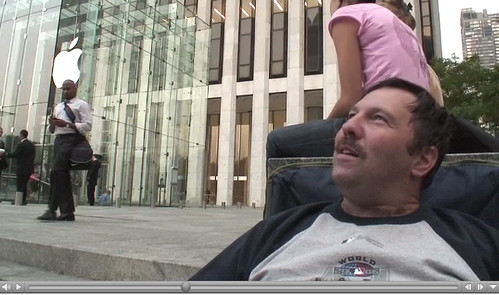
Yes, the Apple iPhone goes on sale Friday. Mr. Packer from Long Island was first in line at the Apple Store in New York. He started the queue at 5:00 a.m. on Monday. Read the "First in Line" blog.
Watch his interview here. For such an effort, he deserves a digg.
I still think it will be able to receive live TV signals from towers and/or satellites. We blogged about Apple’s trademark filing during CES 2006. Now consider this new chipset from Samsung, via EETimes:
Samsung Electronics Co., Ltd., has started sampling a multi-standard channel decoder and multi-band radio frequency tuner chipset made using its 65-nm process that it says supports almost all mobile TV standards including DVB-H/T, DAB-IP, ISDB-T, and terrestrial DMB.
Volume production of the part is scheduled for the fourth quarter of 2007.
The chipset is being offered either as two standalone ICs or as a system-in-chip package (SiP).
"Although a new market, we see high growth potential in mobile TV applications," said Yiwan Wong, vice president, Marketing Team, System LSI Division, Semiconductor Business, Samsung Electronics.
Wong added the part will initially be targeted at the European and Asian markets.
Samsung says the multi-band RF tuner, which receives the analog broadcast signal, has a simplified circuit structure by applying a low IF to compliment the conventional zero IF. It is also a general purpose tuner that supports UHF, VHF and L-band commonly used in Europe and the U.S.
The company says the chipset requires no external low noise amplifier (LNA) and additional memory chips, significantly reducing the bill-of-materials (BOM) cost of the total system. The chip set supports Link Layer processing to output fully error-corrected IP datagrams or MPEG2 transport streams.
The iPhone introduction is only the beginning of the new mobile revolution. Keep up with the news if you can.
And now, the official reviews…
David Pogue of The New York Times:
Walt Mossberg of The Wall Street Journal:

Chrysler’s exclusive Sirius Backseat TV deal just got a little more interesting. As part of a wider sponsorship deal with Nickelodeon, Jimmy Neutron will be promoting the Town & Country’s unique features: MyGig entertainment system, Swivel ‘n Go seating configuration, and Sirius Backseat TV. The details, via MediaPost’s Marketing Daily:
Ads will star Jimmy Neutron, who will explore the vehicle to spotlight features like Swivel-N-Go seating, the latest innovation from the company.
The company says he will also appear in online ads on Chrysler.com. Costumed Jimmy Neutron characters will grace Chrysler’s booth this year and next at auto shows, mobile tours, and in-theater ads where Chrysler products are featured.
The deal also includes a grassroots effort.
Chrysler will be exclusive automotive sponsor of Nickelodeon’s nationwide 20-city road show called "Slime Across America," launching next month.
Chrysler will have a Town & Country display showcasing the SIRIUS Backseat TV and on-site photo opportunities with a Jimmy Neutron costumed character, among other things.
Chrysler will also be featured in billboards on any of Nickelodeon’s local cable affiliate spots geared around the tour.
Chrysler will also have a Town & Country and Chrysler product specialist on site at Nickelodeon Family Suites by Holiday Inn in Orlando, Fla., from November through January 2008, where Chrysler’s custom spots will air on the hotel’s in-house TV network. Nick Hotel branding will be featured on Chrysler.com during the promotional window.
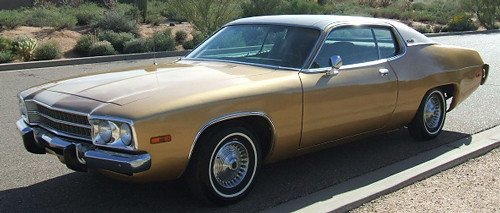
Too bad the Plymouth brand was killed a few years ago, otherwise he’d be driving a Satellite (you can still buy an old one on ebay).
The folks at Viacom have been pretty busy lately with licensing, especially at last week’s Licensing International show in New York. That theme park deal in Dubai ought to be interesting:
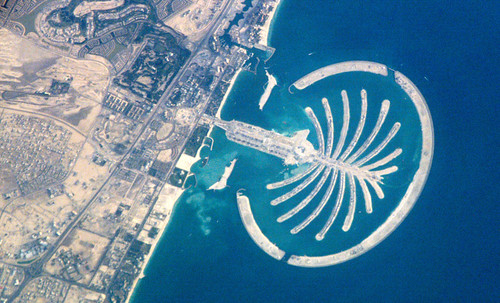
A unit of Viacom Inc. signed a deal with Dubai-based Ruwaad Holdings to create a theme park in the United Arab Emirates, featuring rides and attractions based on the Paramount Pictures film library, which includes “Titanic,” “Forrest Gump” and “The Godfather.”
The park is part of a larger $2.5 billion destination complex that includes boutique hotels and resorts, retail shopping and residential properties. An opening date has not been disclosed.
The deal with Viacom’s Paramount Licensing Inc. division marks the second time Viacom teamed up with a Dubai firm to create a park in the UAE. The company’s Nickelodeon unit signed separate agreements with the Al Ahli Group to license its characters for a $1 billion theme park. Marvel Entertainment Inc. signed a similar deal with Al Ahli.
Nickelodeon will help create rides and attractions based on its children’s cartoon characters, including SpongeBob Square Pants, while Marvel plans to lend its comic book hero’s like Spider-Man, The Incredible Hulk and the Fantastic Four.
Earlier this month, Nickelodeon signed an agreement with Marriott International Inc. to develop a series of upscale resort hotels and theme parks, with the first planned for San Diego in 2010. The companies plan to build up to 20 resorts by 2020 around the world.
Dubai is one of the world’s fastest growing tourism destinations, and the Al Ahli Group theme park is part of a plan to more than double the number of annual visitors to 15 million by 2011. Last year, six million people visited Dubai.
But back to the TV service, which will include Disney Channel, Cartoon Network and Nickelodeon as part of the package. It will use hardward developed by STMicroelectronics:
SIRIUS Backseat TV, which offers consumers three channels of family TV programming, can be received via an in-vehicle satellite video receiver and two small roof-mounted antennas. The SIRIUS Backseat TV digital audio and video signal is broadcast over the same frequency spectrum allocation as SIRIUS radio.
The core of the in-vehicle satellite video receiver, which is manufactured by Delphi for SIRIUS, is based on three ST chips: the STA210 RF tuner IC; the STA240 channel, service and source decoder IC; and the STA264 advanced hierarchical demodulator chip, which extracts the video stream and performs error correction on the received signal.
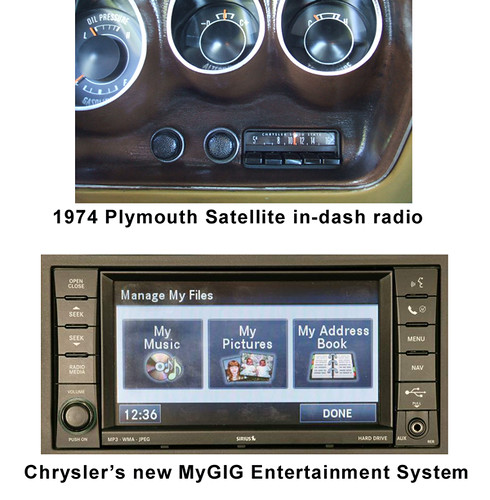
Those Plymouth Satellites came with an AM radio. That’s it. Today, Chrysler’s MyGig system is something we’d expect in a new car:
The system goes a step beyond iPods and other entertainment devices by putting a 20-gigabyte hard drive in the dashboard.
MyGIG allows drivers to download up to 1,600 songs. Users also can put up to eight photos and an address book into the system. Navigation maps with a three-dimensional appearance also are stored on the hard drive. MyGIG incorporates real-time traffic information from Sirius Satellite Radio.
Sirius Backseat TV will not be available as an option in a Dodge Viper, obviously.
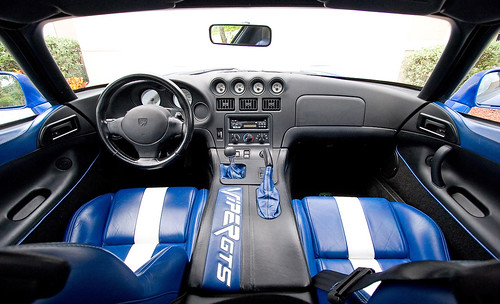
Hey, Jimmy Neutron’s been seen on a Campbell Soup can, but let’s not compare him to Andy Warhol.

Reply to: [email protected]
Date: 2007-06-26, 10:04AM EDT
If you are looking for a microgravity labratory, this place is PERFECT for you. I’m now focusing more on exploration-related activites and have some extra space I can share. I prefer government agencies (are you from the National Institutes of Health?) but am willing to accept a private business.
The room should be available until at least 2015, although some think it can hold-together until 2022.
The move could be a bit tricky. My spacecraft fleet goes out-of-service in 2010. You will need to build or borrow a space-craft to get here.
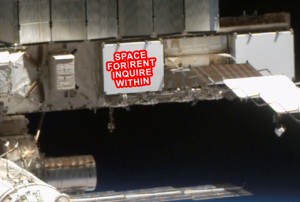
Location: Space
it’s NOT ok to contact this poster with services or other commercial interests
PostingID: 360874
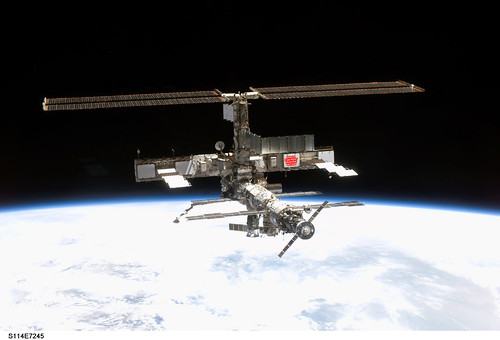
Yes, the International Space Station is for rent. From NewsDay:
For the past two years, much of the science at the space station has been oriented toward returning astronauts to the moon, and even going on to Mars.
“We didn’t need the entire capacity of the space station to do exploration-related research,” said Mark Uhran, NASA’s assistant associate administrator of the space station. “So the capacity that was freed up after we restructured our program is now available to other agencies or private sector companies.”
The space station’s first section was launched in 1998 and it has been inhabited continuously since 2000 by Russian, U.S. and European crew mates. By 2009, the station’s three-member crew is expected to grow to six people.
The station was designed to last until at least 2015, but managers now believe it could operate as late as 2022.
“What probably drives the life is … probably how much the space station is utilized,” said Bill Gerstenmaier, NASA’s associate administrator for space operations.
Once it is completed, it will cost about $1.5 billion a year to run the space station. About half the space station’s U.S. section would be available for the use by outsiders, who wouldn’t have to pay a fee for its use.
NASA’s plans to open up the space station to outsiders, though, depend on whether private companies build spaceships that could travel to the outpost as a replacement for the grounded shuttles after 2010. NASA has given $500 million in seed money to two private companies to build spacecraft and has signed agreements with others.

Rancher W.W. "Mack" Brazel woke-up early one morning after a night of intense storms to check-on his ranch, about 70 miles North of Roswell, NM, and clean-up some debris. What he found started more than 60 years of intense discussion. Conspiracy or cover-up, the debate continues.
We all know the story: Mack couldn’t explain the debris, called the local Sheriff but didn’t make too much of the incident. He told the Roswell Daily Record that he and his son saw a "large area of bright wreckage made up of rubber strips, tinfoil, a rather tough paper and sticks." The Sheriff called the local Air Field who sent military officers. The U.S. military first said it was a flying saucer, then backtracked and said it was a weather balloon. Was this flip-flop a cover-up or simply a communications blunder?
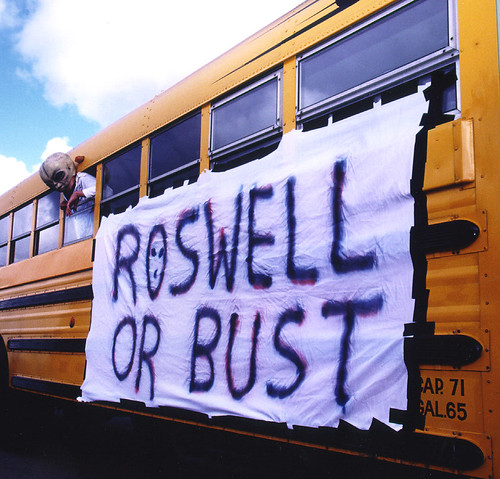
A crowd, mostly of the "cover-up" opinion, will gather in Roswell in early July to "celebrate" (if that’s the right word) the 60th anniversary of this landmark event in UFO history. City officials expect the Roswell Festival could attract 50,000 people to the area, which has developed into a sort-of theme park for flying saucers and aliens, complete with a museum, gift shop, "Alien Zone," and, soon, a roller-coaster.
While the UFO theories didn’t resonate in the reality-based population until Roswell (1947), people were writing about flying saucers much earlier in the century. From claims of "Deros," a race of freaks living under the Earth’s crust, to stories of spaceship kidnappings, pseudo-Science journals tapped into the imaginations of thousands of Americans, from creative teenagers to paranoid-schizophrenics. For many, Roswell confirmed their dreams/conspiracies/nightmares.
No, I do not believe aliens are stalking humans or that the Roswell debris was anything but a downed weather balloon. But I still appreciate what the Roswell incident contributed to American culture. Without sounding too cheesy, it forced all Americans (not just the Paranoid) to consider the limits of our planet and space. It forced Americans to think big, to explore our solar system, to look up at the stars and consider our possibilities. Perhaps—just maybe—we wouldn’t have had the will to land on the moon had it not been for the collective imagination brought on by Roswell. I have little doubt that Roswell spawned generations of space-enthusiasts, scientists, and astronomers that continue to innovate and explore—much of which we discuss here on ReallyRocketScience.
The CommunicAsia 2007 trade show just wrapped up in Singapore, which has been billed as the largest such event ever held in South-East Asia.
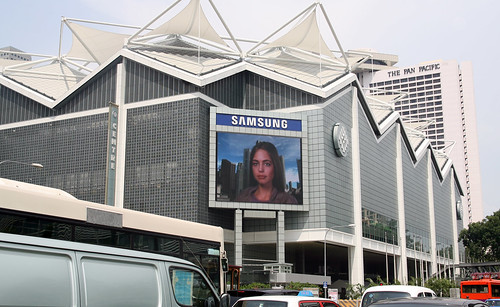
There was no shortage of press hype around this show. From Dubai Internet City to Nokia Siemens Networks, Huawei, to Yahoo! and Samsung. We were especially interested in those in the satellite business — and there were nearly 100 of those.
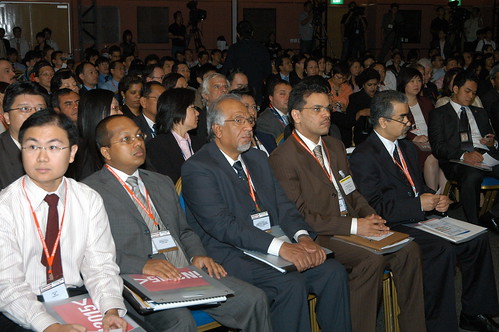
Of the more than 67,000 visitors to this show, we saw one satcom CEO on CNBC Asia this week:

/UFOs/RoswellDailyRecord.jpg)