DIY Friday: USB Charger Kit

No matter how cool gadgets get — and whether you buy them or make them yourself — battery life is still the barrier that reminds us that cool stuff only remains cool so long as the juice is flowing.

Unfortunately, toting around all the different chargers that one needs to keep cameras, MP3 players, cell phones and other gadgets going can be a pain in the posterior.

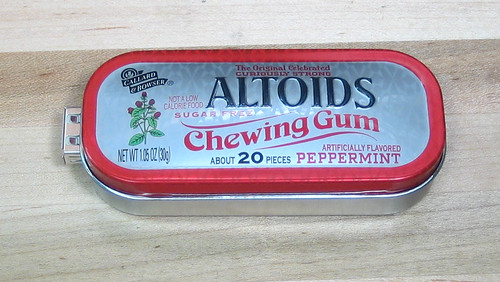
And so for today’s edition of DIY Friday, we present to you…. (drumroll)….. a tin of Altoids!

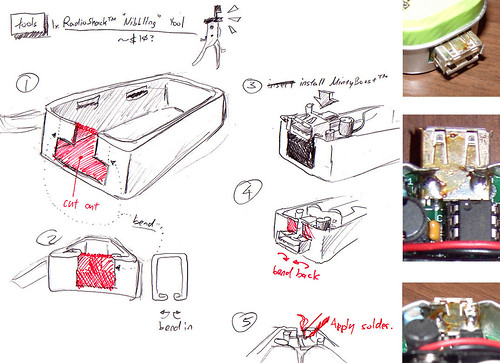
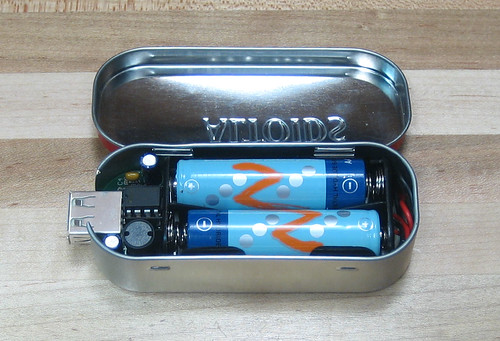
Ok, not quite. Close observers will notice that little USB port over on the left. Open up the tin, and this is what you’ll find:

The inner workings of a DIY USB Charger Kit, made from this schematic:

What’s that? Need more detail, you say? Complete details on how to make your own USB charger kit for your personal gadgets — with or without the handsome Altoids case — can be found here. An even quicker way to jumpstart your weekend project is to buy this kit from Make magazine. For only $20 plus shipping and a few hours of your time, you can have your own portable way of recharging your gadgets without towing around a bevy of chargers and cords.


Ramen in Space… Again, but Now for Longer

According to one of my favorite space sites, SpaceDaily, Japan is Koichi Wakata, whose a veteran astronaut at the ripe old age of 43, will be the country’s first citizen to stay long-term in space begining in the fall of 2008 a three month stint on the International Space Station (ISS).

On his third mission into space (the first happened in 1996, the second in 2000) Wakata will be spending much of his time running a series of experiments in a small laboratory, Kibo (meaning "Hope"), on the multi-national space station. While excited about the opportunity his trip represents, Wakata is even more excited about bringing his nation’s noodles into space.

"’Since I believe that the chances will increase for Japanese astronauts’ long-term stays, I want to check things out such as the clothing, food and accommodation" for future astronauts,’ [Wakata] said.

‘I especially want to try Japanese foods like delicious ramen,’ he said."

Those tasty noodles, invented by the recently deceased Mr. Noodle (right), were originally flown into space on a 2005 US Discovery flight with Japanese astronaut Soichi Noguchi.

Oh, and for those keeping count, according to the Wikipedia, currently 14 of the 193 countries on earth have had representatives visit the ISS so far. Looks like we got 179 to go!

SES Buying Out GE

Reuters reports:

European satellite company SES (SESF.LU: Quote, Profile , Research) (SESFd.PA: Quote, Profile , Research) said on Wednesday it had agreed to buy back a 19.5 percent stake in the company from General Electric (GE.N: Quote, Profile , Research) in a deal worth 1.24 billion euros ($1.62 billion).

SES shares shot up to an 11-month high of 14.80 euros and were up 6.4 percent at 14.50 euros at 1600 GMT, with investors relieved of the prospect of GE releasing shares onto the market.

"SES will contribute certain assets and cash to a new company and exchange shares of that new company for GE’s entire holding of 103,149,900 shares in SES," the company said in a statement of a deal it expected to boost earnings.

In a presentation, SES said it expected its earnings per share to rise by over 13 percent in 2007.

SES Chief Financial Officer Mark Rigolle described the deal as "made in heaven" by removing the overhang of GE’s holding that has been depressing SES shares and by restructuring SES’s portfolio after its 2005 acquisition of New Skies.

SES, one of the world’s largest commercial satellite operators, said it would pay the equivalent of 12 euros for each exchanged share, resulting in a total transaction value of 1.238 billion euros.

This could rise by 45 million euros depending on the closing date. SES said the deal was expected to close in the second quarter of 2007.

GE took the stake in 2001 when SES bought GE’s satellite business Americom.

KBC Securities said in a research note that the valuation of the assets appeared fair, and the disposal of certain assets made sense, with some overlap following SES’s purchase in 2005 of New Skies.

"The transaction should be earnings accretive, will increase financial leverage and bring the free float up to 70 percent," KBC said.

In the credit derivatives market, the cost of insuring SES debt against default edged higher, up 2 basis points to 30.5 basis points, a trader said, on fears that the deal could make the company more attractive in a leveraged buyout.

GE will swap its SES shares for shares in the new company, SES International Holding Inc, comprising assets including one satellite, a variety of stakes in related businesses and 588 million euros in cash.

SES will seek to cancel some 86 million of the 103 million C shares it buys back and convert the remainder to FDRs to pay B-shareholders.

CFO Rigolle said the deal would simplify the shareholding structure, with the cancellation of around one in five of its shares.

SES also set new revenue and core earnings (EBITDA) guidance for 2007 to reflect the GE transaction. It sees revenues of 1.568 billion to 1.608 billion euros and EBITDA of 1.041 to 1.081 billion euros.

SES agreed to buy New Skies in December 2005 to boost its presence in Latin America and the Indian Ocean region.

Separately on Wednesday, Asia Satellite Telecommunications Holdings Ltd (1135.HK: Quote, Profile , Research) said its major shareholder Modernday Ltd planned to take the company private for $282 million. Modernday is jointly owned by CITIC and General Electric Capital Corp. (Additional reporting by Richard Barley in London)
 

Here’s the official news release:

SES (Euronext Paris and Luxembourg Stock Exchange: SESG) announces that it has agreed with GE a EUR 1.2bn split-off transaction in which SES will contribute certain assets and cash to a new company and exchange shares of that new company for GE’s entire holding of 103,149,900 shares in SES, subject to satisfaction of certain closing conditions. As disclosed in March 2006, SES has been discussing with GE a number of options to achieve a structured exit from its remaining shareholding.

GE will exchange its shareholding in SES for shares in a new company, SES International Holdings, Inc. (“SIH”), comprising assets and EUR 588 million in cash, subject to certain closing adjustments. SES has agreed to pay an equivalent of EUR 12 for each exchanged share1, resulting in a total transaction value of EUR 1,238 million. The cash amount and the transaction value may be increased by approximately EUR 45 million depending on the closing date.

The assets of SIH will be:

  • The AMC-23 satellite and its related business
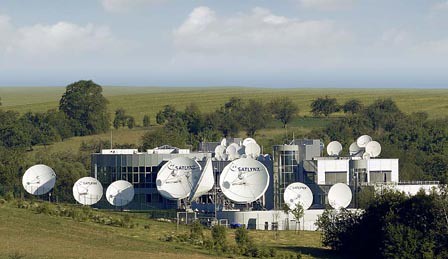
  •  100% of SATLYNX
  •  49.5% of Bowenvale (representing a 34.1% interest in AsiaSat)
  •  19.99% of Star One
  •  5.5% of Orbcomm

Due to the intended US tax treatment of the transaction, third party valuations of the assets were secured.

The transaction announced today allows SES to achieve two important business objectives: to restructure and optimise SES’ portfolio of assets following the SES NEW SKIES acquisition and to remove the GE share overhang.

The acquisition of SES NEW SKIES in March 2006 added to the SES fleet five 100% owned satellites over Asia, Africa and Latin America (NSS-806, NSS-7, NSS-703, NSS-6 and NSS-5). These satellites are in addition to the spacecraft already owned through participations in AsiaSat and Star One, as well as the three other 100% owned assets (AMC-12/ASTRA 4A, AMC-23 and AAP-1), which have comparable coverage and serve similar business purposes to some of the NEW SKIES satellites. This created an opportunity to restructure and optimise SES’ business assets and portfolio of minority participations which led to the decision to divest from the shareholdings in AsiaSat and in Star One as well as to dispose of the AMC-23 satellite operated over the Pacific Ocean Region (POR).

With SES NEW SKIES generating most of its revenues in the government and enterprise infrastructure segment, SES has also re-evaluated the relevance of certain of its satellite end-to-end managed service activities in the enterprise market. As a result, SES decided to divest from SATLYNX, the group’s end-to-end managed service entity. There will now be an increased focus of the SES service business on media and government applications.

SES expects to derive significant corporate benefits from the transaction as it removes the GE overhang which had created the perception of a cap on the SES share price since the announcement that GE intended to divest its interest in SES.

The transaction is expected to close by Q2 2007 subject to the satisfaction of the closing conditions (which include, among others, receipt of certain approvals from SES’ shareholders, a tax ruling regarding the tax treatment of the transaction for GE, and required regulatory approvals).

An Extraordinary General Meeting will be scheduled for March 15th, 2007, in order to allow the Company to buy back all 103,149,900 C-shares, of which 85,958,250 will be canceled. As the B-shareholders have elected to be paid in FDRs in lieu of cash, the remaining 17,191,650 C-shares will be converted into FDRs in order to pay the B-shareholders for their 42,979,125 B-shares. As a result of the transaction, and while maintaining the number of B-shares at 1/3 of the total, the shareholder structure of SES will be simplified.
 

Detecting Debris in Space


Just last week we wrote about the International Space Station needing to manuever to dodge junk in space — or, specifically, the debris from the disused satellite that the Chinese recently shot down in a military experiment.

Thus it’s a bit ironic, as NewScientistSpace points out, to learn that the "only experiment designed to survey and trace the origin of space debris too tiny to be tracked by radar has been cancelled:"

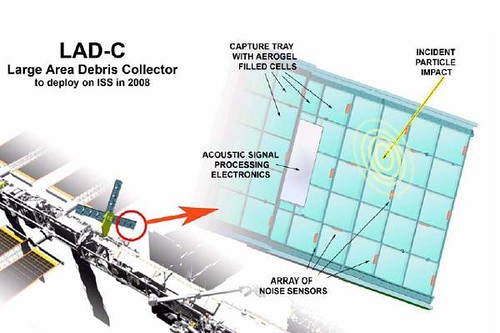
An international team of scientists had been planning to capture and catalogue this dust from outside the International Space Station with an experiment called LAD-C (Large Area Debris Collector). Meant to be launched on a shuttle in 2008, LAD-C was going to catch the debris in a sponge-like aerogel mounted on a 10-square-metre aluminium grid.

When a piece of space debris hit the aerogel, it would have sent vibrations along the metal grid, where piezo sensors similar to the ones in electronic drum kits would have picked up the signal.

A computer would have registered the location, impact speed and timing of the strike, and based on the orientation of the space station, this would have given the particle’s orbital trajectory. Researchers would then know whether it came from space junk, an asteroid or a comet, and would be able to study its composition when the experiment was brought back to Earth in 2009…

The cancellation of LAD-C collector (additional details of which can be found here, in this PDF) comes at a strange time, NewScientist argues:

The cancellation coincides with the most dangerous orbital debris event in the history of space launches. On 11 January, China destroyed one of its own weather satellites with a ground-launched ballistic missile, creating more than 900 objects larger than 10 cm across and an estimated 35,000 smaller objects spanning at least 1 cm. The debris spread throughout low-Earth orbit, from altitudes of 200 to nearly 4000 kilometres, and is expected to stay in space for hundreds of thousands of years. 

Without the LAD-C, how will rocket scientists keep up with all the debris in space?

Why, by reading the Orbital Debris Quarterly, of course.

Meanwhile, this rockets scientist has been told by his supervisor (at home, not in the office) that our own personal LAD-C is operational and should in fact be deployed. 

PBS HD on Satellite TV


We read today in TVPredictions.com satellite TV operators may soon need to carry the Public Broadcasting Service’s HDTV feeds:

Public Broadcasting officials say satellite TV operators should be required to carry their High-Definition signals.

PBS executives from across the country are coming to Washington this week to urge Congress to change the Communications Act to include a must-carry provision.

"DIRECTV and EchoStar use scarce public airwaves to beam their signals to and from satellites," says John Lawson, president and CEO of the Association of Public Television Stations (APTS). "They use highly valuable international orbital slots for these satellites. It’s outrageous that they won’t carry the new digital channels from local public stations, but find a way to carry the big four commercial network stations."

DIRECTV and EchoStar have expanded their local HD service over the last year, but do not offer the PBS high-def signal in most cities.

APTS says the Communications Act should state that the satcasters must carry PBS’ "entire multicast digital programming," which would include the high-def signal and other digital feeds.

Satellite TV services are required to carry the analog feed of the local PBS station under the Satellite Home Viewer Improvement Act.

APTS says DIRECTV is considering carriage of PBS digital feeds, but talks are at an early stage. EchoStar, the group says, is refusing to carry the PBS digital feeds.

In January 2005, the PBS group signed an agreement with the National Cable and Telecommunications Association for carriage of all PBS digital signals on large cable TV systems. APTS says it hopes to sign a similar agreement with smaller cable systems in the near future.

The Association of Public Television Stations Web site gets into the details:

Specifically, APTS seeks to amend Section 338 of the Communications Act to make clear that the digital signals of Public Television stations are subject to the carry-one carry-all provisions related to carriage of local broadcast signals via satellite. This action would clarify that the entire multicast digital programming transmitted by a Public Television station is subject to mandatory carriage.


Gotta love Variety’s witty headlines:

Public broadcasters lobby on carriage

Networks plea to Congress for satellite TV signal

By WILLIAM TRIPLETT

Local pubcasters are set to launch a lobbying blitz to convince Congress to mandate carriage of all their digital signals by satcasters DirecTV and EchoStar.

As the Assn. for Public Television Stations hosts its "Capitol Hill Day" this week, reps from local noncommercial broadcasters from around the country will converge on Congress to express their frustration that "the high-definition signals of commercial stations are carried by satellite distributors, while public television stations’ new digital signals are kept off," according to an APTS statement.

They will therefore ask in the coming days that Congress support legislation requiring that DirecTV and EchoStar carry all local pubcasters’ HD and other digital programming during the transition to all-digital TV and after it is completed in February 2009.

Logging On at Mach 6

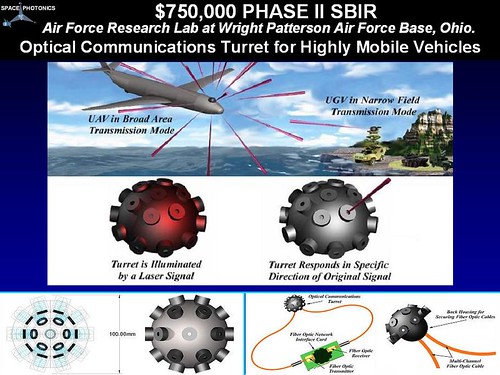
Bringing new, potential meaning to the term, space pirate, is Fayetteville, AR-based aerospace firm Space Photonics who, according to the Northwest Arkansas Morning News, is working to up the bandwidth on military/government space and aircraft using optical technology. Check out the powerpoint slide below to get a better idea of how communication "turrets" would connect with satellites to get high-speed ‘net (and other communications) connections through to fast moving targets.


While the technology might mean that future Maverick’s can pirate copies of The Fast and the Furious VII: Golfcarts of Doom on their forays into the wild, blue yonder, the real excitement its stirring up centers around the potential it opens up for "synchronized communication lines between satellites." While the Morning News seems to think that this might translate into synchronized satellite orbiting competitions, its more likely to change communications in other more important ways.

DIY Friday: Get a Space Job!

Believe it or not, this is Hawaii, and you could be there. Read below to find out how. 


Here’s the ultimate Do-It-Yourself project for the space buff who’s already created their own Mooninite shirt, created a PlayDoh radio, and souped up their WiFi receiver: get a space job!

You may think that only a certain type of 1960s nerd can become a rocket scientist, but in truth, the space industry is incredibly diverse, and talented people from all walks of life can make successful careers within it.

And your colleagues may be more cheerful than you’d ever imagine. 

So how does one go from dreaming of space, to working on projects related to space?

Astroplace has a huge collection of links; two less-imposing places to start are at Spacejobs.org and Space-Careers.com.

Space.com also has a job board powered by CareerBuilder.com, which — while we’re working this sub-theme of American sports — happened to have one of the better ads during the Superbowl.

Ok, so now that we’ve looked at SI cheerleaders and funny ads on TV, where were we?

Oh yeah: we were trying to get a job. What’s out there?

Well, looking at the jobs posted at the Smithsonian, they need an astrophysicist at the Smithsonian Observatory near Boston, but this job is based in (hello!) Hilo, Hawaii. 

Hard to top that that. But if you miss the deadline and want another great place to work, be sure to check out the job opportunities right here at SES-Americom— especially our Associate Program, which is designed to accelerate your career through a 24-month program in which DIY-minded people like you are assigned four challenging rotations, including an international assignment. Rotations provide exposure in selected functions of our business, including Sales and Marketing, Finance, Space and Operations and Business Development.

So put down the PlayDoh radio, and drop us a note.

Satellite Phone System Troubles

If you’re out in a truly remote location, especially at one of the poles, your options for connectivity are limited. First, it probably isn’t wired. Second, geosynchronous communications satellite orbit approximately 36,000 kilometers (22,300 miles) above the equator. This means that once you get to the extreme northern or southern latitudes, your options includes geo satcoms in inclined orbits and low-earth orbit satellites (LEOs). The two leaders in this field are Iridium and Globalstar.

Iridium had their financial troubles years ago and has since recovered, thanks in part to the U.S. Department of Defense. When Iridium went into bankruptcy, it was the DoD that realized they needed Iridium’s network for diversity. In this context, the word “diversity” means a diverse path of communications. Today, a restructured Iridium is holding its own.

Globalstar’s prospects have taken a turn for the worse, as we read in the Silicon Valley/San Jose Business Journal:

Globalstar Inc. said Tuesday its satellite amplifiers are wearing out faster than expected threatening its ability to support two-way communications by as early as 2008.
Milpitas-based Globalstar (NASDAQ:GSAT) said it is trying to launch its next generation of satellites in 2009. In a filing with the Securities and Exchange Commission, the company said that its amplifiers are degrading faster than expected, and it may not be able to fix the problem in time.
The problem may be linked to radiation exposure, Globalstar said.
Globalstar, which went public in November, saw its shares drop almost 26 percent to $10.75 in midday trading. The stock has traded between $12.45 and $17.68.


Concerned yet? Read their Form 8-K filing with the U.S. Securities and Exchange Commission (SEC) and you’ll find this:

As previously disclosed in the Company’s public filings, a number of its satellites have experienced various anomalies over time, one of which is a degradation in the performance of the solid-state power amplifiers of the S-band communications antenna.  The S-band antenna provides the downlink from the satellite to a subscriber’s phone or data terminal.  Degraded performance of the S-band antenna reduces the quality of two-way voice and data communication between the affected satellites and the subscriber and may reduce the duration of a call.  If the S-band antenna on a satellite ceases to function entirely, two-way communication is impossible over that satellite, but not necessarily over the constellation as a whole.  The root cause of the degradation in performance of the amplifiers is unknown, although the Company believes it may result from irradiation of the satellites in orbit.
The S-band antenna amplifier degradation does not affect adversely the Company’s one-way “Simplex” data transmission services, which utilize only the L-band uplink from a subscriber’s “Simplex” terminal to the satellites. 
To date, the Company has managed the degradation of the S-band antenna amplifiers in various technical ways, as well as by placing into service spare satellites already in orbit and moving unimpaired satellites to key orbital positions.  To maintain the highest possible capacity and best possible quality of service in light of this problem and to prepare for the integration of the eight satellites to be launched in 2007, on February 2, 2007, the Company completed the reconfiguration of its satellite constellation to combine two different “Walker” configurations, which continue to operate as a single constellation of 40 satellites plus in-orbit spares.  When launched, the eight satellites will be utilized to replenish the constellation over time as necessary until the second generation satellites are available for service, which the Company currently projects will be in late 2009. 

Fortunately, they’ll be using Inmarsat’s BGAN service at the upcoming Baffin Island expedition, along with Globalstar. Sir Richard Branson, his son Sam and Ed Viesturs will join the team on the last leg of the journey, from late April to the end of the expedition in May 2007.

Dodging Junk in Space

 
Question: How much junk is in the Earth’s trunk — er, orbit?

Answer: A lot. And a lot more since China knocked down an aging weather satellite last month.

Evidence: Check out this graphic from the New York Times, which shows the thousands of pieces of small debris that are now in orbit. 

The accompanying article explains: 

 For decades, space experts have worried that a speeding bit of orbital debris might one day smash a large spacecraft into hundreds of pieces and start a chain reaction, a slow cascade of collisions that would expand for centuries, spreading chaos through the heavens….

Early this year, after a half-century of growth, the federal list of detectable objects (four inches wide or larger) reached 10,000, including dead satellites, spent rocket stages, a camera, a hand tool and junkyards of whirling debris left over from chance explosions and destructive tests.

Now, experts say, China’s test on Jan. 11 of an antisatellite rocket that shattered an old satellite into hundreds of large fragments means the chain reaction will most likely start sooner. If their predictions are right, the cascade could put billions of dollars’ worth of advanced satellites at risk and eventually threaten to limit humanity’s reach for the stars.

Indeed, the destruction of the satellite by China forced the International Space Station to move (see the video above) to avoid debris from the destroyed satellite, which the U.S. military is tracking.


Satellite Executive of the Year

Via Satellite has named Pat Dewitt, CEO of Space Systems/Loral, the Satellite Executive of the Year:


"We had to decide between a number of exceptional executives that lead their companies to new successes in 2006," said Jason Bates, editor of Via Satellite magazine. "However, what set Pat DeWitt apart from the rest was how quickly he turned the company around after such a difficult period. There was consensus at Via Satellite that this was the year to recognize Pat’s achievements."

In 2006, under DeWitt’s leadership, SS/L won a total of seven new satellite construction awards, from a wide array of customers, including Fixed Satellite Service (FSS), Mobile Satellite Service (MSS), Digital Audio Radio Service (DARS) and Direct-To-Home (DTH) service providers. The company also saw the successful launch of five SS/L-built satellites during the year.
 
"SS/L’s success today is a result of the leadership and vision put forth by Pat DeWitt," said Michael Targoff, chief executive officer of Loral Space & Communications. "Pat led the company through a difficult period and has positioned the company as the world’s premier provider of commercial satellites. Congratulations to Pat and all of SS/L on this well-deserved recognition."

Pat DeWitt has held management positions with SS/L and its predecessor companies for 34 years. He started at the company when it was Western Development Labs of Ford Aerospace in 1973, as a financial analyst, and was promoted to positions of increasing responsibility over the years. He was named executive vice president in 1996 and in that role was responsible for finance, information systems, procurement, facilities, and human resources. He became president of the company in 2001 and was named chief executive officer in 2006.

"It is a great honor to receive this award," said DeWitt. "I would like to extend my thanks to the editors of Via Satellite magazine as well as to the employees of Space Systems/Loral and most of all I want to thank our many loyal customers who are the ultimate reason for our success."

The award will be presented at SATELLITE 2007, the premier global event for satellite-enabled communications, which runs February 19-22 at the Washington Convention in Washington, D.C.