Light Pollution, Seen From The ISS
Australia’s National Broadband Network Company orders two expensive broadband satellites from Space Systems/Loral; some politicians attack as not needed and too expensive.
[Delimiter – 02/11/2012]
Satellite Internet company Skycasters launches a 1.8m Satellite Internet trailer said to be “fast, tough, and smart.”
[Market Watch – 02/09/2012]
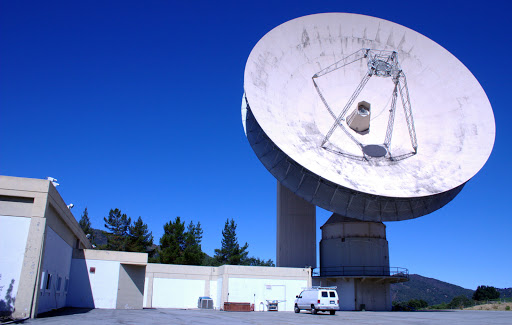
Remember the old days? Jamesburg Earth Station in California is for sale – again – after millionaire’s plan to turn it into an Internet business proved not feasible and he instead turned it into a home.
[NPR – 02/11/2012]
U.S. threatens action against Thales Alenia Space, suspecting that it illegally used U.S. know-how or parts in spacecraft launched by Chinese rockets.
[Baltimore Sun – 02/10/2012]
NASA seeks proposals for flight demonstrations of small satellite technologies with goal of increasing technical capabilities of these spacecraft.
[SpaceRef – 02/10/2012]
First MUOS satellite set to launch February 16, but waveform for manpack systems that would allow warfighters Coms On The Move like cell phone capabilities still not ready.
[Space News – 02/10/2012]
Raytheon is tripling the satellite capacity for all AN/ARC-231 airborne radio terminals at no cost to the end user.
[SatNews – 02/10/2012]
U.S. officials consider developing standards for GPS spectrum to allow companies developing broadband networks to use mobile satellite frequencies without interfering with GPS devices.
[Space News – 02/10/2012]
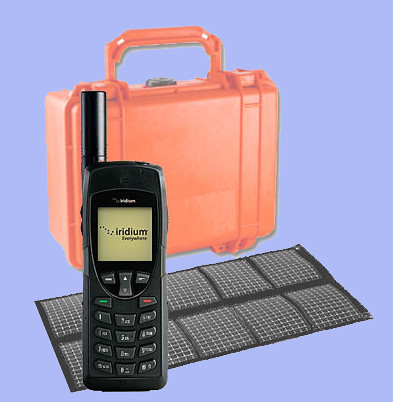
Twitter announces partnership with Iridium and Thuraya that will allow emergency tweets, or tweets from people who have no other broadband access, “available to every person on the planet.”
[vatornews – 02/10/2012]
AsiaSat 6 and AsiaSat 8 scheduled to be launched in 2014 by SpaceX.
[The Register – 02/09/2012]
Russians may spend 346.5 billion rubles (almost US$12 billion) on its Glonass navigation satellite system between 2012 and 2020.
[SatNews – 02/09/2012]
GE-Satcom, also known as Satlynx, is acquired by Trustcomm International.
[SatNews – 02/09/2012]
DVB is investigating expansion of current DVB-S2 standard for satellite contribution and high speed links as Newtec launches Clean Channel Technology(TM) and calls for the DVB expansion.
[MENAFM – 02/09/2012]
Iridium launches second-generation maritime broadband platform, Iridium Pilot(TM), offering fully global maritime broadband with data rates up to 134 kbps.
[Market Watch – 02/09/2012]
ILS sets new launch date of February 15 for SES-4.
[Satellite Today – 02/08/2012]
Researchers in Germany claim to have broken voice encryption of satellite phones on the Thuraya network, exposing dangers and insufficiencies of current encryption algorithms.
[Network World – 02/08/2012]
Reconn, an 8 lb. SATCOM tool introduced by the Harris Corp. and Coolfire Solutions, connects a smartphone to system hardware including a spectrum analyzer, power meter, LNB tester, and multi-meter, and will help users set up, activate, monitor, and troubleshoot satellite systems.
[UPI – 02/08/2012]
Satellite industry set for 10-year growth spurt.
[Communications Technology – 02/07/2012]
Avanti raises funds to build third broadband satellite, HYLAS 3.
[Broadband Choice – 02/07/2012]
ViaSat files lawsuit against Space Systems/Loral, alleging that SS/L used ViaSat technologies in other customers’ satellites.
[SatNews – 02/07/2012]
NASA says Russian space launch glitches no worry – Soyuz is still the most reliable launcher in the world.
[R&D Magazine – 02/07/2012]
Canada approves DISH Network’s request to transfer Canadian spectrum licenses held by TerreStar to DISH.
[SatNews – 02/07/2012]
Marlink upgrades maritime VSAT service with iDirect Evolution technology.
[Market Watch – 02/06/2012]
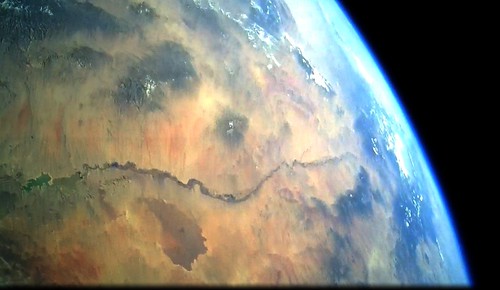
This is the view from a sub-orbital flight? I think you will have “high rollers” ready to spend whatever Sir Richard suggests for a Virgin Galactic trip to see this, captain!
Nice test of the STIG-A rocket from Armadillo Aerospace.

After a very nice Super Bowl yesterday, those of us who spent the time watching eating and drinking massive quantities of stuff we shouldn’t, may be dealing with remnants on another kind of bowl.
How appropriate that today’s Image of the Day from NASA is “Remnant of A Supernova” (G350.1+0.3)…
Vital clues about the devastating ends to the lives of massive stars can be found by studying the aftermath of their explosions. In its more than twelve years of science operations, NASA’s Chandra X-ray Observatory has studied many of these supernova remnants sprinkled across the galaxy.
The latest example of this important investigation is Chandra’s new image of the supernova remnant known as G350.1+0.3. This stellar debris field is located some 14,700 light years from the Earth toward the center of the Milky Way.
Evidence from Chandra and from ESA’s XMM-Newton telescope suggest that a compact object within G350.1+0.3 may be the dense core of the star that exploded. The position of this likely neutron star, seen by the arrow pointing to “neutron star” in the inset image, is well away from the center of the X-ray emission. If the supernova explosion occurred near the center of the X-ray emission then the neutron star must have received a powerful kick in the supernova explosion.
Data suggest this supernova remnant, as it appears in the image, is 600 and 1,200 years old. If the estimated location of the explosion is correct, this means the neutron star has been moving at a speed of at least 3 million miles per hour since the explosion.
Another intriguing aspect of G350.1+0.3 is its unusual shape. Many supernova remnants are nearly circular, but G350.1+0.3 is strikingly asymmetrical as seen in the Chandra data in this image (gold). Infrared data from NASA’s Spitzer Space Telescope (light blue) also trace the morphology found by Chandra. Astronomers think that this bizarre shape is due to stellar debris field expanding into a nearby cloud of cold molecular gas.
The age of 600-1,200 years puts the explosion that created G350.1+0.3 in the same time frame as other famous supernovas that formed the Crab and SN 1006 supernova remnants. However, it is unlikely that anyone on Earth would have seen the explosion because of the obscuring gas and dust that lies along our line of sight to the remnant.
These results appeared in the April 10, 2011 issue of The Astrophysical Journal.
Image Credits: X-ray: NASA/CXC/SAO/I. Lovchinsky et al; IR: NASA/JPL-Caltech
The description references the “Crab Nebula” — get your prints here.
Global Industry Analysts releases report calling for satellites related products and services to reach J.S. $219.6 billion by 2015.
[San Francisco Chronicle – 02/03/2012]
Iran launches its third satellite.
[TG Daily – 02/03/2012]
NewSat signs a 15-year $US180 million contract with MEASAT to supply capacity on its Jabiru-1 satellite; is close to funding new satellites.
[Sydney Morning Herald – 02/03/2012]
Vislink to launch its new Advent Mantis “MSAT” Man Portable Data Terminal, a highly portable tri-band satellite antenna system specifically designed for rapid deployment in hostile environments, at CABSAT 2012.
[SatNews – 02/03/2012]
NASA is seeking proposals for flight demonstrations of small satellite technologies with the goal of increasing the technical capabilities and range of uses for this emerging category of spacecraft.
[Sacramento Bee – 02/02/2012]
SpaceX successfully test fires SuperDraco rocket engine – these engines “will power a revolutionary launch escape system that will make Dragon the safest spacecraft in history and enable it to land propulsively on Earth or another planet with pinpoint accuracy.”
[SatNews – 02/02/2012]
Telesat proposes $40 million investment in Artic Infrastructure to expand broadband services in the North.
[Broadcaster Magazine – 02/02/2012]
XTAR joins as new member of the Satellite Industry Association.
[Space Ref – 02/02/2012]
The European Commission issues contract worth some 255m euros (£210m; $330m) to a German-UK consortium to provide eight more spacecraft for its Galileo satellite-navigation network.
[BBC – 02/02/2012]
Viasat collaborated with Radisys to develop an entirely new ATCA-based Satellite Modem Termination System to support communications with ViaSat 1 and keep up with advancements in satellite technology.
[Market Watch – 02/02/2012]
SES and French Internet provider France-Telecom-Orange announce expansion of SES’ ASTRA2Connect with higher speeds of up to 10 Mbps.
[SatNews – 02/02/2012]
Inmarsat selects Metaswitch to expand and enrich FleetBroadband maritime communications service, allowing simultaneous calls.
[SatNews – 02/02/2012]
Mercury Computer Systems to deliver integrated ATCA(R)-based signal processing subsystem to support next generation mobile satellite system.
[Market Watch – 02/02/2012]
UniTek awarded contract by ViaSat to support the rollout of ViaSat’s Exede satellite broadband service.
[Market Watch – 02/02/2012]
European Commission selects OHB AG of Germany over Astrium to build eight more Galileo positioning, navigation, and timing satellites.
[Space News – 02/01/2012]
Eutelsat’s Tooway(TM) satellite service set to boost broadband in France for SFR affiliate, NomoTech.
[Market Watch – 02/01/2012]
KVH announces major upgrade to its mini-VSAT maritime broadband network, overlaying global C-band satellite coverage atop its Ku-band footprint for first of its kind dual-band maritime satellite network covering 95% of the earth’s surface.
[Market Watch – 02/01/2012]
SatLink launches platforms on Amos 5 Pan-African C-band, and Sub-Saharan Ku-band.
[Broadband TV News – 02/01/2012]
Blue Sky Network selected as Premium Portal Provider for iridium Extreme(TM) satellite phone.
[Market Watch – 02/01/2012]
Satworx teams up with Yukon Quest to provide the 1,000 mile Alaskan dog race event with a communication solution.
[Market Watch – 02/01/2012]
Globalstar customer experience improved mobile voice and data performance as recently launched second-generation satellites come on line.
[Market Watch – 02/01/2012]
Roscosmos identifies cause of the crash of Russian “Meridian” satellite in December as failure of one of the rocket engines.
[CRI English – 03/31/2012]
SES is relocating SES-3 from its location over North America to provide coverage of the Middle East and South Asia regions.
[Business Wire – 01/31/2012]
According to ambitious Turkish government road map for the country’s multiple satellite programs through 2020, a total of 17 Turkish satellites will come into orbit from 2012 to 2020.
[SatNews – 01/30/2012]
Eutelsat’s satellites break the barrier of 4,000 TV channels.
[Market Watch – 01/30/20012]
FCC opens up LightSquared’s embattled wireless plans for public comment.
WireLess Industry News – 01/30/2012
LightSquared asks FCC to exempt GPS receivers from protection.
[NextGov – 01/30/2012]
WBMSAT satellite communications consulting services
Red Aurora Australis from Alex Cherney on Vimeo.
After chasing it for more than two years I was finally rewarded with two displays of Auroa Australis (Southern lights) within a week visible from Mornington peninsula, not far from Melbourne. The nights were warm an clear and the Moon was not in the sky either – I could not have asked for better conditions.
The red color of this aurora is caused by the charged particles from the Sun exciting oxygen atoms high in the Earth’s atmosphere. Hopefully there will be more to come as Sun’s activity increases in 2012-13.
Being able to photograph it all night I came up with a nice video. The brighter Aurora happened on January 22nd and the smaller one, featured in the middle section, was from January 16th, followed by a rather bright Moonrise.


The Iranian delegation has a point: the ITU system of satellite registry could use some revision.
The point was made at WRC-12 in Geneva last week. The bottom line is satellite operators do need to trust each other…
Arasteh said the issue of trust among nations using satellite frequencies is indispensable to the smooth development of satellite telecommunications, whose importance can be measured by the number of nations — even among the least developed — that have launched their own satellites in recent years.
“This trust has been eroded in recent years because of the excessive competition in the use of satellites and the consequent warehousing of slots,” he said. “What we are saying is that we should go much beyond the procedural approach we have taken up to now.”
However, with so much money at stake, the “trust” among operators loses out to “competition.”
SES-4 launch delayed again “for technical reasons.”
[SAT PR – 01/27/2012]
Vessel carrying Atlas booster and Centaur upper stage for Air Force’s AEHF-2 mission contacts bridge over Tennessee River, causing part of the bridge to collapse – no damage to the rocket.
[SatNews – 01/27/2012]
Namibia’s national electricity utility slashes costs of dealing with temporary outages by using GSM and satellite communications to link remote recloses with its head office.
[IT Web – 01/27/2012]
Harris CapRock gets 3 year contract from Siem Offshore to deliver turnkey VSAT communications to five of its supply vessels located offshore in Brazil.
[Scandinavian Oil & Gas Magazine – 01/27/2012]
SkyCasters partners with Ka You Communications on turnkey satellite communications solution called IPReady for EAS CAP (Emergency Alert System/Common Alerting Protocol) compliance.
[SatNews – 01/27/2012]
AAI Unmanned Aircraft Systems and ViaSat sign strategic agreement to develop capabilities for beyond-line-of-sight satellite communications in new AAI unmanned aircraft systems aircraft.
[Azo Robotics – 01/27/2012]
SkyBitz expands footprint with new Iridium-based global solution.
[SAT PR – 01/27/2012]
SBCA accepting grant requests from members and consumer satellite industry professionals until February 1, with grants to be awarded to deserving non-profits or individuals involved in worthy community efforts.
[SatNews – 01/27/2012]
South African communications regulator refuses permission for satellite television network TopTV to broadcast sexually explicit channels.
[Reuters – 01/27/2012]
2012 World Radiocommunications Conference to review and modify global spectrum regulations to ensure the resource is “used effectively to benefit all players.”
[TV Technology – 01/27/2012]
Russian Soyuz-U is launched toward International Space Station carrying the Progress M-14M cargo spacecraft.
[SatNews – 01/26/2012]
Trichet joins board of EADS amid shakeup, with Enders slated to become new CEO.
[Reuters – 01/26/2012]
Delta Airlines announce exclusive marketing agreement with OnAsset Intelligence, enabling Delta Cargo customers to view GPS location information on deltacargo.com.
[SatNews – 01/26/2012]
Space Systems/Loral selected to provide high power communications satellite.
[Space Ref – 01/26/2012]
Sea Launch manifest for 2012 includes Intelsat 19 in the spring and Intelsat 21 in the fall.
[Spaceflight Now – 01/25/2012]
Russia’s Chibis (Peewit) microsatellite, which studies gamma-radiation generated by lightning in the atmosphere, is placed into orbit from the International Space Station.
[SatNews – 01/25/2012]
Space storm predicted by NOAA hits satellites, airlines, but most communication systems not affected.
[Computer World – 01/25/2012]
AMOS 5 begins commercial operation.
[SAT PR – 01/25/2012]
Frontline, leading international seaborne oil transporter, commits to Inmarsat XpressLink for more than 100 vessels.
[Market Watch – 01/25/2012]
U.S. Electrodynamics expands on-net coverage with Zayo ethernet services.
[Market Watch – 01/25/2012]
All Cirrus Aircraft can now be equipped with Perspective Global Connect, integrating worldwide weather, satellite phone, and text messaging features.
[Market Watch – 01/25/2012]
Technion of Israel is developing 3 tiny, unique satellites which could be used for locating missing persons and people in distress.
[The Jerusalem Post – 01/24/2012]
Calian Technologies signs two new contracts for satellite ground systems with combined value of $7.6 million, including installation of Inmarsat BGAN RF ground system in China for Thrane & Thrane.
[Market Watch – 01/24/2012]
LightSquared fights results of USAF interference testing, even as it faces accusations of bribery.
[Daily Tech – 01/24/2012]
Novelsat’s 3G-Sat modulation solution NS3(TM) is first to make satellite data broadcasting possible at fibre level costs, successfully demonstrated in tests by SES and Satellite Mediaport Services.
[Market Watch – 01/24/2012]
Military satellite communications market expected to be worth $9 billion by 2018. [Zawya – 01/23/2012]

Senator Chuck Grassley, R-Iowa, accuses backers of LightSquared’s proposed LTE network of trying to pressure him into giving up investigation.
[NextGov – 01/23/2012]
China aims to launch 21 rockets and 30 satellites as part of its 2012 space program.
[Satellite Today – 01/23/2012]
NOAA’s Space Weather Prediction Center has issued a watch for the strongest solar radiation storm since 2005.
[R&D Magazine – 01/23/2012]
International Campaign for Human Rights in Iran urges World Radiocommunication Conference in Geneva to take decisive steps to end Iranian government’s illegal jamming of satellite signals.
[International Campaign for Human Rights in Iran – 01/22/2012]
Interesting project developing at Cornell University, via grad student Zac Manchester: KickSat. Want one? It’s only a few hundred bucks and will transmit text message from space. That’s cool.
They need help…
I need your help to put as many Sprites into orbit as possible to demonstrate that they can be safely launched and operated. A minimum fundraising goal of $30,000 (that’s 100 people sponsoring one Sprite each) will allow us to build, test, and integrate all the hardware for KickSat and the Sprites.
As soon as funding is in place, we’ll apply for a free launch through several programs, such as NASA’s ELaNa CubeSat program. While we are not guaranteed a free launch, there are many such opportunities each year and I believe this project has enough technical appeal and value to NASA to compete with anything out there.
If at least 400 spacecraft-adventurers sponsor Sprites, we’ll be able to use the additional funding to purchase a commercial launch, which will help ensure us a ride into space and allow us to get there sooner than we could relying on a free launch – by early 2013 if all goes well.
If at least 1000 space pioneers join us by sponsoring Sprites, we’ll be able to dramatically improve and shrink our design by getting custom microchips made. If we can do that, then costs could be driven down so that every school or even every school child could one day have their own spacecraft to explore the solar system.
Yeah, it’s pretty small (3.8 cm) and was promoted by Radio Shack not too long ago.