This composite image of NGC 281 contains X-ray data from Chandra (purple) with infrared observations from Spitzer (red, green, blue). The high-mass stars in NGC 281 drive many aspects of their galactic environment through powerful winds flowing from their surfaces and intense radiation that heats surrounding gas, “boiling it away” into interstellar space. This process results in the formation of large columns of gas and dust, as seen on the left side of the image. These structures likely contain newly forming stars. The eventual deaths of massive stars as supernovas will also seed the galaxy with material and energy.
National Reconnaissance Office declassifies two of America’s top satellite reconnaissance programs, GAMBIT (KH-7) and HEXAGON (KH-9) 25 years after top secret Cold War-era missions ended. [SatNews – 09/30/2011]
ILS Proton Breeze M booster lifts off from Baikonur with SES satellite QuetzSat-1. [SatNews – 09/29/2011]
Hosted Payload Alliance meeting October 13 at SATCON 2011 expected to be attended by more than 150 representatives from industry and government, following panel session “Hosted Payloads on the Horizon: Opportunities and Challenges.” [SatNews – 09/29/2011]
Eutelsat subsidiary Skylogic signs with VIVACOM to provide new generation Tooway satellite broadband service in Bulgaria. [Sacramento Bee – 09/29/2011]
CCID Consulting launches China’s Satellite Application Industry Map White Paper in Beijing, demonstrating industry layout and future trends. [Market Watch – 09/29/2011]
European Space Agency provides research and development guidance to Finnish company Patria, with help of Tampere University of Technology, in designing search and rescue antenna that can be sewn into life vest. [SatNews – 09/29/2011]
Globecomm Systems gets multiple contracts valued at approximately $4M to provide U.S. Government end-users with Ku- and X-band aeronautical services, following launch of Airborne managed network services offering. [SatNews – 09/29/2011]
New Guardian Mobility system brings real-time two-way text messaging to the arena of portable satellite Automated Flight Following systems. [SF Gate – 09-29-2011]
Comtech Telecommunications says it will continue to grow in spite of the loss of two Army contracts, Blue Force Tracking and Movement Tracking System. [Space News – 09/29/2011]
Stratos provides Inmarsat BGAN broadband satellite service enabling Hotmix Radio to stream live, mobile show from Paris Techno Parade on Sept. 17th. [Market Watch – 09/29/2011]
TC Communications provides Inmarsat IsatPhone Pro tor Himalayan expedition led by Peter Hillary, son of legendary mountaineer Sir Edmund Hillary. [SatNews – 09/29/2011]
Comtech EF Data and Intellian announce successful technology integration of v-Series antennas and ROSS Open Antenna Management protocol allowing maritime vessels to globally roam across multiple satellite beams. [SatNews – 09/29/2011]
First high resolution satellite imagery released from NigeriaSat-2, revealing stunning 2.5m resolution photographs. [SatNews – 09/28/2011]
EADS Astrium acquisition of Vizada prepares fighting lines for next MSS battleground. [NSR – 09/28/2011]
Minotaur Rocket launches from Alaska with Navy TacSat4 satellite designed to allow troops with UHF radios to communicate without the need to deploy satellite antennas in dangerous situations. [Fox News – 09/27/25011]
U.S. Space completes study for USAF and identifies cost-effective ways to procure military satellite communications. [Market Watch – 09/27/2011]
Satellite Interference Reduction Group announces huge leap forward in fight against satellite interference following number of developments at IBC including introduction of video carrier ID across the industry. [SatNews – 09/27/2011]
Thrane & Thrane signs to be key launch manufacturer for Inmarsat’s forthcoming Global Xpress service, a new Ka-band satellite Internet service expected to go live in 2013. [SatNews – 09/27/2011]
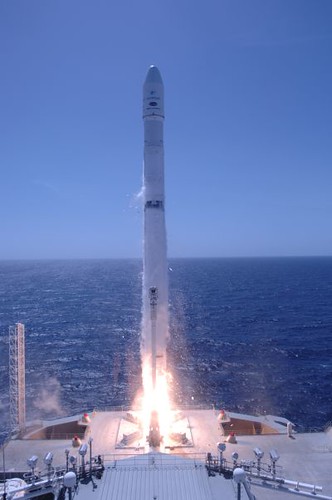
Zenit 3-SL rocket launches from Sea Launch AG’s floating pad in equatorial Pacific with Eutelsat’s Atlantic Bird 7 satellite, marking first Sea Launch mission since emergence from bankruptcy. [ninemsn – 09/26/2011]
NASA plans high-speed laser-based optical space communications system capable of moving data up to 100 times faster than current systems. [Information Week – 09/26/2011]
Bentley Walker upgrades satellite Internet platform to iDirect’s iDX 3.0, and now provides faster satellite Internet across Europe, the Middle East, Africa, and South America. [SatNews – 09/26/2011]
Ozonio and O3b Networks commit to providing Internet services to may remote towns and cities in Brazil’s State of Amazonas. [Market Watch – 09/26/2011]
Adtec Digital’s EN-81 encoder/modulator and RD-60 decoder for 32APSK (Amplitude and Phase-Shift Keying) promise up to 30 percent more data using same bandwidth as 8PSK; companies testing include TV2Go of Canada, U.S. companies TNT and Encompass, and UK based IMG Media and British Sky Broadcaster. [SatNews – 09/26/2011]
NASA reports that all debris from decommissioned research satellite appears to have fallen in remote section of Pacific Ocean. [Wall Street Journal – 09/25/2011]
GOP presidential candidate Michelle Bachmann accuses administration of allowing LightSquared to “put millions of Americans in harm’s way” by allowing it to activate a wireless signal that interferes with GPS. [CBS News – 09/23/2011]
Wireless Backhaul via Satellite, 5th Edition report, available from NSR. [NSR – September 2011]
China’s Tiangong-1 is set to launch into low-earth orbit today, with the hopes of some day building a space station to rival the ISS.
Do they have a plan to dominate space? Not really. Dr. Morris Jones of Australia explains all in Space Daily…
This module is a small space laboratory with a single docking port. It is not the first module of a large Chinese space station, as some media reports are saying.
Tiangong 1 will test some of the technologies that will be used to build a large Chinese space station in the future, but it is not even a prototype of the modules that will be used to build the station.
Tiangong 1 will be used as a rendezvous and docking target for the unmanned Shenzhou 8 spacecraft, which will launch before the end of this year. China has never docked two spacecraft before. Shenzhou 8 will stay docked with Tiangong 1 for about three weeks, and will then send its descent module to a soft landing back on Earth.
If all has gone well with this flight, we can expect Shenzhou 9 to fly to Tiangong 1 in 2012, this time with astronauts aboard. They will live aboard the laboratory and their docked Shenzhou spacecraft for a short mission, then come home. Later in 2012, the Shenzhou 10 mission will also fly to Tiangong 1, delivering its second (and probably final) crew.
At this stage, we don’t know how many astronauts will be aboard Shenzhou 9 or 10. A maximum of three crewmembers can fly aboard one of these spacecraft. It’s possible that there will be two or three astronauts on these expeditions. At least one of the missions is expected to carry China’s first female astronaut.
Tiangong 1 is a vital step in China’s quest to develop a space station, but it must be seen as an intermediate program. Two more Tiangong laboratories are expected to be launched by China in the years ahead, gradually testing more technology for the space station.
Tiangong 3 is expected to have more than one docking port, and will possibly see another regular Tiangong module docked with it before a crew is launched there.
When China’s space station is finally assembled in orbit around 2020, the Tiangong spacecraft will see a new lease of life. It will be refitted to serve as a cargo carrier, delivering food and other supplies to the astronauts aboard the space station.
Yes, it’s a wonderful program, and we’ve been waiting a long time to see Tiangong fly. But please don’t confuse it with the next step in China’s space program. When the final space station is built, it will eclipse the modestly sized Tiangong laboratory in terms of size, performance and achievements.
Convenient launch window for QuetzSat-1 launch on Friday, and you can watch it live from the Baikonur Cosmodrome via Proton/Briz-M on 29 September 2011 @ 18:32 GMT (00:32 a.m. local time on 30 September 2011; 20:32 p.m. CEST, 14:32 p.m. EDT).
In North America, DISH Network Channel 101, and via C-band on AMC-3 at 87 degrees West, C4, downlink frequency 3780.0 MHz, vertical polarization, service ID 136201.
In Europe, Astra 19.2 degrees East, transponder 1.037, downlink frequency 11023.25 MHz, horizontal polarization, symbol rate 22.0 MSym/s, FEC 5/6, service ID 5232, service name QuetzSat-1 Launch.
A webcast is available via ILS Launch, beginning 20 minutes prior to launch window opening.
This gorgeous video was made by science teacher James Drake using images downloaded from The Gateway to Astronaut Photography of Earth. This is a great online resource with basically all of the images taken from orbit, categorized into a searchable database by region and date. He used a free program calledVirtualDub to create the final edit.
James explains on YouTube: “This movie begins over the Pacific Ocean and continues over North and South America before entering daylight near Antarctica. Visible cities, countries and landmarks include (in order) Vancouver Island, Victoria, Vancouver, Seattle, Portland, San Francisco, Los Angeles. Phoenix. Multiple cities in Texas, New Mexico and Mexico. Mexico City, the Gulf of Mexico, the Yucatan Peninsula, Lightning in the Pacific Ocean, Guatemala, Panama, Columbia, Ecuador, Peru, Chile, and the Amazon. Also visible is the earths ionosphere (thin yellow line) and the stars of our galaxy.”
My favorite parts are the golden reflections of the cities’ lights on the solar panels of the ISS and the strobelike flashes of lightning visible in some of the clouds.
In Upstate New York on Saturday (Columbia County), the clouds went away to show a beautiful view of the stars. Light pollution was at a minimum and one of my friends, who spent some time skiing in New Zealand, commented on how the view from the Southern Hemisphere is completely different.
Explanation: From Sagittarius to Carina, the Milky Way Galaxy shines in this dark night sky above planet Earth’s lush island paradise of Mangaia. Familiar to denizens of the southern hemisphere, the gorgeous skyscape includes the bulging galactic center at the upper left and bright stars Alpha and Beta Centauri just right of center. About 10 kilometers wide, volcanic Mangaia the southernmost of the Cook Islands. Geologists estimate that at 18 million years old it is the oldest island in the Pacific Ocean. Of course, the Milky Way is somewhat older, with the galaxy’s oldest stars estimated to be over 13 billion years old. (Editor’s note:This image holds the distinction of being selected as winner in the Royal Observatory, Greenwich, Astronomy Photographer of the Year competition in the Earth and Space category.)
I simply must visit New Zealand some day, but I’ll settle for watching USA vs. Italy today in the Rugby World Cup — in New Zealand.
Sea Launch AG has successfully launched the ATLANTIC BIRD(TM) 7 broadcast satellite from the Equator on the ocean-based Odyssey Launch Platform, marking its first mission for Eutelsat Communications (Euronext Paris: ETL) and its awaited return to launch operations following re-organization in late 2010.
The Zenit-3SL rocket carrying the ATLANTIC BIRD(TM) 7 spacecraft lifted off at 13:18 Pacific Daylight Time (20:18 GMT/UTC) on September 24 from the launch platform, positioned at 154 degrees West Longitude in international waters of the Pacific Ocean. One hour and seven minutes later, the Block DM-SL upper stage inserted the satellite, weighing approximately 4,600 kilograms (10,141 lbs.) and built by Astrium, an EADS company, into geosynchronous transfer orbit, on its way to a final orbital position at 7 degrees West Longitude. Operators at the Hartebeesthoek ground station near Pretoria, South Africa acquired the spacecraft’s first signals from orbit shortly after spacecraft separation. All systems performed nominally throughout the launch mission.
Here’s the video, with dual English and Ukrainian countdown in the beginning, followed by the camera operator trying to keep the rocket in the frame while out at sea…
First global map of salinity of ocean surface produced from data collected by NASA’s Aquarius, aboard the Aquarius/SAC-D satellite/observatory. [SatNews – 09/23/2011]
RRsat expands backup and disaster recovery with Spacecom, acting as Spacecom’s remote and mirror Earth station for telemetry monitoring, tracking, and commanding (TT&C) and In-Orbit Testing (IOT). [SatNews – 09/23/2011]
U.S. Department of Defense tracks NASA’s Upper Atmosphere Research Satellite as its orbit decays, expecting to predict when – and possibly where – it will re-enter the atmosphere. [SatNews – 09/22/2011]
SES-2 satellite built by Orbital, with CHIRP hosted payload, successfully launched from French Guiana. [Market Watch – 09/22/2011]
Japan launches new military Information Gathering Satellite known as Optical-4, with primary mission to provide early warning of impending hostile launches (prompted by 1998 North Korean missile launch). [SatNewqs – 09/22/2011]
Two vessels receive Inmarsat-sponsored award recognizing extraordinary courage and seamanship for their rescue of a party of 64 students from sinking Canadian tall ship Concordia. [SatNews – 09/22/2011]
Defense Department’s 1000 lb., $150M 10-channel high power UHF satellite set to launch September 27 from Kodiak, Alaska – expected to free troops in the field from carrying heavy radio equipment and fiddling with antennas. [Stars and Stripes – 09/22/2011]
Sea Launch, now 95% owned by Russian aerospace giant Rocket & Space Corp. Energia and headquartered in Switzerland, set to launch its first rocket Friday in over two years – ATLANTIC BIRD(TM) 7 for Eutelsat. [LA Times – 09/22/2011]
Virgin Galactic unveils new $8M Final Assembly, Integration and Test Hangar (FAITH) at Mojave Air and Space Port for final stages of production of WhiteKnightTwo and SpaceShipTwo. [SatNews – 09/22/2011]
Thrane & Thrane to manufacture broadband terminals for Inmarsat’s Global Xpress network. [Reuters – 09/22/2011]
Ariane 5 lifts off from French Guiana with Arabsat 5C and SES-2 one day after being delayed by local strike by French Guiana workers. [xinhuanet – 09/21/2011]
China receives first contract in Europe to build communications satellite for Belarus and launch from Xichang Satellite Launch Center. [Satellite Today – 09/21/2011]
South Africa’s one and only satellite, Sumbandila, out of contact with its Mission Control and not downloading any images since being hit by blast of solar radiation in July. [SatNews – 09/21/2011]
LightSquared claims filter developed by high-precision GPS receiver manufacturer Javad GNSS will fix problem of potential interference by LightSquared planned LTE network, can be adapted for receivers already in the market, and won’t make devices more expensive for consumers. [Wireless Week – 09/21/2011]
Following successful trial on one of its LNG tankers, MOL LNG Transport Co. Ltd. is adding the KVH TracPhone V7 satellite communications system and mini-VSAT Broadband service to three of its LNG tankers. [SatNews – 09/21/2011]
MTN Satellite Communications and Sensory International partner to deliver global VSAT services and connectivity to superyachts. [Market Watch – 09/21/2011]
Harris opens new and totally advanced center for manufacturing of tactical radios and assured communication systems. [SatNews – 09/21/2011]
General Dynamics receives FCC license for its Coms-on-the-Move terminals enabling continuous access to private- and government-owned communications satellites while on-the-move in vehicles. [PR Newswire – 09/21/2011]
Eutelsat and MultiChoice Africa Announce Winners of the First DStv Eutelsat Star Awards in competition by over 800 students from across Africa. [Sacramento Bee – 09/21/2011]
Gilat subsidiary Spacenet gets renewal contract valued at up to $27M from U.S. retail giant for critical network solutions and potential store expansion. [Market Watch – 09/21/2011]
NASA expects 26 of heaviest metal parts of a 20-year-old research satellite, which should break into more than 100 pieces as it enters the atmosphere this week, to reach Earth – but no one knows where. [R&D Magazine – 09/20/2011]
Russia’s Proton-M carrier rocket successfully launched with a military purpose spacecraft aboard. [SatNews – 09/20/2011]
Satmex signs multi-year multi-transponder lease agreement with Telefonica subsidiary Media Networks Latin America. [SatNews – 09/20/2011]
Ratheon fields first AEHF satellite communications terminals to U.S. armed forces tactical units. [Space Daily – 09/20/2011]
NewSat Jabiru-1 contracts reach $279M with latest $40.2M contract with Quicklink Communications. [Satellite Today – 09/20/2011]
Marlink and Sea Tel team up to provide satellite communications for third Kaisei expedition seeking viable solutions to problems associated with marine debris in North Pacific Gyre. [Maritime Executive – 09/20/2011]
Vizada and ARINC renew partnership to deliver mobile satellite services to commercial, government aviation customers. [Military & Aerospace – 09/20/2011]
Zhongxing-1A satellite carried aloft by Long March-3B from Xichang Satellite Launch Center in Sichuan Province, China. [SatNews – 09/19/2011]
Senate Appropriations Committee approves $500M in funding for commercial spaceflight as part of NASA’s 2012 budget. [Satellite Today – 09/19/2011]
LightSquared CEO claims U.S. politicians using company as a pinata after being denied opportunity to testify at U.S. House Armed Service Committee hearing. [Satellite Today – 09/19/2011]
Component crunch slows delivery of Ka-band communications satellites as only two companies manufacturing Ka-band TWTs, L-3 and Thales, are unable to keep up with demand. [Space News – 09/16/2011]
Low-cost Disaster Warning Dissemination System conceived by India Space Research Organization can reach general public in local languages with early warnings of potential weather dangers using satellite-based Direct-to-home television broadcasts. [Microwaves&RF – September 2011]
DISH Network’s Blockbuster brand will unveil a streaming service on Friday, via the Denver Business Journal…
CEO Joe Clayton and Blockbuster President Michael Kelly are scheduled to unveil the service from San Francisco in a press conference dubbed “A Stream Come True” (held via Ustream web streaming service, appropriately enough).
Dish Network (Nasdaq: DISH), which rarely underplays a promotional opportunity, promises the service will be “the most comprehensive entertainment package ever!”
In addition to having the webstreaming technology that Blockbuster used, Dish Network has been rumored to be bidding for the online video service Hulu.
Whatever the outlines of the new Dishbuster service, it’s likely to salt Netflix’s recent wounds.
Shortly after buying Blockbuster, Ergen said the purchase wasn’t meant to knock Netflix from the top spot in movie-streaming, because Netflix likely had an insurmountable subscriber lead.
Last week, though, Netflix forecast actually losing subscribers this quarter, and falling 1 million short of its third-quarter projections.
On Monday, the 24 million-subscriber company surprised observers and sent its stock price lower by announcing it’s splitting the company — Netflix will focus exclusively on online movie streaming, and a new wholly owned subsidiary, called Qwikster, will carry on Neflix’s legacy business of shipping DVDs to subscribers by mail.