WBMSAT Satellite Industry News Bits for 06/11/2010

Courtesy of Bill McDonald

Korean navy recovers what is believed to be debris from the Korea Space Launch Vehicle 1 that exploded shortly after liftoff Thursday, the country’s second major space setback in less than a year.
[Korea Times – 06/11/2010]

Thales Alenia Space gets contract from Eutelsat for satellite with forty Ku-band transponders to be launched during third quarter of 2012.
[Tech Watch – 06/11/2010]


Space Systems/Loral (SS/L) ships Dish Network’s EchoStar 15 communications satellite to the Baikonur Space Center in Kazakhstan where it will be launched by International Launch Services.
[Satellite Today – 06/10/2010]

NASA has selected Orbital Sciences to launch the Interface Region Imaging Spectrograph (IRIS) spacecraft in December 2012 aboard a Pegasus XL rocket from Vandenberg U.S. Air Force Base.
[Satellite Today – 06/10/2010]

As sun emerges from one of its quietest periods ever during its 11 year cycle, it may spell trouble for a world increasingly reliant upon communications satellites and power grids.
[Houston Chronicle – 06/10/2010]

German satellite service provider Atrexx launches trio of C-band services for the Africa and Middle East markets.
[Satellite today – 06/10/2010]

Two PRISMA satellites to be launched next week feature Thales Alenia Space’s technology that determines the two satellites’ relative positions to within 1 centimeter, and relative attitudes to within 1 degree.
[SatNews – 06/10/2010]

Hughes Network Systems unveils broadband Internet satellite services for government and enterprise emergency networking solution.
[Satellite Today – 06/10/2010]

BBC World News signs renewal and expansion contract for satellite and teleport services with Intelsat S.A. to distribute programming to Asia-Pacific and Americas audiences.
[SatNews – 06/10/2010]

Azerbaijan government has contracted with Orbital Sciences to build the country’s first satellite, but questions are being asked about the country’s ability to pay, as unnamed source states that the finance ministry is delaying funding of the project.
[Eurasianet – 06/10/2010]

Telespazio’s orders for Orbit Technologies Ltd.’s high performance stabilized marine satellite communications systems to be installed on oil and gas industry platforms worldwide reach $1.1M.
[SatNews – 06/10/2010]

ND SatCom receives Global Telecoms Business Innovation Award 2010 in the Business Service Innovation category for its XWARP(r) solution, which provides IP applications / Cloud Computing over satellite.
[SatNews – 06/10/2010]

BSkyB gains $460.3M settlement in its lawsuit with system integrator Electronic Data Systems, a subsidiary of Hewlett Packard.
[Satellite Today – 06/10/2010]

Globecast is selected to deliver four major Latin American channels to cable headends throughout the United States via the AMC-1 satellite.
[SatNews – 06/10/2010]

Avanti signs long-term Hylas 1 capacity contract with unnamed triple-play consumer telecom service in the U.K. and Ireland.
[Satellite Today – 06/10/2010]

Barrett Xplore Inc. of Canada will lease Loral Space & Communications Inc. owned payload which will be hosted on the Viasat 1 broadband satellite that Loral is building for Viasat.
[TMCnet – 06/09/2010]

Iridium introduces new features for its Next generation of satellites, making laptop connections easier and providing extended SMS messaging for the Iridium 9555 satellite phones.
[Market Watch – 06/09/2010]

Orbit Alchut Technologies Ltd. and Telespazio SpA to supply satellite communications systems for marine oil and gas platforms using C-band capacity and 4m antennas to provide high reliability even during stormy weather.
[Globes Online – 06/09/2010]

Satellite Industry Association (SIA) releases 2010 State of the Satellite Industry Report, showing 11% growth from 2008 to 2009 in overall world satellite industry revenues.
[SatNews – 06/08/2010]

Andreas Georghiou, CEO of Spacenet, accepts a Circle of Excellence award from Washington SmartCEO in recognition of the company’s product innovation.
[SatNews – 06/08/2010]

Eutelsat makes four satellites available for broadcasts from South Africa of the World Cup football tournament.
[Tech Watch – 06/08/2010]

Integral Systems gets contract from a leading satellite service provider integrating an additional geostationary satellite into their existing Epoch Integrated Product Suite satellite management system.
[Market Watch – 06/08/2010]


German ship manager Phoenix Reederei reports drop in monthly satellite expenses of more than EURO1,000 since installing Iridium OpenPort satellite terminals on five of its vessels.
[Market Watch – 06/08/2010]

Inmarsat wins 41st annual royal Academy of Engineering MacRobert Award, Britain’s biggest prize for engineering innovation.
[PR Newswire – 06/08/2010]
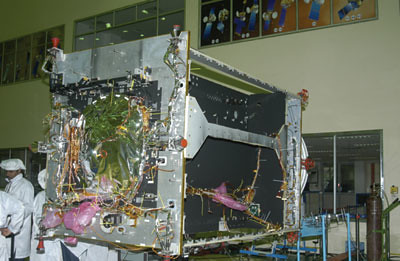


European Space Agency reports successful completion of thermal-vacuum checks in India on the HYLAS 1 advanced broadband satellite being constructed for Avanti.
[Top 10 – 06/08/2010]

Industry experts advise relief agencies and governments to learn from the Haiti experience, where earthquake damage would have made emergency response nearly impossible without satellite communications.
[PR Newswire – 06/08/2010]

Skycasters submits proposal to the USDA RUS Broadband Initiatives Program in Washington, D.C. requesting a $5.1M grant to improve public safety and prompt economic recovery for 37M Americans.
[SatNews – 06/08/2010]

NASA Administrator Charles Bolden professes increased confidence that a resupply vehicle will be available after the Space Shuttle fleet is retired, on the heels of the successful launch of SpaceX Falcon 9 on June 4.
[Satellite Today – 06/08/2010]

Satcom Direct adds graphical weather to its existing FlightDeck Freedom satellite service for aircraft.
[SatNews – 06/08/2010]

NASA successfully completes comprehensive pre-shipment review of the Fast, Affordable, Science and Technology Satellite, of FASTSAT, a microsatellite class spacecraft that will carry 6 experiment payloads to low-Earth orbit.
[SatNews – 06/08/2010]

German Earth observation satellite TanDEM-X, part of project to "map the Earth in 3D" is readied for launch at the Baikonur Cosmodrome in Kazakhstan.
[SatNews – 06/08/2010]

Australian Satellite Communications (ASC) and Cobham announce launch of ReadyCONNECT, a portable, quick-deploy emergency response satellite communications solution.
[SatNews – 06/08/2010]

Arqiva provides Sky with 36MHz of W7 satellite capacity for duratioin of football World Cup in South Africa.
[SatNews – 06/08/2010]

NOORSAT selected by Al Jazeera network to provide satellite capacity to backup the FIFA world Cup 2010 coverage, including the use of the NOORSAT Bahrain teleport as an alternative transmission facility.
[SatNews – 06/08/2010]

SES ASTRA enters into distribution agreement with Polish data network operator NASK to offer its satellite-based broadband service to business customer in the Polish market.
[SatNews – 06/07/2010]

BSkyB pays Virgin Media £160m for its TV channels in deal where Virgin Media gets to offer its subscribers the premium BSkyB HD channels.
[Tech Watch – 06/07/2010]
WBMSAT PS satellite communications systems services

Hayabusa’s Hot Today


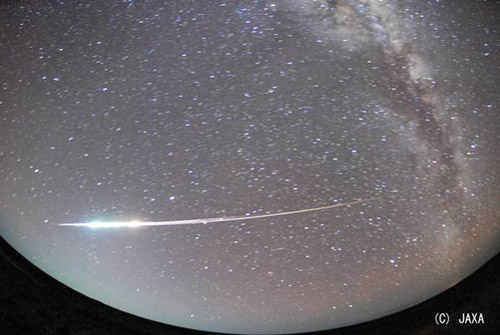
Beautiful video footage, courtesy of NASA, of Hayabusa’s re-entry after a 7-year mission and 6 billion kilometers.


Officially…

 日本時間6月13日19時51分に「はやぶさ」は無事カプセルを分離し、日本時間6月13日22時51分頃には大気圏に突入しました。
 2003年5月9日にM-Vロケットで打ち上げられてから約7年間、イトカワに着陸し、サンプル採取作業を行い、再び地球に帰還するという難事業を、幾多の困難を乗り越え成し遂げることができました。
 これまで応援していただいた皆様に感謝いたします。

 引き続き、豪州において地球に帰還したカプセルの回収作業を進めてまいります


In other words, via JAXA

Hayabusa separated the capsule at 7:51 p.m. and reentered the atmosphere at 10:51 p.m. on June 13th, 2010 (JST).
Hayabusa was launched on May 9th, 2003 by M-V rocket and operated for approximately seven years. During its operation, JAXA was able to achieve the difficult mission including Hayabusa’s sample capture attempt after its touchdown on the asteroid named Itokawa, and Hayabusa’s return to the earth overcoming many hardships. JAXA would like to appreciate every support to JAXA leading this mission to a great success.

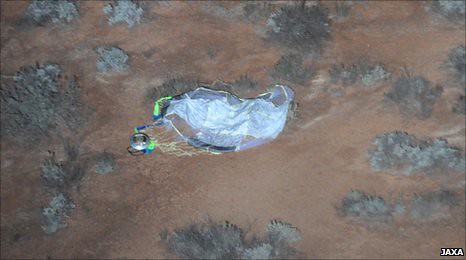
The Hayabusa capsule has just returned to Woomera, Australia. As the next step, JAXA will move forward to the capsule recovery.

So what did it look like on the ground? Somebody from Wakayama University Institute for Education on Space was pretty excited to capture it on video, on the ground in Australia…


KSLV Launch Update


One of the leaders in the "Asian Space Race" suffered a loss today. The news via the BBC…

The Korea Space Launch Vehicle 1 is thought to have blown up 137 seconds after take-off, said science minister Ahn Byong-man.

The rocket lifted off from Goheung’s Naro Space Centre at 1701 (0801 GMT).

But contact was lost as the rocket reached an altitude of 70 kilometres (44 miles).

"Looking from the bright flash seen on the camera mounted on the tip of the rocket, it appears [the KSLV-1] exploded in flight during the first-stage ignition," said Mr Ahn.

Pictures on South Korean television appear to show the rocket’s final moments, with the cameras following a white speck on its downward trajectory into the sea.


IKAROS Solar Sail


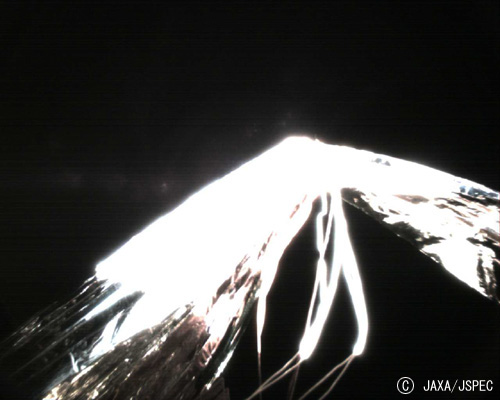
Watch the IKAROS solar sail deploy on this JAXA blog.

World Cup Star Wars


Sure, there’s media attention on the World Cup in South Africa. The latest of Adidas is entertaining (above), and Nike broke viewing records with its spot…


Shaw Direct Satellite TV will be broadcasting the the CBC’s FIFA World Cup in 3D-TV throughout Canada. ESPN will be using an OC-12 fiber connection and use MPEG-4 encoding for their main feed from South Africa. This list goes on and on.

So who’s at the source of all this worldwide broadcasting? Host Broadcast Services, that’s who. And it’s complicated. With more cameras and tech than ever before. TV Technology gives us the detail

HBS crew at the IBC can browse the servers in the OB trucks, while also ingesting up to 18 live video feeds coming from the venues to the IBC. HBS packages the content into a fully formatted programme feed for wholesale delivery to Media Rights Licensees.

The EVS equipment tally at the HBS Production facility is 50 HD XT[2] servers, totaling 1900 hours @ 108 Mbps (DVCPro HD), plus another 1100 hours of hi-res media in an XStore[2] storage platform. 140 IPDirectors are for logging, browsing and content management. 6 XF[2] units are for removable storage. 32 Xedio Media Dispatchers are for P2 file selection, clipping and transfer.

3. IBC Johannesburg — MRL Production — this other half of the IBC comprises the studio and production facilities set up individually by each of the visiting broadcasters, as well the home broadcaster, SABC. Deemed “Media Rights Licensees”, the abbreviated form “MRL” is now the common term to describe the visiting broadcasters and those who stayed at home but nonetheless paid for the rights to rebroadcast the FIFA World Cup matches in their geographical zone.

Collectively, the MRL’s in the IBC will be making good use of 60 EVS HD XT[2] servers, 30 IPDirectors and 20 XF[2] sets of removable storage.

4. Distribution — now somewhat more complicated than it used to be due to the emergence of web and mobile video distribution pipelines in addition to the traditional terrestrial, satellite and cable outlets. Extremely fast turnaround of packaged clips is part of the system design. The HBS promise is to deliver craft edited clips for mobile devices within three minutes after the live action. 

Something to think about as you watch.

Coke Mentos Rocket Car


The guys at EepyBird.com are at it again. This time it’s a car powered by Coke Zero and Mentos. The video was seen 2 million time in its first week.

Wired went behind the scenes for this story

Fritz Grobe and Stephen Voltz are the guys behind the famous video of a Mentos-and-Diet Coke, Bellagio-style fountain, which they estimate has been seen by more than 120 million people. Four years later, they’re back with a rocket car powered by nothing but Mentos and Coke Zero. The video, which debuted this week, shows the duo’s efforts to set a land-speed and distance record for a vehicle powered by nothing but erupting, minty, fizzy soda.

The video was directed by Rob Cohen (director of The Fast and the Furious). Two dimensions not enough? There’s even a 3-D rocket car video you can watch on YouTube, if you have a pair of red-and-cyan 3-D glasses.

Wired sat down with Grobe and Voltz shortly after a recent performance at Maker Faire to find out how they built their 900-pound vehicle. It contains 108 2-liter bottles of Coke Zero, 648 Mentos, an elaborate-looking system of PVC pipes and pistons, and a complicated rig for dropping all those mint candies into all those bottles at the same time. In this exclusive Wired.com video, the duo explain how they made the magic happen.


WBMSAT Satellite Industry News Bits for 06/04/2010

Courtesy of Bill McDonald

Indian security agencies tell the Indian Department of Telecom that foreign satellite communication service providers should be asked to set up an earth station in India if they want to offer services there.
[the Hindu Business Line – 06/05/2010]


The Falcon 9 rocket fired up its nine first stage engines and took off on its first test flight from Cape Canaveral at 2:45 p.m. EDT June 4.
[Space Travel – 06/04/2010]

Intelsat CTO Thierry Guillemin describes details of its behind-the-scenes cooperative effort with customers and AMC-11 operator SES to mitigate interference threats posed by Galaxy 15.
[Satellite Today – 06/04/2010]


A Russian Proton M rocket launches a European-made telecommunications satellite, Arabsat-5B (Badr 5), for the ARABSAT satellite communications operator.
[Bernama – 06/04/2010]

HBO Asia signs long-term transponder lease agreement with APT for capacity on Apstar 2R and its replacement satellite, Apstar 7, to be launched in early 2010.
[Satellite Today – 06/04/2010]

Stratos Global Corporation becomes a distributor for SkyWave Mobile Communications products and services for the global SCADA market.
[Machine to Machine – 06/04/1020]

Thales Alenia beats out Lockheed, winning contract worth some $2.1B to build 81 satellites for Iridium’s next generation satellite fleet.
[BBC – 06/03/2010]

RapidEye (who owns and operates its own constellation of five EO satellites) has signed on Panaxx Corporation to be its distributor in Japan.
[SatNews – 06/03/2010]

The Indian Space Research organization (ISRO) replaces the director of its liquid propulsion systems center following a series of launch mishaps.
[Satellite Today – 06/03/2010]

Rockot Launches Japanese SERVIS-2 Satellite from Plesetsk Cosmodrome in Northern Russia.
[Space Travel – 06/03/2010]

SkyWave Introduces Flex Messaging to IsatM2M Satellite Service, allowing up to 7 times more data than traditional IsatM2M messages.
[GIS User – 06/03/2010]

Zodiac Maritime installs Iridium OpenPort(R) across entire fleet of 156 ships.
[MarketWatch – 06/03/1010]

Airmen from the 2nd and 19th Space Operations Squadrons take control of the Air Force’s newest GPS satellite following its launch into orbit May 28 from Cape Canaveral Air Force Station, Fla.
[Space Daily – 06/03/2010]

China to launch fourth orbiter into space as a part of indigenous satellite navigation and positioning network known as Beidou, or Compass system.
[Space Daily – 06/02/2020]

Gilat to provide satellite communications equipment for SchoolNet project expansion in Ethiopia.
[MarketWatch – 06/02/2010]

SPOT Launches Outdoor Safety Initiative at Teva Mountain Games in Vail, Colorado.
[MarketWatch – 06/02/2010]

Inmarsat to launch its first global handheld IsatPhone Pro at CommunicAsia 2010 in Singapore.
[SatNews – 06/02/2010]

Stratos’ AmosConnect 8 enhances broadband connectivity at sea
[TMCnet – 06/02/2010]

Due to popular demand, Newtec to repeat FREE webinar: "IP is Forcing its Way into the Contribution, DSNG and Distribution Workflows over Satellite. Are you Ready?"
[SatNews – 06/02/2010]

KVH Industries announces that Fleetwood RV, Inc., has selected KVH’s TracVision SlimLine series along with TracVision R6 ST and R6 TX to be the exclusive satellite TV option offered on its 2011 motor homes.
[SatNews – 06/02/2010]

Orbital selected for Azerspace/Africasat-1a satellite by the Ministry of Communications and Information Technologies of the Republic of Azerbaijan.
[MarketWatch – 06/01/2010]

Space Systems/Loral (SS/L) is selected to provide a satellite, Anik G1, to Telesat of Canada.
[SatNews – 06/01/2010]

Russian Space Systems corporation and the U.S. Trimble Navigation Group sign an agreement to create a joint satellite navigation venture in Russia
[Space Daily – 06/01/2010]

International Launch Services (ILS) has contract for ILS Proton launch of two commercial satellites, YAMAL 401 and YAMAL 402, for Russian satellite operator, Gazprom Space Systems.
[SatNews – 06/01/2010]

SES Astra enters partnership with Italian public broadcaster RAI to bring more content to its 3-D demo channel.
[Satellite Today – 06/01/2010]

Serbian government indicts former Serbia-Montenegro defense minister over deal to rent Israeli spy satellite from ImageSat.
[Satellite Today – 06/01/2010]

Australia’s NBN Co is weeks away from issuing a request for tenders to satellite network operators hoping to get a slice of the $43 billion national broadband network project.
[The Australian – 06/01/2010]

The Highly Adaptable Satellite (HYLAS) 1 being developed by Astrium for the satellite broadband operator Avanti Communications, successfully completes month-long test designed to expose the satellite to the rigors of space.
[SatNews – 06/01/2010]

BSkyB releases Sky Mobile TV app for the Applie iPad in the United Kingdom.
[Satellite today – 06/01/2010]

CapRock Communications selects Alpheus Communications’ complete suite of terrestrial connectivity services to provide reliable circuit access and supporting services to its clients.
[Business Wire – 05/31/2010]

WBMSAT PS satellite communications systems services

500 Days


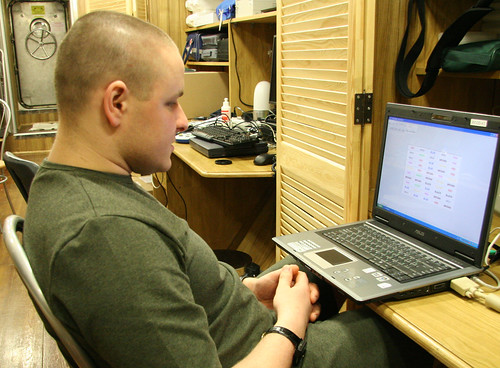
More like 520 days. Six guys, locked up in a box for about a year and a half, starting 3 June 2010.

Why? To simulate a manned mission to Mars! Behold, the objectives of Mars 500

  1. Investigation of the influence of conditions, simulating peculiarities of a manned Martian expedition on health and working capacity of the crew;
  2. Organization of the activity of the crew and its interaction with the ground-based control center taking into account peculiarities typical for the Martian flight;
  3. Verification of the principles, methods and means of control and monitoring of the habitat during over-long staying of the crew in conditions of confined pressurized facility;
  4. Simulation of the activity of the crew on the surface of Mars and dynamic operations during the flight;
  5. Verification of the principles, methods and means of control, diagnostics and forecast of the state of health and  working capacity, improvement of means of providing of medical help and prophylaxis;
  6. Improvement of the means of collection, processing and analysis of medical and physiological information;
  7. Creation and approbation of reference-information system, providing activity of the crew, keeping and transfer of electronic information;
  8. Verification of means and methods of telemedicine for distant control over the state of human health;
  9. Approbation of methods and autonomous means of psychological support;
  10. Assessment of modern technologies, systems and means of support of life and activity and protection of humans.

Let’s see if Letterman picks up on this "top 10" list for his show. More on this mission from the ESA


VASIMR: Hammer-down in Space


Very cool technology being developed by Ad Astra Rocket Company: using plasma engines to reach Mars in 39 days. Hammer-down: space truckin at 110,000 MPH.

Excellent piece in SpaceflightNow.com on the VASIMR engine…

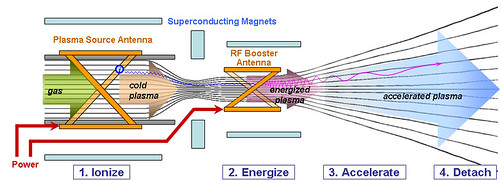
The company’s main project is the Variable Specific Impulse Magnetoplasma Rocket, or VASIMR, a highly-efficient space engine running on electricity and argon gas instead of conventional solid or liquid propellants.

Franklin Chang-Diaz, the project’s chief architect, says the VASIMR engine is the most flight-ready high-power electric propulsion system anywhere in the world.

"It is transformational technology that we are developing," Chang-Diaz said. "It always has been my view that chemical approach to space transportation really was not going to get us very far."
 
Chemical rocket engines require spacecraft to carry all of its propellant during its mission. The VASIMR engine burns small amounts of argon gas, one of the most stable elements on the periodic table. But one of the most revolutionary features of the VASIMR design is its reliance on electricity, a renewable resource in space.

"It’s very robust, but in order to get beyond the moon, and move on to Mars and beyond, we really need completely new transportation technology," Chang-Diaz said. "We view the VASIMR as the workhorse for that transportation infrastructure."

Electrically-powered plasma rockets could cut travel times for missions across the solar system. One concept championed by Chang-Diaz involves a 39-day mission to Mars, but it assumes leaps in nuclear energy production in space. 


Yeah, it works alright. Watch this engine test…


Here’s a video clip about the company…


And a simulation of the trip to Mars…


Moving Museums


Think the world of top-flight museums is a calm, respectable place to work? Like most workplaces, there’s some behind-the-scenes posturing and socially-awkward behavior going on. Comes with the territory, especially where people tend to stay at their jobs longer.

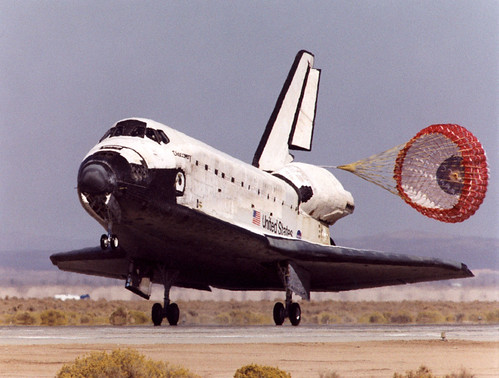
As we climb out of The Great Recession, museums and other cultural institutions are fighting for more revenue and scarce development dollars and it’s getting rough out there. Case-in-point: getting the old space shuttles from NASA after retirement. The National Museum of the U.S. Air Force at Dayton, Ohio, has the Wilmington News Journal on its side

 Throughout the shuttle program, the Air Force has played an essential role in its success. Besides infrastructure and operational support, the Air Force provided NASA with many highly skilled astronauts. The cooperation between NASA and the Department of Defense on the shuttle program dates back to 1969. The Air Force’s satellite launch requirements largely determined the shuttle’s design, and the Air Force saved the shuttle program in lean budget years during development. Recognizing that long partnership, the Secretary of the Air Force has requested a shuttle orbiter be added to the National Museum of the U.S. Air Force.

The museum already receives more than one million visitors each year. The addition of a shuttle is a rare opportunity for the museum which would significantly increase that attendance and be a substantial boost to the economy of Dayton and the region. Museum officials are planning for what we hope will be a favorable decision by NASA. The Air Force Museum Foundation is supporting a major construction program that would expand the museum’s current one million square feet of exhibit space by another 200,000 square feet. That building would also house other impressive related exhibits.

Many who have visited the National Museum of the Air Force regard it as an unforgettable experience. There are aircraft from the early years of flight — such as the Wright 1909 Military Flyer and the Curtiss 1911 Model D — and aircraft used in the modern era. There also is an Air Force One display, including the Boeing VC-137C that served as Air Force One on the day President Kennedy was assassinated. The public can also enter presidential aircraft of Franklin Roosevelt, Harry Truman and Dwight Eisenhower. These are only a few of the many aircraft and educational exhibits on display. The addition of a shuttle orbiter would enhance the significant investment that has already been made in the National Museum of the Air Force.

The reality of manned fight was born from the minds of Wilbur and Orville Wright, two Ohioans who worked in Dayton and developed and tested their aircraft at Huffman Prairie, near what today is Wright-Patterson Air Force Base and the National Museum of the Air Force. Fast forward to today and the shuttle Atlantis is orbiting the Earth on a mission to support the international space station. It is the last scheduled flight of Atlantis. The orbiter is closing in on flying 120 million miles throughout its career. It is appropriate that Atlantis or Endeavour spend their retirement in Dayton for current and future generations of local residents and visitors to see at the place where aviation was born.

 Any others out there? You bet! Vik Saini put together a great list. Sorry, the Space Farms Museum & Zoo in Beemerville, NJ, is not on the list — nothing to do with space; it’s the dude’s name.

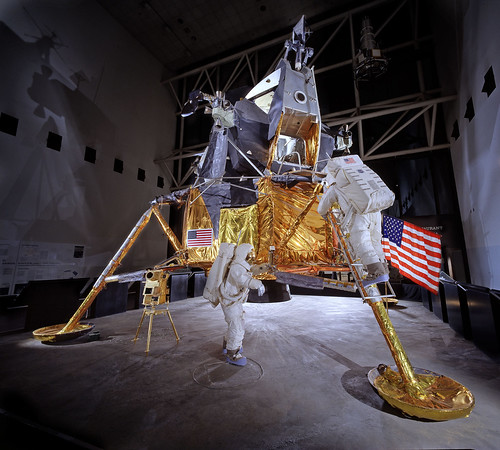
The Smithsonian’s National Air and Space Museum, the world’s most popular, always get the best space stuff. You can’t beat the actual back-up lunar module…