“Spots On The Wall” by Hu Flung Sat


Now we’re getting somewhere with this "TV everywhere" concept.

With it’s ubiquitous coverage, satellite TV is already "everywhere." Now DISH Network, and it’s Sling Media technology, is truly flinging its signals around. The critical summary, via Light Reading’s Cable Digital News:

Dish, which bought Sling Media in 2007 for $380 million and later folded it into its EchoStar Technologies LLC set-top and technology division spinoff, is basing its TV Everywhere strategy on a combination of new hardware and software products that enable customers to "sling" video from the set-top to PCs, mobile handsets, and other video displays with broadband connections. (See EchoStar to Buy Sling Media and Sling Media Slings at CES.)

That all starts with the ViP 922, an HD-DVR that features a 1-terabyte hard drive with Sling’s technology built in. Dish, which was expected to launch that box last year, is matching that with the "TV Everywhere Adapter," a sleeker version of the old Slingbox that gives place-shifting capabilities to a number of Dish HD-DVR receivers using a USB connection. According to Dish’s Website, six existing receivers are compatible with the new place-shifting adapter: the 522, 625, ViP 612, ViP 622, ViP 722, and ViP 722k.

Dish’s new hardware also includes a free-standing, 16×9 WiFi Monitor, also developed by Sling, that is capable of wirelessly transmitting an HD video signal from a set-top to another device on the home’s wireless network. The display itself renders video in 720p and can be used to access the functions of the connected Dish receiver, including the ability to manage DVR recordings.

Dish has also developed a Web-based "Remote Access Mobile App" so customers can manage their DVR recordings on multiple receivers. It also has the ability to transform an iPhone or iPod Touch device into a remote control for TVs connected to compatible Dish boxes. Although Dish’s TV Everywhere hardware components won’t be out until the second quarter, it’s already offering the Remote Access Mobile App for free download.

Dish hasn’t announced any pricing on its TV Everywhere offerings, including the fancy WiFi monitor, but intends to reveal those details closer to the official launch, a company spokeswoman said.

With Sling at the core of this strategy, Dish should find itself ahead of its cable competitors when it comes to TV Everywhere, a term that the satellite-TV giant has since trademarked (it reportedly filed for the trademark last fall), at least in terms of the types of screens it will support at the get-go.

Comcast Corp. (Nasdaq: CMCSA, CMCSK) launched its initial TV Everywhere product, Fancast Xfinity TV, last month, providing authenticated PCs access to a walled garden of on-demand content. Comcast plans to add support for mobile devices later this year. Dish’s version already supports mobile devices, as well as access to the subscriber’s lineup of linear programming. (See Comcast’s ‘Xfinity’ Goes Live and Comcast’s ‘Xfinity’ to Go Mobile in 2010 .)

However, cable MSOs will have an opportunity to offer much of what Dish is introducing in the second quarter. EchoStar, Dish’s tech spinoff, is also marketing a lineup of Sling-loaded boxes for U.S. and European MSOs, but has yet to announce any cable deals. EchoStar officials have also expressed interest in selling Slingboxes directly to MSOs, and it would appear that Sling’s latest standalone box, the 700U, would fit the bill.

 

Great idea and excellent use of in-house technology. Who knows, maybe I’ll go back to DISH for this?

Having a mobile app for your DVR has some practical use, as we’ve noted before.

Meanwhile, DirecTV is all about 3-D TV at CES. I don’t know, man. Didn’t we just accept HDTV as the "OK, I got it now" technology? Now 3-D? Seems a little early for that, but the "Avatar" movie is out to change that.



Afghan Satcom Links


 When we first wrote about the DishPointer AR Pro app a few months ago, this is one of the instances where it can become an indispensible tool for field technicians: quickie site surveys.

Here’s a real example from Afghanistan:

I found out about this thing while doing research to find out the directions to a bird while here in Afghanistan. I stumbles across DishPointer’s website, which was a lifesaver, and saw mention of this app. As soon as I got back to where I could access the market I made sure to get this app. I can’t begin to say how wonderful it is. Being over here, we don’t have any birds that are actually for us. We use Hotbird 6&7, which are for Europe. This App still helps me see if I have line of sight and it helped to align a dish in no time. (I know you see the difference in time in the pics, We had a bad LNB that was making it more difficult to get a good signal.)

The fact that the app stores all the birds for offline use is a truly wonderful thing out here. If I had this before, I could’ve been able to tell within 5 minutes that one of the sites we were at was simply not able to see the bird. We could’ve been in a dangerous location for a mere 15 minutes instead of the 3 days we were there trying to no avail. From now on anytime I go out for an install I’ll make sure my phone is part of my toolbag, and of course this app will be installed.


Getting a site survey done quickly in a combat zone using a $20 app? That’s the type of cost-benefit analysis we like to see.

The DishPointer AR Pro is available via iTunes App Store.

More Spectrum, Please


In an Ex Parte Submission yesterday, the Justice Department is asking the FCC to allocate more spectrum for wireless broadband:

Reallocating spectrum that is being underutilized would encourage the deployment of wireless services and could help to make such services more competitive with wireline offerings. First, an increase in the amount of spectrum that firms could devote to broadband would lower the cost of providing wireless broadband services and encourage entry. Second, more spectrum would allow providers to increase the capacity and reliability of their offerings, thereby bringing them closer to cable modem and fiber-based broadband. Third, the increased capacity in the systems would help support new applications. We urge the Commission to give priority to making more spectrum available to wireless broadband providers so as to maximize their potential to compete against the established wireline ones. According to the FCC Broadband Status Report, there is no time to spare, given the exploding demand for broadband mobile use, the long lags historically experienced in allocating spectrum to new uses, and the danger that "the spectrum pipeline is drying up."

We’re all for it here. Good luck in getting the DoD to surrender some of its spectrum. We have a better chance is getting of that "white space" made available by the digital transition by broadcasters.

The DoJ is correct in citing direct-broadcast satellite’s introduction as bringing true competition to the video marketplace, and making more spectrum available to wireless broadband services will likely have the same effect.

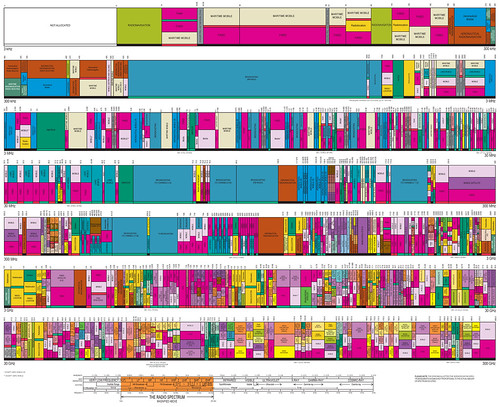
 U.S. Frequency Allocation Chart

More HD for DirecTV


Beautiful launch from the Baikonur Cosmodrome last week, putting DirecTV 12 into orbit:

The new satellite will boost DIRECTV’s High-Definition capacity by 50 percent, to more than 200 HD channels, increase the number of local HD markets DIRECTV will serve and significantly expand movie choices on the DIRECTV CINEMA™ and DIRECTV on DEMAND services. DIRECTV offers more than 130 HD channels today and delivers local HD programming to 138 markets, representing 92 percent of U.S. TV households. Click here to see which HD channels DIRECTV currently carries.

D12, a Boeing 702 model satellite, lifted off on an International Launch Services Proton Breeze M vehicle at 4:22 p.m. PT yesterday from the Baikonur Cosmodrome in Kazakhstan. Controllers at the ground station in Hartebeesthoek, South Africa, have made contact with the satellite and confirmed that all systems are functioning properly. 


Here’s the integration work…


…and the traditional 6:30 a.m. roll-out (yeah, it was cold) …


…and finally, the launch itself…


WBMSAT Satellite Industry News Bits for December 31, 2009

U.S. government 20-year program to combine all government and military acquisitions of commercial satellite services, the Future Comsatcom Services Acquisition, may be worth up to $700m a year.
[Aviation Week – 12/31/2009]

Intelsat-704 replacement satellite, Intelsat-17, will be built by Space Systems/Loral.
[SatNews – 12/31/2009]

U.S. National Geospatial-Intelligence Agency awards three indefinite-delivery, indefinite-quantity contracts for Commercial Satellite Synthetic Aperture Radar (COMSAR) imagery, data products, and direct downlink services.
[Satellite Today – 12/31/2009]

Telesat reportedly will purchase a new direct broadcast satellite, Nimiq 6, from Space Systems/Loral.
[TMCnet – 12/31/2009]

SES bids successfully for Protostar 2 at U.S.$185m; satellite will be integrated into its fleet to provide incremental capacity over Asia.
[SatNews – 12/30/2009]

Congress extends government indemnification of U.S. commercial launches for another three years.
[Satellite Today – 12/30/2009]

Broadcasters in the United States and Britain say the Iranian government has been jamming international satellite transmissions into the country.
[VOA News – 12/30/2009]

Majority of satellite companies responding to Satellite Today Quick Poll claim their businesses broke even in 2009, compared to 2008.
[Satellite Today – 12/30/2009]

Second attempt to launch French military satellite Helios 2B on Ariane 5 after 24 hour delay is successful.
{SatNews – 12/30/2009]

DirecTV 12 satellite built by Boeing, launched December 28, delivers its first signals from space.
[SpaceMart – 12/30/2009]

Russian scientists to meet in secret to work on plan to save Earth from collision with giant asteroid in 26 years.
[PHYSORG – 12/30/2009]

TLC, the winner of a U.S. GSA contract, will sell the SatMAX line of satellite communications extenders to U.S. government agencies and departments.
[TMCnet – 12/30/2009]

Bolivia, in cooperative project with China, expects to launch its first telecommunications satellite, Tupac Katari, in March 2010.
[Satellite Today – 12/29/2009]

Iran plans to unveil its second homemade satellite, national satellite Toloo, in February.
[Satellite Today – 12/29/2009]

ViaSat CEO Mark Dankberg interview lays out the ViaSat plan to become a satellite broadband provider with ViaSat 1 and the Wild Blue acquisition.
[San Diego Union-Tribune – 12/28/2009]

ORBCOMM settles insurance claims related to failures of a Coast Guard Demonstration satellite and three of five quick launch satellites which were all launched in June,2008; two quick launch satellites are still operating.
[TMCnet – 12/28/2009]

Orbital Sciences receives contract to build second high throughput satellite, HYLAS 2, for Avfanti.
[Manufacturing & Technology – 12/27/2009]

WBMSAT PS – Satellite Communications Consulting Services

WBMSAT Satellite Industry News Bits for December 24, 2009

Orbital Sciences Corporation and Thales Alenia Space share prime contractor status on contract for new geosynchronous satellite with regenerative system for broadband serving mobile terminals, to be built for OverHorizon, with offices in the U.S., Sweden, and Cyprus.
[Space Ref – 12/23/2009]

International Launch Services prepares DIRECTV 12 for launch on December 29.
[SatNews – 12/23/2009]

GOES-R gets thumbs up for go-ahead under Lockheed Martin’s contract with NASA.
[SatNews – 12/23/2009]

Space debris cause a lot of problems in launching new satellites.
[Space Mart – 12/23/2009]
Related – NASA and DARPA sponsor first ever international conference on orbital debris removal, seen as a new business area – the big question, who will pay?
[Space Mart – 12/14/2009]

Avanti Communications Group of London orders up HYLAS-2 satellite from Orbital Sciences, to be based on Orbital’s STAR 2.4 satellite platform.
[SatNews – 12/23/2009]

HYLAS 2 satellite to be launched by Arianespace in 2012.
[Space Travel – 12/22/2009]

Arinc and Vizada rollout voice services over Inmarsat I-4 network.
[Satellite Today – 12/22/2009]

Chrisar Software Technoligies contracts with Applied Satellite Engineering to develop satellite data solution for whale watchers using Iridium satellites.
[Satellite Today – 12/22/2009]

The European Space Agency awards a contract to Ariane 5 rocket manufacturer for early development of new upper stage to increase the launcher’s capacity.
[Spaceflight Now – 12/21/2009]

China to launch civil HD survey satellite in 2011.
[Space Daily – 12/21/2009]

KVH’s mini-VSAT broadband service is granted permanent "Earth Station onboard – Vessel" or ESV license authority after operating since September 2007 under an FCC Special Temporary Authority (STA).
[PR Newswire – 12/21/2009

GOES-P satellite arrives at Kennedy Space Center for prelaunch testing.
[Space Mart – 12/21/2009]

Lockheed Martin completes site acceptance testing over the Inmarsat-4 satellite network and delivers the Global Satellite Phone Service gateway in Subic Bay to Inmarsat.
[SatNews – 12/20/2009]

Russia plans research into nuclear engines for spaceships beginning in 2010.
[SatNews – 12/20/2009]


Russian, U.S., and Japanese astronauts blast off for Christmas stay on board the International Space Station.
[SatNews – 12/20/2009]

North America DBS subscriber disconnects investigated by NSR – steady stream of subscribers switch from one to the other provider as "free" period expires – cumulative subscriber disconnects increased by 9% over past three years.
[NSR Report – December 2009]

Helios 2B finally makes it into orbit on December 18, aboard the seventh Ariane 5 launch of 2009.
[Space War – 12/19/2009]

WBMSAT PS – Satellite Communications Consulting Services


Known Universe: The Video


By far the coolest space video ever, via the American Museum of Natural History:

After hovering over Mount Everest and the gorges that plunge to the Ganges, you are pulled through the Earth’s atmosphere to glimpse the inky black of space over Tibet’s high desert. So begins The Known Universe, a new film produced by the American Museum of Natural History that is part of a new exhibition, Visions of the Cosmos: From the Milky Ocean to an Evolving Universe, at the Rubin Museum of Art in New York City.

The magic of this film, though, happens as the inky black expands. Pulling farther and farther from Earth, you see the deep blue of the Pacific give way to night as the Sun comes into focus, the orbits of the solar system shrink smaller and smaller, the constellations Sagittarius and Scorpio stretch and distort, and, as the Milky Way receeds, the spidery structure of millions of other galaxies come into view. Then, you reach the limit of the observable universe, the afterglow of the Big Bang. This light has taken more than 13.7 billion years to reach our planet, and you return, back to Earth, to two lakes that are nestled between Mount Kailash and Mount Gurla Mandhata in the Himalayas.

The structure of The Known Universe is based on precise, scientifically-accurate observations and research. The Hayden Planetarium at the American Museum of Natural History maintains the Digital Universe Atlas, the world’s most complete four-dimensional map of the universe. The Digital Universe started nearly a decade ago. It is continually updated and is the primary resource for production of the Museum’s Space Shows such as the current Journey to the Stars, and is used in live, real-time renderings for Virtual Tours of the Universe, a public program held on the first Tuesday of every month. Last year, some 30,000 people downloaded the Digital Universe to their personal computers, and the Digital Universe will soon be updated with a more accurate and user-friendly software interface. Digital Universe is licensed to many other planetariums and theaters world-wide.

“I liken the Digital Universe to the invention of the globe,” says Curator Ben R. Oppenheimer, an astrophysicist at the Museum. “When Mercator invented the globe, everyone wanted one. He had back orders for years. It gave everyone a new perspective on where they live in relation to others, and we hope that the Digital Universe does the same on a grander, cosmic scale.”

The new film was produced by Michael Hoffman, and directed by Carter Emmart. Brian Abbot manages and Ben R. Oppenheimer curates the Digital Universe Atlas. The exhibition at the Rubin, Visions of the Cosmos: From the Milky Ocean to an Evolving Universe, opened on December 11 and continues through May 10.

The animation was done in Uniview (SCISS AB)


WBMSAT Satellite Industry News Bits for December 18, 2009

 Arianespace began 30 year history of launches with first European Space Agency launch from Kourou December 24, 1979 and never looked back.
[Space Travel – 12/18/2009]

SES wins auction, gets Protostar 2 satellite for U.S. $185 million; satellite will provide incremental capacity over Asia for SES.
[SatNews – 12/18/2009]

GeoEye-1 satellite shut down after antenna malfunction.
[Satellite Today – 12/18/2009]

GOES-14 enters full service; will be used to predict storms and monitor weather over 60% of the planet.
[SatNews – 12/18/2009]

Arianespace postpones the launch of French satellite Helios 2B a second time due to an anomaly.
[Satellite Today – 12/18/2009]

ViaSat finalizes acquisition of WildBlue Communications.
[Trading Markets – 12/18/2009]

Etisalat UAE signs multi-year contract for capacity on Intelsat’s recently launched Intelsat 15 satellite.
[SatNews – 12/18/2009]

DigitalGlobe’s WorldView-2 high-resolution satellite expected to achieve full operational capacity on January 4, 2010.
[SatNews – 12/18/2009]

Orbital Sciences is awarded a Phase 2 contract by the Defense Advanced Research Projects Agency (DARPA) for "Future Fast, Flexible, Fractionated, Free-Flying" (System F6) spacecraft.
[SatNews – 12/18/2009]

FCC unveils a list of proposals to meet national broadband plan – FCC raises idea of forcing cable and satellite operators to provide low-cost set-top devices to integrate broadband and video services.
[Washington Post – 12/17/2009]

Eutelsat wins broadband capacity, distribution deals in Albania.
[Satellite Today – 12/17/2009]

Satellite users may see more sporting events as federal investigators seek to close a loophole that allows cable TV operators to withhold sporting events and programming they own from rival providers.
[Tennessean – 12/17/2009]

Inmarsat hits 5,000 FleetBroadband terminal activations.
[Satellite Today – 12/17/2009]

RT Logic develops software-defined modem for feeder link terminals for Iridium which will be deployed by Iridium at its ground stations.
[TMCnet – 12/17/2009]

Satellite TV may be only option for thousands of Hawkeye fans to see their team in the Orange Bowl, as a dispute between Mediacom Communications Corp. and Sinclair Broadcasting Group could leave cable subscribers without local channels.
[Forbes – 12/17/2009]

China launches first public-welfare mini satellite from Taiyuan Satellite Launch Center in northern Shanxi Province.
[Space Daily – 12/16/2009]

Telenor Satellite Broadcasting’s Thor 6 satellite completes in-orbit testing.
[Satellite Today – 12/16/2019]

MacDonald Dettwiler and Associates announces $254 million U.S. contract win to build and launch a communications satellite for the Ukrainian space agency.
[Vancouver Sun – 12/15/2009]

Russia orbits three new Glonass navigation satellites.
[GPS Daily – 12/15/2009]

Vizada connects satellite service to submarine fiber cable along the East Coast of Africa.
[Satellite Today – 12/15/2009]

Iridium OpenPort provides fishing vessels operating in high northern latitudes continuous coverage including 3 phone lines and a data line up to 128 kbps simultaneously.
[SatNews – 12/15/2009]

NASA’s Wide-Field Infrared Survey Explorer blasted off from Vandenberg AFB on a mission to find hidden asteroids, comets, and other objects never before seen in space.
[R&D – 12/14/2009]

IoStar International Ltd. of Hong Kong is using more than a full Ku band transponder on Telesat’s Telstar 18 satellite to serve the communications needs of NATO troops.
[Satellite Today – 12/14/2009]

Orbital Sciences wins contract to build Intelsat 23 for Intelsat SA.
[Washington Business Journal – 12/14/2009]

Dish Network passes 14 million customer milestone.
[SatNews – 12/13/2009]

Small satellites grow in prominence and take on a growing number of operational roles alongside their full-size counterparts – a conference next year in Greece will discuss their evolution.
[R&D Magazine – 12/11/2009]

China launches remote-sensing satellite, "Yaogan VII", from Jiuquan Satellite Launch Center in northwestern Gansu Province.
[Space Mart – 12/11/2009]

While the satellite industry in general has been trumpeting its successes during the economic downturn, there are signs of weakness in a few key markets in North America.
[NSR Report – Global Assessment of Satellite Supply & Demand, 6th Edition]

Changes in programs, flux in budget, movements in personnel, and delays in decisions, while more bandwidth is required, characterize the government and military satcom market.
[NSR Report – Government and Military Satellite Communications, 6th Edition]

WBMSAT PS – Satellite Communications Consulting Service


Sports TV Loophole Closed


Shopping around for HD sports programming options in New York, you’re sure to find out you can’t get MSG-HD on Verizon’s FiOS TV. Why? It’s Jimmy’s channel and he wants it exclusively on Cablevision. Looking to add Comcast SportsNet HD to your DirecTV package in Philadelphia? No, sorry, not available.

How can they shortchange their viewing customers with this tactic? A 1992 law’s loophole. But not anymore as the FCC is looking to close it up quick, via WSJ

 The FCC’s Media Bureau will circulate an order Wednesday that would close the so-called terrestrial loophole used by companies including Comcast Corp., Cox Communications Inc. and Cablevision Systems Corp. to withhold local sports channels from rivals, an FCC official said.

If approved, the proposal would mean consumers could soon have more choice in pay-TV services. Sports fans who want to watch local baseball, hockey and other games at home wouldn’t be forced to subscribe to the largest local cable provider anymore.

In Philadelphia, for instance, fans of the Philadelphia Flyers, Phillies and Sixers can’t get games broadcast on Comcast’s SportsNet channel on DirecTV or Dish Network. In San Diego, subscribers to AT&T Inc.’s U-Verse television service can’t get San Diego Padres games, which are carried on a channel owned by Cox Communications.

The FCC’s move would be a victory for Dish Network Corp., DirecTV Group Inc., Verizon Communications Inc. and AT&T, all of whom have had difficulties at one point or another trying to get programming—mostly regional sports channels—from a local cable provider.

"Consumers shouldn’t be forced to stick with their incumbent cable provider in order to have access to their local teams’ games, or to watch those games in high definition," a Verizon spokesman said in a statement.

The National Cable & Telecommunications Association, the cable industry’s lobbying group, argued that exclusive distribution of channels "can be a pro-competitive tool."

"Exclusivity allows competing providers to invest in new services that have dramatically changed the marketplace, as can be witnessed by DirecTV’s overwhelming success with the NFL Sunday Ticket package," association spokesman Brian Dietz said.

The FCC requires cable operators to offer access to channels they partially or wholly own to rivals at reasonable rates, but some have used a loophole in a 1992 law to exclude local sports programming.

The loophole allows cable operators to withhold a channel from rivals if it is sent over a cable instead of beamed by satellite. Other pay-TV providers, including satellite TV and now phone companies, have complained to the FCC about the practice for years.

Last year, AT&T filed a complaint against Cox for denying it permission to air San Diego Padres games. Verizon filed a similar complaint against Cablevision for denying it access to a high-definition feed of games from Madison Square Garden.


IP-PRIME, the IPTV service scuttled by SES last year, had the same problem: they couldn’t get carriage rights to MSG-HD

With FiOS-TV moving in on Philly in a big way, we’ll finally get to see what competition will mean for us — the customers.

Too bad the FCC can’t do anything about the Rangers playing badly lately. Fire Sather?

WISE Spacecraft, Ey?


NASA’s Wide-Field Infrared Survey Explorer gave their acronym department a lay-up. They called it WISE and launched it a couple of days ago from Vandenburg:

WISE will see the infrared colors of the whole sky with sensitivity and resolution far better than the last infrared sky survey, performed 26 years ago. The space telescope will spend nine months scanning the sky once, then one-half the sky a second time. The primary mission will end when WISE’s frozen hydrogen runs out, about 10 months after launch.

Just about everything in the universe glows in infrared, which means the mission will catalog a variety of astronomical targets. Near-Earth asteroids, stars, planet-forming disks and distant galaxies all will be easy for the mission to see. Hundreds of millions of objects will populate the WISE atlas, providing astronomers and other space missions, such as NASA’s planned James Webb Space Telescope, with a long-lasting infrared roadmap.

JPL manages the Wide-field Infrared Survey Explorer for NASA’s Science Mission Directorate in Washington. The mission was competitively selected under the Explorers Program, managed by NASA’s Goddard Space Flight Center in Greenbelt, Md. The science instrument was built by the Space Dynamics Laboratory in Logan, Utah, and the spacecraft was built by Ball Aerospace & Technologies Corp. in Boulder, Colo. Science operations and data processing take place at the Infrared Processing and Analysis Center at the California Institute of Technology in Pasadena. NASA’s Launch Services Program at NASA’s Kennedy Space Center, Fla., managed the payload integration and the launch service.

Launch video…


Very cool mission, managed by JPL and CalTech. Be sure to read their "top 10 factoids."