Iran Satellite Jam

Amnesty International is telling us the BBC’s satellite feeds from Iran are being jammed. But they still got this report out:


I especially like this report. The Internet? Its a war zone:

More and more of Iran’s pro-government websites are under assault, as opposition forces launch web attacks on the Tehran regime’s online propaganda arms.

What started out as an attempt to overload a small set of official sites has now expanded, network security consultant Dancho Danchev notes. News outlets like Raja News are being attacked, too. The semi-official Fars News site is currently unavailable.

“We turned our collective power and outrage into a serious weapon that we could use at our will, without ever having to feel the consequences. We practiced distributed, citizen-based warfare,” writes Matthew Burton, a former U.S. intelligence analyst who joined in the online assaults, thanks to a “push-button tool that would, upon your click, immediately start bombarding 10 Web sites with requests.”


Blue Angels Cockpit

Whoa, inside one of the Blue Angels jets. Enjoy.


Moon Luggage


What is Louis Vuitton selling here, luggage for space tourists? Probably not.

They’re featuring Sally Ride, Jim Lovell and Buzz Aldrin in their next big promotion surrounding the Apollo 11 moon landing anniversary next month. Here’s the teaser:


Satcom News

Last week’s news summary, courtesy of Bill McDonald:

TeamCast and BBC will partner to develop new DVB-T2 modulator for professional applications.
[Satellite Today – 06/12/2009]

Euroconsult, a French satellite consulting firm, forecasts that nearly 1,200 satellites will be built and launched between 2009 and 1028, and increase of about 50% over previous decade.
[Satellite Today – 06/11/2009]

Intelsat plans launch of 11 satellites by end of 2012, 5 of which will refresh Asia-Pacific fleet.
[CNBC – 06/11/2009]

Thaicom opens gateway in Jakarta, Indonesia, the 15th gateway in the Asia-Pacific region.
[Satellite Today – 06/11/2009]

GOES-O launch date moved back to June 26th so design changes can be incorporated in linear shape charge system of Range Safety command destruct system of Delta IV rocket..
[SatNews – 06/11/2009]

Marlink acquires capacity on Tlesat’s Telstar 11N to extend its WaveCall maritime coverage into the North Atlantic Ocean.
[Satellite Today – 06/11/2009]

Successful 19 month Japanese moon mission concludes with a controlled crash landing on the surface.
{R&D Magazine – 06/11/2009]

MEASAT Satellite Systems and Classica Asia sign 5 year agreement for UNITEL CLASSICA HD channel to be distributed via MEASAT-3 satellite.
[SatNews – 06/11/2009]

C2SAT enters into licensing agreement for Shanghai based Xinguo IT to produce C2SAT stabilized antenna systems in China.
[SatNews – 06/11/2009]

Lockheed Martin team successfully mates infrared sensor payload to spacecraft bus for Air Force’s GEO-2 satellite.
[SatNews – 06/11/2009]

Digi International enters satellite market with acquisition of all assets of all assets of MobiApps Holdings Private Limited, a developer of machine-to-machine communications technology focused on satellite, cellular, and hybrid solutions.
[Satellite Today – 063/11/2009]

Citrix partners with TeleCommunications Systems to support the satellite communication capabilities of the U.S. Army.
[UPI – 06/10/2009]

Iridium is awarded a phase II contract for continued development of the Distributed Tactical Communications System for the U.S. Navy.
[UPI – 06/10/2009]

ILS gets second contract of 2009  from Intelsat for two new firm satellite launches and one optional launch.
[SatNews – 06/10/2009]

Integral Systems signs deal with Orbital Sciences Corp tfor primary and backup satellite command and control systems for Koreasat-6.
[Satellite Today – 06/10/2009]

Satellite manufacturing facility planned for Dubai based on engineering skills learned during Dubai-Sat 1 construction in South Korea.
[Khaleej Times – 06/10/2009]

Spacenet announces Innovation & Technology award to Missouri Department of Transportation for innovative emergency communications satellite solution.
[TMCnet – 06/10/2009]

Cable and satellite TV providers use the digital TV transition today, Friday June 12, to push to add subscribers.
[nvdaily – 06/10/2009]

Univision and Televisa argue before federal judge over rights to stream Televisa’s shows on line and on cell phones in U.S.
[AP – 06/10/2009]

DirecTV VP for government affairs accuses Comcast and other cable companies of pushing Massachusetts legislation for 5% sales tax on satellite DTV service as Satellite Broadcasting and Communications Association launches media offensive against the legislation.
[Boston Herald – 06/10/2009]

Caprock Government Solutions receives Satellite Industry Leadership Award from 2009 International Satellite and Communications exchange conference in San Diego.
[SatNews – 06/09/2009]

TerreStar announces rescheduling of launch of TerreStar-1 for July7-12, 2009 to ensure on-orbit anomaly on another operator’s satellite has no bearing on flight-worthiness of TerreStar-1.
[SatNews – 06/09/2009]

KVH adds dedicated Crew Calling Gateway to mini-VSAT system for Nor-Shipping in Norway.
[SatNews – 09/09/2009]

Air Force formally terminates contracts with companies including Lockheed Martin Corp. for TSAT communications satellite system.
[Forbes – 06/08/2009]

General Dynamics wins $119m U.S. Army WIN-T order for 293 satellite terminals and support services.
[Satellite Today – 06/08/2009]

KCPC Satellite Communications announces offer to purchase shares of Gilat Satellite Communications.
[Business Wire – 06/08/2009]

WildBlue provides hands-on demonstration of "next generation" satellite broadband for consumers on Capitol Hill.
[Business Wire – 06/08/2009]

Eutelsat announces data rate increase of Tooway consumer broadband service from 2 Mbps to 3.6 Mbps at no additional cost.
[PR Newswire – 06/08/2009]

Inflatable tower, built from materials available today, could climb to the edge of space and be used for research, tourism, telecommunications, or launching spacecraft.
[New Scientist – 06/08/2009]

Senator Feinstein expresses "extraordinarily serious concern" over new electro-optical satellites for the DOD recently approved by President Obama.
[got geoint? – 09/10/2009]

WBMSAT PS – Satellite Communications Consulting Services

 

Coolest Moon Mission

I’d have to agree with Mike Swift of the San Jose Mercury News that Wednesday’s scheduled launch from the Cape on Wednesday, 17 June 2009, will be the beginning of the coolest moon mission ever:

LCROSS may be one of NASA’s most participatory missions. If the spacecraft launches on schedule at 12:51 p.m. Wednesday, it would hit the moon in the early morning hours of Oct. 8. The cloud from the 350 metric tons of debris kicked up by the Centaur booster should spread six miles above the surface of the moon, hitting the sunlight and making it visible to amateur astronomers across North America. The space agency is enlisting telescopes around the country to help monitor the impact.

The 1,664-pound spacecraft will have the best view. LCROSS will separate from the Centaur booster less than 10 hours before impact and will be less than 400 miles above the moon when the spent rocket booster collides at a speed five times faster than a bullet from a .44 Magnum. NASA plans to stream a live view from LCROSS as the Centaur, followed by the spacecraft, plows into the moon.

Over the final four minutes of its existence, as it follows the same terminal trajectory as the Centaur, LCROSS will train its instruments and cameras on the debris cloud, searching it for the chemical signature of water.

Previous spacecraft and ground-based instruments have detected signs of hydrogen near the moon’s poles, and scientists are split over whether that is from ice that could have arrived through the impact of comets or by other means. That ice could have lingered for more than a billion years at the bottom of craters near the lunar poles that have never seen sunlight, where temperatures are more than 300 degrees below zero Fahrenheit.

And despite all the serious scientific talk about hydrogen signatures and lunar regolith, flying a rocket booster into the moon at 5,600 mph to trigger a massive explosion is just flat-out cool.

"We’re certainly going to be making a big splash," Ennico said. "We’re going to see something, but I don’t know what to expect. I know on the night of the impact, I’ll be running on adrenaline."

Found this very good simulation on YouTube:


And here’s the video from Northrop-Grumman…


DIY Friday: Close Encounters Altoid Tin


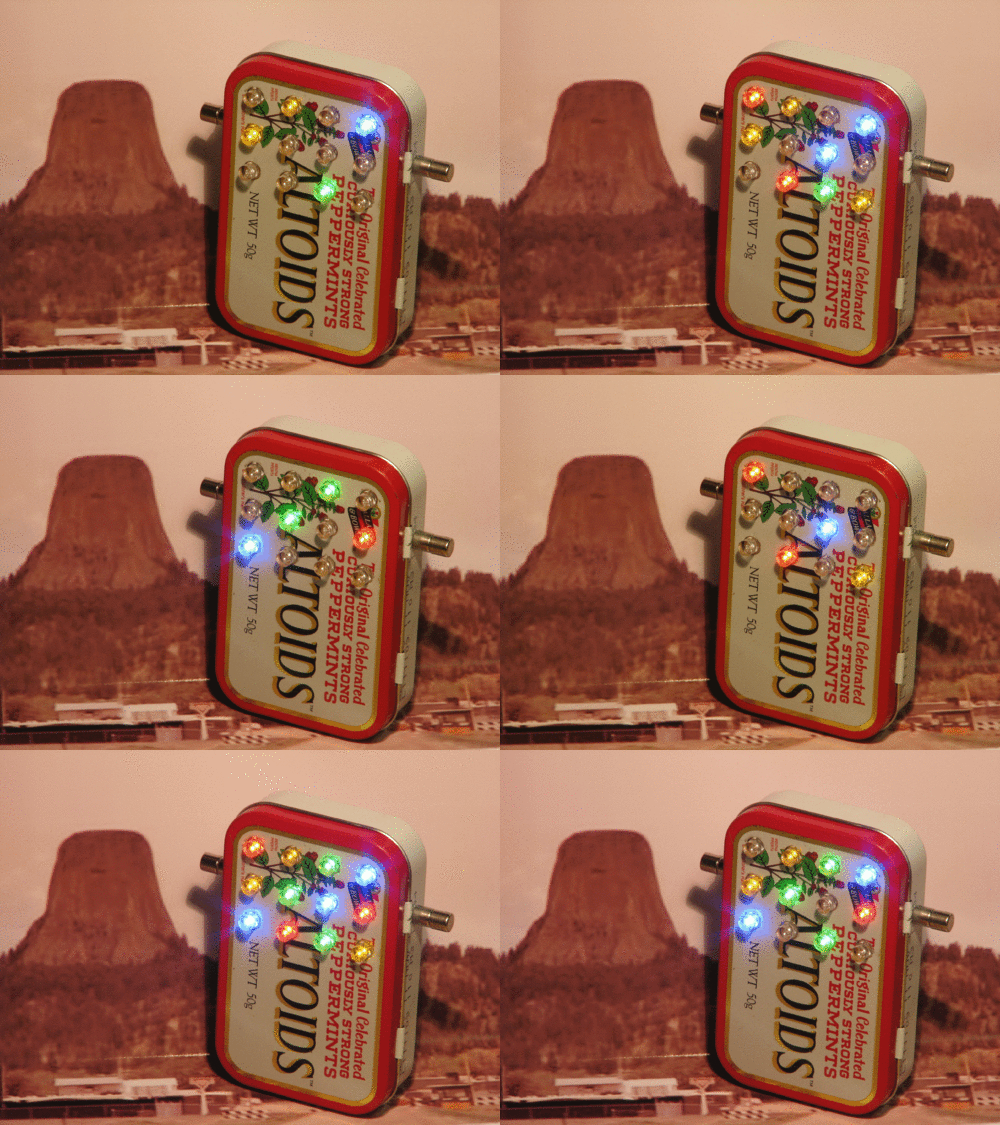
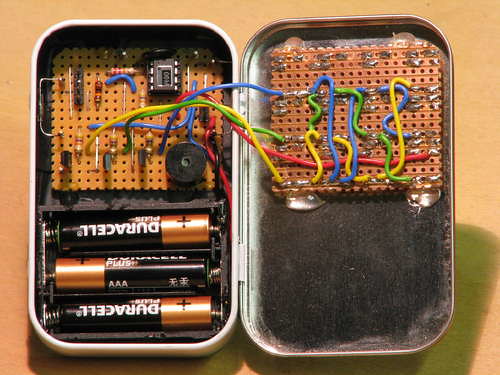
Fantastic entry in the Instructables "Get The LED Out" contest: How To Communicate With An Alien Artifact or . . .Close Encounters of the Curiously Minty Kind.

Most LEDs are VERY bright over a very small viewing angle. Here I’ve used wide-angle flat top LEDs which give the same light but spread over a much wider range which will allow this to be appreciated from all angles. The video really doesn’t do justice to the brightness and clarity of the LEDs. They are bright even in daylight. Also the initial flashing is an artifact. The LEDs are pulsing smoothly.

The 12 LEDs are arranged as three banks of 4, which gives 7 possible patterns of illumination. It would have been good to have more but I wanted to keep this simple and specifically use the PicAxe 08m chip. The spreadsheet shows the way the LED colours and banks are arranged.

For the LED array you will need :-

    * 3 x red LEDs, 3 x blue LEDs, 3 x green LEDs, 3 x yellow LEDs.
    * 6 x 180R resistors (brown, grey, brown) for the red and yellow LEDs.
    * 3 x 220R resistors (red, red, brown) for the blue LEDs.
    * 3 x 330R resistors (orange, orange, brown) for the green LEDs.
    * 18 x 15 hole copper strip veroboard.
    * Spot face cutter ( or a 5mm drill bit or craft knife).
    * Scraps of plain board and link wire.


Love the video clip…


TerreStar Launch Slips


Last month, Eutelsat reported an on-orbit anomaly to its W2A spacecraft’s S-band payload. Although disclosure of this type is material to a  firm’s financial performance, most spacecraft bus and/or payload anomalies are shared with other operators.

Unlike the business side, spacecraft engineering departments know what their counterparts are up to — especially when it comes to anomalies. On-orbit anomalies? Everybody knows about them almost instantly, although it may not become public information for weeks or months.

For those designing/building payloads on the ground, this is absolutely essential information. Make changes now, or "pfft," you’re done. That’s why the TerreStar-1’s launch is slipping a few weeks:

…the launch of TerreStar-1 has been rescheduled for a July 7-12, 2009 window to permit additional time to ensure that an on-orbit anomaly that occurred recently on another operator’s satellite has no bearing on the flight worthiness of TerreStar-1.

"While our vendors have assured us that TerreStar-1 is ready to launch, we believe this short delay may provide a window for additional data to verify that TerreStar-1, including its 18 meter reflector, is unaffected by the anomaly reported by another operator’s S Band satellite," Dennis Matheson, CTO of TerreStar said.

Arianespace, TerreStar-1’s launch services provider, has agreed to this updated launch schedule.

"Throughout the construction of TerreStar-1 we have emphasized quality and certainty over speed. Today’s revised launch schedule is another example of our commitment to eliminate unnecessary risks when we can," said Jeffrey Epstein, President of TerreStar. 

The Eutelsat W2A anomaly prompted a terse statement from Solaris Mobile, the payload’s beneficiary:

Solaris Mobile and its shareholders Eutelsat Communications and SES Astra announce that the current evaluation of the in-orbit tests of the S-band payload on the W2A satellite launched on April 3 indicate an anomaly which requires further tests.

Additional analysis is consequently planned with the satellite’s prime contractor, Thales Alenia Space, in order to identify the cause of the anomaly and to fully assess the extent of the Sband payload’s capability to provide mobile satellite services to the European marketplace.

Solaris Mobile remains confident of its ability to meet the commitments made according to the European Selection and Authorisation Process, under which it has applied for S-band spectrum to provide these services. The company is evaluating a range of options to compensate for this situation and expects to make further announcements in due course.

Crash-Landing Kaguya


Japan’s Kaguya spacecraft is expected to crash into the moon this week. Yeah, this is serious business, according to Inside Japan:

The Japanese Kaguya lunar orbiter is to conclude its research mission in dramatic fashion by crash-landing on the moon later this week.

Observers will be watching the moon’s near side for the final impact made by the probe, which has been in orbit around Earth’s satellite since late 2007, at 18:30 GMT on June 10th.

The mission of the Kaguya probe, formerly codenamed Selene, was to aid study of the evolution of the moon by collecting data on its composition and gravitational field, as well as recording high-definition video of its surface.

Collision with the moon is the typical destiny of such orbiters, with the European Space Agency’s SMART-1 and the Chinese Chang’e 1 among the probes to impact upon the lunar surface in the last two years.

Shin-ichi Sobue, a spokesperson for the Kaguya mission, described the forthcoming collision as "a final show for the Japanese people".

This "landing" will undoubtedly add an exclamation point to the fine video footage gathered by JAXA and partner NHK. This eart-rise is a fine example:


Buen Trabajo, Por Satélite


Satcom service companies in Latin America seem to be doing well, going where other telecom services can’t, and, well, there’s video.

No other technology delivers video to more people simultaneously than satellite. Here’s the press release from Frost & Sullivan:

 "Fiber networks are limited to the most developed regions, leaving important space for satellite-based solutions to grow," says Frost & Sullivan Consultant Andrés Sciarrotta. "Moreover, the higher requirement for mobile content is, in turn, driving demand for data applications transmitted by satellite."

Users, irrespective of their location, can use fixed and mobile solutions to gain access to Internet broadband satellite. The fixed version provides broadband access throughout Latin America, at speed comparable to those available in the big cities.

Users can access their e-mails, transfer files, communicate through voice over Internet protocol (VoIP), or schedule meetings through video conference IP. This type of solution offers the benefits of communication from anywhere in the region (regardless of whether it is inhabited or not), a specially optimized coverage for South America, and a wide range of available services.

Despite these advances, the satellite service market is yet to stave off competition from terrestrial infrastructure and has to find a solution to the unattractive cost structure and payment methods, despite just having overcome historic low prices. The market is also challenged by the underwater cable network in Chile and other land installations. However, market participants can take heart from the governments’ efforts to spur connectivity programs in order to minimize the digital distance among some regions.

"Developments of TV digitalization and high definition TV (HDTV) broadcasting are also expected to drive the demand for transponders," notes Sciarrotta. "Further, the introduction of Ka-Band can augment the array of applications provided over satellite."

The study may be unique in its analysis, but I’d be interested in seeing research similar to what ASTRA produces in Europe. Market penetration estimates in the free-to-air and paid TV services via satellite is something programmers and content owners would be something they’d like to see. I’m certain of that.

What I think the Latin American market needs is more satellite capacity/inventory. If most the best satellites are sold out, what have you got to sell? Mierda!

DIY Friday: Binder Clip Dock

Since we’re using less and less paper, who needs binder clips? Use your surplus to make a dock for your iPhone/iPod.

Sit back and watch…