Author Archive

iPod From Space Falls to Earth

Tuesday, March 28th, 2006

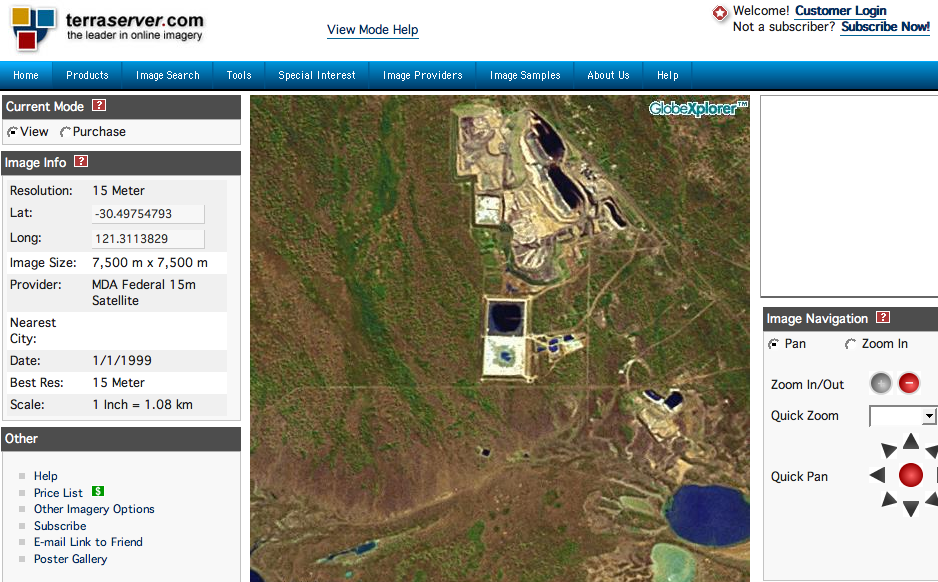
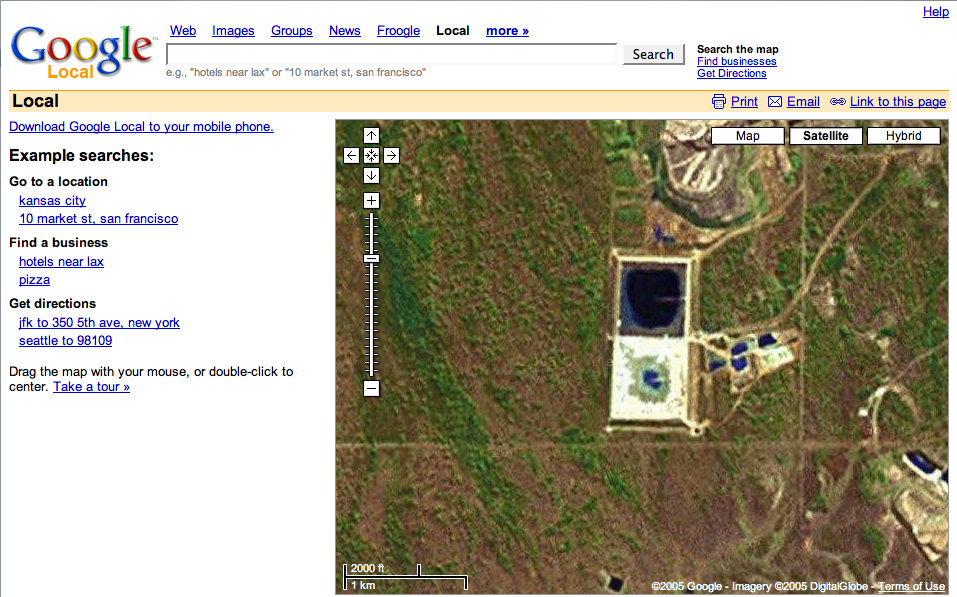
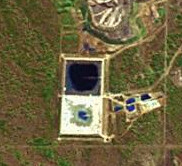
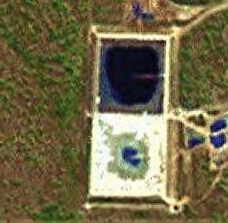
It was fun while it lasted, huh? We saw the Gizmodo post yesterday, about the iPod advertisement that’s viewable from space, and filed it away for future reference. Turns out that, after rocketing around the blogosphere, it’s probably not what it looks like. Some intrepid bloggers noted that the Terrabyte satellite image for that location on January 1, 1999 — before the iPod launched — looks the same  as it does Google Earth today.

We’ve got both images. Care to guess which is which?


It gets better. The Terabyte server’s been rather busy, so when we got a chance we grabbed a screenshot of the whole page. (Note the date.)


terrabyte1999

And we grabbed a shot of Google Earth as well. 


googleearth

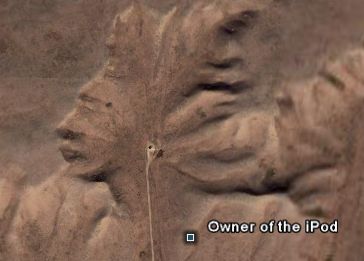
And fun would it bit of snark? The author of the the original post suggests he knows the identity of the legendary space-iPod’s owner.

It is just me? Do things not always look like what they are when seen from space? Or is am I seeing ancient Egyptian royalty here? 

So, is there anything else that looks like an iPod from space? How many can you find?

NASA & Sweden in Moonbase Race?

Monday, March 27th, 2006

The history book on the shelf,
Is always repeating itself…

Abba – “Waterloo” 

We’ve already been to the moon (unless you believe that the whole thing was done on a movie lot), but it looks like we’re going to stay a while the next time we go back. There just one question. Who’s gonna get there first? I experienced a little brain tickle this morning when I saw the news item that NASA is quietly planning a moonbase

For the first time since 1972, the United States is planning to fly to the moon, but instead of a quick, Apollo-like visit, astronauts intend to build a permanent base and live there while they prepare what may be the most ambitious undertaking in history — putting human beings on Mars.

It sounded vaguely familiar, and not because the presdient announced a plan to return to the moon a couple of years ago. I felt that brain tickle because I remembered hearing just a week or so ago that someone else was planning to do the same thing.

A quick search through my bookmarks, and I had the answer. In the race to colonize the moon, NASA has at least one competitor: Sweden.

The proof comes in the form of the innocent-looking SMART-Centre which, according to various reports, has assembled a consortium of more than 50 partners – including Japan’s Shimizu Corporation, US NASA contractor Orbitech and the UK’s Cranfield University – to turn the centre’s Dr. Niklas Järvstråt’s dreams of extraterrestrial conquest into reality.

 You won’t find much about a moonbase at the SMART-Center homepage. For that you’ll have to dig into their projects for the vision statement.

We have already taken the one small step for mankind and landed on the moon. We have seen it, we have conquered it, we have explored it – but our presence has not been sustained. For the benefit of mankind, the survival of our natural resources on Earth and for the proliferation of space exploration, it is now time for the next logical step – an international lunar colony. A colony where men, women and children can live without the need of a continuous supply of materials and technology from Earth; a self-supporting colony where the great circle of life can be sustained in its entirety by lunar raw materials and where all life-sustaining products will be manufactured in situ.

The Swedes have some other big plans in mind beyond moon — including exploring Mars, asteroids, other solar systems, etc., and trying their hand at world peace — but will it be more than they can handle? Then again, as the article linked above notes, NASA has its hands full with emptying its already-tapped-out pocketbook for space shuttle repairs, with a 2020 back-to-the-moon deadline looming over it. The Swedes have a deadline for lunar construction and immigration to happen sometime between 2018 and 2024.

So, it’s not a question of if human beings will return to the moon, but a matter of when and under which flag. Anyone care to lay bets?
Making MobTV Work

Friday, March 24th, 2006

I’ve decided to try my hand at coining a new phrase: mobTV. I figure if mobile blogging can become "moblogging", then mobile television can become "mobTV." Besides, as I’m learning more about it and writing more about it I’m going to need a more efficient way to refer to it if I want to keep up, given the way its spreading and the number of terms I have to learn. 

Since my last post on the mobTV taking off in Korea, it looks like mobTV is coming to China next, if Radioscope has its way.  And on a pretty cool looking phone, if you ask me.

Samsung MobTV PhoneRadioscape has won contracts to supply five more Digital Multimedia Broadcast (DMB) and Enhanced Packet Mode (EPM) transmission systems for mobile TV operators in China, bringing the total to nine in the past few months.

 The company says the contracts are the fruits of at least two years of courting Chinese authorities about its DAB-based mobile TV technology and helping them evaluate the most appropriate technologies for the service, and choosing between DMB, DVB-H and DMB-T.

From there it gets interesting. Qualcomm announced last year that it was bringing mobTV to the states via a  technology called MediaFLO, which Verzion also adopted late last year. For the curious, Mobile Content News has video of MediaFLO in action. (Found via Engadget, and I believe that’s Shrek on the small screen.)  The question is, can it work? The experts aren’t  exactly in agreement. Depending on who you ask, MediaFLO and another technology called DVB-H are doomed because EV-DO already gets the job done and new networks are too expensive to build and support, or DVB-H will be the de facto standard once spectrum allocation problems are solved.

Got all that? Good, because I’m about to add some French to the mix. Alcatel just announced that it’s overcome the spectrum allocation issue by using a satellite frequency.

With the help of satellites, Alcatel aims to overcome a key hurdle in rolling out broadcast television services over mobile phones: the lack of available spectrum. 

The French telecommunications-equipment manufacturer proposes using the widely available S-Band frequency reserved for satellites to transmit broadcast signals both terrestrially and via satellite to mobile phones based on the DVB-H (digital video broadcasting – handheld) standard, instead of the UHF band. 

… The Alcatel proposal calls for equipping base stations with S-Band repeaters and, in addition, using satellites capable of transmitting in the S-Band to deliver content to 3G (third-generation) phones enabled with DVB-H technology in three different ways: base-station streaming, base-station broadcasting and satellite broadcasting.

The article also does a good job of explaining the drawbacks of the three delivery systems. Streaming offers unlimited channels and great indoor coverage, but only for a limited number of users on a network. Broadcast matches it on indoor coverage, and supports unlimited users, but only 27 channels. Satellite matches them on channels and user support, but falls short on indoor coverage. Alcatel claims the answer is an "intelligent content-management system" that seamlessly chooses the right delivery system. 

Leave it to the French to come up with an elegant solution. I just hope it works well enough to eventually get picked up in the U.S. It would be great to catch up on Desperate Housewives reruns on the subway, and get all the way up the street to my office without losing the signal.

Robots on the Road

Monday, March 20th, 2006

Here’s another post about people building the darndest things. On March 28th, thanks to the folks at Darpanet, you’ll be able to watch a dozen driverless vehicles — created by people ranging from entreprenuers to students and hobbyists — attempt to successfully navigate 130 miles of Mojave desert terrain on NOVA’s The Great Robot Race. NOVA’s companion site features background on the dozen teams competing for the $2 million prize, as well as videos of their vehicles, and a preview of the upcoming show. 

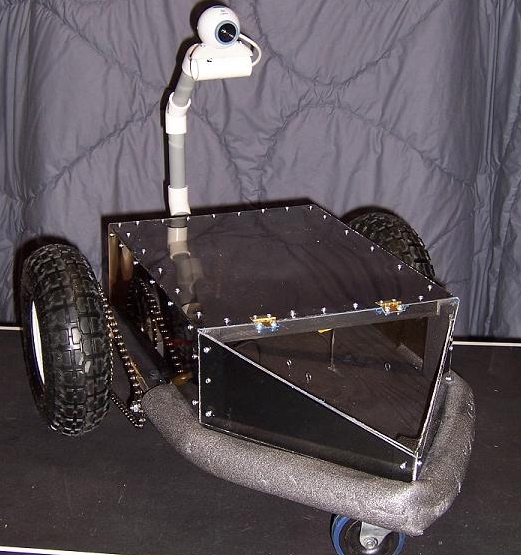
Sounds impressive, and you can bet that with $2 million at stake a lot of time and resources went into building these prototypes. However, my favorite robot vehicle of the day won’t qualify for the competition. It’s a wi-fi rover I found via Make  magazine, built at a cost of $103 by a high school student who won second place in a local science fair with his creation.


He’s got plans to add GPS, and other neat gadgets. After building a robot on just over $100, I wonder what this kid could do with even a fraction of the Great Robot Race prize money.

TV: To-Go vs. Terrestrial

Wednesday, March 15th, 2006

Imagine for minute that you want to watch, say, the Super Bowl or some other big television event. But it’s only available on your phone.  That’s right. None of the "terrestrial" networks are carrying it. Hard to imagine?  It happened in South Korea

Cable TV and other media that are considered as "non-mainstream" are threatening the realm of conventional terrestrial TV.

The latest case was a challenge made by a one-year-old sports channel Xports, which is buying up broadcasting rights for matches of the South Korean national team.

On Wednesday night, Xports exclusively aired the national team’s match with Syria. It was the first time a national team match was not shown on the three terrestrial TV channels _ KBS, SBS and MBC. Adding insult to injury was the fact that the Korea-Syria match was also viewed on versatile mobile phones with satellite DMB functions, another emerging medium of entertainment.

Satellite TV on a cell phone? Evidently, it’s spread so widely in other parts of the world that it’s starting to rival traditional — "terrestrial" — TV. Well, it’s here. And though you may not find it’s your only option for some television events, it’s set to offer more options. It’s expanding into Europe and other countries, through companies like Pantech and Samsung. It’s also coming to Canada and Latin America. Now, I find out that my wireless carrier launched its own video service a week ago, along with two new phones to go with it. 

Boy, am I behind. I haven’t even gotten a video iPod yet.  Now my phone is outdated, and have to choose which new phone to get; never mind deciding what to watch once I get it.

Google Goes to Mars

Monday, March 13th, 2006

Having already been to the the moon, Google goes to Mars and takes us there with Google Mars.

 Google Mars

Besides looking at the pretty pictures via the elevation map, you can check out the "visible" and "infrared" views, as well as the mountains, ridges, plains and  craters of the red planet, as tagged by Google. And clicking on the stories link will lead you to some background information on various sites, like the Bacolor Crater.  

Via Warping it up!

Technorati Profile

Wanna Buy a Space Shuttle?

Monday, March 13th, 2006

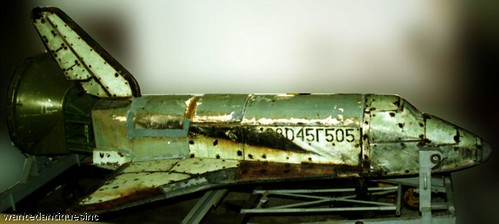
Well, you’re too late and about $98,000 short if — like most of us — you don’t happen to have that kind of change lying around. But if you had it to spare and had happened across a particular Ebay posting over the weekend, you could have bought a Soviet Space Shuttle

 Soviet Shuttle

OK, OK. So it’s not an actual space shuttle. It’s a 1/8 model that was used in various flight tests for the Soviet’s Buran space shuttle.

 The BOR-5 is a 1400 kg exact 1/8 scale model of the Soviet space shuttle Buran. The BOR-5 is 15’6" Long (17′ w/trailer) X 9’10" Wide (wingtip to wingtip) X 5’10" Tall (8’10" Tall on trailer). It was used to validate the aero-dynamic characteristics of the Buran at hypersonic speeds, between 1983 and 1988. The BOR-5 was launched on probably five sub-orbital trajectories from Kapustin Yar, in the direction of Lake Balkhash, using SL-8 (Cosmos) rockets (Russian designation: K65M-RB5). BOR is the abbreviation for Bezpilotnyy Orbitalnyy Raketoplan (Unmanned Orbital Rocketplane).

BOR-5 flights tested (amoung other things) carbon-based and quartz fiber heat-shield material paving the way for the Buran Shuttle. Russian sources are contradictory as to the number of BOR-5 flights. An except from one report reads: " … At an approximate altitude of 110-120 km height, the Cosmos booster pitched down, driving at full thrust for several minutes, accelerated the model to Mach 18.5 at 45 degrees, before separation. The craft landed using a parachute landing system after a flight of 2000 km.

 But those are just details, really. How cool would it be to start conversations with, "So, you know, I own a space shuttle"? If you happen to have $25,000 to spare between now and April you still have shot at an original NASA space shuttle prototype. Sure it’s only .008 scale, but it’s still a space shuttle, right? Anyway, if that’s too big of a hit to the wallet, you can always bid on about a ton of other space memorabilia.

Via Gizmodo and Random Good Stuff.

GPS for Lost Pets

Tuesday, March 7th, 2006

Here’s a use for satellites I hadn’t thought of, but wish I had. No matter where you live, chances are you’ve seen "lost pet" signs stapled to telephone poles, stapled to streetlights, or tacked to grocery store bulletin boards. I always wondered if those signs really helped people find pets who’ve been struck with wanderlust. My guess is that it’s probably hit-or-miss. Via Gizmodo comes news of Global Pet Finder, which uses GPS and 2-way wireless technology to help customers find their lost pets. Their customer testimonials don’t mention any lost pets that have been found, but some owners have gotten pet location alerts via SMS, so my guess it that it’s probably more effective than posting signs all over town.

People Build the Darndest Things

Tuesday, March 7th, 2006

As someone who finds it challenging to put together my three-year-old son’s toys, I’m rather in awe people who can build stuff — from a simple birdhouse to space-bound rockets and satellites. Lately, I’ve noticed people of all ages taking dreams and ideas from mere ideas on paper to reality. In particular, I’m rather in awe of some Philladelphia high school students who built a hybrid car that runs on soybeans.

 
A car that can go from zero to 60 in four seconds and get more than 50 miles to the gallon would be enough to pique any driver’s interest. So who do we have to thank for it. Ford? GM? Toyota? No — just Victor, David, Cheeseborough, Bruce, and Kosi, five kids from the auto shop program at West Philadelphia High School

The five kids, along with a handful of schoolmates, built the soybean-fueled car as an after-school project. It took them more than a year — rummaging for parts, configuring wires and learning as they went. As teacher Simon Hauger notes, these kids weren’t exactly the cream of the academic crop.

“We have a number of high school dropouts,” he says. “We have a number that have been removed for disciplinary reasons and they end up with us.”

…”If you give kids that have been stereotyped as not being able to do anything an opportunity to do something great, they’ll step up,” he says.

The high school inventors have more than earned their “Fab Five” moniker, but they’re not the only ones building some pretty amazing things. Just in the past week, Make Magazine has featured an update on a Rube Goldberg contest at Purdue University, and a Mexican grandfather who builds his own rockets. I f you’re inclined to try your own hand at this, you can check their post on making water rockets, or visit Dirk’s Rocket Dungeon and check out some old rocket plans for reference.

As for me, I’ll stick to putting together my kid’s toys.  That’s challenge enough for me.

Further Scenes from a Universe

Wednesday, March 1st, 2006

Pinwheel

This time it’s the Hubble telescope, bringing you the Messier 101 spiral galaxy (a/k/a the Pinwheel Galaxy) head-on, in just 51 exposures and coming in at a mere 16,000 by 12,000 pixels