Author Archive

Scenes from a Universe

Tuesday, February 28th, 2006

Gamma Ray BurstUniverse Today has a couple of posts up featuring some fascinting satellite imagery, and even a link to some pretty cool imagination. One features some images of Jupiter, Neptune and Uranus from NASA Astrobiology, while the other concerns a cosmic explosion seen by NASA’s Swift satellite

The Swift satellite, whose mission control center is in State College, has detected a cosmic explosion that has sent scientists around the world scrambling to telescopes to document this startling event. Gamma-ray radiation from the source, detected on 18 February and lasting about half an hour, appears to be a precursor to a supernova, which is the death throes of a star much more massive than the Sun. "The observations indicate that this is an incredibly rare glimpse of an initial gamma-ray burst at the beginning of a supernova," said Peter Brown, a Penn State graduate student and a member of the Swift science team.

The Penn State release also links to a pretty cool collapsing star animation, collapsing stars being one of the "leading contenders" for causing gamma ray bursts like the one Swift detected. Also check out the link to NASA’s Goddard Space Center for multimedia from Goddard TV

Why Not a Satellite Watch?

Monday, February 27th, 2006

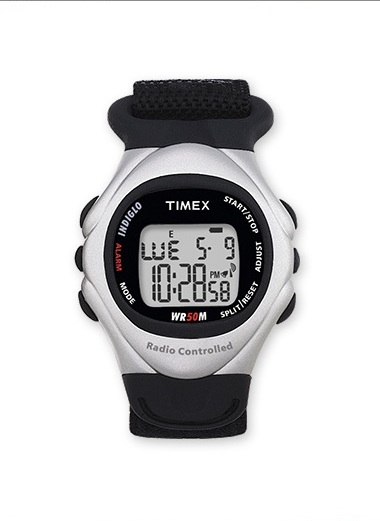
Radio WatchMy watch died this weekend. So I ended up shopping for one this weekend, because I have to have watch. It’s not that I’m terribly punctual or anything. I basically need a watch to tell me how long I can procrastinate, down to the second, before I have to get moving towards where ever I’m supposed to go or get started on whatever I’m supposed to do. Maybe I’m a bit behind on watchmaking technology, but I was surprised to find the watch of my dreams, and to find myself dreaming of one even better.

I was standing in front of the plexi-glass display case perusing the digital models, because an analog watch makes means I have to figure out the time whereas a digital watch just tells me the time. This is important because my watches tend to run up to 15 minutes fast or slow, which means I still have to figure out the time, but a digital display makes it easier to do the math. It was then that I saw a wonder I didn’t know existed: a self-setting watch

Once I got it home and unfolded the instructions, I learned that my "radio controlled" watch is works on Coordinated Universal Time (UTC). Every day at around 1:00 am, it tunes in to a radio signal from Fort Collins, CO, synchronizes and then converts UTC into local time.

So, now I’m thinking that it would be even better if there was a watch that changed time zones when I travel. Like I said before, I usually forget how to set my watch, so changing time zones can be a pain. So, why not a satellite watch that functioned the same way as the radio watch, but that also synched itself whenever I entered a new time zone? Has this been done?  Can this be done?  If so, it would certain make my life easier.

Bring a Little Stardust Home

Thursday, February 23rd, 2006

It hasn’t been long since NASA’s “Stardust”  returned to earth, but scientists are already slicing and dicing microscopic specks of comet dust collected by the space probe. We’re talking “dust” that’s as old as the solar system, verified comet matter, seen for the first time by NASA scientists. Interesting stuff. Fortunately, NASA scientists are letting the public in on the fun. 

Stardust@Home  appears to be modeled after SETI@Home, in the sense that you can volunteer your computer’s unused resources to help with the project by performing mathematical calculations, etc. There’s just one significant difference. They don’t just want your computer’s resources. They want your brainpower too.

First, you will go through a web-based training session. This is not for everyone: you must pass a test to qualify to register to participate. After passing the test and registering, you will be able to download a virtual microscope (VM). The VM will automatically connect to our server and download so-called “focus movies” — stacks of images that we will collect from the Stardust Interstellar Dust Collector using an automated microscope at the Cosmic Dust Lab at Johnson Space Center. The VM will work on your computer, under your control. You will search each field for interstellar dust impacts by focusing up and down with a focus control.

If that sounds exciting to you, and you think you can pass the test, go pre-register to help them out! 

Will the Rocket Car Blast Your Commute?

Tuesday, February 21st, 2006

If you’re one of many commuters who spend countless hours in the car between work and home, you’ve probably seen more than your share of gridlock. Chances are at least once or twice you’ve closed your eyes and dreamed of your car sprouting rockets and wings to lift you far above the parking lot that used to be a freeway. Well, don’t go trading your drivers’ license for a pilot’s license just yet, but some of MIT’s "Aeronautics and Astronautics" students are working on making your rocket car dreams come true

Rocket Car

This summer, graduate students at the Massachusetts Institute of Technology will try to get an idea aloft that has intrigued people for decades: the flying car.

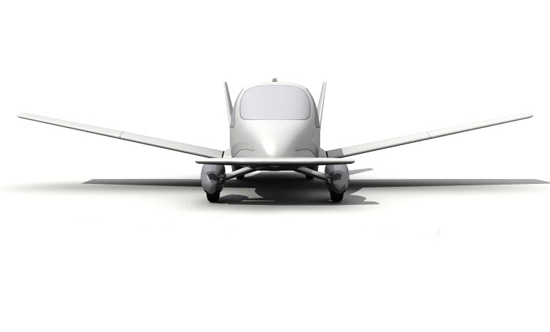
Terrafugia, a start-up created by Lemelson-MIT Student Prize winner Carl Dietrich and colleagues at MIT’s Department of Aeronautics and Astronautics, is aiming to show off what it calls the Transition "personal air vehicle," an SUV with retractable wings, to the EAA AirVenture Conference in Oshkosh, Wis., at the end of July.

The Transition is designed for 100- to 500-mile jumps. It will carry two people and luggage on a single tank of premium unleaded gas. It will also come with an electric calculator (to help fine-tune weight distribution), airbags, aerodynamic bumpers and of course a GPS (Global Positioning System) navigation unit.

Right now, there’s no prototype (I told you not to get your hopes up yet) and according to the article the company doesn’t plan to have one of these in the air before 2009 or 2010. Meanwhile, you can start saving up for one, and check out the pictures of their (one-fifth scale) wind tunnel model. While you’re at it, why not print out a copy and attach it to your sun visor just to have something concrete to dream about while you wait for the traffic to inch forward again?

Space Archaeology?

Thursday, February 16th, 2006

Who knew that NASA did archaeology? Unless someone’s sifting through the sands of some distant planet for signs of ancient intelligent life, I’ve always thought of archeology as the earthbound realm of the Discovery Channel and maybe Indiana Jones. That is, at least until I read that NASA helped uncover lost Maya ruins in the Central American jungle. 

Remains of the ancient Maya culture, mysteriously destroyed at the height of its reign in the ninth century, have been hidden in the rainforests of Central America for more than 1,000 years. Now, NASA and University of New Hampshire scientists are using space- and aircraft-based “remote-sensing” technology to uncover those ruins, using the chemical signature of the civilization’s ancient building materials.

NASA archaeologist Tom Sever and scientist Dan Irwin, both from NASA’s Marshall Space Flight Center in Huntsville, Ala., are teaming with William Saturno, an archaeologist at the University of New Hampshire, to locate the ruins of the ancient culture. Saturno discovered the oldest known intact Maya mural at the site in 2001.

… Sever has explored the capacity of remote sensing technology and the science of collecting information about the Earth’s surface using aerial or space-based photography to serve archeology. He and Irwin provided Saturno with high-resolution commercial satellite images of the rainforest, and collected data from NASA’s Airborne Synthetic Aperture Radar, an instrument flown aboard a high-altitude weather plane, capable of penetrating clouds, snow and forest canopies.

These resulting Earth observations have helped the team survey an uncharted region around San Bartolo, Guatemala. They discovered a correlation between the color and reflectivity of the vegetation seen in the images – their “signature,” which is captured by instruments measuring light in the visible and near-infrared spectrums – and the location of known archaeological sites.

My first thought was that if it’s possible to be an archaeologist without having to tromp around deserts and rain forests, I might start considering a new line of work. (Those mummy-related specials on Discovery and TLC inspire me.) I did a little searching online and found a bit more information about the research team and their research in Petén, Guatemala. Turns out, it’s still archaeology, so they still had to hack through the jungle — using satellite images to guide them — to “ground test” the data. They uncovered a series of ancient sites, right where the data and images predicted they’d be. 

So much for doing archaeology from a nice, air conditioned, indoor space — which I’m guessing were the conditions at the National Space Science and Technology Center, where Sever and Irwin conducted their space-based research before heading out into the field. Sever and Irwin can use satellites to lead them to ancient ruins, and I’ll wait for the same to beam their findings down to my living room.
Alphabet Soup

Tuesday, February 14th, 2006

One of the things I came away with at Satellite2006 (besides some pretty cool pictures) was a head full of acronyms that I still haven’t sorted out. I was reminded of that when I came across CNet’s “Wireless Alphabet Soup” post. I did a little poking around online, and found even more. I’m not sure how many of these I saw or heard at the conference, but it bears more than a passing resemblance to alphabet soup:

3G, 3GPP, BREW, BSS, CDMA, CDMA2000, CDPD, CME-CU, DVB-H, EDGE, ESS, EV-DO, FLO, GGSN, GPRS, GSM, HDML, HIPERLAN, HSCSD, HSDPA, HSUPA, IM1, MAC, MIMO, PKI, RAN, RASP, RU12, SGSN, TDMA, TD-SCDMA, UMTS, WAP, WCDMA, WEP, WIBRO, WIM, WLAN, WiMax, WTLS

I’m sure there are more that I’ve never even heard of before, but this is enough to wrap my brain around for now. If you know any that got left out, drop ’em in the comments. (And help a newbie out by throwing in a definition or two.)

Oh, and just for fun I made up a few of my own and tossed them in. Can ya find ’em? If so, good. Take notes. I have a feeling there might be a quiz of some sort later.

Oprah in Space

Friday, February 10th, 2006

Well, in space, and then in your car (not to mention everywhere else. No, the queen of all media isn’t donning a spacesuit, but thanks to a 3 year/$55 million deal with XM Satellite Radio she will soon be bouncing off the satellites and landing in your car (or at your desk, or wherever you listen to your satellite radio) with a new "Oprah & Friends" channel slated to debut in September.

Actually, it sounds like she’ll be there just often enough to keep the franchise.

"Oprah & Friends," which will debut in September, will rely more on the friends than on Oprah herself. Winfrey said yesterday in a teleconference from Chicago that she will have a half-hour "reality" show each week for 39 weeks — a recorded conversation with her confidante Gayle King.

The rest of the channel’s round-the-clock programming will be hosted by personalities who have become popular through appearances on Winfrey’s talk show, including fitness expert Bob Greene, self-help writer Marianne Williamson and designer Nate Berkus. The shows — which will focus on health, nutrition, self-improvement and current events — will originate from a new studio in Chicago.

So, if you’re a subscriber, you can share your commute with Oprah; occasionally, at least.

Wireless, From Local to Global

Thursday, February 9th, 2006

If I keep returning to the idea of community wireless networks, it’s because I keep seeing stuff that reminds me of it. This morning, no fewer than three items showed up in my daily news/blog feeds, ranging from my back yard to the other side of the world. 

I’m more of a "sidewalk warrior" than a "road warrior," as I can work from anywhere I can get internet access. So, I’m often found wondering the metro-D.C. area, laptop in tow, looking for wireless access. This morning I found out via a local blog, that I can find wireless pretty close to home in Montgomery County, MD, where pretty much all the libraries have free wireless. Glad to hear it. Now I have a few more options besides the hotspots at Borders and Starbucks.

I’d only just finished catching up on local wireless news when I came across two more items from Engadget. The first  reported discussions between DirectTV and EchoStar about establishing a nationwide wireless high-speed internet service. Sure, they’re just talking about it right now, But reports are that Rupert Murdoch is poised to write a big check in support of the venture; the kind of money that moves discussion along and  makes stuff happen.

I couldn’t help thinking about my first post when I read the second Engadget piece, which revealed (via The Wireless Report) that Google is bringing wireless internet to Nigeria.

Nigeria’s Finance Minister Ngozi Okonjo-Iweala stated that Internet search technology company Google has selected Abuja as one of seven African cities to be fully connected with its wireless network.

The  project is one of several Google has planned for "select African nations." That is, aside from its plans for the west coast and the world.

The iPod of Satellites?

Wednesday, February 8th, 2006


The iPod of Satellites

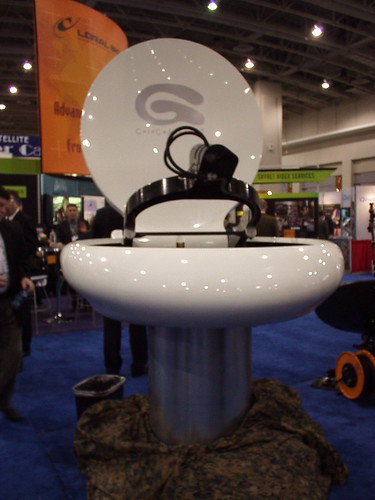
I don’t know what to say about this, also spotted at Satellite2006, except that it’s exceptionally cool. Design-wise, it reminded me of an iPod right away.  Gigasat seems to have absorbed some design sensibility from the iPod phenomenon. Their sleek driveway antennas won’t fit on in your pocket, but the right one might look good on your SUV.

Scandal via Satellite

Wednesday, February 8th, 2006


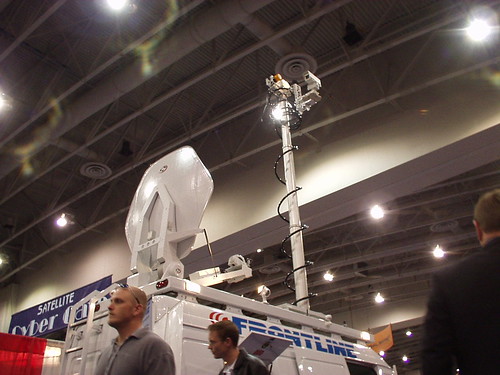
Satellite2006 News Truck
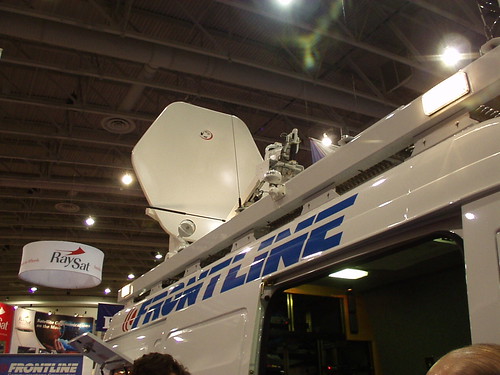
Being a relative “newbie” to the space/satellite beat, I was surprised to see something I actually recognized as I continued my sojourn across the exhibit floor at Satellite2006. As a denizen of D.C., living and working downtown for about 10 years, I’m often alerted to breaking scandals by spotting satellite news vans parked outside of various buildings on my way to or from work. That was my cue to check the news once I arrived at my destination, to see who’d just been indicted, etc.


Microwave Arm
So, it was pretty cool to turn a corner and saw the Frontline news truck parked on the exhibit hall floor, even tho’ there wasn’t an actual indictment. (At least not at the conference. We are in D.C., after all.) I know enough to recognize a satellite dish when I see one, but it wasn’t until I talked to the Frontline rep. that I learned there’s also microwave involved. I admit, I did peek inside to see if there was a microwave in there. But apparently it’s that long skinny pole across from the dish, and the rep explained that it’s used mostly for short haul uplinks to station antennas, which explains why I see poles up and the dishes down on the news vans I spot as I wander around D.C.

There wasn’t anything actually in the van at Satellite2006. I guess the buyers put in the guts. But I still bet that at least some of the vans I see have microwaves inside. After all, news crews gotta eat too.