Author Archive

Bigelow’s Balloon

Thursday, July 13th, 2006

Commercial spaceflight took a big leap forward recently. You might even say it sent up a test balloon, in the form of Robert Bigelow’s inflatable spacecraft.

Bigelow

An experimental inflatable spacecraft bankrolled by real estate magnate Robert Bigelow rocketed into orbit Wednesday to test technology that could be used to fulfill his dream of building a commercial space station.

The Genesis I satellite flew aboard a converted Cold War ballistic missile from Russia’s southern ro Mountains at 6:53 p.m. Moscow time. It was boosted about 320 miles above Earth minutes after launch, according to the Russian Strategic Missile Forces.

The launch was a first for the startup Bigelow Aerospace, founded by Bigelow, who owns the Budget Suites of America hotel chain. Bigelow is among several entrepreneurs attempting to break into the fledgling manned commercial spaceflight business.

Bigelow’s balloon was bankrolled to the tune of about $75 million, out of about $500 million dedicated to having an entire fleet of similar modules circling the earth like sausage links. Mars Blog notes that, even allowing for unexpected costs adding up to $3 billion or more, private entrepreneurs might actually be able to get to the point of having manned spacecraft servicing manned space stations faster and cheaper than, say, NASA.

That’s interesting, given that Bigelow’s balloon could lead to hotels and sports arenas in space by 2015, if all goes according to plan. With the price tag for building ’em, though, I can only imagine what the ticket price will be.

A Computer in Your Brain?

Wednesday, July 12th, 2006

I posted earlier about the possibility of brain-machine interfacing in sometime in the future, but it was only the tiniest hint. Now it turns out there’s a lot more afoot, and DARPA — the people who brought you the robot races — is in on it.

A new brain-computer-interface technology could turn our brains into automatic image-identifying machines that operate faster than human consciousness.

Researchers at Columbia University are combining the processing power of the human brain with computer vision to develop a novel device that will allow people to search through images ten times faster than they can on their own.

Darpa, or the Defense Advanced Research Projects Agency, is funding research into the system with hopes of making federal agents’ jobs easier. The technology would allow hours of footage to be very quickly processed, so security officers could identify terrorists or other criminals caught on surveillance video much more efficiently.

The “cortically coupled computer vision system,” known as C3 Vision, is the brainchild of professor Paul Sajda, director of the Laboratory for Intelligent Imaging and Neural Computing at Columbia University. He received a one-year, $758,000 grant from Darpa for the project in late 2005.

Given DARPA’s interest in advanced robot vehicles, I can’t help but wonder what kind of synergy might develop between “cortically coupled computer vision system” and “autonomous vehicles” like those participating in the Grand Challenge.

Even More Shuttle Video

Tuesday, July 11th, 2006

Just in case you didn’t get enough video in yesterdays post, Phil over at Bad Astronomy points to even more NASA video of the July 4th space shuttle launch, with camera angles from on top and right aft of the starboard solid rocket booster.

The NASA videos area without audio, but here’s a YouTube video of the launch with a play-by-play of the launch.

Happy Birthday, Mr. Tesla

Monday, July 10th, 2006

Tesla

If you’re reading this, chances are you’re doing so on a computer or laptop that’s plugged into an electrical outlet (or in the case of the latter, running on energy stored in its battery), so you should take a moment to thank the guy some say made it all possible. Nikola Tesla, born (according to A Blog Around the Clock) on this date, 150 years ago.

I have to admit that, although I knew Tesla’s name, I couldn’t claim to know much about his involvement with much of what I (and lots of others, I’m sure) take for granted about modern life. I haven’t often given much thought to who’s being the reality that I wake up in the morning in an air-conditioned house, turn on the lights, retrieve breakfast from the fridge and consume it while either sitting in front of the television or the computer.

Yet all of that’s possible due to alternating current; something Tesla contributed to developing. I had to do a bit of googling to find this PBS site devoted to Tesla, to learn that in fact the AC motor was among his inventions and that he’d patented some 20 different types of AC motors. And that’s not to even mention the radio and remote control. (Channel surfers of the world, we now know whom to thank.)

There’s a bit of irony in remembering Tesla’s birthday, as Archy points out. Tesla is credited with bringing electricity to the United States, of which he became a naturalized citizen. Yet, today many of the villages around his hometown have no electricity. But the occasion of his 150th birthday is bringing people together in Tesla’s homeland, and thus his memory may yet get the lights turned on again.

Monday Morning Videos

Monday, July 10th, 2006

Here’s a couple of videos to get your Monday started with a bang. Via Mars Blog, here’s a NASA video of the STS-121 solid rocket booster separating from the space shuttle. (Can’t view the video? Check out the Flickr photoset of the view from earth.)

Also, a little late for the 4th of July but fun to watch nonetheless, here’s a YouTube video of 30,000 bottle rockets launched in 2 minutes.

Your Phone, Your Brain & Your Nose

Friday, June 30th, 2006

There have been some pretty interesting stories circulating about mobile phones this week, and now seems like a good time to encapsulate them all in one place (especially considering the one that landed in my inbox this morning). 

You’ve probably heard about the alleged connection between mobile phones and brain cancer (And who can forget the Canadian University that banned wifi because of health concerns?) Well, the FDA says there’s no clear connection between (pun intended?) the two, but new research from Italy suggests that your cellphone may be stimulating a part of your brain

Cellphone OKDr. Paolo Rossini of Fatebenefratelli hospital in Milan and colleagues used Transcranial Magnetic Stimulation or TMS to check brain function while people used these phones.

They had 15 young male volunteers use a GSM 900 cell phone for 45 minutes. In 12 of the 15, the cells in the motor cortex adjacent to the cell phone showed excitability during phone use but returned to normal within an hour.

The cortex is the outside layer of the brain and the motor cortex is known as the "excitable area" because magnetic stimulation has been shown to cause a muscle twitch.

The science blogger over at Retrospectacle mentions a Japanese study that yielded similar results, and notes that the motor cortex is affected (and temporarily at that, according to both studies) but not the sensory cortex where the visual, auditory, and olfactory (site, sound, and smell) regions of the brain reside. 

That might be true, but according to another set of researchers chatting on your cellphone while driving (even with hands-free accessories) makes you just as impaired as a drunk driver.  And just as dangerous too.

The researchers used a driving simulation device for their study, published in the summer 2006 issue of Human Factors: The Journal of the Human Factors and Ergonomics Society.

They studied 40 volunteers who used a driving simulator four times — while undistracted, using a handheld cell phone, using a hands-free cell phone and while intoxicated to a 0.08 percent blood-alcohol level — the average legal level of impairment in the United States — after drinking vodka and orange juice.

Three study participants rear-ended the simulated car in front of them. All were talking on cellphones and none was drunk, the researchers said.

Motorists who talked on either handheld or hands-free cell phones drove slightly more slowly, were 9 percent slower to hit the brakes, and varied their speed more than undistracted drivers.

Drivers with an 0.08 percent blood-alcohol level drove a bit more slowly than both undistracted drivers and telephone users, yet more aggressively.

And if your cellphone isn’t distracting enough when you’re driving, imagine how much more distracting it might be if there were smells coming from your cellphone. I kid you not. Trendhunter led me to this article about some researchers working to turn your cellphone into a smellphone

Engineers have already developed a system that can record smells of various fruits, such as apples, oranges, melons and bananas, on to a system of 15 microchips in a handheld device.

Each microchip is an electronic ‘nose’, containing a chemical sensor which can pick up different traces in the odour.

The Japanese inventors of the system say these sensors can come up with thousands of different combinations.

The proportions of each odour are carefully noted by the microchips and when the ‘recording’ is played back they recreate them from 96 manmade chemicals. 

I can’t help wondering if the scientists involved in this project have really thought this through. There may be an actual use for this, but I can also think of some good reasons not to put the capability of recording and transmitting odors via cellphone into the hands of at least some people. Can’t you?


Verizon Airfone Grounded

Thursday, June 29th, 2006

Earlier this month, I blogged about JetBlue getting into the in-flight internet/phone business. Now, before the month is quite over, it looks like Verizon is getting out of the in-flight phone business.

Verizon Airfone will exit the in-flight phone business by the end of the year, a company spokesman confirmed Friday.

Airfone’s parent company, Verizon Communications, plans to focus its efforts more on its core business, said Jim Pilcher, a spokesman for Verizon Airfone.

Verizon was initially the favorite to win the FCC auction for the 800MHz spectrum for supplying broadband and phone services in-flight, but dropped out of the running early, which lead to the AirCell — a subsidiary of JetBlue — getting the license to use the spectrum.

Robot Roach Patrol

Wednesday, June 28th, 2006

Forget Raid. Forget Orkin. When you’re facing an infestation of pests, in this case roaches, your best bet might be a robot. This isn’t a new story, from what I can tell, but it’s popped back up in the last couple of days. And it’s an interesting one. Given that you can now have a robot keeping your house clean, why not have one keeping it roach-free?

In a breakthrough for the battle against mankind’s most diehard enemy – the cockroach – European scientists have hoodwinked a group of them into congregating in a place where they can be stamped on easily.

The kick in the mandibles comes from a Belgian-led team who spent three years developing a mini robot that can convince cockroaches to creep out of dark holes and gather in light places. The InsBot looks more like a pencil sharpener than a household pest, but it smells like a cockroach. Most importantly, the InsBot can pass for a Periplaneta Americana (American cockroach).

OK. Maybe you should keep the insecticide handy, since this model apparently just herds the roaches together for easier spraying/stamping. Still, as Technovelgy points out, it has interesting implications for creating more innovative forms of artificial intelligence. Technovelgy also has an interesting post up about a roach-controlled robot. And for good measure, here’s a link to the project itself.

Bots on the Brain

Wednesday, June 21st, 2006

More robot-related news.

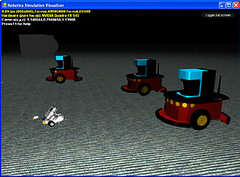
CNet has a gallery of screenshots from Microsoft’s just-announced Robotics Studio.

Robotics Studio

Meanwhile, Wired has write-up on RoboGames, which ends with a quote that sums up the point of getting kids to build robots and bang them into each other.

For [Dan] Albert, as with many of the roboticists who spoke to Wired News, events like RoboGames are about getting kids interested in science and technology. “You start kids out with entertainment, and they gravitate toward engineering as they want more control over their world,” he says.

Finally, though not specifically bot-related, Retrospectacle has an interesting post up about brain-machine interfaces. (Hint: think brain-powered space flight.)

Microsoft Does the Robot

Tuesday, June 20th, 2006

Speculations, theories and predictions abound in the wake of Bill Gates’ announcement that he’s quitting his day job in a couple of years. Among the ideas being bandied about the blogosphere, the predicted end of software is the second most interesting.

Here’s the dilemma for Microsoft. It knows that the Webtop is coming. It knows that desktop applications and Web applications are going to become more and more indistinguishable. And it is making a play for that future with Windows Live and Office Live. But as an organization, it’s heart is just not in it. And why should it be?

Why? Well, I don’t know, but it’s a great lead-in to the first most interesting hint on Microsoft’s direction in a post-Gates world: robots.

Microsoft will announce today that it is launching a new effort to dominate the robot world. They will offer a software platform that could provide a foundation operating environment for robots.

Their motivation for the efforts,according to an announcement letter from Tandy Trower, General Manager, Microsoft Robotics Group,is, "We think robotics is poised to take off rapidly, and there are solid indications that this is true! With component hardware costs coming down and computational capabilities increasing, the robotics industry appears to have the right conditions to really grow quickly."

OK. So Microsoft isn’t building robots (yet?), but launching an effort to help people build robots is an interesting direction, and maybe a feasible one since there isn’t a "webtop" application for that. (Is there?)

Check out the Robot Gossip link for more info on what Microsoft’s up to (like funding a Center for Innovative Robotics at Carnegie Mellon) and specs on Robotics Studio.