Author Archive

China to the Moon … Again

Tuesday, June 20th, 2006

A couple of months ago, I posted about China’s space program (and NASA’s interest in it).

Well, China’s back in the news with plans for moon exploration. Or, rather, the major news media has caught on to China’s lunar ambitions.


A top official in China’s space program has set 2024 for the country’s first moonwalk, a Hong Kong newspaper reported on Monday, cementing its position as a new space power.

The mission would kick off in earnest next year, the Beijing-backed Wen Wei Po paper said, when China launches an unmanned lunar satellite in March or April to orbit and survey the lunar surface.

"China now basically possesses the technology, materials and the economic strength" to put a man on the moon, the paper quoted the official as saying.

Of course, if you’ve been reading this blog, this is kind of old news. A couple of months old, anyway.

Spaceports Abound

Friday, June 16th, 2006

Do you know the way to your friendly neighborhood spaceport? Yeah, me neither. If you’re like me you probably had to first ask “what’s a spaceport?”. Well, the commercial space travel industry is heating up and spaceport — where commercial spacecraft launch, I guess — are popping up all over the place. And if you live in Oklahoma, there may be a spaceport coming to your neighborhood.

Oklahoma Spaceport

The Federal Aviation Administration has given its OK for commercial spaceflight operations at Oklahoma’s spaceport, a former military air base that is expected to begin hosting test flights of a new suborbital spacecraft next year.

“We are the planet’s newest gateway to space,” Bill Khourie, executive director of the Oklahoma Space Development Authority, told MSNBC.com after the FAA’s announcement on Tuesday.

The launch site operator license, issued Monday, gives Oklahoma an edge in the nascent space tourism industry — a market also being targeted by California, New Mexico, Florida and even Wisconsin, as well as Singapore and the United Arab Emirates. However, the FAA’s Office of Commercial Space Transportation would have to issue separate licenses to companies wishing to operate from Oklahoma.

With the Oklahoma spaceport scheduled to start an extensive test site schedule in 2007, one already operating in the Mojave, and activity picking up at the New Mexico site, I have jut one question. Is living near a spaceport anything like living near an airport?

DIY WiFi

Friday, June 16th, 2006

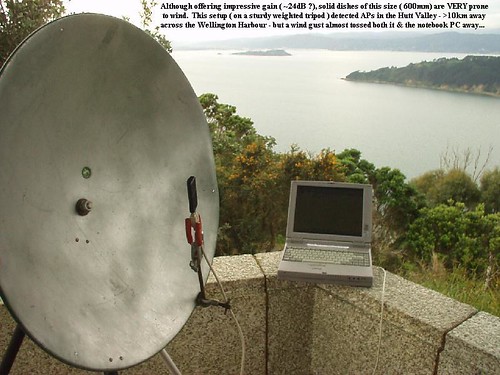
Here’s a few interesting bits about how to build your own antenna, for a DIY Friday. The first one, from Geekcorps Mali, is all about how to build your own antenna with a plastic bottle, using a design based on waveguide theory. Another offers even more detailed instructions. But I was still trying to figure out what one might use these antennae for (and what waveguide theory is) when I stumbled upon some well illustrated instructions on how to build "the poor man’s wifi."


I’m not sure I’ll ever try these instructions, but I had fun looking at the pictures of various wifi access devices made from little more than a USB adaptor and some Chinese cookware. 

Chaperone via Cellphone

Thursday, June 15th, 2006

Back in April, I blogged about Sprint’s GPS tracking package aimed at parents who want to keep better track of the cellphone-totting kids. Well, it’s a trend that seems to be catching on. Verizon just rolled out its own “chaperone” service.

Verizon on Monday introduced a new service aimed at parents who wish to keep track of where their children are through their cell phones. Additionally, the service will give children a way to easily contact their parents.

The “Chaperone” service would be provided in conjunction with the kid-friendly LG Migo, a cell phone designed for easy operation by even the youngest users. The system uses GPS capabilities built into the phone in order to track a child’s position.

The parent would be able to see where the phone is located from a map on the Verizon Web site. Additionally, parents can download a cell phone-based application that would perform similar functions, Verizon said.

… Another feature, called Child Zone, provides a service for parents where they would be alerted when the Migo phone leaves a predetermined area. The service would send a text message to the parent’s Verizon phone.

Linux News has screenshots of the locator screen for the Sprint plan, which give some idea of what parents on Verizon’s plan might see when logging on to make sure little Johnny or Susie comes straight home from soccer practice. It also quotes an industry analyst as suggesting that companies offer such services will need to set “realistic expectations for their customers.

LG Migo Phone

I still find myself wondering what other uses folks might find for this technology, like keeping tabs on straying spouses, etc. That the service requires use of Verizon’s LG Migo phone, which adults are unlikely to use, might reduce that threat. Of course, it would be easy enough to slip the phone into the purse, briefcase, car, etc., of the suspected spouse (or anyone else, for that matter) and keep track of their comings and goings while undetected. But, then again, there are already services that track anyone who has a cellphone, so perhaps that segment of the GPS market is already being served.

Staring into the Sun

Thursday, June 15th, 2006

You’ve heard it since high school. Staring into the sun is bad for your eye. Fortunately, you now have a satellite to do it for you, and even take pictures. I happened across this MetaFilter thread about the TRACE, the Transitional Region and Coronal Explorer, and discovered a treasure trove of photographs shot by the satellite. Kinda like this one.

Solar Flair

TRACEBuilt and launched in April of 1998, on a mission to enable scientists to "study the connections between fine-scale magnetic fields and the associated plasma structures on the Sun in a quantitative way by observing the photosphere" (whatever that means) the satellite isn’t exactly new. But it took its millionth picture of the sun back in October of 1999. So it’s a great source of photographs that make great wallpaper for your desktop your IM profile, as well as movies that just make interesting viewing.

Above the Clouds

Monday, June 12th, 2006

More pictures from space. This time it’s NASA using satellites to look inside storm clouds, in order to predict how much water they hold and how much might fall.

CloudSat

The first images from a $217 million satellite project to measure the moisture content of clouds provided breathtaking views of storms on Earth, scientists said.

“For the first time we’re seeing inside the clouds,” said Graeme Stephens, a Colorado State University atmospheric sciences professor and the principal investigator for the CloudSat project. “We can see tropical storms 15 kilometers deep organized on scales of thousands of kilometers across.”

CloudSat, a formation of five satellites launched April 28, was developed by CSU researchers in conjunction with other agencies to determine the moisture content of clouds, in the hope of developing long-term precipitation models.

“We want to know how much water is in the sky so we can see how much water falls,” Stephens said.

The spacecraft are 438 miles above the Earth.

NASA, of course, has the latest photos.

CGI Meteor Strike

Monday, June 12th, 2006

I posted earlier about Phil’s prediction that the earth probably wouldn’t have a date with a comet last month. And it looks like he was right. There is, however, a YouTube video showing what it might have looked like had Phil been right.

Meteor Strike 2

Okay, it’s probably not exactly like it would have been (the meteor in the CGI video looks much bigger than I think the theoretical comet would have been), but the video is still worth a look.

Being mono-lingual, I can’t tell what the announcer is saying. Can anyone translate? And how accurate is this video anyway?

Via TechEBLog.

WiFi in the Sky

Monday, June 5th, 2006

I have to confess, one of the things I like most about traveling for business is that it usually means a long period of time during which I’m unreachable. The mobile phone is shut off, and I don’t have internet access so I can’t answer email. I’m free to take a nap or read a book while I’m in the air.

Well, no more. JetBlue is moving to do away with my mile-high refuge by making wi-fi internet available in-flight

P11, jetblue tails

JetBlue Airways Corp. won a government auction Friday for wireless spectrum that could be used to provide in-flight telephone, Internet, or entertainment services.

The winning bid of $7.02 million was placed through New York-based JetBlue’s entertainment subsidiary, LiveTV LLC, which provides DirecTV service on JetBlue flights.

The licenses will not mean travelers can use their cell phones in the air, but between instant messaging and the avilability of free Skype calls in the U.S. and Canada, who needs to use their movile phone in-flight.

Flying Robots to Patrol Europe?

Monday, June 5th, 2006

Remember those flying robots we told you about earlier, and how Europe has some of their own. Well, now EU plans on putting those airborne bots to work

uav

Fleets of unmanned "drone" aircraft fitted with powerful cameras are to be used to patrol Europe’s borders in a dramatic move to combat people-smuggling, illegal immigration and terrorism.

The Independent on Sunday can today reveal that the tiny planes will fly at more than 2,500 feet over the English Channel and Mediterranean beaches as part of a £1bn programme to equip Europe’s police forces, customs officers and border patrols with hi-tech surveillance and anti-terrorism equipment.

The aircraft, called unmanned aerial vehicles (UAVs), are already being used by the Belgian government to catch tankers illegally dumping oil in the North Sea. Several ships’ captains have already been prosecuted.

The European Commission now wants to use similar drones, which can have a 6-metre wing-span and weigh as little as 195kg, to patrol the Mediterranean coasts and the Balkans where illegal immigrants try to enter the EU. The Russian government is also close to flying drones over its borders.

Interesting news, but if you ask me they’ll only really be on to something when the put tentacles on those flying robots.

Spacewalk Success

Friday, June 2nd, 2006

Looks like the spacewalk we blogged about yesterday went off without a hitch. Almost.

ISS SpacwalkThe spacewalk took 6 1/2-hours, longer than expected, but nowhere near the record of eight hours and 56 minutes set in 2001.

"OK. We’re going out," Russian commander Pavel Vinogradov said at 6:48 p.m. EDT Thursday as he and U.S. flight engineer Jeff Williams exited the Russian side of the station in their bulky suits while the outpost soared more than 220 miles above Earth.

Vinogradov attached himself to the end of a boom that can extend to 50 feet and Williams maneuvered him to an area on the station where the Russian commander installed a new vent for a broken oxygen-generation system. At one point, the spacewalkers were bathed in a golden glow from a sunset over the Pacific Ocean. After the sun passed, the temperature got chilly.

"My feet are like ice," Williams joked in Russian when asked if he was cold. A Russian flight controller responded, "We need to put brandy into the system instead of water." 

No word on the brandy, but there was a pretty cool droid on board the ISS.