Author Archive

Google Goes Green

Friday, June 2nd, 2006

More interesting uses for Google Maps — the site that brought satellite imagery to your desktop — keep cropping up.

Google Goes GreenGoogle has launched its first mashup–a map-based Web site with information about earth-friendly locations in five of the U.S.’s top travel destinations.


The site, at maps.google.com/green, features information on and video tours of spots in San Francisco, Los Angeles, Las Vegas, New York and Orlando, Fla., as well as tips for "traveling green" during the summer using Google Maps. 

… Listings include the Las Vegas Natural History Museum and the Go Raw Cafe in Las Vegas, the Tree People park and EcoLimo in Los Angeles, the Skyscraper Museum and Central Park in New York, the Forever Florida nature preserve and Horse World Riding Stables in Orlando and, in San Francisco the Red Victorian Bed and Breakfast and the Exploratorium.

But I think my favorite is a non-official mashup called Placeopedia, which matches WikiPedia articles with their locations. You can add a place, or spend click around to various places, which is a great time-waster or way to take a vacation without leaving your desk.

Student Scientists to go to Rocket Launch

Thursday, June 1st, 2006

A couple of fifth grade students are going to see thier first rocket launch, and it’s a happy story of the internet community coming together to help a couple of fifth-graders who may be the next generation of rocket scientists

Here’s your chance to help do just that. Two fifth grade students from Indiana, Cameron Wade and Billy Shannon, both 11 years old, have an experiment that will launch onboard a suborbital NASA rocket. It’s part of a partnership between their school and NASA. The problem is, the grant they have doesn’t cover their own travel to Virginia to see the rocket launch!

They still want to go, of course. The trip will cost $3000, and they’re still $1000 from their goal.

And their experiment sounds pretty interesting. 

Young Rocket ScientistsTheir experiment is already in Virginia, waiting to be loaded onto the rocket. The students placed nuts and bolts screwed together in tiny bottles to see whether the vibrations from the rocket will break them apart.

They also sent up plant seeds, which they will plant this summer along with seeds that haven’t been airborne to see whether there is a difference in growth.

“They’re learning how to follow an experiment through,” Ghaffarian said. “They’re learning how to change the variables and see what happens, and it’s cool because … it makes it much more exciting than if you just buy a couple seeds and plant them.”

The nuts and bolts tie in with a unit the class did on robots and cars. The seeds work with lessons on extreme environments. Everyone in Ghaffarian’s third- through fifth-grade multiage class wrote essays that were judged by the school’s office staff on why they should be chosen for the Virginia field trip.

The good news? In less than a day, the money was raised

I am incredibly pleased and proud to announce that after just a few hours, BABloggers have donated more than $1000 to help the two fifth-graders and their teacher fly to Virginia to see their rocket launch!

… I just talked to Pamela Ghaffarian, the teacher, on the phone, and she was thrilled with how wonderful people have been to send her this money. She told me the two students, Cameron Wade and Billy Shannon, are really excited about the trip. I know they’re happy now, but wait until they actually see the launch! Even though it’s a small rocket, it’ll be really dramatic, and they’ll have the time of their lives.

And it might also inspire them to keep aiming high. Here’s to the science blogging community for coming together so quickly to help these students out!

Spacewalk On, Caddy Off

Thursday, June 1st, 2006

I wrote earlier about the amount of debris in outerspace. Well, there’s one bit of debris that we won’t be adding to what’s already up there. 

Thursday’s 5 1/2-hour spacewalk by the Russian and U.S. occupants of the International Space Station will not include the previously announced attempt to hit a radio transmitting golf ball into Earth orbit, The New York Times reported Wednesday. 

The publicity stunt involved the payment of an undisclosed amount of money to Russia from a Canadian golf company. Russian officials did not explain the reason for the postponement.

In place of the golf shot, the astronauts will replace a malfunctioning camera on the U.S. side of the ISS. 

The spacewalk, sans golf clubs, is on for 6:40pm.

Via Marsblog.  

Roomba on the Moon?

Tuesday, May 30th, 2006

Saturn’s moon, that is. The first intelligent beings we know of in space (besides us, if we count) may be the ones we make ourselves. If this New York Times article is to be believed, scientists basically want to attach a blimp to a Roomba and send it to one of Saturn’s moons. 

Titan

A future space mission to Titan, Saturn’s intriguing moon enveloped in clouds, might deploy a blimp to float around the thick atmosphere and survey the sand dunes and carved valleys below.

… Until recently, interplanetary robotic explorers have largely been marionettes of mission controllers back on Earth. The controllers sent instructions, and the spacecraft diligently executed them.

But as missions go farther and become more ambitious, long-distance puppetry becomes less and less practical. If dumb spacecraft will not work, the answer is to make them smarter. Artificial intelligence will increasingly give spacecraft the ability to think for themselves.

… HAL, the soulful conversationalist at the helm of the spaceship in "2001: A Space Odyssey," is not on the drawing board. The work so far has been more along the lines of Roomba, the robotic vacuum cleaner, with autonomy to perform certain specific tasks.

Interesting. Just about everybody his brother has hacked a Roomba and/or blogged it. I guess the AI techs at NASA will get their crack at doing the same. 

Commercials on Your Cell?

Tuesday, May 30th, 2006

You had to know it was coming. As soon as your favorite television shows and events became available on your mobile phone, commercials couldn’t be too far behind.  This time, however, watching advertisements might pay off if you’re paying attention. 

Virgin Mobile USA plans to announce a way that people can talk for no money at all. They will, however, have to pay with a chunk of their attention.

The program, called SugarMama, lets people earn one minute of talking time by watching 30-second commercials on a computer or receiving text messages on their phones, then answering questions to prove they were, in fact, paying attention. 

Granted, we’re just talking text messages here, but how soon before full-fledged TV-style ads start coming to you via your mobile phone?

It’ll be interesting to see how well this pans out. Industry analysts suggest that anyone who’s "too cheap to buy a minute" probably can’t afford an Xbox (one of the products to be advertised), but Virgin says that the program will put a youth market that’s already inundated with advertisements "in control" of what they see and how they respond. 

The only problem I see is the unanswered question of just when and how often these advertisements arrive? it’s one thing to be interrupted by a phone call. It’s another to be interrupted by an advertisement?

Homemade Mobile

Friday, May 26th, 2006

Here’s one I’ve been saving for a DIY Friday. I didn’t believe it at first, but apparently there are people out there making their own mobile phones. And of course, in the age of the internet, they’ve inevitably found one another. 

Matt Hamrick hates standard-issue mobile phones almost as much as he loves tinkering with them to make them better.

The software security expert reckons he’s spent around $3,000 over the past two years trying to get his calendar and e-mail to sync between his Apple computer and his phone.

"The phones aren’t getting any better," he says. "I’ve been looking for a phone that would meet my requirements for 10 years now."

That quest gained new momentum this month when the Silicon Valley Homebrew Mobile Phone Club, a group Hamrick co-founded, attracted about 40 people to its first meeting.

The fledgling organization owes its name and inspiration to the famous Homebrew Computer Club of the 1970s, which many historians now credit with innovations that paved the way for the personal computing revolution. Members hope something equally climactic will arise from their new association.

Hamrick’s even written a manifesto of sorts for his movement, and there’s at least one more out there like it. I’m impressed with anyone who takes on the task of building their own mobile phone. After all, like most people (according to one of the manifestos), I’m still figuring out how to use the one I bought. 

In a recent phone conversation with a friend, I needed a phone number of a mutual acquaintance. My friend had the number in his mobile phone, but it took several minutes for me to convince him that he could review numbers stored there without hanging up. The sad part of this is that upon discussing the incident with friends who are responsible for the software in some phones, they laughed at what they viewed as "stupid user behavior." Tsk. tsk. If your phone software is so good, why do most of your customers persist in erroneous beliefs about it’s function?

Good question. I’m a bit further along than the guy who didn’t know he could view numbers without hanging up his phone, but I’m a little iffy on whether I can record numbers without hanging up phone. And I’ve never tried to synch it with anything either, though I’m sure I could. And I know it’s got voice dialing capabilities, but I haven’t figured out how to use that either. 

If these guys are modeled on the Homebrew Computer Club, maybe they’ll do for mobile phones what that group did for desktop innovation. And maybe I’ll use a few more functions on my phone.

XM Radio Helix

Friday, May 26th, 2006

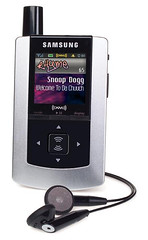
Uh oh. It looks like XM satellite radio is about to have even more legal trouble with RIAA. I blogged a while back about how RIAA filed a lawsuit against XM over the alleged ability of XM’s Inno player to not only play music but also record it.  Well, the news about XM’s new Samsung Helix player may be likely to strengthen the RIAA’s case — it records music too. If you hear a song and right in the middle decide to recort it, the Helix records it, from the beginning. 

Samsung Helix

TO be filed under Best Ideas of the Year: Imagine a tiny music player, smaller than an iPod, that’s also an XM satellite radio receiver. When you hear a song you like — even if it’s halfway over — one press of a button records it from the beginning.

Meet the Samsung Helix (and its twin, the Pioneer Inno): a tiny, well-designed $400 radio that not only lets you enjoy satellite radio in the car, at home or when you’re jogging, but also plays back your own MP3 files and up to 750 songs that you’ve recorded from the satellites.

… Now, not everybody is happy about this feature of the Helix and its Pioneer sibling. XM, which was largely responsible for the design of both players, has been sued by the increasingly busy lawyers of the Recording Industry Association of America. They’re calling the design of these players a tool for copyright infringement.

Or not. It turns out that you can’t do much more with the music you record on the Helix than listen to it on the device. You can’t export it to a computer or another MP3 player. You can’t burn it to a CD, at least not before you download from a pay service like Napster. And since it’s music you already payed to listen to via XM, if you download it you’re actually paying for it twice

So maybe this doesn’t bolster RIAA’s case much. Then again, maybe it’s the price that’s bothering them. They’re asking $150,000 per song in their lawsuit. But to doanload a song you "bookmark" on the Helix is only going to cost you $1.

Comet Cancelled?

Thursday, May 25th, 2006

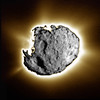
What’s that in the sky? A bird? A plane? Well, no. It’s a comet, but nothing you need to worry about according to Phil over at Bad Astronomy.

Comet

Well, today is the day, once again, that the world won’t end. I’m shocked, shocked, that the comet fragment predicted to hit in the Atlantic causing a seismic event and an ensuing tidal wave hasn’t materialized.

Of course, the day’s not over yet. But I’m pretty sure how this will turn out.

Chris has been blogging the story of whether or not a comet will hit the earth today, and is pretty sure it won’t. He’s updated his post about his Sirus Radio interview on the subject with more than enough links to make an effective case. 

But keep one eye on the sky today just in case, will ya?

NASA on Hurricanes

Wednesday, May 24th, 2006

It’s that time of year. Hurricane season is upon us, and NASA is stepping up its services to better communicate with employees through its intranet. Good thing too, because half of NASA’s offices are smack in the middle of the path Katrina and Rita took to land last year. 

The InsideNASA intranet, built on Vignette’s Next-Generation web Presence platform, help employees at 11 US facilities stay informed about office closures, evacuation procedures and when it’s safe to return to work. Information on the site also will guide employees to make a "safe-arrival call" when they reach their destination.

… There’s also a real-time feed from the Department of Homeland Security (DHS) helps monitor theorist threat advisories. The site has approximately 130 portlets, "a small window of content, such as an animated real-time weather map," Holm said. "We also have an announcement portlet that offers all the latest information at NASA submitted by employees."

… A virtual private network (VPN) provides employees remote access from virtually any device with internet connectivity, such as a Research In Motion (RIM) Blackberry or Palm Treo. NASA employees also can call a hotline to find gas or a hotel when there not able to log into the network, Holm said. "Just for my group, we budgeted about US$300,000 for the project this year," she said. "It includes personnel, management training, operations, content and disaster support, and publishing and information architecture."

Makes sense, since NASA has something of an inside track when it comes to advance info on hurricanes. Metroblogging New Orleans posted that NASA’s satellite study of Rita last summer yielded an interesting discovery about what’s behind the strength of some hurricanes.  

Using a satellite last summer to study hurricane Rita from above, scientists discovered that towering clouds near the storm’s eye were good predictors of future storm strength.

… Specifically, if hot towers are active at least 33 percent of the time during a three-hour period, surface winds have an 82 percent chance of intensifying. Making such measurements on the fly could improve the forecast of a storm’s strength just prior to landfall.

Here’s hoping more accurate forecasts combined with getting information out faster will lead to getting more people out of the path of the next big hurricane.

Robo Euro

Thursday, May 18th, 2006

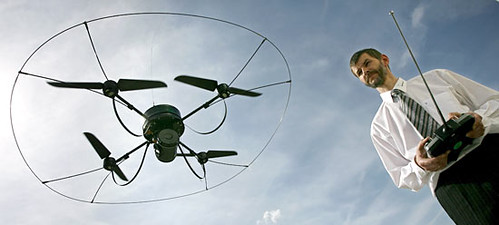
Remember those flying robots we mentioned earlier? Well, Europe has some. Or at least one, a remote-controlled flying reconnaisance robot pictured below. 

This and others like it are on exhibit as I write this, at ELROB — the European Land-Robotic Fair, in Hammelbert Germany. I guess Europe is not to be outdone by DARPA.