Author Archive

NASA Says Water Has Flowed on Mars at Least Twice in Last 7 Years

Wednesday, December 6th, 2006


Well, this sure beats Al Capone’s vault.

 The photo to the left shows new deposits of mud, silt or frost on the surface of Mars, which weren’t there several years ago.

As CNN explains:

 "The latest research emerged when the Global Surveyor spotted gullies and trenches that scientists believed were geologically young and carved by fast-moving water coursing down cliffs and steep crater walls.

"Scientists at the San Diego-based Malin Space Science Systems, who operate a camera aboard the spacecraft, decided to retake photos of thousands of gullies in search of evidence of recent water activity.

"Two gullies that were originally photographed in 1999 and 2001 and re-imaged in 2004 and 2005 showed changes consistent with water flowing down the crater walls, according to the study."

The Christian Science Monitor has more: 

For years, evidence from Mars has supported the idea that billions of years ago, large amounts of water flowed on the planet. Surface-penetrating radar on Europe’s Mars Express orbiter has found large ice deposits several kilometers below the surface.

But the strongest evidence for potential watery habitats today had come from NASA’s Galileo orbiter and from the Cassini orbiter, which is currently touring Saturn and its moons. Galileo’s evidence points to a slushy ocean beneath the thick ice crust of Jupiter’s moon Europa.

Cassini tracked watery geysers bursting from Enceladus, suggesting that this moon of Saturn holds reservoirs of liquid water.

But now, Mars is back on the leader board.

"I think they’ve gotten it right," says Bruce Jakosky, director of the Center for Astrobiology at the University of Colorado at Boulder, of the new results.

The presence of liquid water below the Martian surface doesn’t prove that organisms live there, he cautions. But it does change the discussion.

"People have talked about ancient life, given the evidence for ancient liquid water" turned up by orbiters and surface rovers, Dr. Jakosky explains. And evidence continues to mount that liquid water has been present in the red planet’s geologically recent past. "This is the first piece of evidence that says ‘now,’ not ‘a million years ago,’ " he says.

What is your reaction to today’s announcement from NASA? 


NASA to Make Major Mars Announcement at 1 PM EDT

Wednesday, December 6th, 2006

We’re eagerly awaiting NASA’s live briefing this afternoon at 1 p.m. Eastern, while keeping our enthusiasm in check with memories of Geraldo Rivera opening Al Capone’s vault.

That said, the rumors that water may have been found on the Red Planet are enticing.

You can watch the briefing live on NASA TV, or check back here this afternoon for the full story. 


Thuraya Reduces Cell Coverage in Iraq

Tuesday, December 5th, 2006

While intense debates continue in Washington and capitals throughout the world regarding what to do about the increasing violence in Iraq, the leading cell phone provider in the region has already decided upon its course of action.

Thuraya Satellite Telecommunications Co. has been cutting business in Iraq due to mounting security concerns

Yousuf Al Sayed, chief executive officer of the Middle East company, t[said] on the sidelines of the ongoing Telecom World2006 show that Iraq [represented a] mere seven percent of Thuraya’s mobile satellite phone business so far this year.

Iraq boasted a 60-percent and a 40-percent business share of the company in 2004 and 2005 respectively, said the CEO.

Thuraya, based in the United Arab Emirates and founded in 1997, commands a 26 percent share in the global mobile satellite phone market. This map provides a good illustration of the scope of their coverage, which serves a region 2.3 billion people with 2 Boeing GEO-Mobile Satellites:
 "The Thuraya coverage area encompasses the Middle East, North and Central Africa, Europe, Central Asia and the Indian subcontinent. Thuraya offers GSM-compatible mobile telephone services, transmitting and receiving calls through each satellite’s 12.25-meter-aperture reflector. The satellites employ state-of-the-art on-board digital signal processing to create more than 200 spot beams that can be redirected on-orbit, allowing the Thuraya system to adapt to business demands in real time. Calls are routed directly from one handheld unit to another, or to a terrestrial network. The system has the capacity for 13,750 simultaneous voice circuits."

A Successful Telemedicine Story

Thursday, November 30th, 2006

I used to live in a remote town that, for a time, literally had no doctors. One doctor moved away, another retired, and poof! — for six months you had to drive 100 miles to get your sore throat looked at.

Many people who’ve lived in rural areas, particularly in the West (where there’s a lot of dirt between the lights) can tell similar stories. Delivering quality healthcare in a remote place is difficult and economically challenging. And when the promptness of care is important, the long travel times that many rural residents must endure to get the services they need can be detrimental.

But satellites and cellular technology are helping to change that, and one particularly heartwarming success story comes to us today from the Dakotas: 

By using digital mammograms and a satellite link-up, radiologists in Michigan were able to examine the mammograms of rural Native American women in North Dakota and South Dakota.

This pilot program by University of Michigan researchers was designed as an improvement over the use of films typically used in mobile mammography. Currently, it can take up to a week for women to get their results after having a mobile mammogram, and it can also be difficult to arrange for additional tests.

"Mobile mammography is a critical way for Native American women to get a mammogram. But what happens when a woman needs to be called back for more images? By transmitting the mammograms by satellite, a radiologist could read them on the spot, and three-quarters of the women who needed new images had those done immediately or within fewer than three days," Dr. Marilyn Roubidoux, professor of radiology at the U-M Medical School, said in a prepared statement.

In this pilot program, a mobile mammography unit performed 515 digital mammograms on women living on seven reservations in North Dakota and South Dakota. The images were then transmitted by satellite to the Breast Imaging Division of the university’s radiology department.

On average, it took about 50 minutes from the time the mammography images were sent until the women received a report about the findings. In some cases, when weather and technological factors were perfect, results came back within 30 minutes.


 The University of Michigan press release on the pilot program can be found here.

WiMax Coming to India

Wednesday, November 29th, 2006

Following up on Spektor’s post on EduSat in India (below) comes more news on how new technologies are bridging the communications gap in India’s rural areas. The Economic Times reports on how Motorola plans to cash in on the demand for wireless broadband:

The world’s second largest maker of mobiles is in discussions with telecom operators to provide network and equipment for offering Wimax (highspeed Internet access over a wireless connection).

The annual broadband wireless equipment market opportunity in India is pegged at around $4.5 billion by ’12 and Motorola is keen to bite into this pie. "Motorola will design networks and provide customer premises equipment (CPEs) and handhelds . Our end-to-end solutions will be deployed by operators beginning next October," Mr Amit Sharma, vice-president , strategy and business development, Motorola Asia Pacific, told ET.

India is targeting 30 million broadband (high speed Internet) users by 2010 while the current base is just 2 million. The most difficult part of providing broadband access is last mile, the final leg of delivering connectivity from a communications provider to a customer , as it requires fanning out of wires and cable. Wimax is an easy solution as it doesn’t require a direct line of sight between the source and endpoint. With a service range of 50 km, Wimax supports peak data rates of 23 Mbps. Samsung and Alcatel are other vendors eyeing the Indian wireless broadband market. 

SDAIndia has more projections of WiMax growth in India and Asia; also be sure to check out this article in CIOL from several months ago, outlining why WiMax is emerging as a popular technology for providing rural connectivity:

With common service centers dotting India’s rural map, WiMax can play a major role in delivering various applications. These include online bill payment, processing and submission of government documents, delivery of agriculture, healthcare and entertainment services, in education, research and information sharing and for e-commerce activities including commodity price information, online trading and banking transactions.

The government of India is already working on programs in order to develop simple, low-cost messaging terminals that could extend wireless communications to poorer communities; an operating system for smart cards; and various building blocks for an available mobile communications infrastructure, with Wi-Fi and WiMax key elements.

“WiMax can play a major role towards providing wireless broadband connectivity for the rural masses in India. We have already seen some pilot deployments going on at various locations in India. Moving forward, we are pretty positive about the potential of this technology and how it can deliver more for less for a country like India,” said Karthik Rangarajan, Product Manager, Navini Networks, a broadband wireless access solution provider.

What SpaceTime is It?

Tuesday, November 28th, 2006

The New York Times Review of Books takes a look at Jean-Claude Carrière’s new novel, Please Mr. Einstein:

In its uncounted hours of conversation, “Please, Mr. Einstein” touches down lightly and charmingly on some of the thorniest philosophical consequences of Einstein’s genius and, by extension, the scientific preoccupations of the 20th century — the nature of reality, the fate of causality, the comprehensibility of nature, the limits of the mind — while scrolling through Einstein’s life. It’s easy to see this novel as the germ of a future playlet or movie along the lines of Steve Martin’s “Picasso at the Lapin Agile” or the play and movie “Insignificance,” which featured a mythical Einstein in a hotel room with Marilyn Monroe.

I like Carrière’s Einstein. He’s frank, down to earth and not prone to cosmic mustiness. He’s actually worn an Einstein T-shirt and admits he’s happy to be talking to a woman, especially a woman from the 21st century, because that means his godchild, the atomic bomb, hasn’t destroyed civilization — yet. “I think better when eyes like yours are looking at me,” he tells her, “and when I’m talking to them.”…

Among the features of Einstein’s unusual office are doors he seems able to open on any time and place. At one point, discussing his years in Germany, he and his visitor step out into a Nazi book-burning. Another excursion provides the surprising climax to an amusing side plot about Newton, who just doesn’t get relativity and quantum theory and keeps pestering Einstein to explain what was so wrong with the clockwork world he described in the 17th century. Finally, exasperated, Einstein calls Newton over and opens a door on the atomic blast that destroyed Hiroshima. Newton’s wig flutters in the wind from the shock wave. He stares, aghast, then slowly turns transparent and disappears. Newton’s universe is truly, undeniably dead, and so his sojourn in this intellectual aerie is over.

Carrière’s novel relies upon spacetime as a literary device. But what is spacetime? This "Spacetime 101" page explains the history of spacetime from Pythagoras to Einstein. 

Crazy About Mercury

Monday, November 27th, 2006


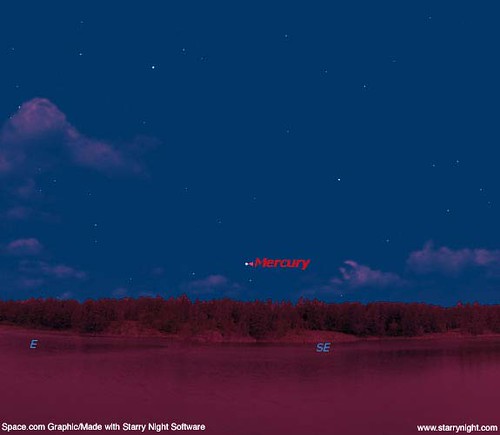
The elusive planet, as Mercury is sometimes known, will be less elusive in the coming weeks. Space.com reports:  

Often cited as the most difficult of the five brightest naked-eye planets to see, because it’s the planet closest to the Sun, Mercury never strays too far from the Sun’s vicinity in our sky.

Mercury is called an "inferior planet" because its orbit is nearer to the Sun than the Earth’s.  Therefore, it always appears from our vantagepoint to be in the same general direction as the Sun. Thus relatively few people have set eyes on it; there is even a rumor that the great Polish astronomer, Copernicus, never saw it.  Yet it’s not really hard to see.  You simply must know when and where to look, and find a clear horizon.

And during these next two weeks we will be presented with an excellent opportunity to view Mercury in the early morning dawn sky [map].

In fact, if you’ve been an early riser this past week, it’s quite possible you might have stumbled across Mercury on your own.  Since Nov. 20, it has been rising at least 90 minutes before sunrise, which is also just about the same time that morning twilight is beginning.  If you scan low along the east-southeast horizon about 45 minutes before sunrise, Mercury has been visible as a distinctly bright, yellowish-orange "star." 

The best views of Mercury, however, are reserved for this weekend, as Mercury will be rising more than 100 minutes before the Sun.  This is even before the break of dawn, so for a short while at least, Mercury will be visible against a completely dark sky. 

Early to bed and early to rise — will, if nothing else, grant you a rare opportunity for a good glimpse of the planet. So get to bed early this week!

Bell ExpressVu Launches Web Interactive TV

Wednesday, November 22nd, 2006

Our Canadian readers may not have the day off tomorrow, but in lieu of turkey Canadians can spend the day calling up stats on a pair of the first truly interactive TV channels to go live. The Globe and Mail reports:

 In a glimpse of how television may look in the near future, satellite provider Bell ExpressVu LP launched two interactive channels yesterday that let viewers call up on-screen stats, headlines and other features while watching news or sports.

The channels — CBC News Plus and TSN Extra — are the first stage in what is believed to be the next battleground for cable, satellite and telecom providers, which have each talked about launching interactive TV in Canada for the past few years.

By pressing a button, viewers access menus with content from each network’s websites. The channel feed shifts to the right side of the TV screen, allowing room for the menu down the left side.

The loading times for each item are about three seconds, said Pat Button, vice-president of marketing for Bell ExpressVu, a division of BCE Inc. The company believes features like on-screen statistics or commentary will be the most popular during the broadcasts of live sports or news programs.

This would be very convenient tomorrow on a cooking channel here in the U.S., as millions of households will be grappling with the question of just how long to roast their birds.

Happy Thanksgiving to all — Really Rocket Science will return to its regular posting schedule on Monday. Enjoy the holiday! 


SinoSat2, Optus D1 on the Fritz

Monday, November 20th, 2006

We wrote in September about China’s efforts to improve television coverage for up to 300 million mainland households through the launch of the SinoSat2 communications satellite, which lifted on October 29th.

Now reports are coming in that SinoSat2 is failing less than a month after being launched. IOL reports:

 A Chinese communications and broadcast satellite is failing less than a month into orbit because of malfunctioning solar panels, a China-watching Hong Kong-based group said on Monday.

The SinoSat-2 satellite, launched on October 29 in the southwestern province of Sichuan, is designed to serve live television signals and digital broadband multimedia systems in China, Hong Kong, Macau and Taiwan.

But technicians discovered its main solar panel had failed to unfold as planned on November 7, disabling some antennae from receiving ground instructions, the Hong Kong-based Information Centre for Human Rights and Democracy said.

"Chinese satellite experts are doing their utmost to save it but the chance of success is slim," the group said in a faxed statement, quoting unnamed sources.

One hopes things are going better with China’s seed breeding satellite. 

SinoSat2’s failure was not the only satellite to give the satellite underwriting market "a serious setback this week," as Satellite Finance (subscription required) reports:

 Next came the problems faced by Optus D1…. After the satellite was launched in orbit tests showed that one of the antennas was not functioning properly. The insurance placement was done by ISB.
 
“Insurers were sworn to absolute secrecy on it,” said one source. “The rumour is that they’re looking at a 50% partial loss.” The satellite was insured for a total of US$130m and Optus may thus get US$65m. Whether underwriters will subsequently turn to Orbital Sciences, the satellite’s manufacturer, in an attempt to recoup some of the outlay remains to be seen.


Swedish Delicacies in Space

Wednesday, November 15th, 2006

NASA is rolling out the space shuttle Discovery to the launch pad this week for a December 7th launch that will carry Sweden’s first astronaut, Christer Fuglesang, to the International Space Station for a 5-week stay.


The BBC reports on the mission, and Fugelsand’s long journey to space: 

In the thick of a complicated series of tasks to rewire the station – hopefully without serious interruption to the resident crew aboard – will be Sweden’s first astronaut, Christer Fuglesang.

He is a 49-year-old particle physicist who joined the European Space Agency (Esa) astronaut corps 14 years ago….

Fuglesang expected to train with Nasa, but found himself on a pioneering assignment to Russia instead. It was 1993 and Europe was preparing for a dedicated research mission aboard the now-defunct Russian space station Mir.

"The toughest part was to learn the Russian language," Fuglesang said. "At that time, we didn’t have any interpreters. There was no material in English. We really had to do everything in Russian."…

German-born astronaut Thomas Reiter, who currently is serving as a crewmember on the International Space Station (ISS), ended up being assigned to the Euromir flight….

Though this will be Fuglesang’s debut space flight, he will have his hands full. Fuglesang is paired with veteran Nasa astronaut Robert Curbeam for the first two spacewalks of the mission.

During the first outing, the pair will install a new external truss segment onto the station’s structural backbone. Two days later, another spacewalk is planned to begin critical work to hook up the station’s permanent electrical and cooling systems.

The ISS mission won’t be all work and no play, however, especially as the holidays approach. Fuglesang already has plans to share some of Sweden’s famous delicacies with his fellow crewmembers:

"Two products that Arla have developed have been approved by NASA and they will feature on NASA’s list of foods that the astronauts can choose from," the Danish-Swedish dairy company said in a statement on Friday.

The two products are a dried milk consisting of lactic pro-biotic bacteria and fruit-flavoured yoghurts that Arla has spent "many years" developing.

Christer Fuglesang, set to be the first Swede in space, has already selected raspberry yoghurt for the duration of the 12-day mission.

Fuglesang hopes to introduce his fellow crew members to other Swedish delights such as dried elk, crispbread and, "seeing as we’re approaching Christmas, gingerbread," the Swedish Space Agency said.

And thus, another first: this may be — as far as we know — the first serving of dried elk on a space mission.