Author Archive

Comet McNaught Streaks Towards Sun

Monday, January 8th, 2007

It’s our esteemed scientific opinion that global interest in astronomy would skyrocket (pun somewhat intended) if all comets and space objects had names as cool as Comet McNaught.

The comet was only recently discovered — on August 7th of last year

When Australian astronomer Robert McNaught announced Aug. 7 that he had discovered a faint comet on a photograph taken at the Siding Spring Observatory in New South Wales, it was a distant and inconspicuous object.  But its orbital motion at once made it clear that this comet, officially catalogued as C/2006 P1, might grow very bright right about now.

Comet McNaught’s orbit indicates that it will sweep to within just 15.8 million miles (25.4 million kilometers) of the Sun on Jan. 12.  This rather close approach—less than half the average distance of Mercury, the closest planet to the Sun—suggests the comet has the potential to briefly evolve into a bright object. The big question is, just how bright?

Recent estimates have ranged widely from magnitude +2.1 (about as bright as Polaris, the North Star) to a dazzling -8.8 (about 40 times brighter than Venus)!  

Just how brilliant McNaught gets remains to be seen over the next 4 days…. but it’s already dazzling the naked eye around the world:
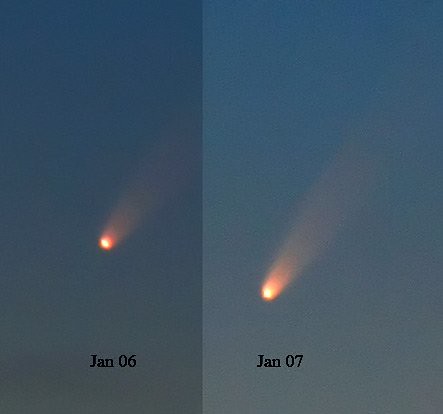
 

A series of images of Comet McNaught can be found here; or click here for a video of McNaught’s orbit.

We encourage you to bring binoculars and a camera when viewing the comet, but never fear if you miss that great shot: 

Regardless of just how bright Comet McNaught becomes, beginning on Friday, Jan. 12 and continuing through Monday, Jan. 15, it will be passing through the field of view of the Solar and Heliospheric Observatory ("SOHO"); a spacecraft that was launched in 1995 to study the Sun.

Astronomers hope to get spectacular views of the comet by utilizing SOHO’s LASCO C3 camera, whose images can also be viewed in real time here.  

We’ll have more on McNaught when it’s closest to the sun on the 12th of this month. 

 

DIY Friday: WiFi Signal Amplifier

Friday, January 5th, 2007

This rocket scientist has recently discovered the joys of a Verizon Aircard while traveling. No more dropping $10 extra bucks in a $200 a night hotel just to get online, or wrestling with the credit card at the airport to check your email between flights. It’s liberating, and wonderful, and somewhat akin to magic.
That said,  my personal plan is $50+ per month, and whenever I use the wireless broadband these days, it seems there’s a freely availably wifi service just out of reach. If only my wifi receiver were better, I might be able to save even that dough.

Which brings us to today’s edition of DIY Friday, and that rugged little gizmo to the left, which looks like a cross between a Glade Plugin and the valve on my gas grill:


Most laptops nowadays have a mini PCI Wi-Fi card hooked to an antenna which is located inside a screen plastic cover on the laptop. I was browsing eBay recently and noticed that there were some Wi-Fi amplifiers available that promoted themselves as improving the reception of the signal. Sadly most of those amplifiers are designed to be hooked to a PCMCIA type card or a router! None of them seemed to be specifically made for a mini PCI card.

I decided to buy a Wi-Fi amplifier and hook it to my laptop. I have an ASUS A2H laptop with a Dell 1470 a/b/g Wi-Fi mini PCI card inside, I bought the card for $20 off of eBay. I bought the amplifier for $118, it is a 500 mw bi-directional amplifier called "turbo tenna", the amplifier was shipped from Hong Kong and I received it shortly after ordering on eBay.


 A nip and tuck of a wire here and there, and the author of the piece found "a dramatic increase in signal strength! More than -80dBm, and the speed of the connection is 24Mbps with signal strength 34% as compared to the same connection at 1% previously tested. You can also see more Wi-Fi connections around you, though of course they’re all password protected."

 But hey — it’s not $50 a month, either.

2007: The Year of the Moon?

Tuesday, January 2nd, 2007

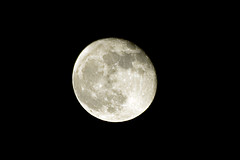
Is 2007 going to be the year of the moon?
In one respect, yes. A slate of robotic lunar explorers are set to head for our lone satellite in 2007 — though not from the United States.

Space.com reports: 

This year, China is set to launch its first lunar orbiter, followed by the summer sendoff of a mega-powerful mooncraft from Japan.

Both nations are kick-starting a barrage of robotic survey ships that shoot for the Moon, including lunar missions by India and the United States in 2008.

As global interest in the Moon grows, so too does the call for multi-nation collaboration in robotic and future human exploration of Earth’s neighboring natural satellite.

China is wrapping up fabrication next month of Chang’e I to be sent spaceward atop a Long March 3A rocket.

The lunar orbiter design—based on their Dongfanghong III satellite platform—is reportedly headed for an April departure from the Xichang Satellite Launch Center in Sichuan Province.

According to Chinese news services, once Chang’e I circles Earth for nearly 8 hours, the spacecraft will then depart on its journey, taking 114 hours to reach Moon orbit.

While precise specifications about onboard science gear is not widely known, Chinese space planners have explained in broader terms the goals of the mission. The craft will yield 3D images of the Moon’s surface, probe the distribution of 14 “usable elements” on the Moon, gauge the temperature of the Moon, estimate the depth of the lunar crust, as well as study the space environment between the Earth and the Moon. The lunar orbiter is designed to carry out a one-year mission.


Solar Storms

Thursday, December 21st, 2006


We wrote yesterday about the challenges a hostile space environment presents to satellite technology; last week we were all reminded of those challenges when a solar flare disrupted satellite signals:

An "energetic" storm on the sun disrupted signals in space and forced mission controllers to shut systems down to avoid damage to spacecraft orbiting Earth, the European Space Agency said.

The sun on December 13 expelled a solar flare after a buildup of magnetic energy near its surface triggered an explosion, the agency said today in an e-mailed statement. The flare caused a so-called coronal mass ejection, which sent a stream of fast-moving atomic particles toward Earth…

The flare was the strongest of five categories for such ejections and was one of a series of eruptions this week that emanated from a region of active sunspots. 

The flare even affected the ISS:

 It may also have caused a fault in the system controlling the space station’s orientation in space.

The ISS usually relies on four large gyroscopes that spin to control its "attitude" without consuming copious amounts of propellant.

Space station flight director Joel Montalbano told reporters in Houston, US, that the unusual solar activity had caused the density of Earth’s atmosphere to increase.

"We’re seeing some problems with our software converging on a nice stable attitude for attitude control," Space.com quoted him as saying.

Last week, astronauts were forced to sleep in protective areas of the station and shuttle as a precaution against the storm.

What do satellite operators like SES AMERICOM do in a case like this? Nothing, really, other than ride it out. 

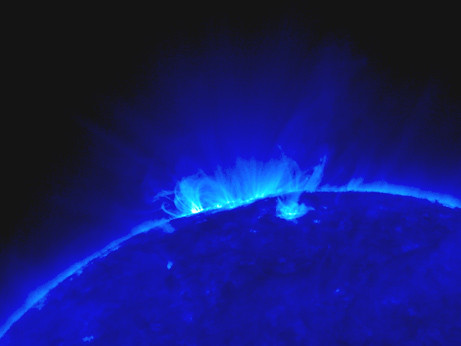
But all that solar activity can be beautiful. The image at the top of this post is from NASA’s twin Solar Terrestrial Relations Observatories (STEREO), which sent back their first images of the sun ‘s growing activity. And some musicians at Berkeley are even making music inspired by "the breeze of electrons from the sun."

Zamfir, eat your heart out.  

But as beautiful as the images of the sun are from last week, some impatient people may wonder what the sun looks like right now. For that, bookmark SolarMonitor.org, which provides nearly real time images of the sun.


Rhythm and Blues Replacing Rock and Roll

Wednesday, December 20th, 2006

Is time running backwards, or are music lovers just getting back to their roots?

Well, neither, as it turns out. Rather, "Rhythm" and "Blues" are the names of the two new satellites that will bring XM Satellite Radio to consumers:  

On Friday, XM began broadcasting through its recently launched XM-4 satellite (known as "Blues") manufactured by Boeing Satellite Systems International, Inc. The combination of "Rhythm (the XM-3 satellite launched in early 2005)" and "Blues" provides a solid foundation to deliver a full complement of digital broadcasts to the XM Nation across the next two decades…

Rhythm and Blues replace XM’s original satellites, "Rock" and "Roll," launched in 2001, which will serve as in-orbit spares for the near-term.

"Rock" and "Roll" were just launched in 2001 — so why replace them so soon?

The first Boeing 702 spacecraft had problems with the solar arrays, which experienced "faster than expected performance degradation during early operational life."

That’s a mere euphemism, insurers say. In a satellite version of a "lemon law," the world’s "largest space-insurance underwriters have agreed to seek damages from Boeing Co. for what they allege was gross negligence in the manufacturing of the first six Boeing 702-class satellites, all of which had defective solar arrays," according to Space News.

Solar array problems aren’t always a case of manufacturing errors, however. The space environment is extraordinarily hostile, and solar array failures can often be caused by conditions in space

In 1997, scientists and engineers of the Photovoltaic and Space Environments Branch of the NASA Lewis Research Center, Maxwell Technologies, and Space Systems/Loral discovered a new failure mechanism for solar arrays on communications satellites in orbit. Sustained electrical arcs, initiated by the space plasma and powered by the solar arrays themselves, were found to have destroyed solar array substrates on some Space Systems/Loral satellites, leading to array failure. The mechanism was tested at Lewis, and mitigation strategies were developed to prevent such disastrous occurrences on-orbit in the future.

Not all problems lead to array failure, however. But maintaining the functionality of solar arrays remains one of the key challenges to satellite engineers working in a difficult environment.

Satellite Internet Coming to Saskatchewan

Tuesday, December 19th, 2006

Say that three times fast, eh?

We’ve written before about the challenges of bringing broadband access to remote, rural regions of Canada (in communities like Black Tickle, Labrador) — and the resulting lack of Internet access options for rural residents in the north.

But there’s good news today for those who want broadband in Saskatchewan:

Saskatchewan Communications Network (SCN) Minister Glenn Hagel and OmniGlobe Networks, Inc. (OGN) Chair Julian Costley today signed a Memorandum of Understanding to form a long-term strategic alliance.  The two companies will work together to deliver a satellite-based wireless broadband Internet service capable of supporting video-conferencing, Voice over Internet Protocol (VoIP) and other e-solutions to rural and remote communities across Canada….

Earlier this year, SCN and OGN undertook a six-month project together to deliver wireless broadband Internet service to several remote communities in northern Quebec.  The success of the Quebec project demonstrated large-scale interest for a national service combining satellite with terrestrial wireless access, inspiring the two organizations to jointly extend the model across Canada.

Omniglobe has years of experience delivering VSAT services (such as distant learning) to rural Canada. But delivering true broadband to Canada is going to require far more spectrum (bandwidth) then VSAT. Where will that spectrum come from?

The most likely answer is Ciel Satellite Group, which recently filed applications for 9 licences in Canada: 

On November 15, the Ciel Satellite Group filed nine applications with Industry Canada for multiple satellite orbital positions across several frequencies. The applications were submitted in response to Industry Canada’s Call for Applications to License Satellite Orbital Positions, the largest in Canadian history. Applicants who are awarded licences from the Call will have the opportunity to build and launch satellites to bring new spectrum into use for DTH, HD and broadband services, for the benefit of Canadians in all regions of the country….

David Lewis, President and CEO of Ciel, noted, "This is a key event in Ciel’s history and, at the same time, a defining moment in the history of Canadian telecommunications."

IPTV Movin’ and Shakin’

Thursday, December 14th, 2006

Longtime readers of Really Rocket Science know that we’ve been closely tracking the emerging (and soon to be explosive growth) in IPTV (see our posts here, here and here).

It’s expected that global household subscriptions to IPTV will leap from 2 million in 2005 to more than 34 million by 2010 — and with growth like that, you’d expect to see lots of players jumping into the game, or consolidating to form a larger team.

And indeed they are. Marketwire today carries a press release announcing that IPTV and advanced media services companies Auroras Entertainment, LLC and Broadstream Communications, Inc. have signed a Letter of Intent to merge following shareholder approval. The name of the combined entity will be Avail Media, Inc.

We heard this scoop a few days ago over at Fierce IPTV. From the press release:

  Ramu Potarazu, formerly COO of Intelsat and now CEO of Broadstream, will become CEO of Avail. Diane Smith, Auroras’ CEO, will become President of Avail. Rounding out the executive team will be Jon Romm – EVP of Sales, Marketing and Business Development; Steve Bukowski – EVP, Integration and Operations; Mike Kazmier – EVP, Technology; and Ben Goux – CFO. Both Broadstream and Auroras will be wholly owned entities of Avail Media.

It’s interesting that Ramu Potarazu and Jon Romm, formerly of Intelsat, are playing key roles in this new venture, especially considering rumors that Intelsat has internally killed its IPTV service. One wonders if the new venture will lead Auroras to move off of Telesat’s satellite.

In related news, the progress of other IPTV ventures is less than encouraging

And merger announcements aside, an obvious key to future IPTV success is content— and SES Americom has a clear lead in transport agreements with major content providers.

Nonetheless, we’ll continue to watch this space closely, and to bring you the latest news from the burgeoning IPTV market. 

ILS Launches Malaysia’s MEASAT3 Communications Satellite

Wednesday, December 13th, 2006

International Launch Services successfully lifted Malaysia’s third and most powerful communications satellite — MEASAT3 — via a Proton rocket from ILS’s launch facility at Baikonur Cosmodrome in Kazakhstan yesterday.

On hand to witness the launch in person were Tai Kai Xin, age 10, and Izza Azreenah binti Azizan, 17 — winners of a launch drawing contest (link opens in PDF) that MEASAT Satellite Systems held for schoolchildren across Malaysia.

New Straits Times provides the details from the chilly launch pad: 

Cheers, sighs of relief, and even tears of joy flowed freely among most of the over 50 officials and invited guests who braved icy conditions and temperatures of -17 degrees Celsius to witness the lift off at 5.28am Kazhak time (7.28am Malaysian time).

As the countdown hit zero, the 5.5- tonne rocket, propelling the Measat 3 to its orbit in outer space, tore off almost silently from the launch installation with a huge ball of fire from burning fuel below propelling its upward trajectory.

Only seconds later did the blast off register to witnesses on the ground with a major tremor that jolted the surrounding areas and a delayed, deafening thud to sound the lift off.

Measat 3, which carries a payload of 24 C-band and 24 Ku-band, is the biggest satellite launched so far by owners Measat Satellite Systems Sdn Bhd which also has Measat 1 and Measat 2 already in operation.

The new satellite has a 15-year orbit mission life and will change the lives of Malaysians and alter the landscape of the regional satellite business.

The launch of Measat 3 was telecast live in Malaysia by sister firm and pay TV operator Astro, which will be a big user of the new satellite in future.

The event was also telecast live globally on the Internet by US-Russian joint venture firm International Launch Services (ILS) and top officials of ILS and Boeing, the makers of the satellite.

The ILS broadcast of the launch can be viewed (in its full 51-minute glory) here. Also be sure to check out ILS’s Launch Blog for additional details, as well as their photo gallery for some cool shots of the Proton rocket.

Behind the Scenes on the Shuttle Night Launch

Tuesday, December 12th, 2006

After a delay due to weather, the Saturday night launch of the Space Shuttle Discovery marked the first shuttle night launch in more than four years.

The Discovery mission involves more than NASA, however: Playing a key role in analyzing the weather and the launch itself was the Air Force’s 45th Space Wing out of Patrick Air Force base in Florida.

Air Force Link provides a unique behind-the-scenes look into the role of the 45th Space Wing in Discovery’s launch:

Several units across the 45th SW played vital roles such as helping validate the pad after the shuttle rolled out, final ordnance installation, providing weather forecasts, organizing and training Department of Defense contingency response forces and media relations.

The wing also provided eastern range support with a vast network of radar, telemetry, meteorological, optical and communications instrumentation that helped facilitate a safe, picture-perfect launch….

Another of the ways the 45th SW supported this mission was monitoring restricted airspace near Kennedy Space Center and helping keep it clear during the launch window.

Staff Sgt. Adam Greer, of the wing’s 1st Range Operations Squadron, served as an aerospace control officer. He closely monitored a radar scope and had the capability to facilitate contacting pilots who strayed into the restricted airspace, if necessary, during the mission.

Sergeant Greer remembers watching space shuttle launches as a kid. He said it’s surreal that he is part of the launch team now.

"The fact that I played a role in space exploration by helping launch a mission to the International Space Station is something that will stay with me forever," he said.

The STS-116 mission is the 33rd for Discovery and the 117th space shuttle flight. During the planned12-day mission, the crew will continue construction on the International Space Station, rewiring the orbiting laboratory and adding a segment to its integrated truss structure. 

Click here for more information on the 45th Space Wing at Patrick AFB.

A Rocket Science Finish to 2006

Thursday, December 7th, 2006

If the weather cooperates, tonight’s launch of the Space Shuttle Discovery could kick off a "rocket finish" to 2006.

At least nine satellite or shuttle launches are scheduled between now and December 31st.


NASA reports from the launch pad at Kennedy Space Center

All systems onboard the space shuttle are functioning normally this morning, but there’s a 60 percent chance of weather prohibiting a liftoff at 9:35 p.m. EST. A cold front moving through the area is expected to bring with it a lingering blanket of clouds and isolated light rain. The team will press on with the countdown for now, in case the weather cooperates after all.

Starting shortly after 9:00 a.m., Discovery’s orange external tank will begin loading 500,000 gallons of liquid oxygen and hydrogen. This process, called "tanking," takes about three hours to complete. The propellant levels in the tank will be continuously "topped off" until the final minutes of the countdown.

Across the space center, in the Operations and Checkout Building’s crew quarters, the astronauts are scheduled to wake up just as tanking is getting under way. After breakfast, a weather briefing and suiting up, they’ll board the silver Astrovan and leave for the launch pad amid the cheers of Kennedy employees.

The STS-116 mission is the 33rd for Discovery and the 117th space shuttle flight. During the 12-day mission, the crew will continue construction on the International Space Station, rewiring the orbiting laboratory and adding a segment to its integrated truss structure.

But will the weather cooperate? "The forecast has trended for the worse right now," says Kathy Winters, the shuttle’s weather officer.

The weather in French Guiana looks a bit better for tomorrow’s planned launch of Arianespace’s final Ariane 5 mission of the year,  which will lift SES-Americom’s AMC-18 satellite. That launch can be seen live in North America beginning at 4:45 pm EDT.