Author Archive

DIY Friday: Get a Space Job!

Thursday, February 8th, 2007

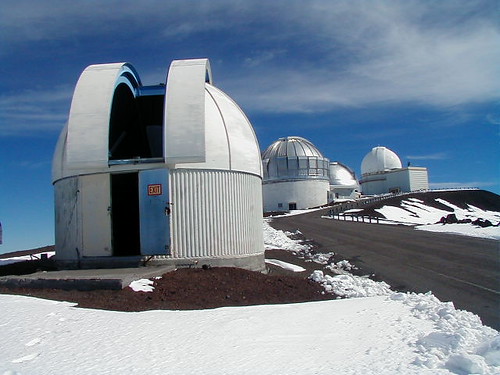
Believe it or not, this is Hawaii, and you could be there. Read below to find out how. 
 

Here’s the ultimate Do-It-Yourself project for the space buff who’s already created their own Mooninite shirt, created a PlayDoh radio, and souped up their WiFi receiver: get a space job!

You may think that only a certain type of 1960s nerd can become a rocket scientist, but in truth, the space industry is incredibly diverse, and talented people from all walks of life can make successful careers within it.

And your colleagues may be more cheerful than you’d ever imagine. 

So how does one go from dreaming of space, to working on projects related to space?

Astroplace has a huge collection of links; two less-imposing places to start are at Spacejobs.org and Space-Careers.com.

Space.com also has a job board powered by CareerBuilder.com, which — while we’re working this sub-theme of American sports — happened to have one of the better ads during the Superbowl.

Ok, so now that we’ve looked at SI cheerleaders and funny ads on TV, where were we?

Oh yeah: we were trying to get a job. What’s out there?

Well, looking at the jobs posted at the Smithsonian, they need an astrophysicist at the Smithsonian Observatory near Boston, but this job is based in (hello!) Hilo, Hawaii. 

Hard to top that that. But if you miss the deadline and want another great place to work, be sure to check out the job opportunities right here at SES-Americom— especially our Associate Program, which is designed to accelerate your career through a 24-month program in which DIY-minded people like you are assigned four challenging rotations, including an international assignment. Rotations provide exposure in selected functions of our business, including Sales and Marketing, Finance, Space and Operations and Business Development.

So put down the PlayDoh radio, and drop us a note.

Dodging Junk in Space

Tuesday, February 6th, 2007

 
Question: How much junk is in the Earth’s trunk — er, orbit?

Answer: A lot. And a lot more since China knocked down an aging weather satellite last month.

Evidence: Check out this graphic from the New York Times, which shows the thousands of pieces of small debris that are now in orbit. 

The accompanying article explains: 

 For decades, space experts have worried that a speeding bit of orbital debris might one day smash a large spacecraft into hundreds of pieces and start a chain reaction, a slow cascade of collisions that would expand for centuries, spreading chaos through the heavens….

Early this year, after a half-century of growth, the federal list of detectable objects (four inches wide or larger) reached 10,000, including dead satellites, spent rocket stages, a camera, a hand tool and junkyards of whirling debris left over from chance explosions and destructive tests.

Now, experts say, China’s test on Jan. 11 of an antisatellite rocket that shattered an old satellite into hundreds of large fragments means the chain reaction will most likely start sooner. If their predictions are right, the cascade could put billions of dollars’ worth of advanced satellites at risk and eventually threaten to limit humanity’s reach for the stars.

Indeed, the destruction of the satellite by China forced the International Space Station to move (see the video above) to avoid debris from the destroyed satellite, which the U.S. military is tracking.


Head Off to Titan!

Thursday, February 1st, 2007

If you’re looking for cool images from space on the web today, there’s probably no more interesting place to be than the Cassini-Huygens homepage, which has newly-released images of a huge cloud system covering the north pole of Titan.

The images can also be seen on the Visual and Infrared Mapping Spectrometer instrument homepage, which also has detailed information on the technology behind Cassini’s observations:

VIMS has several unique capabilities. It is able to identify the chemical composition of a surface, atmosphere, or Satrun’s rings by measuring the visible and infrared energy. VIMS is, in essence, a color camera that takes pictures in 352 different wavelengths between 300 nm and 5100 nm. This range, coupled with the ability to discern different wavelengths (called spectral resolution), allows the VIMS instrument to be able to very accurately quantify the light it detects.

It’s also well worth checking out the flash animation that NASA’s Jet Propulsion Laboratory has up on their website, summarizing what is known about Titan, largely throught the observations of Cassini.


Canada Invests in Space Technologies

Tuesday, January 30th, 2007

The Canadian government recently announced a major investment of $10.3 million in R&D contracts to Canadian firms for the design of new space technologies and applications:

"The investments announced are crucial for supporting Canada’s leadership position in niche markets such as robotics, remote sensing, satellite communication components, and radar, and for making groundbreaking technologies market-ready. These are technologies that respond to Canadian needs and those of our international partners," said Minister [of Industry Maxime] Bernier.

Nearly $1.9 million of those grants went to the Ottawa area. But what exactly is being funded?

A list of projects is available on the Canadian Space Agency website; they include "guidance, navigation and control software to improve the autonomy, safety and reliability of space systems; improvements on a new satellite design that can be used for studying the environment and monitoring natural resources; a feasibility study on an instrument which measures water content of soil without touching it; and near-instantaneous distress alert technology."

The end result of such investments reach far beyond Canada. In November of last year, the CSA signed a Memorandum of Understanding (MOU) with the Egyptian government to explore uses of space technology in Egypt:

The main focus of the agreement is currently Earth observation to promote sustainable growth; in past years Canada has worked extensively with various satellite applications to connect its far-flung population of 32 million people spread out over 10 million square kilometers. As the MOU is an open agreement, however, there are virtually no limits on the possibilities.

The Egyptian project is aimed at promoting sustainable development, and may help deliver high-tech telemedicine services to the region.

Which, we must admit, seems to be a better use of money than this widely-publicized bit of Canadian research

The Death of Driveway Moments?

Thursday, January 25th, 2007

"Driveway moments," for those who don’t know, is a term used by NPR and other radio stations to describe those radio stories (or songs) that are so rivetting that you sit in the driveway listening to it after you’ve arrived home.

A variation that I’m familiar with is provincially known as "parking lot eternity" — when you sit and scream at the DJ for not telling you the name of the artist who did that awesome song two or three segments earlier.

Such experiences would come to an end, we’ve known, if and when Tivo for Radio ever showed up in our vehicles.

In Europe, that moment may soon arrive:

The luxuries of owning a PVR for watching TV shows may soon show up in automobiles. The European Space Agency, or ESA. is working on a new satellite radio system that requires little changes to automobiles but will allow listeners to perform the same PVR functions, but to their favorite radio stations. Pausing, rewinding and time shifting will all become usable features for in-car radio.

The ESA’s system employs what it calls "cache" memory for radio — essentially either a hard drive storage medium or some form of solid state memory such as flash memory. When released, the ESA’s system will more than likely employ solid state flash memory for storing audio data, which will better withstand bumps and jolts while driving around.

While satellite radio already exists from Sirius and XM, ESA’s system’s claim to fame is its cost which, according to the ESA, will be a lot cheaper to implement. Because the new system does not require the use of local transmission towers for assistance — like Sirius and XM — there are costs associated with setting up a local ground infrastructure. The ESA’s system will also use existing communications satellites that are already in place. This will require flat satellite dishes to be installed on automobiles, but the ESA claims that the system is small enough to be integrated well.

 ITWire has more.

Bicycling in Low Gravity

Tuesday, January 23rd, 2007

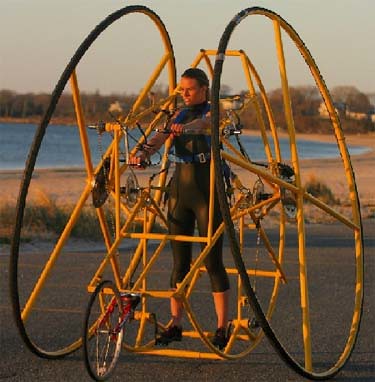
Here’s an interesting concept:

What is it, you ask? It’s a hyperbike — and NASA has put up a little cash to see where it goes (pun intended): 

The Hyperbike is a working prototype created by inventor Curtis DeForest for a human-powered vehicle that will be faster than a traditional bicycle and much safer…

In creating the HyperBike, DeForest tried to remedy the flaws of the standard bicycle. For one thing, it has no seat; the rider stands upright. Also, the arms are used for additional power. DeForest describes pedaling the HyperBike as "swimming on dry land." Motor vehicle speeds of at least fifty miles per hour are easily attained….

One of the most interesting differences lies in the greater stability of the HyperBike. A conventional bicycle has the center of gravity higher than the spinning axis of the wheels. The HyperBike positions the rider in such a way as to put the center of gravity below the wheel axis.

Apparently, it is the stability and balance of weight relative to spinning forces that has NASA interested. These factors would make the Hyperbike a good choice for low gravity environments. The NASA-funded Space Alliance Technology Outreach Program has invested some capital in the development of the next model.

Now, I’ll admit to a tendency to get overly excited about these things — don’t even ask me about the Segway — but don’t you think this is pretty cool?

Northrup Grumman Opens High-Energy Laser Facility

Thursday, January 18th, 2007

Via Air Force Online comes the news that Northrup Grumman has opened the "first of its kind by private industry in the US” high-energy laser facility dedicated solely to military systems at Redondo Beach.

The Daily Breeze has the details:

The Directed Energy Production Facility, part of Northrop’s Redondo Beach-based Space Technology sector, represents the first of its kind by private industry in the United States and probably the world, company officials said.
Sword Medical

The new facility has three large laser laboratories to produce solid-state lasers, which use electric power to create an intense beam of light. The site also will be used to integrate lasers into larger defense systems….

Northrop is building on the laser technology it inherited from TRW Inc. when it bought the company in 2002….

The Joint High-Power Solid State Laser program will be the first work conducted in the new facility, Northrop said. In its third phase, this Department of Defense program will build and demonstrate the first 100-kilowatt solid-state laser.

The Northrop Grumman press release can be found here; far more interesting, however, is this animated and live video from Northrop Grumman of the defensive and tactical applications of laser technology on land, sea and air.

While you’re watching video and thinking about lasers and unexploded ordinance, be sure to check out this video from the White Sands Missle Range in southern New Mexico. The High Energy Laser Systems Test Facility  is located at White Sands.

Chores on the Space Station

Wednesday, January 17th, 2007

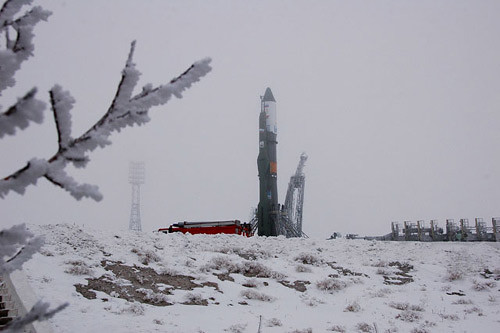
That snowy rocket you see is a Russian Soyuz rocket at Kazakhstan’s Baikonur Cosmodrome, which is set to launch tonight at 9:12 p.m. EST (0212 Jan. 18 GMT) and which sheds a light on the chores that go into keeping the International Space Station running.

Space.com explains what goes into a space station shopping list:

Riding aboard the Progress 24 space freighter will be more than 1,720 pounds of propellant, 110 pounds of oxygen and about 3,285 pounds of dry cargo – which includes new equipment, experiments and spare parts. The fresh supplies are expected to arrive at the space station’s Russian-built Pirs docking compartment Friday at 10:03 p.m. EST (0303 Jan. 20 GMT) .

 To prepare for Progress 24’s ISS arrival, the station’s Expedition 14 crew and their flight controllers on Earth will cast off an older cargo ship – Progress 22 – from its berth at the Pirs compartment at about 6:29 p.m. EST today (2329 GMT).

As for the trash — well, it looks like someone took it out a bit early:

Fragments of a Russian cargo ship carrying garbage and used equipment from the international space station (ISS) have crashed into the southern Pacific Ocean ahead of the arrival of a new cargo ship, a Russian official said.

Engineers undocked the Progress M-57 at around 2.29am (1029 AEDT) and sent it hurtling toward Earth, said Vera Medvedkova, a spokesman for the Federal Space Agency.

Much of the ship burnt up as it re-entered the atmosphere, and fragments crashed in a vast area of the Pacific, some 4,200 kilometres east of New Zealand, just under four hours later, she said.

Funny. It seems like it takes more than four hours just to get my trash out to the curb.

The News at CES and MacWorld

Tuesday, January 9th, 2007

The 40th Annual CES (Consumer Electronics Show) kicked off yesterday in Las Vegas — and even if you’re thousands of frigid miles away (as we are), you can be there virtually by following Engadget’s live coverage of the event.

And if you want to duck out virtually, take this virtual tour of the Venetian, where the conference is being held. 

But we digress. The big news to come out of CES yesterday was DIRECTV’s announcement of their launch and carriage of 100 HD channels in 2007. 

The big news today? Well, it might actually come from the MacWorld Conference and Expo in San Francisco, where today may be:

… the day we find out whether all the rumors are true and the Applephone and / or solid-state ultraslim MacBook and / or iTV and / or true wireless-video-touchscreen iPod will be announced (we’re not holding our breath on any of the above), or whether we’ll spend another few months sorting through rumor, speculation, and bad Apple product mockups.

The keynote at MacWorld will be broadcast live beginning at 12 noon EDT today; you can tune in for a webcast and get other breaking news from both conferences on the Engadget website.

‘Plutoed’ chosen as ’06 Word of the Year

Tuesday, January 9th, 2007

The AP reports that our dear former planet has found newfound fame in the slang of the hip:

 Pluto is finally getting some respect — not from astronomers, but from wordsmiths.

"Plutoed" was chosen 2006’s Word of the Year by the American Dialect Society at its annual meeting Friday.

To "pluto" is "to demote or devalue someone or something," much like what happened to the former planet last year when the General Assembly of the International Astronomical Union decided Pluto didn’t meet its definition of a planet….

"Plutoed" won in a runoff against "climate canary," defined as "an organism or species whose poor health or declining numbers hint at a larger environmental catastrophe on the horizon."

Other words considered: murse (man’s purse), flog (a fake blog that promotes products) and macaca (an American citizen treated as an alien).