Author Archive

Atlas V Launch Tonight!

Thursday, March 8th, 2007

A United Launch Alliance Atlas V rocket is scheduled to launch this evening from Cape Canaveral Air Force Station.
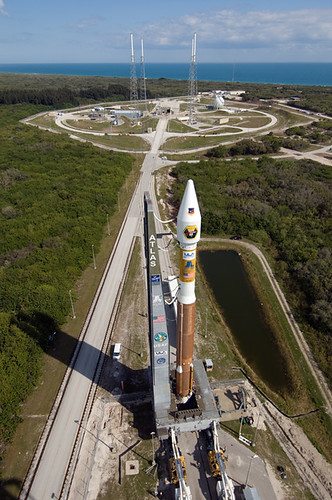
 

The launch is set to go at 9:37 EST; the launch window extends until 11:42 EST. The 45th Space Wing of the U.S. Air Force will be handling launch operations, and the weather forecast (opens in PDF) looks good, if a little gusty. A live webcast can be found here.

The always-convenient worldwide launch schedule details the payload: 

The United Launch Alliance Atlas 5 rocket (AV-013) will carry six satellites during a complex launch of the Air Force’s Space Test Program-1 mission. The payload list is led by the Orbital Express in-space refueling demonstration mission consisting of the Autonomous Space Transfer and Robotic Orbiter, or ASTRO, prototype servicing satellite and the NextSat serviceable spacecraft. 

Space.com has more on the Orbital Express: 

Built for the Defense Advanced Research Projects Agency (DARPA), the Orbital Express vehicles are aimed at demonstrating autonomous spacecraft refueling and servicing techniques [video, image].

For military uses, such capabilities would allow reconnaissance satellites to keep station over specific areas of interest and tank up on vital propellant later, though the technology could also aid general-use spacecraft in need of periodic equipment repairs, replacements or an orbital boost, mission managers said.

Additional information on the mission can be found on DARPA’s Tactical Technology Office website. Also be sure to check out this series of pictures of the Atlas 5’s pad rollout on the Spaceflight Now website.

And if you’re online later this evening for the live webcast — please share your reactions to the launch in the comment thread below. 

Space Weather Forecast Sees (STEREO) Gain

Tuesday, March 6th, 2007

To the left: An image of a February 25 eclipse taken from NASA’s STEREO-B satellite.
Back in October, we wrote about the successful launch of of NASA’s STEREO mission. (Click here for video of the Delta II launch.)

The STEREO (Solar TErrestrial RElations Observatory) Mission uses stereoscopic 3D vision to construct a complete picture of the sun and the nature of solar flares. Among the uses of such knowledge: protecting future astronauts from the dangerous effects of solar flares and providing better space forecasting.

The Washington Post now gives us an update on STEREO’s progress

The effort to improve space weather capabilities took a major step forward last week with the transmission of never-before-seen images of a solar eruption traveling the 93 million miles from the sun to Earth.

Sent back by the twin satellites of NASA’s newly launched Solar Terrestrial Relations Observatory (STEREO), the video is part of an ambitious new effort to learn more about massive electromagnetic storms on the sun, and the dynamics and characteristics of their eruptions. The sun is a huge furnace of nuclear fusion, in constant turmoil with flares, eruptions, convections and the release of lower-energy solar winds.

The "fronts" produced by coronal mass ejections, as the biggest eruptions are called, are the prime movers of space weather in Earth’s neighborhood, and understanding them better is essential to space weather forecasting.

"With STEREO, we can track the front from the sun all the way to Earth and forecast its arrival within a couple hours," said Russell Howard, principal investigator for STEREO’s most cutting-edge instrument, which will allow researchers to observe the movements of solar eruptions in three dimensions. "The new views from STEREO are like having a curtain lift from our eyes — they are extraordinarily instructive."

They are also pretty amazing, as this video animation taken from STEREO images shows. 

The Washington Post continues: 

STEREO cost NASA and its European partners about $600 million to build and is expected to operate for at least two years. It has already detected somewhat surprising characteristics of the solar eruptions. Researchers have, for instance, located "hot spots" within a solar eruption as it speeds from the sun, and they have seen loops and arcs formed from the hot plasma. They have also begun to measure the velocity of the eruptions, which gradually slow as they collide with other solar matter moving far more slowly in the solar winds.

Like most researchers, STEREO team members say they are looking for solar surprises as much as confirmation of existing hypotheses. The detailed study of space weather is in its infancy, they said, and the opportunity for discovery is vast.

We’ll keep you updated on STEREO’s discoveries as they are reported; in the interem, be sure to check out the STEREO mission homepage for the latest developments. 

DIY Friday: Beer Launching Fridge!

Friday, March 2nd, 2007

Real rockets scientists are obsessed with launches. There’s something about cylindrical metal objects flying through the sky that captures our imagination.

Beer captures our imagination, too, which is why today’s DIY Friday combines two great obsessions into one lazy invention: the Robotic Beer Launching Refridgerator!

John W. Cornwell, a student at Duke University, invented this contraption — which we are certain history will rank alongside the printing press and the remote control for its impact in changing our lives for the better. He writes

Have you ever gotten up off the couch to get a beer for the umpteenth time and thought, "What if instead of ME going to get the BEER, the BEER came to ME???" Well, that was how I first conceived of the beer launching fridge. About 3 months and several hundred dollars later I have a fully automated, remote controlled, catapulting, man-pit approved, beer launching mini-fridge. It holds 10 beers in its magazine with 14 more in reserve to store a full case. It is controlled by a keyless entry system. Pressing unlock will start the catapult rotating and when it is aiming at your target, pressing unlock again will stop it. Then the lock button can be pressed to launch a beer in the selected direction….

To everybody who is asking about price, the BLF took me at least a hundred hours to build, as well as several hundred dollars worth of parts. I would put the price at about $2500 to build ONE.

The photos posted on Cornwell’s website reveal pure engineering genius, though for a while we puzzled why the the "magazine" only holds 10 cans of beer when they are sold in 12 packs.

The answer, of course, is that you and your buddy drink one while you load the fridge with beer.

Beautiful

Friday, March 2nd, 2007

The latest image from Cassini of Saturn’s rings is a sight to behold:


More images here

Iran’s Sputnik?

Thursday, March 1st, 2007

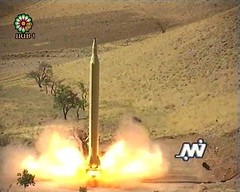
What precisely did Iran launch earlier this week, and what does it mean?
That’s a hot topic among space, military and diplomacy analysts around the world. 

"Calling the test a scientific achievement which will help propel Tehran’s research into the next century, Iranian leaders say its aerospace research center has launched a rocket 150km (93 miles) above the Earth, which returned with the aid of parachutes,"  Iranian.ws reports.

The Fars News Agency claims the "space rocket" was launched for "scientific purposes." 

"But the 25-30-ton rocket could be a wolf in sheep’s clothing to test longer-range Iranian missile technologies," Spaceref.com counters. 

What’s the truth? Radio Free Europe spoke to Shannon Kile, a senior nonproliferation expert at the Stockholm International Peace Institute in Sweden, for analysis. She says:

Well, there is actually some confusion about exactly what Iran launched. The initial reports that came from the Iranian state media indicated that Iran was in fact trying to place a satellite into orbit, and the head of the Iranian space agency quickly dismissed that, saying no, that in fact this was a sounding rocket [a rocket bearing scientific instruments to probe the upper atmosphere] and the purpose of the rocket was basically to go above the 100 kilometer boundary that is commonly considered to mark the beginning of space. The type of rocket that Iran used appears to have been a single-stage, liquid-fuel rocket that probably is a derivation of one of their simpler, medium-range ballistic missiles….

The rocket that was launched last week was basically a sounding rocket, this is half-a-century-old technology. It doesn’t represent any major technological achievement for Iran. [However], it’s important to keep in mind that there are a number of reports recently in trade and industry publications which indicate that Iran is preparing a real satellite launcher based on the Shahab-3 medium-range ballistic missile.

The Shahab missle series, interestingly enough, is a variation of the Scud missles made famous during the first Gulf War.

What do you think is the meaning of this week’s rocket test by Iran?

DIY Friday: Sun Outage Calculator

Friday, February 23rd, 2007

There is no greater tool for DIY enthusiasts than the Internet, and today’s DIY activity is just a click away: a sun outage calculator!

But wait — what’s a sun outage? Now’s a good time to ask.

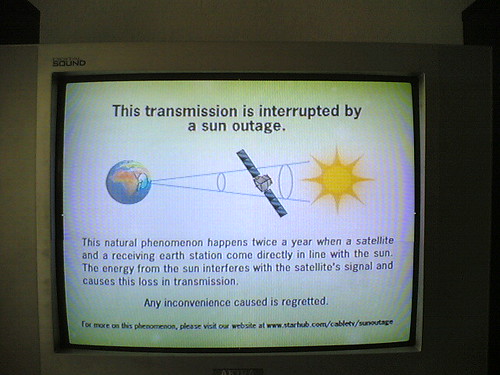
Sun outage is a natural phenomenon, which occurs twice a year (in the spring and fall) when the sun appears to be passing directly behind the satellite as seen from a receiving earth station.

Since the sun is a potent source of radio frequency energy, the earth station’s receivers are overwhelmed by the sun’s “noise” output and reception becomes impossible for a brief period of time, usually less than 10 minutes.

An observer at the earth station will notice that the antenna feed’s shadow will fall exactly in the center of the reflector during the peak of the sun outage period.  This indicates that the antenna, the satellite and the sun are in direct alignment.  At this point in time, the sun’s radio signals are being focused directly into the antenna’s receive feed.  This results in a temporary degradation in the signal to noise ratio of the signal being received from the satellite and a consequent degradation in Eb/N0 (Energy per bit over Noise referenced to zero) in digital systems.

Sun outage generally occurs between 9 AM and 3 PM for locations in the continental United States.  The duration and intensity of the outage will begin as a slight degradation in signal, increasing to a peak level over several days and will then begin to reduce in intensity and duration over a similar period.  These outages pose no danger to earth station equipment and they are not related to sunspot activity.

So how do you predict when the sun is going to mess up your signal? This sun outage calculator gives you predictions based upon the satellite you’re receiving from, your location on earth, and the time and date.

SES also offers a bunch of charts (good luck with that). Intelsat also offers marginally useful maps of sun outages for spacecraft — but they let you input your exact location. I like that.

Satellite 2007 Blog Feed

Tuesday, February 20th, 2007

Click here for the latest blog posts from the official Satellite 2007 blog.

Making Money on the Moon

Tuesday, February 20th, 2007


Want to get in on the ground floor of the moon?

As NASA moves forward with its $100 billion plan to start human settlement of the moon by 2030, it is making room for private enterprise on our original satellite.

Alan Boyle at MSNBC explains: 

The prospects for private enterprise on the moon  — ranging from astronomical telescopes to gee-whiz television to medical isotopes and fusion fuel — were listed during a weekend session at the annual meeting of the American Association for the Advancement of Science….

The first thing that anyone’s going to make money off of, from the moon, is probably going to be information of some kind," [Paul Spudis, a planetary scientist at Johns Hopkins University’s Applied Physics Laboratory,] said. That could take the form of interactive television, virtual-reality tours or remote control of lunar probes, leading to "a huge entertainment/educational market that will develop around the lunar return," Spudis said.

Worden touted the idea of lunar surface observatories: "There is already a reasonable investment that’s been made by a private group for putting telescopes on the moon for scientific purposes, much in the way that private investors have built many of the large telescopes in the world," he said.

That group is the International Lunar Observatory Association, which is still being organized by Space Age Publishing’s Steve Durst. The concept calls for sending a 10-foot-high (3-meter-high) probe, equipped with a radio dish antenna as well as communication and power-generating equipment, to the lunar surface. In a telephone interview, Durst told MSNBC.com that the likeliest site would be Malapert Mountain near the lunar south pole.

Based on two feasibility studies conducted by California-based SpaceDev, the mission could be done for $50 million, with a target date in the 2010 time frame, Durst said. A "founders’ meeting" for potential funders is being planned for this November, he said….

As the pace of NASA’s plans accelerates, Durst hopes the International Lunar Observatory will serve as a relay for communications traffic between Earth and the moon. "We’re looking at commercializing that capability," he told MSNBC.com.

What I’m waiting for — though admittedly I’ll be waiting a long time — is the first scheduled Virgin Galactic flight to the moon, as I’ve always wondered what spring really is like on Jupiter and Mars.

DIY Friday: USB Charger Kit

Friday, February 16th, 2007

No matter how cool gadgets get — and whether you buy them or make them yourself — battery life is still the barrier that reminds us that cool stuff only remains cool so long as the juice is flowing.

Unfortunately, toting around all the different chargers that one needs to keep cameras, MP3 players, cell phones and other gadgets going can be a pain in the posterior.

And so for today’s edition of DIY Friday, we present to you…. (drumroll)….. a tin of Altoids!

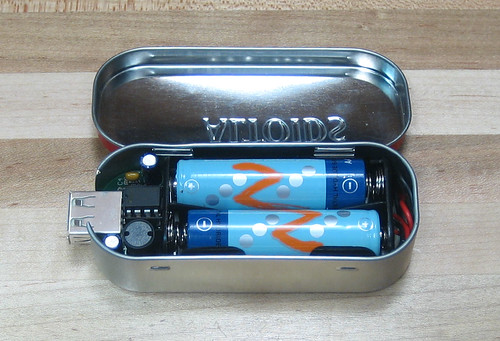
Ok, not quite. Close observers will notice that little USB port over on the left. Open up the tin, and this is what you’ll find:

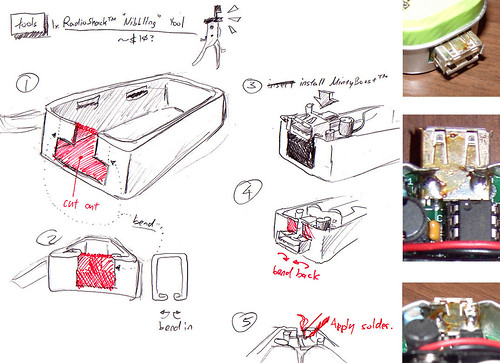
The inner workings of a DIY USB Charger Kit, made from this schematic:

What’s that? Need more detail, you say? Complete details on how to make your own USB charger kit for your personal gadgets — with or without the handsome Altoids case — can be found here. An even quicker way to jumpstart your weekend project is to buy this kit from Make magazine. For only $20 plus shipping and a few hours of your time, you can have your own portable way of recharging your gadgets without towing around a bevy of chargers and cords.


Detecting Debris in Space

Tuesday, February 13th, 2007


Just last week we wrote about the International Space Station needing to manuever to dodge junk in space — or, specifically, the debris from the disused satellite that the Chinese recently shot down in a military experiment.

Thus it’s a bit ironic, as NewScientistSpace points out, to learn that the "only experiment designed to survey and trace the origin of space debris too tiny to be tracked by radar has been cancelled:"

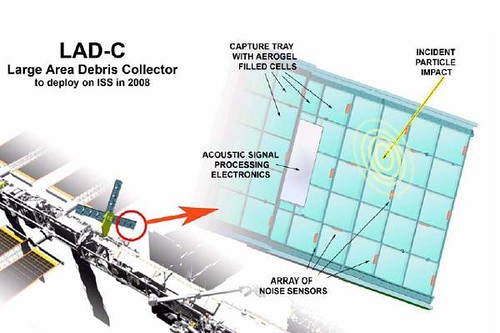
An international team of scientists had been planning to capture and catalogue this dust from outside the International Space Station with an experiment called LAD-C (Large Area Debris Collector). Meant to be launched on a shuttle in 2008, LAD-C was going to catch the debris in a sponge-like aerogel mounted on a 10-square-metre aluminium grid.

When a piece of space debris hit the aerogel, it would have sent vibrations along the metal grid, where piezo sensors similar to the ones in electronic drum kits would have picked up the signal.

A computer would have registered the location, impact speed and timing of the strike, and based on the orientation of the space station, this would have given the particle’s orbital trajectory. Researchers would then know whether it came from space junk, an asteroid or a comet, and would be able to study its composition when the experiment was brought back to Earth in 2009…

The cancellation of LAD-C collector (additional details of which can be found here, in this PDF) comes at a strange time, NewScientist argues:

The cancellation coincides with the most dangerous orbital debris event in the history of space launches. On 11 January, China destroyed one of its own weather satellites with a ground-launched ballistic missile, creating more than 900 objects larger than 10 cm across and an estimated 35,000 smaller objects spanning at least 1 cm. The debris spread throughout low-Earth orbit, from altitudes of 200 to nearly 4000 kilometres, and is expected to stay in space for hundreds of thousands of years. 

Without the LAD-C, how will rocket scientists keep up with all the debris in space?

Why, by reading the Orbital Debris Quarterly, of course.

Meanwhile, this rockets scientist has been told by his supervisor (at home, not in the office) that our own personal LAD-C is operational and should in fact be deployed.