Author Archive

DIY Friday: Satellite Reception on the Move

Friday, September 8th, 2006

On Wednesday, Rocco scooped the world with the first photographs of the Lyngbox, which was officially unveiled today in Europe.

What makes the Lyngbox "officially cool" by Really Rocket Science standards is its database of worldwide satellite ladder charts, which essentially allows users to "plug and play" the Lyngbox anywhere in the world. Travelling from London to Capetown? Just bring your Lyngbox with you, plug it in, peruse the database, and within moments you’ll be watching the local satellite channels.

Of course, there has always been an alternative to purchasing cool gadgets — and that alternative is to Do It Yourself. This site has long offered instructions on Satellite for Caravans — how you can rig your RV (or car or "caravan") and stay connected to the world of satellite TV while on the road in Europe: 

You will not get a picture by simply waving the dish around; the digibox has to decode the signal before a picture can appear for the first time and that can take a couple of minutes or more. So if you just swing the dish around, you’ll have already moved it out of the signal again long before the picture has a chance to appear. Providing you know the technique however, it is fairly straightforward to tune in a digital system and once you’ve got the hang of it you would be very unlucky if it took longer than about 5 minutes. I’ve had people writing to say they got a signal within a few minutes, others took longer. For myself, it normally takes me only a minute or two these days. My own record is 10 seconds – pure fluke, I stuck the dish on its mast and obtained an immediate signal – just happened to point it in precisely the right direction first time!

You’ll need a satellite dish, a digibox, and a TV (don’t forget that) to catch signals while on the road from Astra or Sky:

 The Astra 2 system consists of 3 satellites close together in space so that your dish will ‘see’ all of them as if they were a single unit. All 3 transmit signals aimed at Europe but the coverage on the ground varies considerably. The 2 older satellites, 2A and 2B, can be thought of as flood lights, lighting up a huge area of Europe, whereas the newer Astra 2D is more like a spot light focused on the British Isles. For the sake of convenience the signals are referred to as the north beam, south beam and narrow beam (or more usually just the 2D beam).

If all of this is sounding confusing, the alternative to DIY is always to buy. Newsfactor magazine has a great article on gadgets available to bring you satellite content while in the fast lane, including some DIY tips for acquiring satellite radio in the U.S.:

Do-it-yourselfers have plenty of options too. There are two ways to go with DIY satellite radio: purchasing a car stereo with satellite radio built-in (requires professional installation) or purchasing a dashboard mounted controller that uses a vacant FM frequency to provide the satellite programming.

Dashboard-mounted models, such as the Delphi Roady XT ($79.99) or the Sirius Sportster Replay radio ($139.99), plug into the vehicle’s cigarette adapter and use a roof mounted magnetic antenna to capture the satellite signal. There is a caveat: as a vehicle travels over long distances an FM channel may no longer be unused and available for satellite signals, so the satellite signal will lose clarity as the FM signal gains strength. At that point, a new vacant FM frequency will have to be selected to improve satellite signal clarity. In spite of the limitations, these dash-mounted models provide a quick way to get satellite radio without having to install a compatible stereo system professionally.

So when it comes to acquiring satellite signals while on the road, the question is not whether or not you can receive them. The question is simply: DIY or buy?
Shuttle Launch Delayed

Wednesday, September 6th, 2006

Maybe tomorrow? The AP reports:

NASA postponed the launch of space shuttle Atlantis by another day after discovering a problem with a fuel cell early Wednesday.

The fueling process had yet to start when one of three cells that provide electricity to Atlantis malfunctioned. The space agency planned to further examine the problem, and if possible try to launch at 12:03 p.m. EDT Thursday.

"The launch rules say you need to have three good, operating fuel cells," said NASA spokesman Bruce Buckingham. "We’re going to see if it’s something that’s a real problem or whether it’s something we can rectify."

The problem was discovered shortly before an overnight meeting to decide whether to start pumping the shuttle’s fuel tank with supercold liquid hydrogen and liquid oxygen. When the shuttle’s fuel cells were powered up, a low voltage reading came from one of the units, and the other two spiked up to compensate.


Atlantis to Launch Tomorrow at 12:29 pm EDT

Tuesday, September 5th, 2006

The Space Shuttle Atlantis is set to (finally) lift off tomorrow, Tuesday, September 6th at 12:29 pm EDT. NASA’s launch blog should begin coverage of the event around 6:30 am tomorrow.

Weather has twice delayed the start of STS-115. Lightning at Kennedy Space Center on August 25th delayed the previously-scheduled launch, and then the Atlantis crew had to wait out the passing of Tropical Storm Ernesto.

The launch of STS-115 will make history when it carries Heidemarie Stefanyshyn-Piper, the first Ukrainian-American into space. (Be sure to check out her biography or this interview.)

As always, we’ll bring you updates on the launch of the Shuttle as the countdown begins.

Oops!: Astronaut Reveals Name of New NASA Spacecraft

Tuesday, August 22nd, 2006

AP:

The name of the new vehicle that NASA hopes will take astronauts back to the moon was supposed to be hush-hush until next week.

But apparently U.S. astronaut Jeff Williams, floating 220 miles above Earth at the international space station, didn’t get the memo.

Williams, through no fault of his own, let it slip Tuesday that the new vehicle’s name is Orion.

"We’ve been calling it the crew exploration vehicle for several years, but today it has a name — Orion," Williams said, taping a message in advance for the space agency that was transmitted accidentally over space-to-ground radio.

NASA planned to reveal the new name Aug. 31, when the space agency also announces which contractor will build the vehicle. Competing for the award are Lockheed Martin and a team made up of Northrop Grumman and Boeing.

You just can’t keep a secret these days. 

Construction to Resume on Space Station

Tuesday, August 22nd, 2006

"For more than three years, the International Space Station has floated half-built above the Earth. Maintained by a skeleton crew, the station — an assemblage of modules and girders — has not come close to its stated goal of becoming a world-class research outpost," the New York Times reports.

But the long break in building out the International Space Station— a result of the grounding of the space shuttle fleet following the Columbia disaster— is about to come to an end:

Since the project began in late 1998 with the joining of two American and Russian modules, the United States and 15 other nations have slowly put together a structure that weighs more than 400,000 pounds, with a habitable volume of almost 15,000 cubic feet. When completed, it is to weigh almost a million pounds and have a cabin volume of more than 33,000 cubic feet, larger than a typical five-bedroom house.

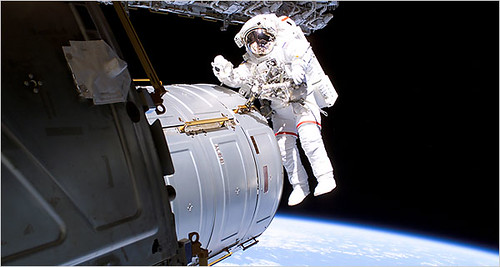
Getting to that goal will require some of the most difficult shuttle missions ever mounted by the National Aeronautics and Space Administration, starting with the Atlantis’s launching from the Kennedy Space Center at Cape Canaveral, Fla [next Sunday]. The shuttle and its crew of six will haul a 30,000-pound, 45-foot truss segment to the station, delicately remove it from the cargo bay and install it during three spacewalks by two teams of astronauts….

NASA has allotted about 15 flights to complete the project before the shuttles are retired in 2010. The next four missions will carry other massive truss segments to extend the station’s central girder to more than 350 feet. The girder will eventually support four huge sets of solar-power arrays, batteries and heat-dispensing radiators.

The additional truss segments, which will increase the mass of the station by 40 tons, will also include 10-foot-wide rotary joints shaped like wagon wheels that will allow the solar arrays to track the sun for optimum power as the station moves in orbit. The Atlantis is delivering the second array, joining one put on the station in 2000.

You can learn more about the International Space Station here

Intelsat Building for Sale

Monday, August 21st, 2006

Steve Pearlstein had an interesting column in Friday’s Washington Post regarding the changing fortunes of Intelsat and its famous headquarters in Washington, D.C.:

Time was when Intelsat was something of a metaphor for business in Washington, a government-backed enterprise that put the city at the center of the global satellite industry. Its futuristic office building on Connecticut Avenue was meant to symbolize Intelsat’s technological prowess and financial reliability.

Today, Intelsat is still something of a metaphor, but for a very different business environment. Its official headquarters is in Bermuda, its building is for sale, some operations are moving to Atlanta, and its debt is rated as junk. Intelsat’s prospects are now tied up as much with financial engineering as with the other kind.

All this is the result of transactions by private equity firms that took Intelsat from a government enterprise to a private company and merged it with Comsat, PanAmSat and parts of Loral, among others. But in the process, they have also loaded Intelsat with more than $11 billion in debt and drained much of the company’s equity value.

More information on Intelsat’s financial woes can be found here and here. Yet regardless of Intelsat’s financial outlook, the future in Washington won’t quite be the same if the Intelsat building — long a Connecticut Avenue landmark and a must-see for futurists touring the nation’s capital– gets renamed.

Unless, of course, you purchase it in our honor and rename it, say, the Sebadoh Building. (This might be the company with the listing.)

More photos: Check out this arial photo as well as this "blast from the past" photo of John Andrews with a model of the proposed building back in 1980.


Koreasat-5 to Launch Tonight

Monday, August 21st, 2006

As we reported last week, SeaLaunch is set to lift the Koreasat-5 communications satellite from its launch facility in the Pacific this evening.


The Korea Times reports: 

KT, South Korea’s largest fixedline and broadband operator, said Monday that it will send its fourth commercial satellite into orbit from the Pacific Ocean this week, marking the nation’s first satellite launch from the open sea.

The Koreasat-5 will be launched at 12:27 p.m. Tuesday [8:27 p.m. U.S. Pacific time on Monday evening] from an area south of Hawaii. The launch will be controlled by an assembly and command ship and a launch platform ship, KT said.

The satellite will replace the Koreasat-2 satellite in providing wireless communications and broadcasting services, the company said.

Unlike previous KT satellites that helped telecommunications in local areas, the Koreasat- 5 will cover other Asian countries, including Japan, China, the Philippines and Taiwan.

The satellite will start its service after four months of testing, it added.

 The SeaLaunch Mission page can be found here.

DIY Friday: Solar Satellite Dish Cooker

Friday, August 18th, 2006

Here’s a true story. A few weeks ago, my gas grill was stolen from my backyard. I went outside one Friday afternoon with a spatula and some burgers and — there was nothing there.

I can’t say I was disappointed that the grill was gone. There was a certain satisfaction knowing that whoever had taken the thing had some arduous scrubbing ahead of them if they wanted to remove several years’ worth of crispy cheese and hamburger fragments that had ossified onto the grill. Losing the grill to theft, I reasoned,  had at least spared me from that long-avoided chore.

But replacing the grill did present me with another problem — that ancient dilemma that has plagued mankind for, oh, three generations now:

Gas, or charcoal? 

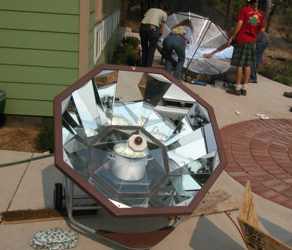
But now I learn that there is a new, third option for outdoor cooking: solar. A group of smart cookies from the Durango Renewable Energy Group have crafted a solar cooker made from a recycled satellite dish.

Reports have it that this fine addition to any suburban patio will bake cookies in under 15 minutes. Instructions on how you can create your own solar oven using mirrors (or a "cheaper" and lower-powered version using aluminum foil) can be found here.

My decision on how best to replace my grill has been further complicated by a neighbor who swears that the fourth option for grilling is pretty much the greatest invention in human history. I’m dubious about his assertion, and the clouds today raise my doubts about crafting my own solar cooker.

Which leaves me, metaphorically at least, still holding that spatula and a plate of uncooked burgers and wondering: gas, charcoal, solar, or George? 

The British Telecommunications Market 2006

Friday, August 18th, 2006

Doug Lung points to more evidence of the transformation of the media landscape. OfCom, the independent regulator and competition authority for the UK communications industries, has released The Telecommunications Market 2006 report. Lung summarizes:

The 293-page report contains some interesting findings about trends in the communications industry, including TV broadcasting, and consumer usage of, and attitudes to, various communications services. One conclusion reached was that a new "networked generation" is turning away from TV, radio and newspapers in favor of online services, downloadable content such as Podcasts and participation in online communities.

In a result that’s sure to concern traditional TV broadcasters, the report found that on average 16- to 24-year-olds in the United Kingdom spend one hour less per day watching television than the average television viewer. Their radio listening is lower too, by an average of 15 minutes per day compared to the wider population. One bright spot, however, is that among all groups, TV viewing increased slightly, by 11 minutes per week.

Digital television, consisting of both satellite and terrestrial Freeview channels, is growing in popularity. Freeview households spend more time watching digital-only channels than any of the five main public broadcasting channels, but the public service broadcasters’ own digital-only channels are gaining audience, with total viewing increasing nearly 6 percent between 2001 and 2005. Free TV remains popular and Freeview was the main driver of multichannel TV growth, adding 2.0 million homes in the 12 months ending March 2006. The report said there are now 7.1 million homes in the U.K. in which the main set receives digital terrestrial TV.

While the TV broadcasting model in the U.K. is quite different from that in the U.S., it is interesting to see that subscription revenues in 2005 were up by 8.5 percent to 3.9 billion pounds ($7.3 billon) for all pay TV services, exceeding commercial television advertising revenue in 2005 by almost 10 percent. Overall TV industry revenues increased 4 percent in 2005 compared with 2004.

A PDF of the key points of the report can be seen here.
 

All Hail Hale

Tuesday, August 15th, 2006

We found NASA’s Picture of the Day on Sunday to be particularly fascinating.

This Mars Global Surveyor (MGS) Mars Orbiter Camera (MOC) image shows dried streambeds—martian gullies— in the mountainous central peak region of Hale Crater. Some scientists have suggested that the fluid which carved these gullies was liquid water, and that it either resulted from ancient snowmelt or from release of groundwater that percolated to the surface in the intensely fractured rock of Hale’s central peak. In either case, the gullies are dry today, and dark sand can be seen as dunes near the right/lower right part of the image.