Author Archive

The Laptop Go Boom! Echo

Tuesday, August 15th, 2006
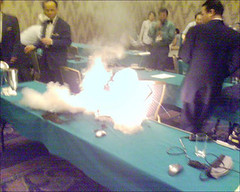
Loyal readers will recall our assiduous reporting earlier this summer on the explosion of a Dell laptop computer at a  business conference in Japan.

Now, it is evident, our remarkable editorial instinct has once again been proven correct, forcing the Washington Post, New York Times, USA Today and the AP into a desperate scramble to catch up to the new and vaunted journalism embodied by Really Rocket Science.

(When you read breathless news stories about how blogs are changing the media, they are, of course, referring to us.)

Never the sort to gloat, our hearts brim with pity as we think of the strained and perspiring editors of the Gray Lady and the nation’s wire services, clumsily stabbing their porcine fingers at their keyboards, trying to figure out this Google thing in a vain attempt to stay apace with the very edge of the new media vanguard, to break the news that we have invariably already broken — ney, smashed to pieces, exposed for the world to see and understand, then meticulously reconstucted by the nimble prose and dazzling insights of the writers of Really Rocket Science, who selflessly offer their beacon of hope and reason in a world too frequently perceived as chaotic and incomprehensible by journalists of a lesser caliber.

 We do it because we care. We do it because we believing that exploring the vast interiors of ignorance is our small and humble way of contributing to a more civilized world. We are not journalists, nor mere bloggers. We are cartographers of the human spirit, and though others follow to fill in the details of roads and bridges and recalled laptop batteries and so on and so forth, we remain at the front, always, bringing you the news even before the masses have grasped it as news — outlining, as it were, the shapes of new continents that lie at the edge of this vast informational sea known as the Internet.

Land ho! we cry, through the lonesome gale, as the rest of the crew sleeps dreaming of their childhood cribs below the deck. 

We will persist. And we will continue to peer out into the darkness, to alert you of the shape of things to come. To find, as is our burden and fate, safe passage through the ongoing storm.

Send us your tips to [email protected]

Arianespace Successfully Launches Twin Satellite Payload; Koreasat 5 to Lift via Sea Launch Next Week

Monday, August 14th, 2006

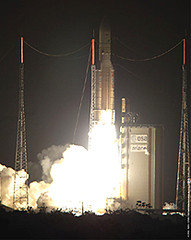
Arianspace’s Friday evening launch of a twin satellite payload, which Spektor previewed last week, was a success. From the mission update:

After an on-time lift-off at 7:15 p.m. from Europe’s Spaceport in French Guiana, the heavy-lift Ariane 5 delivered Japan’s JCSAT-10 telecommunications spacecraft and the European Syracuse 3B secure military relay platform into an accurate geostationary transfer orbit.

Tonight’s flight was Ariane 5’s 28th mission, and marked its 14th consecutive success – underscoring the launcher’s maturity. JCSAT-10 was installed in the upper payload position on Ariane 5, and was released approximately 27 min. into the mission. This was followed some 5 minutes later by the separation of Syracuse 3B, which occupied the lower slot in the payload "stack." 

A series of photographs from the launch can be seen here

In other commercial satellite launch news, Sea Launch will be lifting the Koreasat 5 communications satellite on the evening of August 21st. Sea Launch has provided a nice graphical display of the satellite launche’s profile and groundtrack here.

As always, we’ll have more updates on the launch as it approaches. 

Mary Very Easily Makes Jam Saturday Unless No Plums?

Monday, August 14th, 2006

Elementrary and high school students may have to come up with a new mnemonic phrase for remembering the planets, depending on the outcome of a debate taking place this month at the International Astronomical Union’s General Assembly meeting in Prague:

At a 12-day conference beginning Monday, scientists will conduct a galactic census of sorts. Among the possibilities at the meeting of the International Astronomical Union in the Czech Republic capital of Prague: Subtract Pluto or christen one more planet, and possibly dozens more.

"It’s time we have a definition," said Alan Stern, who heads the Colorado-based space science division of the Southwest Research Institute of San Antonio. "It’s embarrassing to the public that we as astronomers don’t have one."

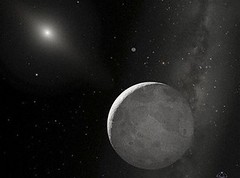
The debate intensified last summer when astronomer Michael Brown of the California Institute of Technology announced the discovery of a celestial object larger than Pluto. Like Pluto, it is a member of the Kuiper Belt, a mysterious disc-shaped zone beyond Neptune containing thousands of comets and planetary objects. (Brown nicknamed his find "Xena" after a warrior heroine in a cheesy TV series; pending a formal name, it remains 2003 UB313.)

The Hubble Space Telescope measured the bright, rocky object at about 1,490 miles in diameter, roughly 70 miles longer than Pluto. At 9 billion miles from the sun, it is the farthest known object in the solar system.

The discovery stoked the planet debate that had been simmering since Pluto was spotted in 1930.

Some argue that if Pluto kept its crown, Xena should be the 10th planet by default — it is, after all, bigger. Purists maintain that there are only eight traditional planets, and insist Pluto and Xena are poseurs.

"Life would be simpler if we went back to eight planets," said Brian Marsden, director of the astronomical union’s Minor Planet Center in Cambridge, Mass.

 What do you think? How should a planet be defined? Should our solar system have eight, nine or ten planets? And if Xena becomes the 10th, what strange jam will Mary have to make?

Blast from the Past: Saving Skylab

Friday, August 11th, 2006

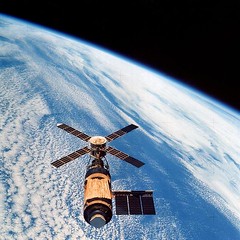
Although Skylab, America’s first space station, fell back to Earth more than 17 years ago, the full-size training mock-up of Skylab is still intact — although in incredible disrepair (and inhabited by several raccoons) —  outside the U.S. Space and Rocket Center near NASA’s Marshall Space Flight Center in Hunstville, Alabama.

Now, a group of volunteers has launched the Skylab Restoration Project with the goal of restoring the training module to its former glory. CNN reports:

Tom Hancock, a board member of the American Institute of Aeronautics and Astronautics, is the leader of the project. He said he is working on the restoration for people like his 18-year-old daughter.

"It’s history. It’s a chance for people my daughter’s age to kick back and see what it was like when I was young," said Hancock.

Made primarily from spare parts left over from the Apollo program, Skylab orbited the Earth for six years beginning in 1973. It helped pave the way for science projects aboard the space shuttle and the International Space Station currently in orbit.

Astronauts learning to live in space trained in Skylab mock-ups at Marshall and the Johnson Space Center in Houston. Three crews of three astronauts each spent a total of 171 days in Skylab, which re-entered the atmosphere in a fiery blaze in 1979.

The Skylab mock-up was displayed for years inside the Space and Rocket Center. But exhibits change, and it was eventually moved outside to a back lot.

 The Skylab Restoration Project is seeking volunteers in the Huntsville area and donations to assist with the project. Visit SaveSkylab.org to learn more and to see "then and now" photos and videos of the Skylab training module.

James Van Allen, 1914-2006

Thursday, August 10th, 2006

In the annals of rocket science, there are few names that loom larger than James Van Allen. 

Van Allen, who came to national prominence with the launch of the first U.S. satellite Explorer 1 in 1958 and who "made the first major discovery of the early space age," died yesterday in Iowa City, Iowa at the age of 91.

A geiger counter developed by Van Allen was attached to Explorer 1, and data sent back by the counters indicated the existence of two belts of charged particles trapped by Earth’s magnetic field — which became known as the Van Allen Belts.

The Telegraph has more on this remarkable man:

The Van Allen belts were discovered by instruments designed by him and carried into space by Explorer I, America’s first satellite. The success of the launch of the 31 lb rocket gave America’s space mission a badly-needed boost after the Soviet Union’s propaganda coup with the Sputnik programme, and Van Allen was featured on the front cover of Time magazine in 1959….

An entire academic discipline, that of magnetospherical physics, owes its existence to Van Allen’s discoveries.

 From the beginning, Van Allen had been keen not only to ensure that rockets were successfully launched, but that they should provide information about aspects of the Earth. In 1950, in conjunction with the British geophysicist Sydney Chapman, he originated plans for an international scientific study of the planet which culminated in the International Geophysical Year (1957-58) of which the satellite programme was the most visible and successful element.

Explorer I’s launch in January 1958 was followed by two further rockets in March, carrying a cigarette-sized "magnetic tape recorder" devised by Van Allen. Explorer IV followed in June, and confirmed the existence of a radiation band 250 miles above the Earth.

He then supervised the Pioneer 10 and 11 rockets, which studied the radiation belts around Jupiter in 1973 and 1974, and went on, five years later, to do the same for Saturn, work which he described in his book First to Jupiter, Saturn and Beyond (1981). He continued to survey the results of the Pioneer and Mariner programmes over decades.

He was also a significant force in the interplanetary missions to Venus, Mars, Neptune, Saturn, Venus and Uranus, contributing to the Voyager programme and the Galileo spacecraft. Much of the knowledge which we now have of the electromagnetic forces, plasmas and radio signals in the solar system derives from the instruments which Van Allen devised and supervised.

 Additional news stories and obituaries can be found here.


Google’s Astronomy Picture of the Day

Wednesday, August 9th, 2006

Astronomy buffs who use Google Desktop to organize their computers can now download a cool plugin that delivers an Astronomy Picture of the Day. The plugin allows users to easily share the daily picture with friends using Google Talk:

Discover the cosmos! Each day a different image or photograph of our fascinating universe is featured, along with a brief explanation written by a professional astronomer.

If Google Talk is installed on your system, you can share the sheer beauty of our universe with your friends. If neither Google Talk is available nor any friends are online, the service and its button are unavailable.

With eye candy, transparency and smooth animations for your viewing pleasure. Undocking recommended!

Click here to download the plugin. 

Google, XM to Share Ad Inventory

Friday, August 4th, 2006

As new technologies continue to break down the old barriers in the media business — we watch TV on our cell phones, as the saying goes, and make telephone calls through our cable company — there will be new mergers and deals between once-disparate companies as businesses look for new ways to expand their reach and customer base in a transformative media landscape.

Among the most creative and forward-looking companies is, of course, Google — and now they’re getting involved in the satellite radio business as a means of expanding their advertising reach: 

Google and XM Satellite Radio today announced an agreement that hints at the future of not only radio, but also television advertising. Under the terms of the deal the two companies will help each others advertisers reach the other’s audience–including letting Google advertisers place targeted radio spots within XM channels.

Inventory on XM’s non-music channels will be available to Google’sadvertising base through dMarc’s media network (www.dmarc.net). As part of the deal, Google advertisers will be able to reach XM’s millions of subscribers nationwide and XM will have access to Google’s large and small advertisers to offer relevant, targeted messages to their subscribers.

The dMarc platform, acquired by Google in January 2006, simplifies the sales process, scheduling, delivery and reporting of radio advertising, enabling advertisers to more efficiently purchase and track their campaigns on terrestrial radio, and now on XM Satellite Radio. For XM, Google’s technology automatically schedules and inserts advertising across XM’s non-music commercial channels, helping to increase revenue with a wealth of new advertisers, while decreasing the costs previously associated with processing advertisements.

After months of trials, the new platform is now in full production for dMarc advertisers. Google AdWords’ customers will be able to place terrestrial and satellite radio spots when the dMarc platform is integrated into AdWords targeted for fourth quarter of this year. 

Our industry observers tell us that Google is still working on ways to improve the CTR of radio ads, which remain stuck at a disappointing  0%. 

DIY Friday: Convert Your Primestar Dish to 802.11

Friday, August 4th, 2006

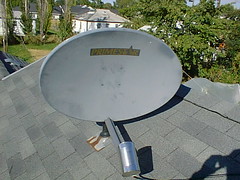
What do you do if you need to get WiFi access in a relatively remote location — say, a distant outbuilding? Waiting for WiMAX might mean waiting a long time in rural areas. Why not just grab an old Primestar dish, a tin can, and some coaxial cable, and rig up your own WiFi antenna?

A student at Walla Walla College explains: 

 It is easy to make a surplus Primestar dish into a highly directional antenna for the very popular IEEE 802.11 wireless networking. The resulting antenna has about 22 db of gain, and is fed with 50 ohm coaxial cable. Usually LMR400 or 9913 low loss cable is used if the source is more than a few feet from the antenna. The range using two of these antennas with a line of sight path is around 10 miles at full bandwidth. I must stress the line of sight part though. Leaves really attenuate the signal.

The "things you need" can be found easily by any aspiring MacGyver:

   1.  A Primestar dish.  (You may use any old dish, but if it is bigger than the Primestar the gain will be higher, and it may not be within the Federal Communications Commission rules for use within the United States.  In fact I have come to find out that there seem to be several different dishes that Primestar used, and I am only sure that the one I used, pictured above, used with the ordinary Wavelan or Airport transceiver card is within the effective radiated power limits given by the FCC.)
   2. A juice can (about 4 inches in diameter and at least 8 inches long).
   3. A chassis mount N connector.
   4. You will also need a "pigtail" connector which has the proprietary Lucent connector (for the PCMCIA card) on one end and an N connector on the other. The pigtail can be obtained from a number of online stores for $35 to $40.

Once assembled, you’ll want to brace the highly directional antenna securely against the wind. 


Goodbye Static!

Thursday, August 3rd, 2006

I drive an old pick-up truck most of the time– a rock-bottom barebones 1996 Mazda B2300 with something like 135,000 miles on it– and when it comes to listening to music I have only three options: AM, FM, or trying once again to dislodge the copy of The Cure’s Disintegration, which has been stuck in the casette player since about 2003.

To put satellite radio or an MP3 player in the poor beleagured truck would be like dressing up a pig in pearls. Why bother?

But for those who drive newer vehicles, an iPod- and satellite-connected vehicle will soon be de rigeur

In the latest boost to its dominance in portable music players, Apple Computer Inc. is teaming with General Motors Corp., Ford Motor Co. and Mazda Motor Corp. to integrate the iPod into car audio systems.

GM and Ford are the nation’s No. 1 and No. 2 automakers, and the new alliances mean the iconic audio gadget will now be compatible with more than 70 percent of the new 2007 model vehicles sold in the United States, Apple said Thursday….

Demand for built-in satellite radio features has also prompted Ford to expand its relationship with Sirius Satellite Radio Inc. VanDagens said more than 90 percent of Ford and Lincoln Mercury cars will offer satellite radio by the 2008 model year.

What will be truly interesting is the impact that standardized satellite radio availability will do to the market share of local radio stations. They don’t call the peak listening hours "drive time" without reason. As more drivers tune out the radio and tune in their favorite satellite station or MP3 playlist, the over-the-air radio industry will be forced to undergo transformative change– or face the same decline that cable brought to the Big 3 Networks.


Launching the Coke/Mentos Rocket

Thursday, August 3rd, 2006

Being rocket scientists and all, we couldn’t help but be fascinated by the latest craze lighting up the blogosphere: instructions and videos on how to combine Mentos with Diet Coke to create and launch your own home-made bottle rocket.

This particular launch  is one of the top videos on YouTube, with nearly half a million viewings in the past six weeks:

An explanation on how it’s done can be seen here:

Of course, being rocket scientists (and, for some of us, parents as well) we must provide a caveat– bottlerockets are inherently dangerous, no matter how they’re constructed. We direct you to Newton’s Second Law of Motion for further explanation.