Author Archive

MobaHO!

Friday, July 28th, 2006

We love the name MobaHO! That exclamation point captures perfectly the exciting potential of satellite digital multimedia broadcasting.

That potential is being realized in Tokyo, as JCN reports

Mobile Broadcasting Corporation (mbco) and Sapporo-based taxi company Daikoku Kotsu will introduce MobaHO!, the world’s first satellite digital multimedia broadcasting service for personal and mobile device use, for taxi customers this month.

Taxis are equipped with LCD monitors which come with an internal speaker and are placed on the head rest of the passenger seat.

The service will provide taxi customers with a variety of programs such as real-time news, genre-specific music programs and overseas FM radio through 37 audio channels, and seven video channels including news, sports, and entertainment. All programs include ‘taxi ads’ as well.


Russian Rocket Crash Destroys Montana’s First Satellite

Friday, July 28th, 2006

Launching rockets into space has become so common and frequent that we tend to forget that space flight is an inherently risky business. As the old adage about general aviation goes, it’s safe– but extremely unforgiving. When things go wrong, they tend to go wrong spectacularly, and the result can be years and years of work lost, as students at Montana State University learned this week when the Russian rocket carrying Montana’s first satellite crashed in Kazakhstan:

At 100 feet tall and 15 feet across, the Dnepr missile was to carry 18 satellites into orbit. Nearly 200 students, faculty, and members of the public gathered at the Engineering and Physical Sciences building on the campus of Montana State University to cheer the launch from Baikonur Cosmodrome as it was relayed by live video.

However, 13 minutes after the launch, a much-anticipated signal from the rocket had not been received. About two hours later, a space news Website posted a story that the rocket had crashed….

The rocket carried MEROPE, Montana EaRth Orbiting Pico-Explorer, which was the culmination of five years of work and waiting by more than 100 MSU students….

MEROPE was a specific satellite design known as a CubeSat. CubeSats are shaped like a cube 10 centimeters (4 inches) on a side and weigh 1 kilogram (2.2 pounds). They were envisioned as student satellites that could be designed, built, tested and launched in the time it takes a student to earn a four-year undergraduate degree.

Undergraduates from physics, electrical engineering, computer science, mechanical engineering, art, business, even geology and microbiology, worked on the project through MSU’s Space Science and Engineering Lab. …

Over its four-month lifetime, MEROPE was to take measurements of the Van Allen Radiation Belt, a donut shaped band of super-charged particles that can kill astronauts and destroy satellites. The belt’s radiation levels and its shape are constantly changing. MEROPE’s monitoring was to contribute to the understanding of "space weather," Larsen said.

As Bill Hiscock, head of MSU’s physics department, points out, 95% of the work done by the students took place simply in getting the satellite to the launch pad. So, although the satellite was lost, the educational value of the project for tomorrow’s engineers and scientists was not.

Russia’s Federal Space Agency says a first stage engine shutdown caused the crash.


Upselling Space Tourism

Monday, July 24th, 2006

Well, that didn’t take long. Even before the space tourism industry has taken off (no pun intended), there’s already a first class upgrade that is out of reach for us hoi polloi. From the AP:

You don’t have to be an astronaut anymore to experience walking in space. All you need is $35 million and the willingness to risk your life.

A private Virginia firm that already has sent three super-rich men to the international space station for $20 million each announced Friday it would offer an even rarer adventure: A stroll outside the space station for an extra $15 million.

"It is the holy grail of spaceflight; it’s something very few of the astronauts and cosmonauts have done," said Eric Anderson, chief executive of Space Adventures Ltd.

Added former NASA spacewalker Kathy Thornton, who is on the firm’s advisory board: "It’s just sort of the feeling of freedom, that you are your own satellite."

With the blessing of the Russian space agency, Space Adventures is arranging for the first spacewalking tourist to go into orbit in about a year or so, Anderson said. The trip would involve a launch in a Soyuz capsule, an eight-day stay aboard the international space station and a 90-minute spacewalk in a Russian spacesuit. An extra month would be added to the six-month cosmonaut training.

More information is available directly from the Space Adventures website, where they feature their advertising slug for the offering: "Think outside the spacecraft." 


The Birds and The Bees Meets the Mile High Club

Monday, July 24th, 2006

Biology and space flight have been closely intertwined ever since the Soviets first launched Laika into orbit in November of 1957. The unique environment of space presents an incredible laboratory environment for biologists to study biological processes, and literally thousands of experiments have been undertaken in the last 50 years.

Now the Chinese government, following in Mendel’s footsteps, is taking genetic and biological research in space one step further — launching the country’s first seed satellite — specifically designed for seed breeding– this coming September:

Shijian-8 is expected to carry at least 2,000 varieties of plant seeds in nine categories, including grains, cash crops and forage plants, as well as seeds of fungi and molecular biomaterials that have been sequenced.

Sun Laiyan, chief of the China National Space Administration, said the "seed satellite" will enable scientists to try and cultivate high-yield and high-quality plant varieties.

Exposed to special environment such as cosmic radiation and micro-gravity, some seeds will mutate to such an extent that they may produce much higher yield and improved quality, said Sun.

Space experts said 40 per cent of mutated space seeds can be used in space breeding experiments.

Since 1987, nine Chinese satellites and several of China’s six Shenzhou spacecraft have carried seeds for experiments and a number of new species of plant seeds have been bred in space, but never before has the country launched a satellite exclusively for seed breeding.

Space-bred seeds are big business:

Liu Luxiang, director of the Centre for Space Breeding under the Chinese Academy of Agricultural Sciences, said that between 2001 and 2004, space-bred rice and wheat varieties developed by his centre had been planted in about 566,600 hectares, producing an additional 340,000 tons of grain.

Experiments have shown that the vitamin content of vegetables grown from space seeds is 281.5 per cent of that of ordinary vegetables; and microelements of ferrum, zinc and carotene are also higher than normal.

The planting of space tomatoes and green peppers in Southwest China’s Sichuan Province, which started in 1999, has raised average yield by 10 to 20 per cent, with the fruits bigger and of better quality, according to earlier newspaper reports.

Space tomatoes! But are they organic?


DIY Friday: Disguise Your Dish

Friday, July 21st, 2006

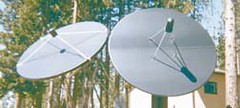
Let’s face it: no matter how cool it may be to have a satellite dish, they make terrible lawn ornaments. Only the most hardy space nut finds the local neighborhood array a thing of beauty– and many homeowners associations have introduced covenants prohibiting the use of large dishes.

But for $900 bucks or so, Clearsat has a DIY solution that will please those who don’t like looking at your dish:

Most Home Owners Associations (HOA’s) have agreed that if the dish is adequately disguised, they will allow it. The ClearSat Umbrella Style Dish Cover will comply with most reasonable HOA’s by covering both the front and back, and when coupled with a set of chairs and table, can actually function as a patio set.

One or two persons can install the umbrella cover in about 15 minutes. It does not require any drilling or modification to the dish whatsoever. Once the fiberglass rods are inserted between the hub and end socket, the cover springs into shape. You simply rest the end sockets on the edge of the dish and zip up the back panels.

The shade provided is not to be overlooked as an added benefit — especially this week, when most of North America is blistering under a scorching heat wave. 


Looking for the Killer WiMAX App

Friday, July 21st, 2006

Rumors have been going on for months about the two big U.S. satellite TV providers (DirecTV and EchoStar) merging. The buzz grew louder earlier this week after the Los Angeles Times quoted EchoStar CEO Charlie Ergen at the Allen & Company annual media-mogul-fest in Sun Valley, Idaho saying that combining the two largest satellite TV providers could save $3 billion in expenses.

The comment set off a renewed flurry of press speculation of a potential merger. The Rocky Mountain News (EchoStar is based in Englewood, CO) reported yesterday:

EchoStar Communications Corp. shares were raised to "buy" from "sell" at Citigroup Inc. because of an increased chance that the No. 2 satellite television provider may combine with rival DirecTV Group Inc….

"It reflects our belief that there is a greater chance that EchoStar and DirecTV may attempt to merge," Bazinet said
of his rating change.

A merger is more likely since EchoStar and DirecTV formed a joint venture to bid for wireless spectrum in an auction next month, Bazinet said in the note. Satellite TV companies are also facing rising competition from cable companies such as Comcast Corp. as well as from telephone companies such as Verizon Communications Inc. that are starting TV services.

Propelling the talk is the growing awareness that IPTV will fundamentally change the media landscape and the balance of power between satcom- and telco-delivered content, as well as growing evidence that Rubert Murdoch’s News Corp is set to receive approval for a project that could create a national WiMAX network. As The Hollywood Reporter writes:

Approval is imminent for the project that could take at least two years and $2 billion, providing News Corp. and DirecTV a valuable wireless interactive broadband loop with consumers to directly sell content, advertising, goods and services. WiMax is a wireless a broadband technology often referred to as "WiFi on steroids" with a much wider 30-mile range than the more limited access offered by WiFi services. WiMax, which is short for World Interoperability for Microwave Access, also promises to provide more security and speed than traditional wireless connections.

"If we can pull something off … there is no reason why that shouldn’t link in with everything," News Corp. chairman and CEO Rupert Murdoch said in a recent interview….

High-level sources say the unprecedented undertaking will involve strategic equity partners that bring WiMax spectrum, equipment and other expertise to the mix. In one of the most likely scenarios, News Corp. and DirecTV have been in advanced talks with Clearwire Corp., a WiMax venture of Craig McCaw, in which chipmaker Intel Corp. and equipment manufacturer Motorola Inc. recently invested $900 million.
McCaw has been amassing one of the largest stables of licensed radio spectrum to build his own national wireless WiMax network. Intel, which has a vested interest in the commercial success of WiMax, particularly for PC users, has been one of Clearwire’s partners from the start….

Some sources say that EchoStar could join DirecTV in providing a united domestic satellite-backed WiMax alternative to cable and to telephone competitors such as Verizon, Cingular and Sprint Nextel. Sprint Nextel is working with a consortium of cable operators including Comcast and Time Warner to assist them with a much-needed wireless out-of-home extension.

Still, not everyone is convinced that the coming WiMAX wars will lead to consolidation on the SatCom side. Al Lewis in the Denver Post says that "anybody who believes EchoStar and DirecTV are about to merge should remember the forgotten tome "The Essential Guide to the Echo- Star/DirecTV Deal:"

Australian media mogul Rupert Murdoch had his team of lobbyists canvass Washington with this 123-page diatribe in 2002.

It argued, in exhaustive detail, why Douglas County-based EchoStar should not be allowed to acquire DirecTV from Hughes Electronics….

In October 2002, the Federal Communications Commission [sic– it was the FTC] blocked Ergen’s deal. The Justice Department blocked it too.

Then Murdoch’s News Corp. acquired a controlling stake in DirecTV for $6.6 billion…

And now – four years later – there are continuing rumors that DirecTV, the nation’s No. 1 satellite-TV provider, will acquire EchoStar, No. 2.

EchoStar and DirecTV are working on several joint projects that involve the two-way transmission of voice, video and data. But if Murdoch were to bid on EchoStar, he’d have to argue against his previous arguments. Or he’d have to argue that the satellite-TV business has changed significantly over the past four years.

The results of the August auctions for additional WiFi spectrum will give observers a clue as to who is coming out ahead in the inevitable rush to bring WiMAX to market. And whether the DirecTV and EchoStar rumors are just rumors or not, we’d expect to hear more talk of consolidation on both sides as emerging technology further alters the old divisions between cable, satcom and telcos.
 

Rock On for Paint On: Successful Test of “Paint On” Antenna Technology Announced

Tuesday, July 18th, 2006

Who was it that said technology for those who do not understand it is indistinguishable from magic?
I can’t recall at the moment, but I was reminded of the quote as I read about the successful test flight of an airship utilizing new "paint-on" antenna technology.

NASA’s Langley Research Center, RTI International, Applied EM, Inc., International Communications Group, Unitech, Sierra Nevada Corporation, and Techsphere Systems International, Inc. today announced the successful June 21 completion of the test flights in Nevada.

Azom provides additional details:

The experiment provided the first opportunity to test and evaluate the electrical, electromagnetic and mechanical properties of the "paint-on" antenna technology during an actual flight.

"The successful airship test flights demonstrate exciting possibilities for ‘paint-on’ antenna technologies," said David Myers, vice president of RTI’s Engineering and Technology Unit. "This new technology can be used to assist with hurricane disaster relief, provide enhanced security of ports and borders, perform science observation missions and improve military communications."

High altitude airships can be used for both defense and homeland security purposes including surveillance of battlefields and domestic borders and ports. The airships are intended to serve as economical station-keeping communications and/or ground-sensing platforms that will augment both ground-based and more expensive satellite systems. The airships will operate well above commercial air traffic and the jet stream and beyond the range of most ground-to-air missiles.

In addition to communications, the "paint-on" antennas are a key enabling technology to achieve the high altitudes necessary for Department of Defense and Homeland Security persistent surveillance missions of the nation’s coastal waters, land borders, urban areas and critical infrastructure.

"RTI also arranged for NASA to demonstrate the potential of a lower-cost alternative to satellite remote sensing by installing a GPS Reflectance Remote Sensing Experiment to conduct soil moisture measurements during the flight," according to Azom.

Although it’s certainly a long way off, one can imagine the technology one day applied to the side of your house — eliminating the need for either a satellite dish or (for some of us) the old bunny ears.

It doesn’t even have to look like aluminum foil, apparently.

ISRO Launch Failure

Monday, July 17th, 2006

The sense of relief felt by many following Discovery’s successful completion of its mission today is a reminder that spaceflight is a complicated and sometimes dangerous business.

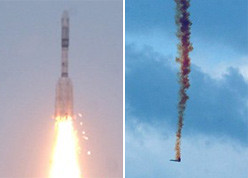
Another reminder came just last week, when the launch of India’s Geosynchronous Satellite Launch Vehicle GSLV-F02 ended in dramatic failure on July 10th, destroying "India’s newest communications satellite and the nation’s largest rocket,"" according to SpaceFlightNow

"ISRO officials were forced to destruct the GSLV F02 to prevent populated areas from being hit by the rocket debris falling from the sky," reports domain-B

You can see a video of the launch failure here. Details of the rocket’s satellite payload can be found here and here. IBN has the summary of the disaster:

Seconds after a perfect takeoff, the 49-metre-long launch vehicle, deviated from its trajectory and plunged into the Bay of Bengal.

The three-stage 414-tonne launch vehicle of the ISRO, which lifted off from Satish Dhawan Space Centre on Monday evening, started under-performing right from the start and veered off its path after travelling a few kilometres into the sky….

GSLV-F02 was carrying a 2,168-kg INSAT-4C, the latest satellite of the Indian National Satellite System series, aimed at augmenting the Direct-To-Home television services, facilitate video picture transmission, digital satellite news gathering and provide VSAT connectivity to National Informatics Centre.

Perhaps the worst news of the day: neither the rocket nor the satellite were insured


Discovery Lands

Monday, July 17th, 2006

MSNBC has some good video coverage as well.

Global IPTV Set to Make Huge Leap

Monday, July 17th, 2006

We’ve written before about the incredible growth potential of IPTV and mobile TV — both of which, after all, were all the buzz at this year’s NAB conference— but this snippet from Digital Trends really caught our eye:

Recent reports suggest that global IPTV subscriptions are expected to jump from 2 million to 34 million between 2005 and 2010. North America is expected to see the quickest growth with a forecasted 14 million households by 2010 accounting for 80% of these subscriptions….

What’s suprising is the slow IPTV deployments taking place in Asia as TDG predicts that Asia will only account for a mere 5.6 million subscriptions. This is primarily due to the impending launch of Digital Terrestrial Television (DTT)….

The Chinese government has stated publicly that this new standard (dubbed ‘Digital Multimedia Broadcasting – Terrestrial/Handheld’ or ‘DMB-T/H’) will eventually serve more than half of China’s TV viewers, especially those in suburban and rural areas. Until then, analog and broadband based services may well find a healthy market for the few years to come.

"IPTV market conditions vary widely depending on the country or geography in question, entailing that individual markets will evolve and behave in very unique ways," added Dixon. He also noted that a handful of individual service operators will account for 75% of the deployed volume with the remaining 25% split between hundreds of other operators. "These conditions will pose a challenge to all types of IPTV solutions vendors, one that requires detailed and flexible implementation and go-to-market strategies." 

IPTV will radically change the broadcast communications market– from technology to content. It truly is a new frontier, with the potential to be as transformative for video content as cell phones have been for telecommunications.