Author Archive

The Mystery at the Center of the Heart

Friday, July 7th, 2006

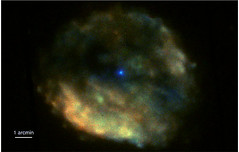
An amazing photo showing the aftermath of a 2,000-year-old star explosion reveals something never seen before: astronomers believe the blue dot at the center may be a neutron star, less than 20 kilometers wide. Space.com reports:

Embedded in the heart of a supernova remnant 10,000 light-years away is a stellar object the likes of which astronomers have never seen before in our galaxy.

At first glance, the object looks like a densely packed stellar corpse known as a neutron star surrounded by a bubble of ejected stellar material, exactly what would be expected in the wake of a supernova explosion.

However, a closer 24.5-hour examination with the European Space Agency’s XMM Newton X-ray satellite reveals that the energetic X-ray emissions of the blue, point-like object cycles every 6.7 hours—tens of thousands of times longer than expected for a freshly created neutron star.

It is behavior that’s more commonly seen in neutron stars that have been around for several million years, researchers say.

The mystery is fully explored in the July 7 issue of the journal Science


How to Deliver Goods to the International Space Station

Friday, July 7th, 2006

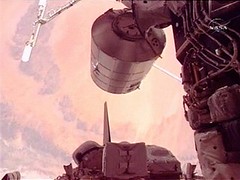
After performing a backflip to allow crewmembers of the International Space Station to inspect its belly (and to provide cool images for space fans everywhere), Discovery docked with the ISS yesterday.

The big item on the mission agenda today? Moving supplies

The astronauts moved a huge cargo container, nicknamed Leonardo, onto the space station by robotic arm. Among the goodies awaiting the space station crew were a new stationary bicycle for exercise, an oxygen generator that will eventually allow the space station to support six inhabitants, a machine that cools the station’s cabin air and a lab freezer for scientific samples…

For the first time in three years, the international space station had three crew members. European Space Agency astronaut Thomas Reiter joined Pavel Vingogradov and Jeff Williams, who marked their 100th day at the space station Friday.

The shuttle isn’t the only means of delivering supplies to the ISS, of course. Earlier this week, the European Space Agency announced the successful completion of acoustic testing on "Jules Verne," the first Automated Transfer Vehicle: 

The ATV, an unmanned vehicle that will deliver supplies to the International Space Station (ISS), will be put into orbit by the European Ariane-5 launcher. Acoustic testing is vital to ensure the ATV can withstand the vibrations caused by the extreme noise levels generated during launch.


Discovery’s Launch — From Any Angle

Thursday, July 6th, 2006

MSNBC has a cool interactive web page that allows you to watch Discovery’s July 4th from multiple camera angles. Click here to check it out.

Satellites Aid Voluntary High-Seas Trawling Ban

Thursday, July 6th, 2006

Here’s an interesting story out of the Indian Ocean:

In a global first, four major fishing companies announced today a voluntary halt on trawling in eleven benthic-protected areas in the southern Indian Ocean. This will protect and conserve the benthic and associated fish fauna and related biodiversity in one of the largest marine protected area enclosures ever.

By setting aside an area almost equal to Australia’s Great Barrier Reef National Park, these businesses are sending a clear signal that they want to keep fish on people’s plates for generations to come…

Using the scientific knowledge gathered over a decade of activity in the Indian Ocean and in consultation with staff of the Fisheries Department of the United Nations Food and Agriculture Organization (FAO), SIODFA have delimited 309 000 km2 of ocean floor in eleven separate benthic protected areas — a total zone with an area approximately the size of Norway — where their vessels will no longer fish. To verify compliance with these self-imposed restrictions, the companies will track their vessels’ locations and activities via a special satellite monitoring system.

We’ve written before about how scientists are using satellites to study ecosystems, land and water usage and climate change– but to the best of our knowledge, this is the first time we’ve heard of satellites being used for enforcement of voluntary conservation measures.

 
Do you know of any other examples? If so, please post them in the comment threads and we’ll highlight them here.

Bezos Goes Orbital

Wednesday, July 5th, 2006

There’s a new player in the tourism-fueled race for space.

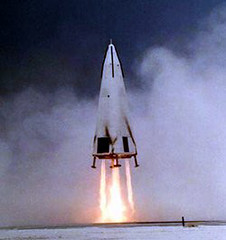
As we mentioned back in FebruaryAmazon founder Jeff Bezos has been fueling Blue Origin’s New Shepard Reusable Launch system, according to Space.com.

[The] Blue Origin rocket concept is patterned after the DC-XA that was operated by NASA and the Department of Defense under the Reusable Launch Vehicle program. The flight vehicle was tested at White Sands during the summer of 1996, and demonstrated a 26-hour turnaround between its second and third flights, a first for any rocket. 

Evidence that Blue Origin is moving forward with the project came when the company filed a draft Environmental Assessment with the FAA for the company’s launch site north of Van Horn, Texas:

The more than 200-page draft EA is a necessary step required by the FAA/AST for Blue Origin to get the needed permits and/or licenses to fly their rocket hardware.

Blue Origin proposes to launch its reusable launch vehicles (RLVs) on suborbital, ballistic trajectories to altitudes in excess of 325,000 feet (99,060 meters) from a privately-owned space launch site in Culberson County, Texas.

As outlined in the EA, the Blue Origin launch site would be approximately 25 miles (40.2 kilometers) north of Van Horn, Texas. It lies within a larger, privately-owned property known as the Corn Ranch. Access to the proposed launch site is from Texas Highway 54, which is approximately five miles (8 kilometers) west of the proposed project’s center of operations.

Also on the group’s to do list at the site is putting in place a vehicle processing facility, a launch complex and vehicle landing and recovery area, as well as an astronaut training facility, and other minor support amenities…

"The strategy is to build the New Shepard suborbital vehicle incrementally, starting with low-altitude tests, progressing to higher-altitude testing, and culminating with commercial flights. Early testing would use prototype vehicles that are smaller and/or less capable than the proposed final design," according to the Space.com report. 

Weekend Roundup

Wednesday, July 5th, 2006

We hope everyone enjoyed the long holiday weekend.

The big non-event of the weekend was the expected near-miss between 2004 XP14 and Earth on Monday:

A large asteroid hurtled harmlessly past the Earth early Monday at a distance of about 269,000 miles – slightly farther away than the moon.

Residents with telescopes in the United States and Canada had the best view of 2004 XP14, which appeared as a streaking dot in the northern sky.

Astronomers tracking the space rock’s path since its discovery in 2004 had determined that it would pose no risk to Earth during the encounter nor in the next 100 years. Judging by its brightness, 2004 XP14 was estimated to be a quarter-mile to a half-mile wide.

An asteroid that size, if it smashed into Earth, would probably cause regional destruction. Scientists have said it would take a mile-wide or larger asteroid to cause widespread devastation that could threaten civilization. 

The big event that finally happened– on July 4th, no less–  was the successful launch of space shuttle Discovery yesterday:

The liftoff, right on schedule at 2:38 p.m., was the start of a 13-day flight that is the first in a year for the diminished shuttle fleet as NASA continues its efforts to resume more frequent human spaceflight.

The Discovery is to rendezvous on Thursday with the International Space Station, where it is carrying equipment, supplies and a fresh astronaut for the station’s crew.

But this is also considered the second and final test flight for the shuttle fleet since the loss of the Columbia and its seven astronauts in 2003, and the Discovery’s ascent was scrutinized for the kind of liftoff debris that caused that disaster.

At 2 minutes 53 seconds into the flight, an onboard camera showed numerous pieces of debris appearing to fall away from the external fuel tank. They fluttered away and did not appear to strike the shuttle, carrying a crew of seven.

N. Wayne Hale Jr., NASA’s shuttle program chief, said the pieces had fallen "after the time we are concerned about," after the air becomes so thin that debris usually floats harmlessly away.

A piece of debris that broke off later in the ascent did appear to strike the midbody of the orbiter, NASA officials said. But they added that it probably did not do any damage.

In all, officials said, insulating foam broke away from five spots on the external fuel tank and a solid rocket booster, some with several pieces of foam.

We’ll be bringing you updates of the space shuttle’s 13-day mission over the next two weeks. 
 

UFO Threatens Space Station

Tuesday, June 27th, 2006

How’s that for a hyperbolic headline? It’s rooted in fact:

MOSCOW – An unknown floating object close to the International Space Station ISS has concerned ground control, according to reports from the US Space Agency NASA on Tuesday.

The object is approximately 2.8 kilometres away from the International Space Station, said the Russian flight control centre in Moscow, citing a NASA source.

The situation… does not yet require a dodge manoeuvre…..

“The object has no number in the list of space debris,” Kireyev said, according to reports from the Russian Itar-Tass agency.

“It is however probably an old piece of space exploration equipment.”

If the object gets any closer to the ISS, astronauts Jeff Williams and Pavel Vinogradov would have to take the precaution of moving to the rescue space shuttle Soyuz TM.

A dodge manoeuvre could cause difficulties for the docking of the US space ship “Discovery”, due to be launched on July 1.

Perhaps the astronauts should practice on this game.

Laptop Go Boom!

Tuesday, June 27th, 2006

We can’t vouch for the veracity of this, but it amused us to no end:

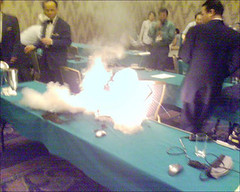
 AN INQUIRER READER attending a conference in Japan was sat just feet away from a laptop computer that suddenly exploded into flames, in what could have been a deadly accident.
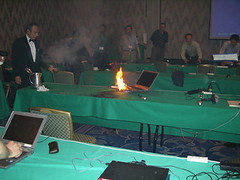
Gaston, our astonished reader reports: "The damn thing was on fire and produced several explosions for more than five minutes"….

"It is only a matter of time until such an incident breaks out on a plane," he suggests.

Our witness managed to catch all the action in these amazing pictures.

"Fire extinguishers leave a mess on your suit and belongings; pack your stuff (if you can) and leave, leave, leave!" he advises.

We don’t have any further details of the model of the computer in question. In light of the evidence, however, we’d suggest you avoid actually using a laptop on your lap. 


The after-photo:


New Satellite Service By 2012?

Monday, June 26th, 2006

The FCC has proposed allowing new satellite service in the 17 and 24 gigahertz band spectrum — a proposal which, if passed, could add new competition to satellite radio and other emerging broadcast industries, Billboard Radio Monitor reports:

 In an email exchange with Billboard Radio Monitor, one high-level engineering source wrote that “the ‘Ka-Band’ frequencies (18 GHZ to 40 GHZ) usually suffer from extreme susceptibility to rain-out and fog failure conditions. On the plus side, the satellite antennas (up in orbit) can send more spot-area signals to different parts of the [continental U.S.], potentially creating individual market coverage signals, which can’t effectively be done at 2.3 GHZ.”

Radio Monitor sources and industry observers estimate that the shortest possible timetable for a new satellite service to make its way through the FCC, onto the launch pad and into space would be five or six years.

The FCC’s Notice of Proposed Rule Making (NPRM) for establishing a new satellite service was originally going to be part of the commission’s Open Meeting agenda but it was deleted at the last minute. Instead, the FCC’s commissioners handled the vote later in the day, with all five commissioners approving the NPRM.

An FCC press release about the Notice says the service “holds the potential of bringing a new generation of innovative satellite services to American consumers—providing a mix of video, audio, data and multimedia services to residential and business subscribers.”


Nix and Hyrda

Monday, June 26th, 2006

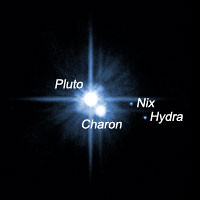
In other Hubble news (see the post below), a pair of small moons orbiting Pluto, first photgraphed by the Hubble Telescope in 2005, now have official names: Nix and Hyrdra.

"Nix and Hydra are roughly 5,000 times fainter than Pluto and are about two to three times farther from Pluto than its large moon, Charon, which was discovered in 1978," according to the official Hubble website.