Author Archive

A Gravity Powered Plane

Thursday, April 13th, 2006

In an effort to create a truly zero-emissions vehicle, Nevada-based Hunt Aviation is exploring ways to use gravity as a powersource– for an airplane:
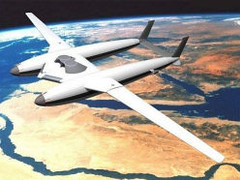
                                        

In order for the GravityPlane to become airborne, gas bags inside a pair of rigid, zeppelin-like structures are filled with helium from storage tanks inside the vehicle. This causes the aircraft to become lighter-than-air, and it rises from the ground. Compressed-air jets on the sides of the craft add further propulsion, pushing the vehicle skyward and decreasing the craft’s overall weight by releasing the stored air which acts as ballast. Once the craft reaches the altitude where the helium is no longer lighter than the surrounding air– theoretically as high as ten miles up– it is unable to climb any further. Some of the stored compressed air is then expanded into the dirigible areas, decreasing the buoyancy effect of the helium and starting the aircraft’s descent phase.

Hunt Aviation has a video explaining the concept of how the plane works. On one level it’s a simple idea– combining lighter-than-air technology to get the vehicle aloft and then gliding from extreme height to the destination. But the devil, as they say, is in the details, and the video reveals the technical complexity that is often involved in implementing a "simple" idea.

Commenters at this blog were relatively unimpressed by the concept. What do you think? 
First Light For SETI Optical Telescope

Wednesday, April 12th, 2006

The Planetary Society and Harvard physicist Paul Horowitz pointed a giant telescope at the sky for the first time yesterday, beginning a systematic search for light signals from an alien civilization. Science A-Go-Go reports:

Housed beneath a retractable roof situated high atop a wooded ridge in Harvard, the telescope isn’t what most people would expect when they visualize a powerful optical telescope. But what may look like a mish-mash of metal bars and mirrors to the uninitiated represents a truly ambitious project that would make Planetary Society founders Bruce Murray, Carl Sagan, and Louis Friedman, Executive Director of the Planetary Society, extremely proud….

[T]he powerful 72-inch SETI optical telescope pointed its giant mirror at the sky for the first time on April 11, and began a systematic search for light signals from an alien civilization.

The telescope has some impressive computer muscle behind it, with the developers claiming that it can process the equivalent of all books in print in a second. Its optical detectors are cutting edge as well, with a sensitivity that can detect a billionth-of-a-second flash of light. The formidable technology driving it should allow the new telescope to scan the entire northern hemisphere sky over the course of a year.

The Planetary Society says that the observatory represents the biggest SETI project it has ever sponsored… [D]espite many years of scanning the skies for radio signals, there has been little in the way of any definitive ET activity, hence the Society’s interest in the visible spectrum. "We have been listening for alien signals for decades," said Friedman, "it’s time we started to watch for signals as well."

It is now common among SETI advocates to argue that alien civilizations are just as likely to communicate with light signals as they are with radio waves, and not without good reason, as there are a number of advantages to using light as a form of interstellar communication. Unlike radio waves, a laser-like beam suffers little interference as it travels through space, not to mention the vast amount of data that can be transmitted using such a beam. Additionally, a laser’s unidirectional quality coupled with its brightness – capable of reaching intensities 10 times greater than the sun – make it easier for receivers to both see and track the beam to its source. And aside from the initial outlay, the optical SETI project is simpler, cheaper and will cost far less to maintain than its radio counterparts.

But one of the project’s major strengths is also one of its biggest weaknesses, because unless an extraterrestrial beam is pointed our way it is unlikely that it will be detected. But despite this limitation, the Society are happy that they are now covering yet another possible avenue of communication in their search for alien civilizations.


Mars, In Color

Monday, April 10th, 2006

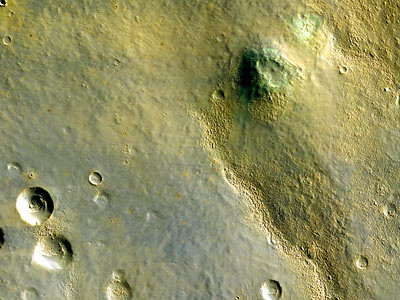
Friday saw the release of the first color image from NASA’s Mars Reconnaissance Orbiter.

ABC News reports:

The crisp test images released Friday revealed pocked craters, carved gullies and wind-formed dunes in Mars’ southern hemisphere. The diverse geologic features show the importance of water, wind and meteor impacts in shaping the Martian surface, scientists said.


The orbiter, the most advanced spacecraft ever sent to another planet, reached Mars on March 10 and slipped into an elliptical orbit. Over the next six months, it will dip into the upper atmosphere to shrink its orbit, lowering itself to 158 miles above the surface.

Last month, the orbiter beamed back the first view of Mars from an altitude of 1,547 miles. Those first test images were meant to calibrate the high-resolution camera aboard the spacecraft. The latest images were taken at the same time, but scientists spent several weeks processing them.

The Reconnaissance Orbiter will begin collecting data in November, and scientists expect the resolution of those images to be nine times higher.

The image is in infrared color– so the colors seen in this post are not what would be seen by the human eye.

 For additional information on the above image, click here.


Boeing Orbital Express Passes Major Milestones

Friday, April 7th, 2006

SpaceDaily reports:

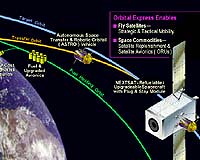
 The Boeing Orbital Express system, a Defense Advanced Research Projects Agency (DARPA) program aimed at demonstrating fully autonomous on-orbit satellite servicing, last month completed two major test milestones.

The program completed its Baseline Integrated System Test (BIST) of the Autonomous Space Transport Robotic Operations (ASTRO) spacecraft and a series of electromagnetic interference and compatibility tests to verify component operation in the spacecraft’s actual electromagnetic environment….

 The Orbital Express System consists of two satellites: Boeing’s ASTRO servicing spacecraft and NextSat, a prototypical, modular next-generation serviceable client satellite developed by Ball Aerospace.

The Orbital Express launch is scheduled for October, when the system will demonstrate for the first time: fully autonomous rendezvous out to 7 km with a capability that could support rendezvous at separation distances up to 1,000 km; soft capture and sub-meter range autonomous station-keeping; on-orbit refueling and component replacement as well as other robotic operations. Upon a successful demonstration, Orbital Express will provide the foundation for developing an operational system that can provide routine on-orbit servicing of existing and future space assets.

The full article can be found here

Closing the Digital Gap: A Laptop for Every Child

Thursday, April 6th, 2006

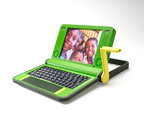
It’s been just over a year since Nicholas Negroponte announced at the World Economic Forum in Davos, Switzerland the goal of developing a $100 laptop not for the marketplace, but to be distributed to schools globally to provide "children around the world with new opportunities to explore, experiment, and express themselves."
What does the initiative have to do with satellites or rocket science? Indirectly, everything. Such initiatives excite interest in technology in general– and the opportunities for education and discovery provided to so many children by the $100 laptop will play a critical role in bringing a creative and educated individuals to the next generation’s workplace, regardless of industry.

But for today, we’ve filed this under "cool stuff," because the technology itself is cool:

The proposed $100 machine will be a Linux-based, with a dual-mode display—both a full-color, transmissive DVD mode, and a second display option that is black and white reflective and sunlight-readable at 3× the resolution. The laptop will have a 500MHz processor and 128MB of DRAM, with 500MB of Flash memory; it will not have a hard disk, but it will have four USB ports. The laptops will have wireless broadband that, among other things, allows them to work as a mesh network; each laptop will be able to talk to its nearest neighbors, creating an ad hoc, local area network. The laptops will use innovative power (including wind-up)

A wind-up option would be great on my own PC, which always seems to die on long flights just when I’ve decided to turn away from Minesweeper and try to get some work done.

We’ll be tracking the latest news on the $100 Laptop project as news becomes available, because the potential is huge for the technology to "trickle up" to consumer laptops and for the project itself to unlock creativity in millions of children around the world.

 (Be sure to check out additional design concepts here.)

Space Symposium Kicks Off in Colorado

Wednesday, April 5th, 2006

The 22nd National Space Symposium opened its doors in Colorado Springs, Colorado yesterday.

The Symposium, sponsored by the Space Foundation, is an annual space industry conference that brings members of the global space industry and the military together.

Space.com reports:

“In terms of intellectual content, this Symposium is clearly our most exploration-focused and most commercial-entrepreneurial focused ever, said Elliot Pulham, President and Chief Executive Officer of The Space Foundation… 

Local station KKTV looks at what’s of interest to the general public:

This year’s show features a robot who can dance and entertain named "Sprockit." It also features NASA’s Crew Exploration Vehicle, or C.E.V. NASA says the C.E.V. will replace the shuttle and sit four to six people.

The C.E.V. is a refined version of the old Apollo vehicle. They say it’s safer than a shuttle and more economical. 

 More stories can be found here. You can also check out photos from the symposium and even check out the live webcam of the exhibit hall (in the left hand column).

 Organizers expect more than 7,500 people to attend the symposium, which runs through tomorrow at the Broadmoor Hotel.


UAE Man to be First Tourist in Space?

Tuesday, April 4th, 2006

USA Today reports that the space tourism race is on– and one of the first tourists is ready for his journey:

 Adnan al-Maimani insists he isn’t looking to be a pioneer — he just dreams of looking down on Earth. So the 40-year-old entrepreneur is paying more than $100,000 to go on the first flight traveling to the edge of space from a Mideast nation.

The flight, which will travel about 62 miles toward space and give its passengers up to five minutes of weightlessness, is part of an American company’s plan to establish a spaceport in the northern tip of the United Arab Emirates.

Virginia-based Space Adventures — the only company to have successfully sent private citizens into space — won’t say when the flight will take place, only that it will be within a few years….

The journey has to wait until Space Adventures carries out plans it announced in February to build a commercial spaceport in Ras Al-Khaimah, the most northern of seven emirates making up the United Arab Emirates….

Space Adventures, whose advisers include Apollo 11 moonwalker Buzz Aldrin and several shuttle astronauts, says 200 people have already made reservations for future suborbital spaceflights, although the program is still in a developing stage.

Space Adventures has a partnership with the Russian Federal Space Agency and previously sent American businessman Dennis Tito, scientist Gregory Olsen and South African Mark Shuttleworth on Russian rockets to the international space station. Each paid $20 million.

As we’ve reported before, Space Adventures is locked in a race with Virgin Galactic to bring the next wave of  of tourists, if not quite to the stars, then above the stratosphere. But as any tourist anywhere knows, getting there is easy. It’s finding decent lodging that’s the hard part.

 Virgin Galactic’s Richard Branson is thinking that through, according to Hotels Magazine (link to story not available):

SIR Richard Branson is taking a giant leap for mankind by drawing up plans to build the worlds first space hotels, his space flight company Virgin Galactic has told The Business.

Alex Tai, its operations director, who will pilot Virgins first commercial space flight in 2008, has held talks with US hotel entrepreneur Robert Bigelow about the project, Virgin Galactics president Will Whitehorn confirmed.Bigelow Aerospace is developing inflatable pods it believes could receive the first space travellers by the end of the decade. Branson, Virgin Galactics chairman, revealed the space hotel discussions in Dubai last week.

Branson said: We are talking to people who are developing hotels for space. We are also talking to people who are developing launch craft to get hotels into space. People know that we can turn something that might seem a bit bizarre into a commercial reality. Personally, I think theres a demand for space hotels.

Calling from the Sea

Monday, April 3rd, 2006

Imagine this problem:

 You’re on-board a ferry cruising across the North Sea between Newcastle and Amsterdam and you realize that you have to call home. Or someone back home has to call you. But you’re hundreds of kilometers from the nearest cellular operator’s service area. So what do you do? What can they do back home?

One alternative is to see if the ferry is equipped with a satellite telephone, but these services tend to be expensive and do not solve the problem of being accessible via your own cell phone number. Increasingly, therefore, a Base Transceiver Station (BTS) has become a permanent fixture on cruise ships and ferries. A BTS, connected to a cellular operator’s land-based Base Station Controller (BSC) over a satellite link, enables passengers to use their regular GSM telephones while at sea, but, given the expense of leasing satellite bandwidth, this alternative cannot serve a large number of simultaneous users either. So how can ship operators ensure that every passenger who wants or needs GSM service coverage will be able to afford it?

Maritime Communications Partner AS (MCP), a Norwegian-based provider of onboard cell phone connectivity to cruise ships and ferries that provides global coverage through leading suppliers of maritime satellite services, has come up with an ideal solution.

 MCP is based in Grimstad, Norway– the port of the poets. "It’s the place to be/ when you must make a call/ at sea," as our own in-house poet (we got him cheap, from a temp service) tells us.

The key technology used by MCP are GSM A-bis optimization gateways designed by RAD Data Communications. The gateways reduce costs by saving on satellite bandwidth.

But you don’t have to be on a Danish-owned cruiseship on the North Sea (where MCP has deployed the product) to enjoy the benefits of the new technology. Skywave Communications Solutions resells the Globalstar Maritime Satellite Phone System for use on private boats.

Playing a Small Part in Understanding Small Things

Friday, March 31st, 2006

The Cern Courier reports on a grassroots project that utilizes the power of the web– and the unused computing power of personal PCs– to help analyze the interstellar dust particles brought back by the Stardust space capsule in early January:

Finding the tiny interstellar dust particles in the Stardust Interstellar Dust Collector will be extremely difficult. The impacts created by interstellar dust can only be found using a high-magnification microscope with a field of view smaller than a grain of salt….. Stardust@home enables public volunteers to help in this task, which is done more accurately by humans than by any pattern recognition software. After a web-based training session, passing a test and registering, volunteers download a virtual microscope (VM). The VM automatically connects to the Stardust@home server and downloads stacks of images created by an automated microscope at the Cosmic Dust Lab at the Johnson Space Center. Each field can then be searched for interstellar dust impacts by focusing up and down with a focus control. The first images for scanning should become available in April and the project should be completed by October.

For more information on on Stardust@home, click here.

Brazil Joins Astronaut Club

Thursday, March 30th, 2006

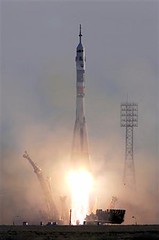
"Brazil’s first astronaut blasted off from earth on a cloudless day on Thursday with a Russia-U.S. crew bound for the orbiting International Space Station," Reuters reports:

Marcos Pontes, a 43-year-old Brazilian Air Force pilot, was hunched inside the spacecraft with Russian cosmonaut Pavel Vinogradov and U.S. astronaut Jeffrey Williams, both of whom were starting a six-month rotation in space….

Pontes, who packed a Brazilian soccer team shirt, returns to earth in 10 days with the outgoing crew, American Bill McArthur and Russian Valery Tokarev.

The Russian Soyuz rocket took off at 0230 GMT (3:30 a.m. British time) from the Baikonur cosmodrome, on a piece of Kazakh steppe rented by Russia from its ex-Soviet neighbour. It is scheduled to dock in two days’ time.

Soon after launch the first stage of the rocket fell away and tumbled back to earth, still glowing orange, while the Soyuz sped higher and higher into space.

"It’s beautiful, absolutely beautiful," said Michael Baker, a NASA international space station programme manager.

Russian spacecraft bear the responsibility for shipping crew and supplies to the station after NASA grounded its shuttle fleet in July when it failed to fix a technical problem that killed seven astronauts in 2003.

Soyuz rockets have proved safer than the shuttle despite their 1960s heritage.