Author Archive

NAB2006: TV Masters Illuminate Content Distribution

Thursday, April 27th, 2006

IMAS Publishing’s NAB Daily has a great set of stories covering events and presentations at the conference.

Though a good deal of the conference focuses on tech, in the end content remains king, and a new media platform will only succeed if there’s something interesting to watch on it. Distributing that content is opening up new revenue streams for companies both young and old, as conference attendees learned at yesterday’s Television Masters Luncheon:

The event was entitled, "New Distribution Pipelines: Turning TV Content Into Revenue."

The keynote address, delivered by Anne Sweeney, co-chair of Disney Media Networks and president of Disney-ABC Television Group, focused the necessity of change to maximize opportunity.

"Our industry is in the midst of a seismic shift," Sweeney said.

Citing an earlier era when cable and home video first threatened broadcasters, Sweeney cautioned the audience against "old thinking."

"Take heart, we have successfully overcome it in the past. We adjusted to the changing reality to reclaim our viewers," she said.

Sweeney said ABC made history when it agreed to make its content available on Apple’s iTunes service. Learning from the mistakes of the music industry, the network understood that this distribution route would not cannibalize its content’s value, but rather enhance it.

"iTunes created a new revenue stream for our content," Sweeney said.

Disney will continue to test and experiment in an effort to discern viewers’ preferences, Sweeney said. She described a planned ABC.com project during May and June in which episodes of popular ABC programs will be offered as free streams – including three required-viewing ad breaks.

"These emerging platforms aren’t ‘alternate,’ they’re additive," she said.

Sweeney acknowledged that the path from traditional broadcasting to today’s divergent distribution was a challenging one.

"We don’t have all of the answers, but we’re committed to working with our affiliates for the answers," she said. "I like the fact that old media is leading the way into the future."

In the lively panel discussion that followed Sweeney’s address, moderator Tony Kern of Deloitte & Touche led industry luminaries through the maze of issues facing both networks and affiliates.

Larry Kramer, president of CBS Digital Media, advocated experimenting with different ingredients, methods and technologies. "We’re basically trying everything," he said.

Kramer described CBS’ experiment with free streams of its 2006 March Madness broadcast. While the 2005 event, which required viewers to pay, drew an audience of 25,000, this year’s Webcast was served to five million viewers, 300,000 of whom signed on the first 15 minutes of the telecast.

Kramer felt the CBS broadcast audience hadn’t been compromised by the move. "Who wouldn’t rather be watching at home on a 50-inch plasma?" he asked. Instead, the Web feeds reached viewers who would otherwise have missed out on the network telecast, and the numbers bore out that hypothesis, revealing the highest ratings for that event in eight years.


European Hams Hear Signals from the Edge of Space

Thursday, April 27th, 2006

This one gets filed under "cool stuff," for sure:

Hams in Germany received signals from American spacecraft Voyager 1 March 31 using a 20 meter parabolic antenna of a radio telescope on a frequency of 8.4 GHz….

A team of hams at AMSAT-DL/IUZ Bochum (The Institute for Environmental and Future Research at Bochum Observatory) using Doppler shift and sky positioning, received the signal from a distance of 8.82 billion miles (14.7 billion km). That’s roughly 98 AUs, or 98 times the distance from the Sun to Earth. This is the first recorded reception of signals from Voyager 1 by radio amateurs….

Voyager 1 was launched in September 1977 to conduct close-up studies of Jupiter and Saturn, Saturn’s rings and the larger moons of the two planets. Originally built to last only five years, the probe will continue to send back astronomical information to NASA and the JPL until at least 2020. Voyager 1 will continue to study ultraviolet sources among the stars, and the fields and particles instruments aboard will continue to search for the boundary between the Sun’s influence and interstellar space. Communications will be maintained until the nuclear power sources can no longer supply enough electrical energy to power critical subsystems. 

 The achievement by the German hams makes Satellite Radio seem déclasse.

The Idiot Box and the Internet Collide at NAB

Wednesday, April 26th, 2006

NAB2006— the world’s largest electronic media show– is underway today at the Las Vegas Convention Center. Besides the slots, the big hit of the day is IPTV. Communications Daily (subscription required; 30 day trial available) reports:

 IPTV and mobile TV are to this year’s NAB convention here as HDTV was a decade-plus ago. "You can’t walk on the [NAB show] floor without hitting your head on IPTV," said Sebastian Moeritz, pres. of the MPEG Industry Forum, which is working with the Internet Streaming Media Assn. (ISMA) and others on IPTV (Internet protocol TV) specifications and standards.

The U.S. market for mobile TV is "huge," said Michael Schueppert, pres. of Modeo, now running a mobile TV trial in Pittsburgh. He said initial data indicate at least 10% of U.S. cellphone users will add mobile TV capability the next 6-7 years. Schueppert said that could mean about 20 million U.S. mobile TV users, "substantially more" than today’s total of XM and Sirius users…..

 PC World also wheighs in on nascent industry of delivering content to IPTV:

WHEN STEVE JOBS announced last fall that iTunes fans could buy episodes of Lost and Desperate Housewives for $2 a pop, a market for portable TV shows emerged overnight. And services like MobiTV and Verizon’s Vcast let cell phone owners watch TV on the go.

If your eyes can handle TV shows playing on screens as small as an inch on the diagonal, MobiTV’s $10-a-month service (available in the United States on Cingular, Sprint, and a few regional carriers) streams content from CNN, MSNBC, and other stations to a supported handset.

Verizon’s $15-per-month Vcast lets you watch live TV, but only on phones that support Verizon’s high-speed EVDO wireless service–and only in markets that offer it. Cingular recently announced plans to offer 18 channels of video as part of its $20-a-month Media Net package. The service will include 3- to 5-minute clips from popular programs such as King of the Hill and That’s So Raven. 

We’d love to hear about cool things you’re seeing at NAB. Tell us what’s going on (besides losing the nest egg) in the comments below. 

Sixteen Candles for Hubble

Tuesday, April 25th, 2006

Remember Sixteen Candles, the 1984 John Hughes film featuring Molly Ringwald and Anthony Michael Hall? Hilarity ensued, as they say, when Ringwald’s film family forgot her sixteenth birthday.

We’re thinking of the film as we realize we missed an important date yesterday– the sixteenth anniversary of the  launch of the Hubble Telescope aboard the space shuttle Discovery on April 24, 1990.


To celebrate the birthday, NASA and the European Space Agency (ESA) have released a "mosaic image of the magnificent starburst galaxy, Messier 82 (M82). It is the sharpest wide-angle view ever obtained of M82, a galaxy remarkable for its webs of shredded clouds and flame-like plumes of glowing hydrogen blasting out from its central regions."

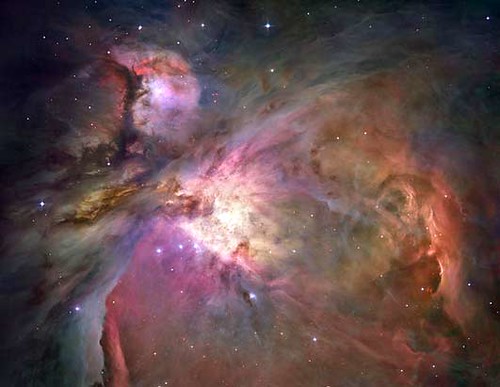
The image can be seen here. Or click here to view a series of other images captured during Hubble’s long life, such as the one above. (This one is  our particular favorite.)
 

The Kon-Tiki Sails Again!

Friday, April 21st, 2006

"Nearly 60 years after Thor Heyerdahl’s Pacific Ocean crossing aboard the balsa raft Kon-Tiki, a Norwegian team is in Peru putting final touches on a new vessel to repeat the journey," the AP reports.


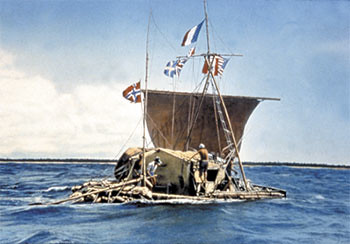
                                                    The original Kon-Tiki in 1947.

"I think we are mentally prepared and we are really, really anxious to put this raft in the ocean," said Olav Heyerdahl, 28, the adventurer’s grandson and one of the six-member crew.

Behind him in a dry-dock in Lima’s port of Callao loomed the balsa raft Tangaroa — named for the Polynesian god of the ocean — which is scheduled to set sail April 28.

The expedition had been set for last year, but was postponed after key sponsors diverted funds to help victims of the 2004 Southeast Asian tsunami.

In 1947, Thor Heyerdahl and his team sailed their primitive raft 5,000 miles from Peru to Polynesia in 101 days to support Heyerdahl’s theory that the South Sea Islands were settled by ancient mariners from South America. Heyerdahl, who died in 2002 at age 87, documented his voyage in the best-selling book "Kon-Tiki" and in an Oscar-winning documentary film.

The adverturer’s 67-year-old son, Thor Heyerdahl Jr., came to Peru to see the new vessel and cheer on his own son. "I’m very happy for him that he gets this opportunity," he said.

The new 56-foot vessel is larger than the Kon-Tiki, with eight crossbeams lashed to 11 balsa logs from Ecuador and covered by a bamboo deck. Atop a hardwood cabin, the crew fitted a thatched-reed roof made by Aymara Indians.

The Kon-Tiki carried only the most basic equipment, even by 1947 standards. But the Tangaroa features abundant modern technology, including solar panels to generate electricity and satellite navigation and communications gear.

We’re not sure if the expedition has Internet access while adrift in the South Pacific, but it is possible if they contacted Connexion by Boeing, which uses SES-Americom’s AMC-23 satellite, which is the only satellite that they can use for Internet based on their route.

Consider that a modern factoid for an ancient journey.

The Kon-Tiki Sails Again!

Friday, April 21st, 2006

"Nearly 60 years after Thor Heyerdahl’s Pacific Ocean crossing aboard the balsa raft Kon-Tiki, a Norwegian team is in Peru putting final touches on a new vessel to repeat the journey," the AP reports.

The original Kon-Tiki in 1947.

"I think we are mentally prepared and we are really, really anxious to put this raft in the ocean," said Olav Heyerdahl, 28, the adventurer’s grandson and one of the six-member crew.

Behind him in a dry-dock in Lima’s port of Callao loomed the balsa raft Tangaroa — named for the Polynesian god of the ocean — which is scheduled to set sail April 28.

The expedition had been set for last year, but was postponed after key sponsors diverted funds to help victims of the 2004 Southeast Asian tsunami.

In 1947, Thor Heyerdahl and his team sailed their primitive raft 5,000 miles from Peru to Polynesia in 101 days to support Heyerdahl’s theory that the South Sea Islands were settled by ancient mariners from South America. Heyerdahl, who died in 2002 at age 87, documented his voyage in the best-selling book "Kon-Tiki" and in an Oscar-winning documentary film.

The adverturer’s 67-year-old son, Thor Heyerdahl Jr., came to Peru to see the new vessel and cheer on his own son. "I’m very happy for him that he gets this opportunity," he said.

The new 56-foot vessel is larger than the Kon-Tiki, with eight crossbeams lashed to 11 balsa logs from Ecuador and covered by a bamboo deck. Atop a hardwood cabin, the crew fitted a thatched-reed roof made by Aymara Indians.

The Kon-Tiki carried only the most basic equipment, even by 1947 standards. But the Tangaroa features abundant modern technology, including solar panels to generate electricity and satellite navigation and communications gear.

We’re not sure if the expedition has Internet access while adrift in the South Pacific, but it is possible if they contacted Connexion by Boeing, which uses SES-Americom’s AMC-23 satellite, which is the only satellite that they can use for Internet based on their route.

Consider that a modern factoid for an ancient journey. 


CloudSat and Calipso to Blast Off Early Friday AM

Thursday, April 20th, 2006

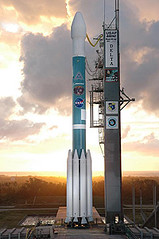
A Delta II rocket will launch a pair of atmospheric research satellites for NASA early Friday morning.


The AP gives a summary: 

A Delta 2 rocket carrying the CloudSat and Calipso satellites will blast off shortly after 3 a.m. Friday [from Vandenberg Airforce Base.]

CloudSat and Calipso are equipped with instruments to study the formation of clouds and microscopic airborne particles called aerosols in unprecedented detail.

Observations from the satellites should help scientists improve weather and climate forecasts.

CloudSat and Calipso are managed by NASA’s Jet Propulsion Laboratory in Pasadena.

Live launch coverage on the web (for all you night owls and early risers) is available here. Also be sure to check out the NASA website for more information about CloudSat and Calipso.

More Space Junk

Thursday, April 20th, 2006

If you read NooBee’s post about SpaceNet 4’s retirement (below) yesterday, then you know that space– or at least the Earth’s orbit– is full of junk.

But now there’s something you can do about it. Sort of. At least, there’s a cool way you can spend some time (or a great deal of time, depending on how highly you rate the things you should be doing at work) learning about the wide range of space junk floating in the earth’s orbit: by playing this free online game

The junk is out there.

NASA Working on Antimatter Rocket for Missions to Mars

Monday, April 17th, 2006


Is science fiction destined to become just science

Most self-respecting starships in science fiction stories use antimatter as fuel for a good reason – it’s the most potent fuel known. While tons of chemical fuel are needed to propel a human mission to Mars, just tens of milligrams of antimatter will do (a milligram is about one-thousandth the weight of a piece of the original M&M candy)….

The NASA Institute for Advanced Concepts (NIAC) is funding a team of researchers working on a new design for an antimatter-powered spaceship that avoids this nasty side effect by producing gamma rays with much lower energy….

When antimatter meets matter, both annihilate in a flash of energy. This complete conversion to energy is what makes antimatter so powerful. Even the nuclear reactions that power atomic bombs come in a distant second, with only about three percent of their mass converted to energy.

Antimatter rockets have significant advantages over nuclear-powered spacecraft, including improved safety, efficiency and speed:

The Reference Mission spacecraft would take astronauts to Mars in about 180 days. "Our advanced designs, like the gas core and the ablative engine concepts, could take astronauts to Mars in half that time, and perhaps even in as little as 45 days," said Kirby Meyer, an engineer with Positronics Research on the study.

Advanced engines do this by running hot, which increases their efficiency or "specific impulse" (Isp). Isp is the "miles per gallon" of rocketry: the higher the Isp, the faster you can go before you use up your fuel supply. The best chemical rockets, like NASA’s Space Shuttle main engine, max out at around 450 seconds, which means a pound of fuel will produce a pound of thrust for 450 seconds. A nuclear or positron reactor can make over 900 seconds. The ablative engine, which slowly vaporizes itself to produce thrust, could go as high as 5,000 seconds.

Although one of the drawbacks to antimatter rockets is its high cost of development, we wonder if that can’t be mitigated by passing the hat around to the millions of science-fiction fans around the world, who have dreamed of anti-matter-powered rockers for years.

(Via Rawstory.) 


COSMIC Launch

Monday, April 17th, 2006

COSMIC— the Constellation Observing System for Meteorology, Ionosphere and Climate– was successfully launched from Vandenberg Air Force Base in California on Friday night. The AP reports:


Six weather satellites successfully reached orbit and were ready to begin their five-year mission to track hurricanes, monitor climate change and study space weather, it was announced Saturday.

"Ground stations have received signals from all six satellites," according to an update on the Web site for the project’s manager, University Corporation for Atmospheric Research in Boulder, Colo.

The satellites were launched on a rocket booster Friday evening from this Central Coast base. They were placed into orbit about 500 miles above Earth, where they separated to form a chain.

The satellites will take about 2,500 daily measurements by using global positioning receivers to track radio signals passing through the atmosphere, scientists said.

The information gathered will be used to enhance research and improve weather forecasting. Scientists hope the data will help them better track storms and monitor long-term climate change.

The COSMIC web page can be found here