Author Archive

Waiting for the Bus

Friday, May 19th, 2006

Where’s the bus? Satellite technology (combined with your handheld or PDA) may soon provide the answer to that question, at least in Manhattan. NY1 News reports:

A plan using a satellite tracking system for buses is moving forward.

New York City Transit says a pilot program proposed last year could be in place by November.

Technology will allow for website displays with real-time bus locations and arrival times.

Updates would also be available on electronic message boards.

Riders will even be able to access times on your cell phone or blackberry.


And if you had a ringtone to this classic Replacements song — well, then riding the bus would almost be cool.

Map of the Known Universe

Tuesday, May 16th, 2006

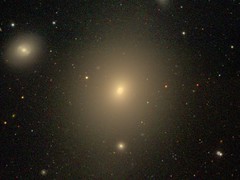
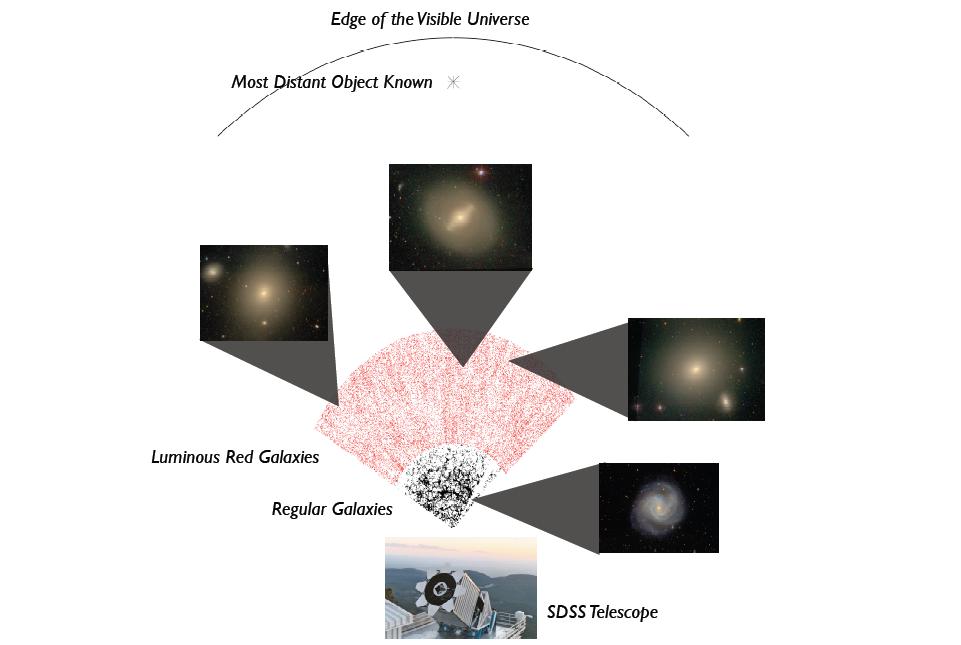
Astronomers have released the largest-ever atlas of the cosmos — and it’s coming soon to the world wide web.

The Royal Astronomical Society reports:

Traditionally, astronomers have needed to take a "spectrum" of each galaxy to determine [the distance between galaxies], splitting its light into many components to reveal sharp features with which to measure the amount of redshifting. This requires a time-consuming, individual observation of each galaxy.

The new cosmic map has been constructed using a novel technique focusing on a special class of galaxy whose intrinsic colour is very well known. For these ‘Luminous Red Galaxies’ researchers can measure the amount of colour distortion, and hence the approximate distance of the galaxy, just by looking at digital images of the sky, without the need to obtain a full spectrum.


What is most striking is that the new study and atlas have revealed that "the ordinary matter our bodies are made of and that we experience in everyday life only accounts for a few percent of the total cosmic budget:"

Our Universe contains billions of galaxies of all shapes and sizes. In recent years astronomers have used increasingly large surveys to map out the positions of these galaxies, stepping their way out into the Cosmos.

The new cosmic map unveiled today is the largest to date — a three-dimensional atlas of over a million galaxies spread over a distance of more than 5 billion light years. The findings confirm that we live in a Universe filled with mysterious dark matter and dark energy.
"We have analyzed the patterns in this map and discovered waves of structure over a billion light years across," said Dr. Chris Blake of the University of British Columbia, principal author of the study. "These waves were generated billions of years ago and have been vastly stretched in size by the expanding Universe."
 
The full findings of the report can be found here.

A Date with Apophis; or, Killer Asteroids

Monday, May 15th, 2006

I wouldn’t change your plans yet (though you might want to get busy practicing the Ameriroids game), but Michael Cabbage at the Orlando Sentinel reports on the progress of NASA’s program to identify asteroids that cross the earth’s orbit — and takes a look at the odds of a an asteroid striking the earth in the coming decades:
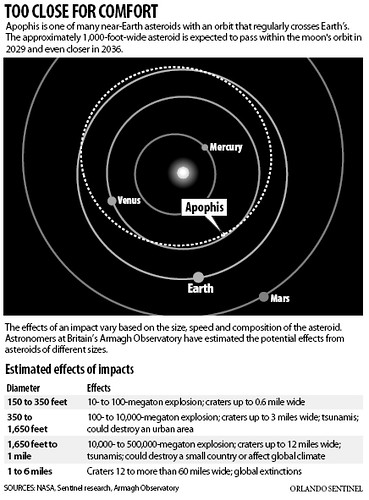


 Mark your calendar for Sunday, April 13, 2036. That’s when a 1,000-foot-wide asteroid named Apophis could hit the Earth with enough force to obliterate a small state.

The odds of a collision are 1-in-6,250. But while that’s a long shot at the racetrack, the stakes are too high for astronomers to ignore.

For now, Apophis represents the most imminent threat from the worst type of natural disaster known, one reason NASA is spending millions to detect the threat from this and other asteroids….

Objects this size are thought to hit Earth about once every 1,000 years, and, according to recent estimates, the risk of dying from a renegade space rock is comparable to the hazards posed by tornadoes and snakebites. Those kind of statistics have moved the once-far-fetched topic of killer asteroids from Hollywood movie sets to the halls of Congress.

"Certainly we had a major credibility problem at the beginning — a giggle factor," said David Morrison, an astrobiologist at NASA’s Ames Research Center in Mountain View, Calif. "Now, many people are aware this is something we can actually deal with, mitigate and defend against."

In 1998, lawmakers formally directed NASA to identify by 2008 at least 90 percent of the asteroids more than a kilometer (0.6 mile) wide that orbit the sun and periodically cross Earth’s path. That search is now more than three-quarters complete.

Last year, Congress directed the space agency to come up with options for deflecting potential threats. Ideas seriously discussed include lasers on the moon, futuristic "gravity tractors," spacecraft that ram incoming objects and Hollywood’s old standby, nuclear weapons.

To help explore possible alternatives, former Apollo astronaut Rusty Schweickart has formed the B612 Foundation. The organization’s goal is to be able to significantly alter the orbit of an asteroid in a controlled manner by 2015.

For those so inclined, more things to worry about can be found on the NASA Near Earth Object Program website.

Bloggers Blog also has a roundup of other posts on Apophis fron around the blogosphere. 

Slinging into Space

Friday, May 12th, 2006

Are rockets déclassé when it comes to launching stuff into space?

Well, not really. Nothing can quite compare to the countdown to launch and the rumble as the rocket lifts off from the pad.

But in the future, rockets might not be the only way of lifting things into the Clarke Orbit and beyond. 


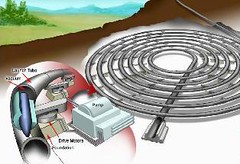
We’ve written before about the space elevator; the picture above depicts another method being explored by scientists and engineers — a giant slingshot:

What if we could throw something so hard, it would wind up in space? At NASA’s behest, Ed Schmidt and Mark Bundy of the Army Research Lab are looking at ways of firing projectiles into orbit.

The notion has a very long pedigree. Back in 1687 when Isaac Newton first came up with the theory of gravity he also introduced the concept of an orbital cannon which could fire a cannonball so fast that it would never come down. The first serious attempt to shoot into space was the High Altitude Research Program (HARP) carried out in the US in the 60’s…. HARP used a modified 16-inch naval gun to loft projectiles to the incredible altitude of 112 miles before being cancelled in 1967.

The ARL study looks at more sophisticated approaches than your basic cannon, including a blast wave accelerator, and electro-magnetic rail gun, and an EM coil gun. But the wildest idea may be the Slingatron: a giant, hypervelocity, rapid-fire slingshot. The machine would spin a projectile faster and faster through a spiral-shaped tube, building up increasing amounts of centripetal force along the way – just like a discus-thrower, spinning himself around before a toss, or like a latter-day King David, winding up his weapon before he whacks Goliath.

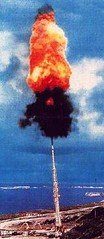
Personally, we think slingshots are dangerous– you could poke out your brother’s eye, as Mom used to warn– but cannons look pretty cool:


And engineers for a relaunched HARP project could easily be found in the autumn in Montana, at the Annual World Championship Punkin Chunkin.

Then again, slingin’ a punkin would be pretty cool, too. 


U.S., India Team Up for the Moon

Tuesday, May 9th, 2006

"Indian and U.S. space agencies Tuesday signed an agreement to put two U.S.-made scientific instruments on board of Chandrayaan-I, India’s first unmanned moon explorer, in 2008, Indo-Asian News Service reported:

NASA will put one mini synthetic aperture radar (Mini SAR) and moon mineralogy mapper (M3) on board of Chandrayaan-I, according to the agreement.

"The objective of SAR is to detect water in the permanently shadowed areas of lunar polar regions, while M3 will map the minerals on the lunar surface and study its characterization," [Indian Space Research Organization (ISRO) chairperson G. Madhavan] Nair said.

Chandrayaan-I will be launched from the Satish Dhawan Space Centre (SDSC) at Sriharikota in southeast India’s Andhra Pradesh, by an advanced polar satellite launch vehicle (PSLV), into a 240-24,000 km earth orbit and placed subsequently in a 100-km polar orbit around the moon, with its own propulsion system.


Geocaching Hits Yosemite

Tuesday, May 9th, 2006

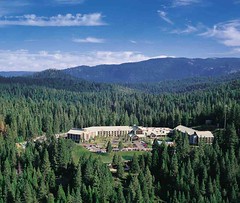
The popularity of geocaching– a high-tech scavenger hunt conducted using handheld GPS units– is not likely to be a surprise to readers of the Really Rocket Science blog. But the AP has an interesting report on how a lodge in Yosemite National Park is capitalizing on the sports’ popularity to bring visitors to its luxurious surroundings:


 [T]he Tenaya Lodge, just outside Yosemite National Park near Wawona, began offering a geocaching program along with its nature hikes and horseback riding outings last year….

Built 15 years ago and renovated recently, the 244-room Tenaya Lodge is the grandest of Yosemite’s perimeter "gateway" hotels catering to the park’s overflow and visitors who prefer to put a little distance between themselves and Yosemite Valley’s bustle….

Essentially, the sport is a cross between orienteering and a treasure hunt using high-tech navigation. Someone hides a "cache" – typically a plastic or metal bucket with a lid – with a logbook and some goodies in it and publishes the precise latitude and longitude on the Web. The goal is to dial those coordinates into your handheld GPS unit and have it lead you to the stash.

Since the sport began in 2000, it has grown exponentially. According to Geocaching.com, there are currently 202,735 caches in 218 countries…..

When I switched on the unit, it locked onto four satellites in geostationary orbit – meaning they appear to hover over one point on the globe – and spat out our elevation (5,288 feet) and our exact location (37 degrees, 26.402 minutes by 119 degrees, 36.237 minutes.) Depending on how well it linked up with the satellites, it was accurate to anywhere from 25 to 100 feet. With various "waypoints" pre-programmed, the GPS unit directed my wife, Jeri, and me down a series of increasingly rough dirt roads – the last was four-wheel-drive territory _ and beeped to alert me at various junctions. Or at least it was supposed to. The hotel is still working the kinks out of the system.

Read the full report on the author’s geocaching adventure in Yosemite here.


RF Delusions Now Online

Thursday, May 4th, 2006

Doug Lung presented his paper RF Delusions Saturday afternoon at the NAB2006 Conference (which we covered here) and has now posted the presentation online for those who missed it:

The presentation addresses common "delusions" concerning broadcast coverage, interference and RF safety. The major focus is coverage. One example illustrates that using data from the azimuth patterns in the FCC CDBS and the standard elevation patterns from OET-69 may lead to significantly different results from those obtained by using the actual antenna azimuth and elevation patterns. (These would include the actual electrical and mechanical beam tilt.) This is one of the more extreme cases and limitations on time and computer resources would make it difficult, if not impossible, for the FCC to study all U.S. TV stations using their actual 3D antenna patterns.

Most interference studies conducted using the FCC software (available on its Web site) with its inherent simplifications and methodology for calculating the depression angle will not show such an extreme difference in signal levels. Ironically, errors are likely to be greater when azimuth and elevation patterns from the FCC antenna database and OET-69 are used instead of actual antenna patterns for studies conducted with third party coverage and interference software that accurately calculates the depression angle. Directional antenna azimuth and elevation patterns should be included with recent TV construction permit applications, but they have to be extracted individually from exhibits attached to the application.

Audio copies of the presentation are also available at NABStore.com.

Fermi’s Paradox: Why We Haven’t Met Any Aliens

Wednesday, May 3rd, 2006

Seed Magazine takes a look at Fermi’s Paradox:

Sometime in the 1940s, Enrico Fermi was talking about the possibility of extra-terrestrial intelligence with some other physicists. They were impressed that life had evolved quickly and progressively on Earth. They figured our galaxy holds about 100 billion stars, and that an intelligent, exponentially-reproducing species could colonize the galaxy in just a few million years. They reasoned that extra-terrestrial intelligence should be common by now. Fermi listened patiently, then asked, simply, "So, where is everybody?" That is, if extra-terrestrial intelligence is common, why haven’t we met any bright aliens yet? This conundrum became known as Fermi’s Paradox.

"The Paradox has become even more baffling" in the past 60 years, as the technology to conduct the search for intelligence has improved dramatically with no results, according to the article’s author, Professor Geoffrey Miller of the University of New Mexico. Miller posits a radical hypothesis:

I suggest a different, even darker solution to the Paradox. Basically, I think the aliens don’t blow themselves up; they just get addicted to computer games. They forget to send radio signals or colonize space because they’re too busy with runaway consumerism and virtual-reality narcissism. They don’t need Sentinels to enslave them in a Matrix; they do it to themselves, just as we are doing today. Once they turn inwards to chase their shiny pennies of pleasure, they lose the cosmic plot. They become like a self-stimulating rat, pressing a bar to deliver electricity to its brain’s ventral tegmental area, which stimulates its nucleus accumbens to release dopamine, which feels…ever so good.

It’s an interesting theory. Perhaps ET is too busy playing Pac Man (does that reveal I’m a Gen Xer or what?) to care about reaching out to explore our solar system. Zoning out takes precedence over homing in for alien species, says Miller:

This is the Great Temptation for any technological species—to shape their subjective reality to provide the cues of survival and reproductive success without the substance. Most bright alien species probably go extinct gradually, allocating more time and resources to their pleasures, and less to their children. They eventually die out when the game behind all games—the Game of Life—says "Game Over; you are out of lives and you forgot to reproduce."

 The full entertaining article can be found here

National Astronomy Day: “Bringing Astronomy to the People”

Wednesday, May 3rd, 2006

This Saturday, May 6th, is the 33rd Annual National Astronomy Day, and events are being held all around the country: 

Astronomy Day is a grass roots movement designed to share the joy of astronomy with the general population – "Bringing Astronomy to the People."  On Astronomy Day, celebrated this year on Saturday, May 6, thousands of people who have never looked through a telescope will have an opportunity to see first hand what has so many amateur and professional astronomers all excited.  Astronomy clubs, science museums, observatories, universities, planetariums, laboratories, libraries, and nature centers host special events and activities to acquaint their population with local astronomical resources and facilities.  Many of these events are located at non-astronomical sites; shopping malls, parks, urban centers-truly Bringing Astronomy to the People.  It is an astronomical event that helps highlight ways the general public can get involved with astronomy – or at least get some of their questions about astronomy answered.

Astronomy Magazine has a partial list of events around the country. If you know of events near you, please post them in the comment threads. 

Weather Satellites Launch After Weather Delays

Monday, May 1st, 2006

Seventh time’s the charm, right?


After six tries over eight days, NASA launched a Delta 2 rocket Friday and a pair of satellites that will give planet Earth its newest health checkup by examining the secrets of clouds.

The 12-story-tall rocket built by Boeing rumbled off Space Launch Complex-2 at 3:02 a.m. into foggy skies at Vandenberg Air Force Base.

The approximately $515 million mission placed two satellites into orbit: CloudSat and CALIPSO (Cloud-Aerosol Lidar and Infrared Pathfinder Satellite Observations). About 90 minutes later, officials confirmed that the satellites had arrived in space.

“With the successful launch of CloudSat and CALIPSO we take a giant step forward in our ability to study the global atmosphere," said David Winker, CALIPSO principal investigator from NASA’s Langley Research Center, Va. "In the years to come, we expect these missions to spark many new insights into the workings of Earth’s climate and improve our abilities to forecast weather and predict climate change."

 We wrote about the launch in anticipation on the 20th of April; Rocco kept us updated in the comment threads ("CloudSat can’t launch because of clouds. Go figure."); but now the wait is over, and you can view Friday’s successful launch here.