Author Archive

DIY Friday: Make Your Own Crickets

Friday, July 11th, 2008

No, this isn’t a biology project.

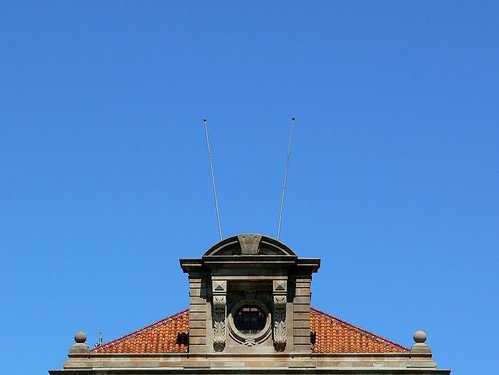
Let’s say you live in an urban environment like this.  And what you long for is the sounds of long-ago summers, and the relaxing sound of cricketsong.

Unfortunately, live crickets won’t make it very long on the mean streets of the big city. But you don’t need to pine away any longer, because today’s DIY Friday project is about making electronic crickets:

Is that too much work for you? You can always download a cricket ringtone to create that relaxing summer evening feeling whenever someone calls.

(For ourselves, we’ve already got an awesome ringtone, and we’re not parting with it.)


Water, Water Everywhere (Except Here)

Thursday, July 10th, 2008


We’ve all heard about the ice samples found by the Phoenix Mars Lander on the surface of Mars.

For the past several weeks, the Martian dirt and ice have been clutched in the scoop of the Lander’s robotic arm, in a sort of scientific Butoh dance, while NASA engineers and scientists have figured out a way to get the sample into the Thermal and Evolved Gas Analyzer (TEGA) — AKA the "analysis ovens:"

TEGA… heat[s] Martian soil so that any gases emitted can be analyzed. On its first test in mid-June, the oven being used developed a short circuit. [NASA] scientists stalled any further TEGA analysis while they were studying the problem. And now they’ve halted planned tests and moved a test of Martian ice up to the front of the line, according to Ray Arvidson, a co-investigator for the Phoenix Mars Lander’s robotic arm team and a professor at Washington University in St. Louis.

"Because of the possibility, even the remote possibility, that TEGA might go belly-up in the next sample, we wanted to go straight to ice," said Arvidson. "We cleared the pathway to get the next sample from the ice. The prudent choice is to go off and get the most important sample." 

Where did Mars’ water go, you ask? 

The two most likely possibilities are that the water was lost to space, or that it is now underground, as a huge amount of buried ice.

But Mars isn’t the only place in the solar system where evidence of water has (possibly) been found; a study published today in Nature reveals that researchers have found evidence of water molecules in pebbles retrieved by NASA’s Apollo missions on the moon, nearly forty years ago:

 Erik Hauri of the Carnegie Institution for Science in Washington had developed a technique called secondary ion mass spectrometry or SIMS, which could detect minute amounts of elements in samples. His team was using it to find evidence of water in the Earth’s molten mantle.

"Then one day I said, ‘Look, why don’t we go and try it on the moon glass?"’ Alberto Saal of Brown University, who helped lead the study, said in a telephone interview….

 What they found overturned the conventional wisdom that the moon is dry.

"For 40 years people have tried (to find evidence of water) and were not successful," Saal said.

"Common sense tell us there is nothing."

Saal’s team did not find water directly, but they did measure hydrogen, and it resembled the measurements they have done to detect hydrogen, and eventually water, in samples from Earth’s mantle.

The evidence shows that the hydrogen in the sample vaporized during volcanic activity that would be similar to lava spurts seen on Earth today.

It took the scientists nearly three years to get NASA to fund their project. The findings point to the existence of water deep beneath the moon’s surface — a radical change in the scientific understanding of our moon’s formation.

The pebbles analyzed were scattered by lunar volcanoes that erupted three billion years ago, when the moon was still a cooling hunk of magma cast into orbit by the collision of a Mars-sized asteroid with Earth, according to ABC News:

Though NASA’s Lunar Prospector appeared to have struck ice in 1999, its findings proved inconclusive. Had they been supported, scientists predicted that any water would have come from gases emitted by meteorites striking the moon….

Critically, telltale hydrogen molecules were concentrated at the center of samples rather than their surfaces, assuring Saal’s team that water was present in an infant moon rather than added by recent bombardment.

"That was not known," said William Feldman, a Los Alamos National Laboratory geophysicist who was not involved in the study.

If that water in fact came from the Earth, then planetary geologists can be certain that our planet contained water 4.5 billion years ago. That would change the dynamics of models of Earth’s formations….

Alternatively, water could have been added after the moon was ejected into space but before it cooled, raising new questions about the water’s origin.

"This opens up so many lines of study," said Saal.

More practically, the widespread presence of water beneath the moon’s surface could prove a boon to future lunar colonies, who could harvest it for breathable oxygen

Meanwhile, here on Earth, potable water is increasingly under short supply as droughts and population growth put a strain on our own water resources.

The solution increasingly is desalination plants, particularly in the Middle East, where the amount of fresh water available to each person could fall by half by 2050:

The UAE and other Gulf countries have traditionally responded to water scarcity by boosting desalination capacity. Most of the potable water in the region is produced via desalination, a process in which dissolved salts are removed from seawater.

However, earlier this year a UN official warned that GCC countries would find it increasingly difficult to continue building desalination plants at the current rate.

The region’s water consumption was so high that continuing in the same way would require significant financial investments and might prove impossible to sustain, said Dr Ahmad Ali Ghosn, the natural resources programme officer at the UN Environment Programme.

In Abu Dhabi, residents consume an average of 550 litres of water per day. If consumption levels remained this high, Gulf governments would have to spend up to US$35 billion (Dh129bn) in the next decade to finance the expansion of their desalination capacity.

In addition, water is heavily subsidised in the region, with end-users paying between five and 10 per cent of the cost. The UN estimates that GCC countries spend between US$1 and US$2 to produce a cubic metre of desalinated water.

Desalination unfortunately has several adverse effects on the environment. It is a very energy-intensive process, with desalination plants releasing large amounts of carbon dioxide into the atmosphere, which contributes to global warming.

Perhaps a water pipeline from the moon is in our future? 

French, Indian Scientists Meet in Goa

Tuesday, July 8th, 2008

Now this is the place to have a conference. 

Between the trance music, the beaches, and the all-day-and-all-night parties….  well, we can understand why management never leaps at the idea when we propose a blogging retreat there at the beginning of each new quarter.

But if you’re actually doing business in India, Goa’s a nice destination, which is why the Joint Working Group of the Indian Space Research Organisation and the French Space Agency Centre National d’Etudes Spatiales (CNES) met there this past weekend to review the progress of their collaborative projects.

Top of the agenda (besides suntanning and dancing, we presume) was the status of Megha Topiques, an Indo-French collaborative satellite project scheduled for launch in 2009 for tropical weather monitoring:

 The french-indian MEGHA-TROPIQUES satellite is devoted to atmospheric research. The data collected by the satellite will … improve our knowledge on the water cycle contribution to the climate dynamic in the tropical atmosphere and our understanding of the processes linked to the tropical convection. CNES and the Indian Space Research Organization (ISRO) will share joint responsibility for the satellite and science missions, with CNES acting as prime contractor for some of the instruments.

Megha Tropiques carries four payloads– a microwave radiometer, a humidity sounder, a radiation measuring instrument and a radio occulation sounder for atmospheric studies. Key among its tools is MADRAS, a conical scanning microwave imager developed jointly by CNES and ISRO.


The Megha-Tropiques satellite will be launched by an Indian PSLV launcher on a 800 km orbit with an inclination of 20°. 

It will be identifiable by the glowsticks attached to the satellite upon launch. </snark>

This Solar System is Lopsided

Thursday, July 3rd, 2008

If you ever felt things were a little off-kilter, now we know why:

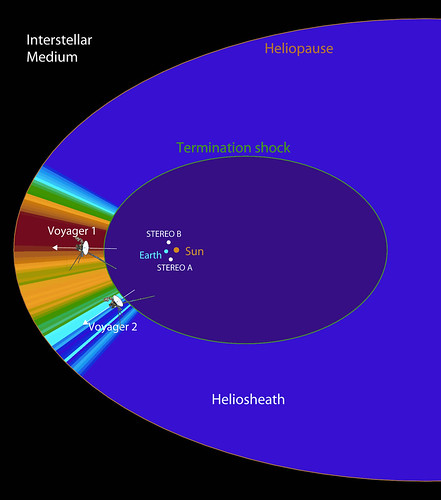
 The Voyager 2 spacecraft, which has been traveling outward from the Sun for 31 years, has made the first direct observations of the solar wind termination shock, according to a paper published in the July 3 issue of the journal Nature.

At the termination shock the solar wind, which continuously expands outward from the sun at over a million miles per hour, is abruptly slowed to a subsonic speed by the interstellar gas.

Shock waves in the thin, ionized gas — called plasma — that exists in space are similar in some respects to the shock waves produced by an airplane in supersonic flight. Shock waves in space are believed to play an important role in the acceleration of cosmic rays, which are very energetic atomic particles that continually bombard Earth.

The most energetic cosmic rays, which are potentially hazardous to astronauts, are believed to be produced in intense shock waves caused by supernova explosions — immense stellar explosions that occur in massive stars toward the end of their lives.

The termination shock is believed to be responsible for the origin of less energetic cosmic rays called "anomalous cosmic rays." The recent observations at the termination shock are expected to help physicists understand how cosmic rays are produced by the turbulent fields that exist in such shocks.

Gurnett said,"There is no way for us to make direct measure of a super nova shock, so the Voyager 2 measurements at the termination shock provide us the best opportunity in the foreseeable future to understand how cosmic rays are produced by supernova cosmic shocks."

Here’s a summary of the electric field amplitudes in the Voyager-1 1.78 kHz and 3.11 kHz PWS spectrum analyzer channels from 1992 to present: 


So what does all that mean?

You can dig into the scientific analysis here. Or, NASA’s Jet Propulsion Laboratory provides a lay explanation, as well as a much better picture:


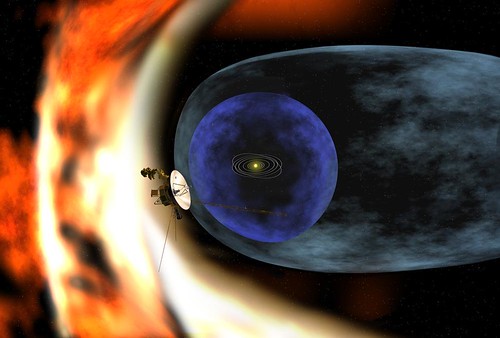
This artist’s rendering depicts NASAs Voyager 2 spacecraft as it studies the outer limits of the heliosphere – a magnetic ‘bubble’ around the solar system that is created by the solar wind. Scientists observed the magnetic bubble is not spherical, but pressed inward in the southern hemisphere, according to recent data published as part of a series of papers in this week’s (July 3, 2008) Nature. These findings help build up a picture of how the sun interacts with the surrounding interstellar medium.

Having crossed the termination shock and the edge of our solar system, Voyager now continues on; in five to seven years, it may have something equally profound to tell us about deep space.

Meanwhile, NASA’s Stereo Mission (which we blogged about here and here) has created its first images of the edge of the solar system, and its findings are equally interesting and helpful in understanding what happens at the point where the solar system meets interstellar gas:


 NASA’s sun-focused Solar Terrestrial Relations Observatory, or STEREO, twin spacecraft unexpectedly detected particles from the edge of the solar system last year. …

From June to October 2007, sensors aboard both STEREO spacecraft detected energetic neutral atoms originating from the same spot in the sky, where the sun plunges through the interstellar medium.

Mapping the region by means of neutral, or uncharged, atoms instead of light "heralds a new kind of astronomy using neutral atoms," said Dr. Robert Lin, professor of physics at the University of California, Berkeley and lead for the suprathermal electron sensor aboard the STEREO spacecraft…..

The results, reported in the July 3 issue of the journal Nature, clear up a discrepancy in the amount of energy dumped into space by the decelerating solar wind. The solar wind was detected when Voyager 2 entered the heliosheath.

Researchers determined that the newly discovered population of ions in the heliosheath contains about 70 percent of the dissipated energy from the solar wind, exactly the amount unaccounted for by Voyager 2’s instruments. The Voyager 2 results also are reported in the July 3 issue of Nature.

The Berkeley team concluded that these energetic neutral atoms were originally ions heated up in the termination shock area that lost their charge to cold atoms in the interstellar medium and, no longer hindered by magnetic fields, flowed back toward the sun and into the sensors aboard STEREO.

Would it be a bad holiday pun to call all of this a shocking discovery?

Indeed it would be a bad pun. But now it’s done.

Enjoy the Fourth!

Satcom in Uganda

Tuesday, July 1st, 2008

We’ve written extensively about efforts to connect Africa with the digital world (see Com in Africa: A Changing Marketplace, A Pan-African E-Network, With India’s Technology, and Which Satellites Aid Oil Exploration in Africa?, for examples).

Now, East and Southern Africa are about to be connected to the global internet pipeline by undersea cable, and terrestrial networks are rapidly expanding in major towns.

But what about the more remote nations of Africa, such as Uganda, home of the Bwindi Impenetrable National Park?


Like Nigeria, Uganda relies upon satellite for its principle mode of digital communications

Satellite transmission remains the most apt mode of digital communication in Uganda and much of Africa where spotty infrastructure and geographical isolation still pose a formidable challenge to the deployment of fibre optic cables, according to an official from Afsat Communications ltd.
 
Afsat is Africa’s largest provider of Very Small Aperture Terminal, (VSAT) based internet services. At a June 19th media presentation in Kampala on the potential of satellite technology in bringing internet access, Afsat’s General Manager Job Ndege said VSATs were still the best and cost efficient means of bringing the Ugandan masses access to internet.

Currently Afsat is marketing its services in Uganda under the brand name iWay Africa and connects its clients to: “fast, reliable, efficient and cost effective broadband intenrt” and “Tailor designed and highly available intra-corporate connectivity solutions.”

The company is present in 28 sub-Saharan African countries and has installed about 5200 VSATs on both the broadband and intra-corporate platforms. Lately there has been a lively debate among the ICT industry analysts, policy makers and academics on the relevance of VSATs in the wake of efforts, now in advanced stages, to connect East and Southern Africa to the word’s fibre optic network.

Monitor Online has a good interview with Afsat’s Job Ndege, who notes that VSAT is immune to the problems of poor infrastructure "because it is possible to have a VSAT system that completely bypasses the local infrastructure.
This is a key advantage of VSAT as compared to other technologies."

For delivery of the digital connection, Afsat’s iWay Broadband utilizes the Intelsat 10 (IS-10) and NSS-7 satellites. 

Exclusivity

Thursday, June 19th, 2008

Earlier this week, we wrote about the proposed Sirius/XM merger moving closer to reality.

Once the merger is complete, new chipsets will need to be produced so both XM and Sirius can be received. ST Microelectronics, which makes chips for both, is one company that should benefit from the merger:  

The Department of Justice’s stamp of approval on the proposed Sirius/XM Radio merger this week is good news for semiconductor suppliers, according to industry watchers. With only the Federal Communications Commission yet to green-light the union (which could happen in as quickly as a month, according to published reports) the merger will mean a boost in chip sales as radio suppliers scramble to make their receivers compatible with both satellite systems….

The DoJ approval could also spike demand for satellite radios now that consumers have reason to hope the merger will go through. Prospective customers have been sitting on the fence until now, reluctant to be caught in the same boat as HD DVD owners, who backed the wrong horse….

Chip-maker ST Microelectronics should fare well if the merger is approved. The company is the sole provider of XM’s baseband chipset and one of a pair of suppliers of Sirius baseband chipsets. ST also delivers tuners for both systems and expects to continue supplying hardware companies with the same components when radios have to receive signals from both services’ existing satellites.

If the new Sirius decides to integrate the baseband and tuner on a single chip, ST will be in the enviable position of being able to do so with a minimal learning curve, according to Michael Kasparian, market development manager for the automotive business unit at ST. However, he said, a redesign into a single baseband chip will require retooling, because the two basebands are currently worlds apart. That kind of overhaul, however, is typical in the dynamic consumer electronics product cycle, although getting the new chip spec from Sirius could take up to a year after FCC approval. "We’d be talking about a 65-nanometer CMOS process for the baseband chip," he said. "If it takes longer to get the design, we may be to 45-nanometer." 

The article above got us to wondering: what will happen to all those exclusive deals that Sirius and XM have signed with various manufacturers?

Will the Lamborghini Murciélago lose some of its exclusive appeal if it’s double-dating both radio providers?


After all, it’s just today that Automobili Lamborghini S.p.A announced that it will "offer SIRIUS as its exclusive satellite radio provider in Lamborghini vehicles. The first Lamborghini to include SIRIUS as standard factory installed equipment will be the Murcielago beginning with the 2009 model year in the U.S." 

Will such exclusive deals lower the value of this?

Or reduce the appeal of the Sirius-equipped 2008 Ford Expedition Funkmaster Flex Edition?

For now, the nouveau rich muscle car driver who wants their XM has to turn to Ferrari.

Tough choice, eh? 

Somehow, we don’t think these exclusive deals will matter much to the sales of such super cars. Those who can afford them can probably afford an aftermarket chip retrograde.

But it will be a little less exclusive, won’t it? 

Sirius-XM Deal Moves

Tuesday, June 17th, 2008


The proposed merger between satellite radio giants XM Satellite Radio and Sirius Satellite Radio seems closer to becoming a reality, following Federal Communications Commission Chairman Kevin Martin statement yesterday that "with the voluntary commitments [the companies have] offered, on balance, this transaction would be in the public interest." Martin asked for a total of eight concessions, including lifting restrictions on the hardware that is able to transmit the enlarged company’s broadcasts, and opening some channels to noncommercial and minority-owned broadcasters.

BusinessWeek has some analysis on how the FCC-imposed concessions may actually help Sirius and XM, and expand the reach of satellite radio:

 Some merger conditions may even help the combined company achieve its goal of reviving growth, which has slowed in recent months. Take the seemingly major requirement that the companies allow any hardware manufacturer to make and sell satellite radio receivers. This would appear to make it easier for consumers to choose between satellite radio, HD radio, music players, and other rival formats. Yet looked at another way, with satellite radio no longer limited to stand-alone devices, it might find its way into more gadgets, such as phones and music players. That, in turn, could widen satellite radio’s distribution. What’s more, Sirius and XM may be able to save money by no longer having to subsidize satellite radio players, as they do now.

Consider the requirement that Sirius-XM make 24 channels available for noncommercial and minority programming. "That can create demand for these users to sign up for the service," says James Goss, an analyst at Barrington Research. Yes, the condition means the two companies must get rid of about 8% of their current programming—but analysts estimate there’s as much as a 50% overlap between the XM and Sirius program lineups anyway. What’s more, by giving away 24 channels, Sirius-XM also may save on programming fees. "If anything, it should save Sirius-XM money," says April Horace, an analyst at Janco Partners.

Martin’s statement doesn’t mean the deal is done, however; "Martin needs at least two other commissioners to vote for the deal, and FCC sources tell BusinessWeek.com he hasn’t yet been assured he’ll get those votes."  And as a letter writer to the Wall Street Journal observes, there’s plenty of precedent for long delays from the FCC: 

[B]y FCC standards, the 400-plus days that the XM-Sirius matter has been languishing before the agency is not very long. Delay has been a serious problem at the FCC for as long as the agency has been in existence….

Just this month the FCC acted to affirm an action by its staff that was taken six years ago denying an extension of time for construction of a radio station that had originally been authorized in the early 1980s but had never been built. The six-year delay in taking action that the FCC, expert agency that it is supposed to be, should have [taken] six days, or at most six weeks.

And the LA Times reports that Martin’s conditions haven’t satisfied the merger’s fiercest critics: 

Two leading consumer advocates blasted the proposed conditions as failing to ensure that satellite radio prices won’t eventually rise. And Martin, a Republican, may have trouble pushing his proposal through the FCC….

Despite intense opposition from the National Assn. of Broadcasters, which represents traditional radio stations, the Justice Department approved the merger in March. Antitrust regulators agreed with Sirius and XM executives that their combination would not create a monopoly because iPods and other devices give people growing options for listening to music in their cars and elsewhere.

But Martin had said the merger faced a high hurdle at the FCC, which, to ensure competition, barred any future merger when creating satellite radio in 1997. Martin has pushed Sirius and XM to formalize some pricing promises made to lawmakers and agree to other conditions.

The companies first announced their intended merger, now valued at about $3.85 billion, in February 2007.

Super-Earths Galore!

Monday, June 16th, 2008

Just how common are Earth-like planets in the universe?

About five times more common than previously thought, according to European researchers presenting their latest findings at a conference in France today:

European astronomers on Monday said they had located dozens of giant planets in three distant solar systems.

The discovery suggests that at least one third of stars similar to our own Sun harbour such planets, multiplying previous estimates by five.

A trio of these ‘super-Earths’ — so-called because they are several times the mass of our own planet — were detected orbiting a star known as HD 40307 some 42 lights away.

Reuters has additional details: 

The [three] planets are bigger than Earth — one is 4.2 times the mass, one is 6.7 times and the third is 9.4 times.

They orbit their star at extremely rapid speeds — one whizzing around in just four days, compared with Earth’s 365 days, one taking 10 days and the slowest taking 20 days.

The first planet outside our solar system was detected in 1995, and less than 280 of these exoplanets had been found before today’s unveiling of 45 new exoplanet discoveries.

The astronomers used the High Accuracy Radial velocity Planet Searcher— or HARPS — to spot the planets. The next-generation HARPS spectrograph is used in conjunction with the 3.6-m telescope at La Silla observatory in Chile


La Silla is a 2400-m mountain, bordering the southern extremity of the Atacama desert in Chile. It is located about 160 Km north of La Serena. Its geographical coordinates are: Latitude 29º 15′ south & Longitude 70º 44′ west.

Originally known as Cinchado, the mountain was renamed La Silla (the saddle) after its shape. It rises quite isolated and remote from any artificial light and dust sources (astronomy’s worst enemies). La Silla was the first ESO observatory built in Chile. 

The ESO press release also has additional information on these exciting, extra-solar discoveries.

Analog Deathwatch: Day 250

Thursday, June 12th, 2008

Are your bunny ears rapture ready?


Readers of Really Rocket Science know that on February 17, 2009, the era of analog television broadcasting will come to an end, and the nation’s full-power television station will have completed their transition to all-digital broadcasting systems.

Some folks call that the DTV Transition. We prefer the term Analog Deathwatch, and over the next seven months, we’ll be bringing you semi-regular updates on the end of the analog age. 

So, back to your rabbit ears. If they’re going to enter the new world of digital TV, you’ve got to prepare. 

The Consumer Electronics Association (CEA) and National Association of Broadcasters (NAB) have had a site up for a while, to walk consumers through the need to perk up some new ears. And we’ve already given you a DIY project to get cheap DTV reception via your PC.

Now come reports that the Dish Network is about to begin selling its own converter box for $40: 

The new DTVPal Digital Converter from Dish Network is a digital off air converter which converts over the air digital broadcasts to an analog format your older analog televisions can display. The new DTVPal is made by Echostar for Dish Network and is getting ready to hit the streets.

Read the full review quoted above. The Dish converter may end up costing $59, but the price is not final.

Thanks to the Federal Government’s $40 coupon program, designed to soften the economic blow of new bunny ears, that works out to just $19 each.  (Get your coupon here.)

Of course, not everyone is yet aware of the coming analog armageddon.  Neilsen’s research indicates that the hispanic market — which relies disproportionately on over-the-air broadcasting to receive TV transitions — hasn’t been getting the message from the FCC about the coming transition.

That’s why Univision has launched "Escuadrón Digital" (Digital Squad), a grassroots and on-air initiative using a one-on-one approach to ensure viewers are informed and prepared for the DTV transition in February 2009.

In Phoenix, for example, KTVW Univision 33 last weekend celebrated its first Grand Digital Television Fair to help local residents better understand the transition to digital television (DTV).

Phoenix, by the way, was one of the featured markets in a webinar on DTV transition and how it will affect local broadcasters last month. You can play back the webinar here.

Satellite Broadband, Down Under

Tuesday, June 10th, 2008


With summer almost here in the northern hemisphere, our thoughts are turning to long afternoons and evenings spent around the barbecue and the neighborhood pool.

But in the southern hemisphere, of course, it’s the winter solstice that is approaching on June 21st. That means long nights at home, waiting for warmer weather — and brighter days — to return.

The good news for southern hemisphere residents, however, is that internet via satellite is often far cheaper than it is here. That means that they can surf the night away while still squirreling away enough cash to make it through winter.

In New Zealand, for example, Internet via satellite can now be had for as little as $38 a month:

Satellite broadband wholesaler Bay City Communications is launching a rural broadband service, called Rocket Broadband, today.

The IPSTAR satellite, owned by Thaicom, covers all of New Zealand, says Bay City managing director Tony Baird.

The company is offering three plans — Explorer, Discovery and Voyager. At $49.95 (excluding GST) per month, the Explorer plan offers a 256Kbit/s downlink and 128Kbit/s up, with a 500MB data cap…..

Across the Tasman, the Australian government’s Broadband Guarantee Program offers eligible consumers access to subsidised broadband with a guaranteed minimum level of service. The Australian government pays $2,500 per installation of the satellite broadband and that has greatly helped uptake over there, says Phil Cross, business development manager of IPSTAR Australia.

The article cites the advantages that satellite broadband can bring to rural residents, such as "reduced fuel costs and time savings thanks to online banking and online shopping… social inclusion and the ability to network online, do email and participate in video-conferencing, as well as distance education and research online for school children." Bay City and IPSTAR are also making life better for New Zealand’s farmers.

IPSTAR uses spot beams to improve efficiency of their services:


 The IPSTAR system is comprised of a gateway earth station communicating over the IPSTAR satellite to provide broadband packet-switched communications to a large number of small terminals with network star configuration.

A wide-band data link from the gateway to the user terminal uses an Orthogonal Frequency Division Multiplexing (OFDM) with a Time Division Multiplex (TDM) overlay. These forward channels employ highly efficient transmission methods including Turbo Product Code (TPC) and higher order modulation (L-codes) for increased system performance.

In the terminal to gateway direction or return link, the narrow-band channels employ the same efficient transmission methods. These narrow-band channels operate in different multiple-access modes based on bandwidth usage behavior, including Slotted-ALOHA, ALOHA, and TDMA for STAR return link waveform.  

There’s no doubt that satellite internet has plenty of room to grow in remote New Zealand and the wide-open spaces of Australia. And it’s growth that IPSTAR is likely to achieve, with clever ads like this one propelling their marketing strategy in the far east:


As well, Australia’s Broadband Guarantee Program (mentioned above) provides a steady source of revenues for expanding satellite broadband.  

Whether such a program ever takes hold in the United States depends on the outcome of the net neutrality debate. And with the heat of summer getting to us here, it’s unlikely that that debate will stop raging anytime soon.