Author Archive

China Launches Zhongxing-9

Monday, June 9th, 2008
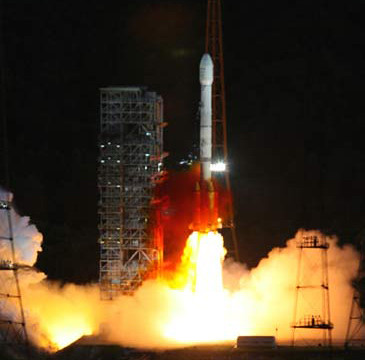
China announced today the launch of its new communications satellite, Zhongxing-9, from the Xichang Satellite Launch Center in the southwestern Sichuan Province.

The bird went up at 8:15 p.m. Beijing Time on Monday:

The satellite was shot into space aboard the Long March-3B rocket carrier. It was the 107th launch mission for the Long March series of carrier rockets….

The China Great Wall Industrial Corporation (CGWIC), the contractor of the satellite launch, signed the launch service contract with China Satcom in November 2005.

As the only company engaged in international commercial satellite launching services, CGWIC has launched 34 foreign satellites for 28 services.

Zhongxing-9 was built by France-based Thales Alenia Space for China Satcom, which plans to use it for live television broadcasts of the Beijing Olympic Games in August.

The launch of  Zhongxing-9 may help rural residents of China get a clearer picture of the Olympics, but other networks are getting increasingly worried about just what they’ll be able to broadcast to the rest of the world:

 Television networks that will broadcast the Beijing Olympics to billions around the world are squaring off with local organizers over stringent security that threatens coverage of the games in two months.

Differences over a wide range of issues — from limits on live coverage in Tiananmen Square to allegations that freight shipments of TV broadcasting equipment are being held up in Chinese ports — surfaced in a contentious meeting late last month between Beijing organizers and high-ranking International Olympic Committee officials and TV executives — including those from NBC.

In response to the complaints from broadcasters, Sun Weijia, head of media operations for the Beijing organizers, asked them to put it in writing, only to draw protests about mounting paperwork.

The CBC has more about TV execs’ mounting worries:

In a meeting with Chinese officials held in Beijing on May 29, nine media organizations that have paid for the rights to broadcast the Olympics were told there’s unlikely to be live coverage from Tiananmen Square or the Forbidden City.

This is a change from two months ago when International Olympic Committee officials in Beijing said China had agreed to allow live coverage.

Broadcasters have been denied permits to record aerial views of the two sites for media coverage of the Games, which begin Aug. 8.

"For us to potentially not be able to do live reports from Tiananmen — the most iconic place in China — is a disgrace," said Scott Moore, executive director of Canada’s CBC Sports. "I’ve been told that to do business in China, you have to have patience. We don’t have time to have patience. The Games have begun for us already."

It should be interesting to see how the Olympic broadcasting — which sounds like an event in and of itself — will play out.

One thing is for certain: it doesn’t matter how good your satcom broadcasting capability if you can’t get the shot you want to broadcast in the first place.
 

XH-150 Returns to Seattle

Tuesday, June 3rd, 2008

Longtime readers here at Really Rocket Science know that we’re always impressed with next generation technology.

Today, this press release from AFS Trinity Power Corporation caught our eye: 

 Two XH-150 prototypes are returning this week to the Seattle area after being unveiled at the North American International Auto Show in Detroit and then traveling to cities across the U.S. to demonstrate the car to carmakers, government officials and the driving public, including a ride-and-drive demonstration on Earth Day for members of Congress in the Nation’s Capital.

Road tests of the XH-150 at Michelin’s Laurens Proving Grounds in South Carolina prior to the Detroit unveiling demonstrated extreme fuel economy without sacrificing performance. Test reports indicated the XH-150 traveled 41.9 miles without burning an once of fuel in a mixed urban/highway driving cycle, achieved all-electric highway speed of 87 MPH, accelerated faster to 60 MPH than comparable gasoline-only models (11.6 seconds) and, in full hybrid mode, delivered zero to 60 in just 6.9 seconds.  Along with dramatically reducing vehicle emissions, the XH-150 is expected to significantly reduce the cost of operating a car. It uses only one dollar of off-peak electricity to provide enough power for the average driver’s 40 miles of daily driving and can achieve 150 miles per gallon during a typical 340 mile week. No other hybrid or plug-in hybrid of which AFS Trinity is aware has demonstrated the ability to achieve such fuel economy, range,  highway speed and acceleration.

The Governor of Washington, along with local and state officials, will be tooling near South Lake Union in Seattle today to celebrate the homecoming of the incredible vehicle.


So what’s it like? Check out these videos and these images for more on just how normal the future actually looks.

Blogging at 300 KM/H

Monday, June 2nd, 2008

No, the title of this post isn’t a reference to the velocity of our Kerouacian prose — it’s what you could be doing if you took a train between Paris, Brussels, Amsterdam and Cologne:


 The first commercial application of the European Space Agency (ESA) “Broadband on Trains” initiative officially launched May 14 on six high-speed Thalys trains… Passengers on the trains equipped with “Thalysnet” have continuous Internet connectivity while traveling at 300 km/h via a satellite 36,000 km above the trains.

The satellite link uses a low profile tracking antenna on the train to provide a two-way connection to the Ku-band satellite system and a hub station connected to the Internet backbone. Terrestrial wireless is used to maintain a connection when the train is traveling through tunnels. The total bandwidth from the satellite shared among users on the train is 2 Mbps down and 512 Kbps up. Bandwidth across all trains in the fleet is allocated on demand according to the usage level.

The tracking antenna truly is low-profile. If a train passes you at high speed, you’d be hard pressed to see the little nub whizzing by you:


The ESA initiative to bring broadband to trains started nearly two and a half years ago; as of May of this year, Thalysnet is officially and commercially available to train passengers

Thalysnet… was developed by a consortium lead by Nokia Siemens Networks, which combines satellite communications with conventional wireless data technologies to provide a continuous Internet connection on board trains travelling across national borders at 300 km/h. One of the companies in the consortium is the UK-based 21Net, which carried out a pilot project in 2005 under the European Space Agency’s Broadband to Trains initiative.

21Net worked with leading railway operators such as RENFE (Spain) and SNCF (France), along with Thalys, to develop a solution combining bi-directional satellite communications with terrestrial wireless technologies.

With soaring gas prices leading to an increase in public transport usage here in the US, could an American equivalent of Thalysnet be far behind? 

Phoenix: Day Two on Mars

Tuesday, May 27th, 2008

The big news of the holiday weekend was, of course, the successful landing of the Phoenix Mars Lander at 7:53 pm Eastern time on Sunday — a landing which we previewed two weeks ago.


There was only one minor snag reported in the challenging landing: the protective sheath around the trench-digging robotic arm failed to unwrap all the way after touchdown. The sheath now covers the arm’s elbow joint, but NASA describes that as merely an "inconvenience."

The excitement behind the successful landing was evident. Maybe it was because of the slow holiday weekend, but the landing was big news in the mainstream media — not just among space buffs– with the Drudge Report parking a headline most of the day on Sunday and Monday that asked if Phoenix would find evidence of life on Mars as it explored the planet’s arctic plain.  

Since the trench-digging arm that Phoenix will use to collect the soil samples that might contain traces of organic compounds won’t be extended until possibly tomorrow, the answer to the Drudge Report’s questions is clearly "not yet."

But already, Phoenix has sent back some amazing pictures and videos of the Red Planet’s polar region:

  • The Mars Reconnaissance Orbiter snapped this dramatic photo of the Phoenix Lander suspended beneath its parachute as it descended to Mars on Sunday. (For an explanation of how the Orbiter snapped the photo, watch this video.)
  • Here’s a good video from inside the Jet Propulsion Laboratory as Phoenix touched down, showing the excitement and anxiety inside mission control.
  • Check out this photo of where Phoenix landed (in the Vastitas Borealis region) as well as this animation showing an orbital view sweeping upward from Olympus Mons, the tallest volcano in the solar system, to the flat terrain where Phoenix touched down.
  • A bevy of raw images from the Red Planet (in black and white) are available here.
  • How do the images and video come back to earth? NASA explains.
  • More videos and animations of Phoenix are available here.

All in all, NASA has outdone itself in providing information to the public over the web for the Phoenix mission — and done an incredible job of packing that information in a compelling way.

The next press briefing on the mission is set for 1 pm Eastern today. Also check out the Phoenix Landing blog for more updates.

DIY Friday: Build Your Own Multitouch Interface

Friday, May 16th, 2008


At Maker Faire earlier this month, the $500 Open-Source Multi-Touch Table was deemed by Popular Mechanics as one of "5 Garage Inventions That Might Outperform Their Big-Name Predecessors … at Half the Cost:"

We’ve followed the next generation of hands-on computer interfaces all the way from the labs to Jeff Han’s wall-mounted display for CNN and the CIA, from the hype surrounding Microsoft’s Surface to the reality of the touchscreen table arriving in AT&T stores. And while we were disappointed that Eyebeam’s much-ballyhooed, open-source Cubit device didn’t end up making it to Maker Faire, this “happy accident” from four geek colleagues more than made up for it. In about three combined day’s worth of tinkering after work at a computer-graphics firm in the movie industry, DeRose teamed with his son and software engineers Josh Minor, Brendan Donohoe and Rudro Samanta to turn an Instructables project into a laptop-powered version of Surface—for 500 bucks (including $100 in maple for the table itself, plus the computer and a projector). “It’s a cool little recipe,” DeRose says of the DIY hardware, which uses cheap LEDs for basic functionality ranging from a music sequencer to Pong—though not much else. 

The potential for multitouch surface interfaces is huge. Microsoft is pouring money into development of its version, while Apple is planning on expanding its iPhone interface to a broader range of its product offerings. 

But why wait when you can make your own DIY mini MTI?

Also check out other MTIs at the NUI Group website, which includes alternate instructions on how to make a cheap (but effective) MTI

Mars Madness is Building

Thursday, May 15th, 2008

Mars Madness is on the rise in Tucson, the Arizona Daily Star reports. That’s because on May 25th, NASA’s Phoenix Mars Lander is scheduled to touch down on the red planet. The event is significant in Tucson because the University of Arizona’s Lunar and Planetary Lab team is leading the mission’s science and built some of the instruments.

But the fever is spreading well beyond Arizona for this risky mission:

Fewer than half of attempts to land on Mars have succeeded, but planetary scientists leading the Phoenix Mars mission are cautiously optimistic. So far, all looks good, they say.
Public events to celebrate the landing are planned for at least 110 sites around the world, including London and Paris. There’s even a virtual landing bash planned, in Second Life, which is a virtual social world on the Internet.

Just how risky and difficult is it to put a lander on the surface of Mars? To answer that question, check out this excellent video from NASA’s Jet Propulsion laboratory. (NASA has done a fantastic job promoting the mission and landing in the style of a summer movie blockbuster):

The Phoenix Mars Mission website provides additional detail:

At 125 km (78 miles) above the surface, Phoenix will enter the thin martian atmosphere. It will slow itself down by using friction. A heat shield will protect the lander from the extreme temperatures generated during entry. Antennas located on the back of the shell which encases the lander will be used to communicate with one of three spacecraft currently orbiting Mars. These orbiters will then relay signals and landing info to Earth.

After the lander has decelerated to Mach 1.7 (1.7 times the speed of sound), the parachute is deployed. Shortly after the parachute is deployed, the heat shield is jettisoned, the landing radar is activated, and the lander legs are extended. The lander continues through the Martian atmosphere until it comes within 1 km (.6 miles) of the Martian surface. At this point, the lander separates itself from the parachute. It then throttles up its landing thrusters and decelerates.

When Phoenix is either at an altitude of 12 m (39 ft) or traveling at 2.4 m/s (7.9 ft/s), the spacecraft begins traveling at a constant velocity. The landing engines are turned off when sensors located on the footpads of the lander detect touchdown.

As we’ve mentioned, only half of all international attempts to land on Mars have succeeded. Back in 1999, the Mars Polar Lander (MPL) went missing as it entered Mars’s atmosphere, and its fate has been a mystery ever since. But now there is a chance for a member of the public to locate the missing spacecraft and help work out what went wrong, thanks to a new "Spot the Spacecraft" challenge

The High-Resolution Imaging Science Experiment (HiRISE), based at the University of Arizona in Tucson, has a raft of images of the MPL’s projected landing area, but scans of the huge images came up blank.

So now, the HiRISE team’s blog has published 18 images, and has challenged the public to find the lost lander.

Can you find the MPL? The images can be viewed here

We’ll report more on the landing of the Phoenix Mars Lander after the 25th. 


Texting Hubble

Tuesday, May 13th, 2008


Really difficult to send a text from up here with these gloves on…..

Here’s an interesting tidbit from England:

 Text messaging is almost five times more expensive than receiving information from the Hubble Space Telescope, research has indicated.

A typical text costs 5p so if you send one megabyte of data by text – equivalent to 7,490 messages – it will cost around £375.

However, a researcher found that if you send one megabyte of data from the Hubble telescope, which is 370 miles into space, it costs a relatively cheap £85.

If you divide £85 by the number of messages in a megabyte, the equivalent cost of sending a text from the space telescope is just over 1p.

Scientist Dr Nigel Bannister, of Leicester University, worked out the figures and said they showed mobile phone users were paying far too much to text….

He said: "The bottom line is texting is at least four times more expensive than transmitting data from Hubble – and is likely to be substantially more than that."

Our first reaction to Dr. Bannister’s (personal webpage here; University of Leicester here) research was one of profound skepticism. Maybe it wasn’t quite apples to apples to compare data transmissions from Hubble with SMS messages. And surely, we thought, he neglected to include the astronomical (no pun intended) costs of Hubble’s Control Center, for example, which runs four rotating flight teams from Space Telescope Operations Control Center (STOCC) at NASA’s Goddard Space Flight Center in Greenbelt, Md.

Nope, says Dr. Bannister:

He said the mobile phone prices looked even more "astronomical" when you considered that he had added all the costs of staff and processing to the price of the Hubble data transmission.

Without those extra costs, the amount of data in a text could cost as little as 0.1p.

We’re still not convinced, but the low cost of texts may explain why Hubble keeps poking us so freely on Facebook.

(More info on Hubble can be found here.)

Your Name in Space

Monday, May 12th, 2008

So you’ve bought your little corner of the universe through the International Star Registry, but you want more to give yourself a chance at immortality.

After all, in 5 billion years, when our sun is in its last throes, the name of your star won’t be worth the paper its printed on, because the paper itself will be incinerated.

What you want is a record for someone else — or something else — to find, an intergalactic message in a bottle that says, I was here.

Now, thanks to NASA and the Kepler mission, you can have just that:

Finally, the chance for your name to be carried into space has come.

When the Kepler Mission rockets away from Earth, a DVD containing perhaps millions of human names will be on board.

"This mission will provide our first knowledge of Earth-like planets beyond our solar system," said Kepler Mission principal investigator William Borucki.

The Kepler Mission is scheduled for launch in February 2009 from the Kennedy Space Center in Florida. There is no limit to the number of names that can be submitted, officials said.

At the end of this year – in November – the Name in Space DVD will be mounted on the exterior of the spacecraft. A video of the DVD being mounted on the spacecraft will be taken and posted on the Kepler Mission Web site before the spacecraft is shipped to NASA’s Kennedy Space Center in December.

"It’s a way for the public to participate in our space program," said David Koch, deputy principal investigator for the Kepler Mission. "We’re looking for several million names. … The only limitation is people’s interest."

A copy of the DVD with all of the names and messages will also be given to the Smithsonian Institution’s National Air and Space Museum in Washington, D.C.

You can submit your name for free on the Kepler Mission website, where you can also learn more about the spacecraft and the mission:

The Kepler photometer is a simple single purpose instrument. It is basically a Schmidt telescope design with a 0.95-meter aperture and a 105 deg2 (about 12 degree diameter) field-of-view (FOV). It is pointed at and records data from just a single group of stars for the four year duration of the mission. …

An Earth-trailing heliocentric orbit with a period of 372.5 days provides the optimum approach to meeting of the combined Sun-Earth-Moon avoidance criteria within the Boeing D2925-10 (Delta-II) launch vehicle capability (launch videos). In this orbit the spacecraft slowly drifts away from the Earth and is at a distance of 0.5 AU (worst case) at the end of four years.  Telecommunications and navigation for the mission are provided by NASA’s Deep Space Network (DSN).

And for a better understanding of the craft your name will eternally be sailing (or at least drifting) upon, check out the video above from YouTube.

Panasonic to Pursue Broadband at 35,000 Feet

Thursday, May 8th, 2008

We’ve long been fans of inflight broadband, ever since Ed blogged two years ago about his experience watching TV at 35,000 feet while  reflecting on the use of Connexion by Boeing.


Way back in September of 2006, when Boeing shut down Connexion, we reported that Panasonic was looking to get onboard with inflight broadband. It took them longer than we expected to book their flight, as it were, but now Panasonic and Intelsat have announced that they are teaming up to bring broadband to air travelers:

Panasonic, known for delivering state-of-the-art in-flight entertainment technology, is introducing an advanced satellite transmission platform that will allow airline passengers the ability to access Internetbased information and entertainment. The service, Panasonic eXConnect, provides passengers Internet connectivity.

The platform will leverage Intelsat’s existing GlobalConnexSM Broadband service that is available on Intelsat’s global fleet of 53 in-orbit satellites, and regional teleport facilities. By utilizing Intelsat’s existing infrastructure, Panasonic will be able to introduce eXConnect in key regions around the world, providing an efficient and cost-effective means to scale the network capacity as demand grows.

Panasonic eXConnect enables two-way broadband connectivity that provides a wide range of applications useful to both the passengers and crew such as VPN, live TV, shopping, streaming media, tele-medicine, operational applications and personal devices integrated to the airline’s in-flight entertainment systems. With data rates comparable to ground public WIFI hotspots, eXConnect offers airlines the opportunity to further differentiate their in-flight product with a valuable service to their passengers.

ARINC is also working to put a wifi cloud up there with the regular puffy whites. They introduced their own inflight broadband service in Germany back in March

ARINC’s Oi connectivity enables passengers to surf the Internet (by the hour, day, or flight leg), access e-mail during flight, chat over Instant Messenger, watch real-time news and sports flashes, hear bulletins—all on their own personal laptops. They can even watch and download the latest Podcasts. ARINC’s Oi technology makes optimum use of Inmarsat Swift satellite communication services.

Passengers merely switch on their PCs and can connect instantly via a wired or wireless cabin backbone to the Oi Web Portal. The Portal is fully customized to each airline’s requirements, supporting a combination of free view or paid applications. Oi will feature a range of price points to suit most budgets, and ARINC expects webmail prices will be under US$10 a flight, with larger attachments requiring an extra charge.

$10 bucks really isn’t that bad for email access per flight leg, considering Sebadoh recently shelled out $3 for a mere half ounce of peanuts that lasted about 2 minutes. 

What about the other services we’ve blogged about in the past, like the Row 44 platform being pursued by Alaska Airlines? We hear Row 44 is moving up, but it’s not yet full.

BBC, ITV to Launch Freesat

Tuesday, May 6th, 2008

How much does the satellite TV subscription cost you?

In the UK, viewers will soon be able to answer "nothing," with the long-awaited release of Freesat, a digital satellite TV service from the BBC and ITV that is rolling out with more than 80 TV and radio channels. (That number is expected to rise to 200 by the end of the year.)

The full dish, as it were: 

Freesat will be available to 98% of UK homes, including those who currently cannot receive Freeview, which is broadcast via terrestrial transmitters and aerials.

Customers will have to make a one-off payment for a digital box, satellite dish and installation.

Viewers will need an HD-ready TV in order to view high-definition programmes.

Millions of people have already got HD-ready TV sets, but until now have not been able to access HD programmes for free.

Could such a free service be made available in the North American market? Bell Canada is contemplating it

 Bell Canada, which operates the Bell ExpressVu satellite service, says it is exploring a proposal to give Canadians "free" access to a limited number of high-definition channels.

Dubbed "FreeSat," Bell said yesterday the offer would be ideal for consumers who are eager to access local HD stations but wary of paying subscription fees to television service providers.

"Bell ExpressVu believes that we can provide a service whereby we carry a certain number of high-definition signals from each of the major national and regional networks on our satellites," Gary Smith, president of Bell Video Group, told the federal broadcast regulator yesterday. "All they (consumers) would need would be the reception equipment."

The front-end cost of that receiver was not specified. Bell executives, however, made it clear that "free" access would be restricted to local over-the-air signals and would not include specialty or "pay-TV" networks.

Smith said FreeSat would also be a boon to conventional broadcasters because it would allow them to avoid "huge investments" in new transmission towers and distribution systems to carry those high-definition signals across the country.

The Canadian Radio-television and Telecommunications Commission has set 2011 as the deadline for television channels to be broadcast in high-definition digital, and networks around the country are scrambling to meet that deadline.

Meanwhile, back in Britain, BSkyB is not taking the threat of Freesat to their subscription base lying down. They recently lowered prices to preempt the competition:  

BSkyB will not stand by and let Freesat take its market. As we report this week, the broadcaster has already reacted by reducing the price of its HDTV box. And BSkyB has the ability to target customers at the low end of the market beyond its £150 (US$297.63) “Freesat from Sky”. Its Sky Pay Once service is now available as a standard product after a successful trial last year.

For a one-off payment of £75, BSkyB provides a free four-month subscription to four of its six basic-tier television channel packages along with a set-top box, dish, viewing card and standard installation. This compares favourably to a basic Freesat box and installation, which will start from about £130.

So will Freesat steal huge market share from paid services? It’s possible, but not necessarily a given. The demand for premium channels, after all, has led millions of people around the globe to pay for broadcasting via satellite or cable despite it being available (mostly) for free over the air.

Nonetheless, on the margins, it will be interesting to see how Britons respond to the availability of Freesat.