Author Archive

Unplugging Propaganda

Thursday, January 17th, 2008

In today’s media-saturated world, even extremists have PR campaigns.

Because winning hearts and minds requires reaching as many eyes and ears as possible, it’s little wonder that satellite operators sometimes find themselves inadvertently in the midst of the battle against militant extremists.

The latest incident involves Thaicom and Hezbollah

Satellite operator Thaicom has terminated broadcasts by a Lebanese television channel, al-Manar TV, after learning it was backed by the Shiite militant group Hezbollah. Shin Satellite, which owns Thaicom, pulled the plug on al-Manar TV on Monday.

The satellite had been broadcasting test transmissions for the station.

The abrupt cancellation followed a report by the Israel-based Intelligence and Terrorism Information Center (ITIC) a few weeks ago that a Thai communications satellite, Thaicom, was transmitting al-Manar, to a vast audience.

Thaicom broadcasts to most countries in Asia as well as to Australia, Africa and central Europe.

US counter-terrorism specialist Andrew Cochran said ITIC reported that al-Manar raised funds for Hezbollah through advertisements broadcast on the network and an accompanying website that requested donations for the terrorist organisation.

Al-Manar has also provided support to Palestinian terrorist organisations, including the Palestinian Islamic Jihad (PIJ) and al-Aqsa Martyrs Brigade. It was known to have transferred tens of thousands of dollars for a PIJ-controlled charity, he said.

The report from the Intelligence and Terrorism Information Center in Israel details the sequence of events that led Thaicom to being alerted to the issue and canceling the broadcast. The report can be read here. Wired also reports on the incident.

This isn’t the first time that Al-Manar has crept its way onto western satellites. Way back in August of 2006, we blogged about how one guy on Staten Island built an HDTV uplink in his back yard to distribute Al-Manar via satellite. And last year, Intelsat had its own embarrassing situation in Sri Lanka.

With the proliferation of satellite channels and capacity, we’re likely to see such incidents continue into the future.

More Satcom Internet in Europe

Tuesday, January 15th, 2008

Last week, we wrote about ViaSat and Eutelsat teaming up to offer new broadband capacity via Ka-band, and the impact the joint effort may have on internet satellite offerings in the United States and Canada.

But the growing satellite broadband market isn’t limited to North America, of course. In Europe, SES Astra’s ASTRA2Connect (which we blogged about last August) utilizes the commercially mature Ku-band technology to deliver broadband across the continent:

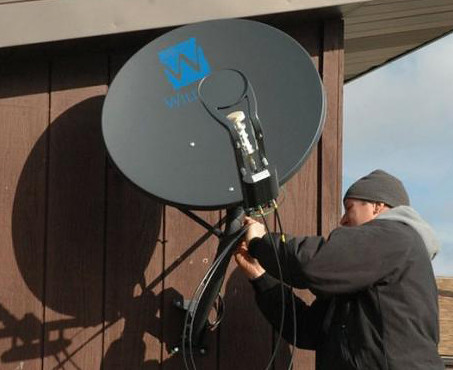
The home equipment is so easy to install that you can even do it yourself. A complete kit of accessories comes with the package including:

  • A satellite antenna (typically 75-80cm)
  • A transmitter/receiver (LNB), which sits on the front of the dish
  • A satellite modem, which is connected via an Ethernet cable to your PC

ASTRA2Connect is sold through resellers.  Just last month, SES Astra signed deals with Euro Marketing Group (to offer ASTRA2Connect in Poland through such brands as SkySatPlus) and with Zug, Switzerland-based telecoms provider Yato, who will distribute the service in Germany.

And today, the news is out that ASTRA2Connect is available in France and Italy as well:

Nine months after the product launch in April 2007, SES Astra now has distribution agreements in seven European countries, the satellite operator said.

Future revenue secured by these contracts amounts to 165 mln eur with more than 200,000 consumer terminals to be installed within three to five years, it said.

SES Astra had already signed contracts for Astra2Connect in Germany, Austria, Switzerland, Ireland and Poland. Additional contracts in several other European countries are under negotiation, the group said.

In France, the product will be distributed to consumers under the brand Viveole by communications service provider Auvea Ingenierie.

In Italy, Astra2Connect will be marketed to consumers by the broadband service provider Digitaria, an affiliate of the network and satellite service providers Netdish and Eurosatellite, SES SA said.

At last count, the ASTRA satellite system reaches 109 million homes in Europe and North Africa, broadcasting nearly 1,900 TV and radio channels in analogue and digital formats.

Eutelsat, Viasat Team up to Offer Broadband Capacity

Thursday, January 10th, 2008

It’s incredible to reflect — and appropriate in these early days of a new year — on how rapidly broadband access has grown in the last four years. Back in 2004, some of us were still contending with dial up at home, while on the road, an 802.11b connection was a rare luxury.

Now, of course, WiFi is ubiquitous, but for true road warriors, seeking out a Starbucks is no longer  an acceptable way to maintain productivity. Aircards or satellite broadband are the way to go.

And for those in the rural and ex-urban hinterlands, satellite broadband is increasingly edging out DSL and Cable as the way to get connected. As we’ve blogged before, WildBlue has been so successful in signing up ex-urbanites that they’ve had to turn away business.


But more capacity is on the way. Eutelsat and ViaSat are working together in developing the Ka-band for Internet access services: 

ViaSat and Eutelsat are cooperating around ViaSat’s Ka-band SurfBeam networking system and a common wholesale business model to offer service through ISPs, telecommunication companies, and direct-to-home television providers, the US company said.

Eutelsat announced separately that it has selected EADS Astrium to deliver its first satellite operating exclusively in Ka-band frequencies.

ViaSat, too, is getting its own satellite — a first for them — to be built by Loral and operated by Telesat:

The new spacecraft is scheduled to launch in 2011 and is expected to provide more than 15 years of service life. It employs SS/L’s space-proven 1300 platform and high-capacity Ka-band spot beam technology to ultimately service more broadband users at faster data rates than any previous satellite.

The orbital location, 115 degrees West, is one Telesat has had for a while. (It was not one of the new licenses issued last June.)

Meanwhile, Telesat’s Canadian competitor broke ground on its satellite control center last month:

The Ciel Satellite Group announced today that it has selected SED Systems, a division of Calian Ltd, to expand SED’s satellite control center facilities in Saskatoon in preparation for the initiation of tracking, telemetry and control (TT&C) operations for Ciel-2, a satellite that is planned for operation by the first quarter of 2009….

SED Systems has been in operation since 1965. Headquartered in Saskatoon, Saskatchewan, the company is ideally located, in terms of look-angle to Ciel-2’s 129 degree West orbital position. In March 2008, ground will be broken to install the monitoring antenna, while the entire facility renovation and upgrade is expected to be complete by the end of summer 2008. A team of dedicated satellite controllers will be trained and in position, ready to operate Ciel-2 well before its planned fourth quarter 2008 launch and in-orbit testing.

It should be noted that ViaSat’s further adoption of its DOCSIS-based Surfbeam platform, which is used by WildBlue in the U.S., could lead to ViaSat helping WildBlue with additional capacity in the future.

For a local perspective on Viasat’s new venture, check out this article from the San Diego Union-Tribune

Without a doubt, the satellite broadband business continues to boom.

Race for Mobile TV Platform Entering Final Lap

Wednesday, January 9th, 2008

We’ve written before about mobile TV, and about Samsung’s video chipset for mobile TV technology. Now, the race is on to determine which mobile digital television technology will become the standard — with PC Magazine calling the competition a war.

"The battle between Blu-ray and HD DVD may be settling down at last, but in the mobile TV arena another competition is just getting under way," reports the Ecommerce Times:

 Two different mobile digital television technologies will enter testing this year, each backed by a different set of vendors. In one camp, there’s the A-VSB platform developed by Samsung Electronics Latest News about Samsung and Rohde & Schwarz; in the other, it’s the MPH (Mobile-Pedestrian-Handheld) platform, jointly developed by LG Electronics Latest News about LG Electronics and Harris.

Both have performed well in preliminary technical trials conducted by members of the Open Mobile Video Coalition industry alliance, the group said. Ultimately, however, only one will be chosen by the Advanced Television Systems Committee standards-setting body as the official U.S. standard for mobile digital TV, Gerry Kaufhold, principal analyst with In-Stat, told TechNewsWorld.

LG just unveiled its Mobile Pedestrian Handheld (MPH) in Las Vegas:

Woo Paik, LGE president and chief technology officer, said that since the development of the digital broadcast system began, broadcasters have sought a system with the capability of delivering programming to mobile viewers.

LG, which holds the patents to the 8-VSB modulation scheme used in the ATSC television broadcast system, developed MPH to provide broadcast quality video receivable by devices moving at speeds of up to 140 miles per hour. The system will also be capable of working with the current ATSC DTV broadcast standard, LG said.

Here’s Mahalo Daily’s Veronica Belmont at LG’s booth at CES:


Samsung’s technology, meanwhile, is heading for national trials:

The trial will use SES Americom’s IP PRIME facility in Vernon Valley, N.J., and satellite capacity to beam national signals to A-VSB transmitters in local markets, which will also be inserting local content into an A-VSB "in-band" stream that will broadcast within stations’ existing digital spectrum.

Rohde & Schwarz and Samsung are supplying the local transmission technology, Nokia Siemens is providing back-end service management and MobiTV will handle the service’s interactive features. SES Americom will provide overall integration of the project.

Here’s Samsung’s demo from last year’s NAB:


Finally, there are rumors that Apple might announce mobile TV next week at MacWorld. We’ll see on Tuesday.


DIY Friday: Parade!

Friday, December 28th, 2007

It’s the final DIY Friday of 2007…. so what should you be working on?

A float for your local New Year’s Day parade, of course.


Few places are better for community parades then Santa Cruz, California, which holds the Last Night Santa Cruz DIY Parade every year. You can check out the highlights from previous years here.

Meanwhile, we’re waiting in anticipation to see NASA’s Jet Propulsion Laboratory’s Rose Bowl parade float on Tuesday, which will honor the 50th anniversary of the launch of Explorer 1:

 On the parade float, Explorer 1 fires off the launch pad at the center. In its wake arises a collection of historic JPL robotic explorers, as well as planetary ports of call. On one of the solar panels displays a floral “photographic” representation of the Explorer pioneers whose vision ignited the spark for U.S. space exploration — William Pickering, then director of JPL, scientist James Van Allen and rocket designer Wernher von Braun. Ascending from Explorer’s fiery plume are a Martian orbiter and a six- wheeled Mars Science Laboratory, which in 2010 will carry on the tradition of NASA/JPL robotic exploration. On the other edge of the plume, climbing beyond the garland of rings surrounding the planet Saturn is JPL’s Voyager 1 — humanity’s most distant emissary — which is now on its journey headed into interstellar space.

The 25-foot-tall float is jacketed by everything from black seaweed, eucalyptus leaves, split pea and ground walnut shells to daisies, roses, carnations, chrysanthemums, carnations, strawflower and cut everlasting.

From all of us at Really Rocket Science — Happy New Year! 

DIY Friday: Travel Tips

Friday, December 21st, 2007

So you’ve been thinking that this would be a nice year to give that special someone a DIY project, to demonstrate your skills and show that a gift made with love is more valuable than one bought with cash.

But who are you kidding?  Time is running out. If you don’t have your holiday shopping mostly wrapped up by now, a DIY project is probably out of the question.

Get thee to a gift certificate, and quickly.

But you can utilize your DIY skills if you’re traveling this season.  And you may need that take-charge gene over the coming days. As Wired reports, "The year 2007 was the worst for flight delays since the government began keeping stats more than a decade ago. In 2002, 17 percent of flights arrived late (defined by the FAA as delayed 15 minutes or more)."


Here are four travel tips to help you navigate the holiday airport nightmare. 

  1. Google has a new feature that you may not know about: flight-tracking. Just type your airline and flight number into the search box, and get the departure and arrival location and estimated time.
  2. So your flight is on time, but you’re wondering if you’ll be able to make that connecting flight at O’Hare? Well, first of all — what were you thinking flying through O’Hare during the holidays!? But okay, the plans are set. Use Wired magazine’s handy Google  map of airport delays (pictured above) to see how long you’ll be on the tarmac.
  3. When you’re on the way to the airport — and thinking that the sudden snow squall you’re driving through might cause a delay — use 4INFO from your cell phone to get the latest update. Simply text your airline and flight number  to the mobile search service at 4INFO (44636) to get the latest. And slow down! Snow is slippery to drive through.
  4. Are you worried that the bad kids up to no good? Check out the Global Incident Map if fears of terrorism are giving you the holiday heartache.

From all of us at Really Rocket Science, have a safe and happy Holiday Season!

Boeing Hands Spaceway 3 to Hughes

Tuesday, December 18th, 2007


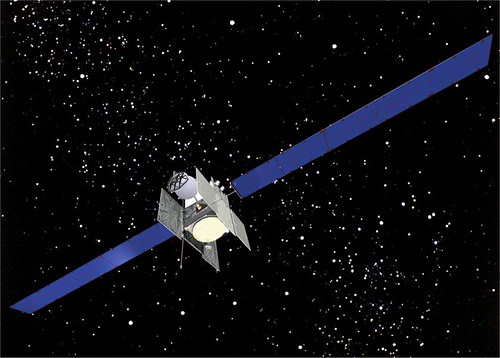
After four months of in-orbit testing, Boeing has handed over the Spaceway 3 satellite (pictured above in an artist’s rendition) to Hughes Network Systems. Hughes will utilize the Boeing-built satellite to provide HughesNet broadband satellite services throughout North America.

Launched via an Ariane 5 that lifted from the Ariane Launch Complex 3 in the tropics of Kourou, French Guiana on August 15th of this year, Spaceway 3 is Boeing 702 — a huge satellite weighing in at 6075 kg, with a 132-foot solar array span.

So what will it do? The press release from the launch gives us an overview:

"Boeing is helping Hughes in its vision to ‘Connect to the Future’ through satellite-based Internet services," said Howard Chambers, vice president and general manager of Boeing Space and Intelligence Systems. "Flying more than 22,000 miles above North America, the Spaceway 3 satellite will allow Hughes Network Systems to provide existing and new customers with high-speed, two-way communications for Internet, data, voice, video and multimedia applications."

Boeing manufactured the high-power, 702 satellite operating in Ka-band to enable Hughes to provide customers a new range of broadband-via-satellite services throughout North America. The Boeing-built technology that will enable these services includes a digital processor, downlink phased array antenna, microwave switch matrix, and flight hardware and software that will provide point-to-point and point-to-multi-point connectivity to Hughes’ customers. 

The Hughes Spaceway site, meanwhile, provides additional technical details:

SPACEWAY will enable a full-mesh digital IP network that will interconnect with a wide variety of end-user equipment and systems. This North American broadband satellite system will enable a range of innovative applications, enterprise-wide.

The SPACEWAY satellite features innovative, onboard digital processors, packet switching, and spot beam technology. Spot beam technology will enable the satellite to provide services to small terminals, while onboard routers will enable mesh connectivity. Users of the system will be able to directly communicate with any other user of the system without requiring connection through a central hub.

What does this mean for the approximately 325,000 current HughesNet subscribers?  Spaceway-3 uses Ka band spotbeams (at 20/30 GHz) and cannot be used by current subscribers, who are using Ku-band (11/14 GHz). So the handover of Spaceway is all new business for Hughes, and, according to a discussion on DSLreports, subscribers will need an entirely new outdoor unit (ODU) to tap into Hughes’ next generation model.

But with throughput as high at 16 Mbps expected from Spaceway, many HughesNet subscribers may decide switching out their outdoor unit is worth it. 

Dude, Where’s My Satellite?

Monday, December 17th, 2007

My grandmother used to say that a good scare could take five years off someone’s life. Is that what happened to India’s Insat-4CR satellite?


              Missing?
 

"One of the best-kept secrets of the Indian Space Research Organisation (Isro)" is that Insat-4CR (the launch of which we blogged about in September) "’disappeared’ in space about a month later," according to Daily News Analysis:

The satellite, which has 12 transponders meant for defence applications, direct-to-home (DTH) services and news gathering for television channels, was, however, “spotted” again with the help of the US-based National Aeronautics & Space Administration (Nasa) and brought back to a near geosynchronous orbit (36,000 km above earth). This took 15 days of manoeuvres, which consumed fuel normally meant for five years. This means the life of the satellite has come down from 10 years to five years.

A satellite’s life is determined by its fuel supply. As it keeps drifting in space, it has to be propelled back to the desired orbit using precious fuel.

A highly-placed source told DNA that Insat-4CR “disappeared” some time in October, almost a month after its orbit was raised for the fifth time to a near-geosynchronous orbit from the master control facility (MCF) at Hassan in Karnataka on September 7. The GSLV-F04 launch carrying Insat-4CR was critical for Isro after it lost Insat-4C #one minute after launch on July 10, 2006. Insat-4CR had a perfect launch, but the unusual drift in space was totally unexpected. Insat-4CR, weighing 2,130 kg, is identical to Insat-4C.

When its tracking systems failed to locate the satellite, Isro sought help from Nasa. The Nasa Orbital Debris Program Office located it a few days later. “Reclaiming the satellite was no mean achievement,” said the source, “but in the process, the satellite lost fuel meant for five years.” 

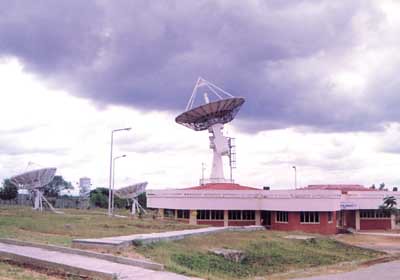
ISRO’s satellites are tracked from a giant 32 meter antenna installed at the Indian Deep Space Network (IDSN) at Byalalu, 40 km from Bangalore.

ISRO has denied the report that Insat-4CR went missing: "It’s totally false and baseless. We totally deny it," ISRO spokesperson S Satish said.

DIY Friday: Build Your Own iPod Dock

Friday, December 14th, 2007

Us rocket scientists — and particularly Rocco — love our iPods. In fact, Rocco’s been waiting for the Apple patent/trademark filing from 2006 to come true for years now.

We like iPod docks, too. At the top of Rocco’s Christmas list is a nice, clean iPod dock that will deliver a quick charge and sync.

Let’s just say that Rocco’s been pretty good this year, and so Santa is looking. There are a lot of options to consider.

This miConnection Zork Alien iPod dock seems appropriate for Rocco’s obsession with SETI, and it’s only $23. Or we could go with something more "professional," like this basic unit for $40 or this sharp KefDock, which is designed to integrate your iPod with your home theater system.

Of course, what Rocco really wants is a dock with integrated speakers, one that will charge and sync while thumping out some heavy bass.

We could harken back to Rocco’s memories of the sock hops he attended as a lad with this jukebox, but it’s $289, and, in truth, Rocco hasn’t been that good.

So what to do? Well, Santa does have some elves, so why not a DIY or DIE ("Do it, Elves!") project, since it is the penultimate Friday before Christmas?

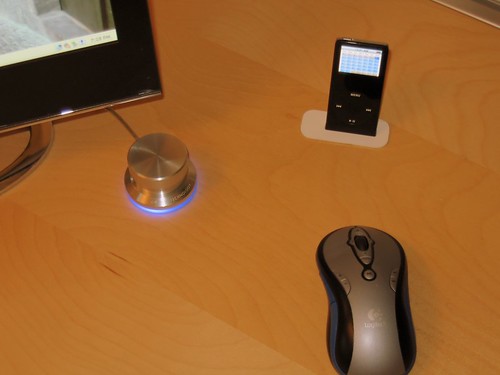
Simple Simon made a nice, minimalist iPod dock by building it into his desk:


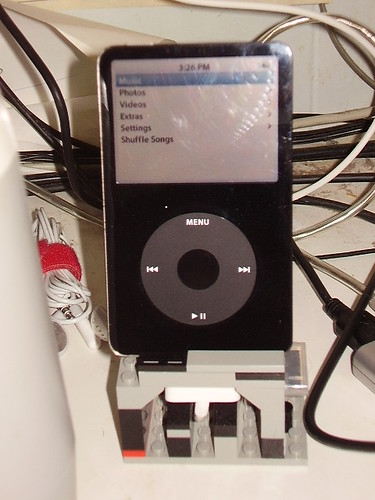
LinuxMatt added some child-like style to his DIY dock by using LEGOs: 


Or, if you want really simple — or to broadcast your green, recycling machine lifestyle — you can build a dock using the packaging material that came with your iPod. 

For ourselves, however — having a nearly unlimited supply of elves — we’re going to go with the start-from-scratch, design-it-yourself iPod super dock project recently posted Engadget.com in four parts: 1, 2, 3, 4.

Get busy, elves. 


Heading North for the Ursids

Thursday, December 13th, 2007

Normally the Ursids meteor shower isn’t that spectacular, and when it peaks this year around the 22nd of December, a bad moon will make viewing it difficult in Europe and Asia, and it will be daytime in North America. So why is  Peter Jenniskens, a meteor astronomer at the Carl Sagan Center and SETI Institute, travelling all the way to the North Pole to view it this year?

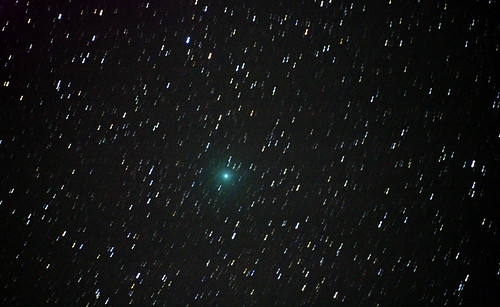
Peter explains that it’s the presence of Comet 8P/Tuttle (pictured above) within the shower, and a long-standing mystery or the Ursids’ outbursts, that are bringing him high over the North Pole: 

We are preparing to visit the North Pole on December 22, to see an unusual meteor shower called the Ursids. This meteor shower radiates from the constellation known as the Little Dipper: Ursa Minor. This minor shower is quite unremarkable in most years, but this year the parent comet 8P/Tuttle is approaching, and it has a strong Perseid-level shower in store for us. We think. We predict a peak time around 20 – 22.2 Universal Time and a width of 5 to 8.5 hours at half the peak rate.

Unfortunately, that means that North America is not a good place to be, for our purpose. The outburst will happen during our daytime. Best viewing will be in Asia and Europe. Even from those locations it won’t be easy to see this shower, because of a bad moon that night, and frequent bad weather in December…

The Ursid outburst is too rare an opportunity to miss, though, because the comet returns only every 13.6 years. This time around, the comet comes closer to us than ever before, at least since it was discovered in 1790, passing at only 0.25 AU on January 5….

The Ursid outbursts are somewhat of a mystery. They have been heard, more than seen, in the years around past returns of the comet, by people listening for distant radio stations. Each time a meteor appeared in the cold winter sky, it would create a trail of ions, which reflected radio waves to the observer. They would hear a brief "ping". While counting those pings, it was clear to those listeners that something unusual was happening on December 22 in some years.

In collaboration with Esko Lyytinen of Helsinki, Finland, and Jeremie Vaubaillon of Caltech, I investigated these reports, and we discovered that the dust may have been ejected by comet Tuttle around AD 300 to 900, or perhaps earlier. Results will be published in the upcoming December issue of the Journal of the International Meteor Organization. It takes a long time for the dust to move from an orbit similar to that of the comet into an orbit that can hit Earth. Close encounters of Jupiter near the ascending node of the comet orbit seem to play an important role, especially when they occur shortly after the dust has been ejected and is still concentrated in space. The dust itself is most affected when its motion around the sun "rings," or resonates, with that of Jupiter.

The upcoming outburst is a great opportunity to test this model. When the Earth travels through the stream of dust, we may hope to see the dominance of some particular returns of the comet in the past, when all the dynamics worked in our favor. This could cause a particular peak time and rate profile of the shower.

To investigate this, we are hoping for an opportunity to observe the outburst from a Gulfstream V aircraft in a mission similar to our campaign to study the September 1 Aurigids. If approved, the Ursid flight will be a long 16-hour mission, involving one aircraft, departing from NASA Ames Research Center in the early morning of December 22nd. The plane will fly north-west towards Alaska, land in Anchorage for a refuel stop, and then continue on to follow the Earth’s shadow, fly over the Arctic and turn towards Canada to return at Ames just after sunset. We don’t need to fly all the way to the North Pole, just far enough north to stay in darkness all the time. The aircraft will follow the Earth’s rotation, making the meteors fall from a radiant high in the sky throughout the mission. The moon will stay low on the horizon on one side of the plane.

16 hours? That’s a long flight in a cold place. The flight path of Jenniskens’ Gulfstream V can be found here and here; the Federation des Astronomes Amateurs du Quebec also has some good finder charts here. Finally, for spotting Comet 8P/Tuttle, this finder chart is helpful.

Happy comet and meteor gazing!