Author Archive

The Olympics, Received on the Go

Tuesday, December 11th, 2007

Yesterday we wrote about how FOX News is pushing the envelope in truly mobile broadcasting for the Democratic and Republican presidential primaries.

But if networks are broadcasting on the go, are viewers receiving with the same mobility?

The answer, of course, is yes. 2008 should see increasing growth in mobile TV delivery. For example, the Echostar affiliate in Hong Kong is in on the Beijing Olympics mobile broadcast:

 Siano Mobile Silicon has signed a collaboration agreement with CMB Satellite, the Hong Kong based affiliate of EchoStar Communications Corporation and Huaqi,  to provide advanced solutions for China’s up-coming mobile TV service known as CMMB, or S-TIMI, starting at the 2008 Olympics.

CMMB (or S-TIMI) is the technology developed in China and selected by the State Administration for Radio, Film and Television (SARFT) as the main platform for delivering TV services to mobile devices. The CMMB network will use both satellite and terrestrial signals to obtain effective coverage both in densely populated cities, including indoor reception, as well as in sparsely populated rural areas. The commercial launch of mobile TV in China is anticipated to coincide with the Beijing Olympic Games.

CMB Satellite, a Hong Kong-based affiliate of EchoStar, is the primary provider of S-band satellite capacity for China’s CMMB mobile video system.

Will the Aigo-branded MP4 player factor into the Olympics plan? Possibly. Here’s a demo of the product from generationMP3 on YouTube:

Another mobile TV receiver that may become a hot item is the Siano DT501HS. The chipset is capable of multiple reception (DVB-H, DVB-T, T-DMB and Enhanced Packet Mode DAB):

The DT501HS, which was launched last month in Italy, is the world’s first commercial DVB-H product for PCs. This USB card combines DVB-H (Digital Video Broadcast for Handhelds) mobile TV technology with HSDPA (High Speed Downlink Packet Access) 3.5G cellular technology, for the PC and notebook markets. The TV/modem card provides end users with on-the-go access to a wide range of high-quality multimedia and data communication applications, like movies, music and sports and allows consumers to use their PC’s and notebooks as the centre of their multimedia and data communication applications. Onda Communications co-developed the pioneering card with Siano Mobile Silicon, and software vendors CyberLink and NagraVision. The DT501HS is currently marketed by TIM (Telecom Italia Mobile) in Italy, for its DVB-H and data communication networks subscribers.

Unlike other DVB-H products in the market, the slim DT501HS does not have an external antenna that sticks out. Instead, it uses Siano’s CES Innovations 2008 award winning tiny antenna chip, the SMS8021 (co-developed with Vishay), which is mounted on the internal PCB and exhibits high performance gain over the entire UHF spectrum.

The Siano would be competing with a new player from Korea, the Tomato D18. (Here’s an English site in the works.) Three things are amazing about this little fruit: it’s 8.5 mm thin, has an incredible 60GB of storage, and costs just $100.

If sales of the PocketDish are any indication, consumers are eager to get their hands on cool mobile TV devices, and the market is primed for some explosive growth. 

The Election, Brought to You on the Go

Monday, December 10th, 2007

The New York Times has an article today on how the Fox News Channel is using satcom on the move to report on the presidential primaries:

As the beginning of primary season approaches, Fox News Channel is introducing a pair of satellite reporting units capable of broadcasting live video while on the move. The vehicles, two retrofitted sport utilities, had an early debut on Nov. 30 during a hostage incident at Hillary Rodham Clinton’s campaign office in Rochester, N.H., and are already raising interest and questions about their potential influence on live television news reporting.

When Leeland Eisenberg, the suspect in the incident, walked into the office and claimed to have a bomb, Fox News saw it as a perfect opportunity to try out its Election Link vans, which can stream live video while moving. Carl Cameron, Fox’s chief political correspondent, jumped into one of the vans to drive to the scene, giving Fox News viewers alternating views of his torso buckled into the passenger’s seat and shots of New Hampshire roads rolling past.

“This is exactly why the Election Link vehicles are going to be deployed by Fox News in New Hampshire and Iowa,” Mr. Cameron said on the air. “The breaking aspect of the politics and the shocking types of events that can happen when presidential politics are in play.”

The vehicles will be sent to Iowa and New Hampshire for campaign coverage before the first caucus and primary, and theoretically will allow Fox to broadcast live video as primary season proceeds. The three-person vans have three cameras: one on the roof, one on the dashboard and one that can be removed from the vehicle and transmit back to it from a distance of up to a quarter-mile.

According to Brian Wilson, Washington bureau chief for Fox News, the vans do have a few technical limitations. “The signal comes in at just a hair short of broadcast quality,” he said.

He said that the vehicles were much less expensive than a traditional satellite van, however, and would be used when mobility and speed, rather than high-quality video, were most needed.

The Times doesn’t go into great technical detail on the roving reporting SUVs, but they could be using ViaSat’s ArcLight platform, as was first demonstrated last year during the Race Across America (and which is being used again in 2007). The Race Across America is billed as "the world’s toughest bike race":

We watched the Race Across America through the ViaSat Web site in 2006, and it was very, very cool, with live, uninterupted video with no "buffering." True, most of the time you would just watch some cyclists pedal away, but the video quality was remarkable.  

While Fox News and the Race Across America are two examples of how satcom on the move can be used, a big part of ViaSat’s market is the federal government, particularly defense

ViaSat’s Mobile Satcom system uses ArcLight® technology to provide affordable, 2-way,"always-on", "cable-like" broadband IP access via satellite to ground, airborne, and maritime platforms while on the move. This Comms On-the-Move system allows commanders, sensors, and weapons systems to interact seamlessly to establish a real-time view of the battlefield and allocate firepower as effectively as possible. The system enables the IP-based capabilities such as live video conferencing, streaming video, and C2PC Situational Awareness.

Americom Government Services also sells the platform, which will also be used for maritime broadband on the AMC-21 satellite that is scheduled for launch in mid-2008.

DIY Friday: Rockets!

Friday, December 7th, 2007

It’s hard to believe we haven’t presented this before, given that we are rocket scientists and all.

Nonetheless, it honor of our profession and our blog’s name, we present today’s DIY project: build your very own model rocket!

If you’re like us, your first hand-on experience with rockets probably came through an Estes rocket kit. Sebadoh used to launch these from an empty lot in Scottsdale, Arizona, and lost at least half a dozen of his creations to neighbors’ roofs and trees throughout the neighborhood…. and Rocco’s first D engine, in a Big Bertha, was never found, and is still lying somewhere around Lexington, NY. (If you find it, please drop Rocco a line.) 

Estes is still making rocket kits like this one. (We confess that we assumed they had gone the way of lawn darts, honestly.) And if you’re really into model rockets, the Amateur Rocketry Society of America is the place to be.

But if you’re not into just purchasing your solid fuel engines, why not take rocketry to the elemental DIY level, by building a water-powered rocket? Here’s one that uses jet foaming: 

Check out the Water Bottle Rockets blog for instructions on how to make your own. But be warned: model rocketry isn’t all fun and games. There’s some serious competition out there, as this video of the world-record flight of 1,821 feet demonstrates.

If you’re going to compete, you’d better document your launches. Here’s how to make a rocketcam to prove that you’ve broken the surly bonds of earth by a country mile.

Happy flying! 

Green Flags for Shuttle Launch Today

Thursday, December 6th, 2007


Is this the sportiest shuttle mission ever?

When the Shuttle Atlantis lifts off from Kennedy Space Center today at 4:30 pm, its payload and crew will give two nods to the history of sports.

The first nod is courtesy of the Daytona International Speedway, with a small addition to the payload:

In conjunction with the historic 50th running of the Daytona 500 scheduled for Feb. 17, 2008, and the 50th anniversary of NASA in 2008, the orbiter will carry three green flags into space to celebrate the two milestones.

“We’re excited to be able to partner with NASA on this exciting project,” said Speedway President Robin Braig. “Stay tuned as we’ll have other exciting things to announce in the coming weeks.”

The flags will travel more than a million miles at 17,500 mph during the 12-day mission to deliver Columbus, a science research module to the International Space Station. The shuttle is scheduled to lift off at 4:31 p.m. EST.

Once back on earth, the winner of February’s Daytona 500 will take home a flag; one will hang in the Daytona 500 Experience and the final one will go to NASA.

(Want to relive the 49th annual Daytona 500? Check out the last 2 laps of the 2007 race, with a spotter talking to a driver, in this YouTube video.)

The second nod to sports is actually a member of the Atlantis crew: Leland Melvin, the former University of Richmond football star who was drafted as a wide receiver by the Detroit Lions in 1986. In 1988, while trying out for the Dallas Cowboys, a hamstring injury on the practice fields ended his football career — but began his career toward becoming an astronaut:

Melvin credits football for helping him train for the trip he’s about to take.

"I can remember with sports, there were times when my coach (at Richmond), Dal Shealy, would come into our room the night before the game and tell me to close my eyes," Melvin remembers. " ‘Leland, you are in the end zone, pulling the ball in, pulling it to your body for a catch to win the game.’ … You’re going through the mechanics of what you’re doing, and when you visualize it and sleep on it, when you wake up the next day, you’ve already done it. So doing it is really second nature to you. It’s in your subconscious."

The repetition, the visualization are all part of the training for Melvin’s primary job, which is operating the 58-foot robotic arm on Atlantis that will deliver the 22-foot-long, 13-ton Columbus Laboratory to the International Space Station on Day 4 of the 11-day mission. The procedure will take about 2 1⁄2 hours and will include carrying German astronaut Hans Schlegal on the mission’s first spacewalk. The time and distance are exact, and are calibrated in minutes and centimeters.

Live coverage of the mission launch should begin at 11:30 am EST on the STS-122 Launch Blog. NASA TV will also carry the launch via live webstream — or you can catch it in HDTV on HDNet beginning at 3:30.

Choices, Choices: Triple Play or HDTV?

Tuesday, December 4th, 2007


It’s not just the holiday season. With just more than 13 months to go until U.S. broadcasters shut off the analog, and with the increasing proliferation of HDTV broadcasting, the race is on between cable and satellite television providers to convince consumers that their product will give them the most bang for the buck.

One of the primary selling points has been offering HDTV and DVRs, long favored by the satellite TV marketers as their value-added proposition. Cable has been favoring "triple play" — bundling digital TV, IP phone, and internet into one package.

For the time being, it seems that cable/sat TV divide is likely to remain in place, as the new owners of DirecTV believe the period of rapid growth for triple play has passed: 

 Liberty Media CEO Greg Maffei said Monday that DirecTV Group’s strategy of concentrating on video services – primarily HDTV – apparently seems to be working and when his company takes over control of the satellite TV giant later this year, there won’t be a big change in strategy….

When LGreg Maffeiiberty agreed to take control of the satellite TV giant, there was speculation that the Denver-media conglomerate would invest heavily in bringing a wireless high-speed data product to DirecTV. But at the UBS Securities Media & Entertainment conference Monday, Maffei seemed to downplay the need for a high-speed Internet play.

Maffei credited DirecTV’s current management team, which has differentiated the product from cable and telco offerings by focusing on HDTV content and high-end digital video recorders. Their success was proven in the most recent quarter, where DirecTV added about 240,000 customers.

While Maffei admitted that the triple play bundle of voice, video and data may have hindered DirecTV’s subscriber growth in the past, that time appears to have gone by. That, he said is backed up by the recent basic subscriber losses at the larger cable companies.

“Most of the growth in voice and data has already occurred; that is why you’re seeing slowing growth rates for the cable guys,” Maffei said. “By concentrating and differentiating around content and HD and the TV experience, DirecTV has been able to find a customer set that enjoys that product and reaches for that product.”

The early adopters, it seems, have all chosen their path; now the marketplace is focusing on picking up the rest of the subscribers — and the competition is fierce. DirecTV and Dish are matching each other’s offers, though DirectTV has a leg up in its HDTV offerings, providing 85 HDTV channels to Dish’s 34. (On the cable side, the score is this: Cablevision has 42 HDTV channels, including all New York Metro local sports in HD for free, while Comcast has 44 and TimeWarner offers approximately 30.)

Another channel sparking demand for direct-to-home satellite TV is RFD-TV, which bills itself as "Rural America’s Most Important Network" and is the new home of the "Imus in the Morning" video simulcast. RFD-TV is one of the 285+ video channels available on IP-PRIME, the IPTV service built for small and mid-size telcos. 

Meanwhile, the cable guys clearly disagree with Maffei’s observation that triple play’s heyday of growth is behind them; they feel triple play remains underpenetrated

But will a new "quadruple play" — adding wireless cell coverage to cable’s triple play offering — shake up the marketplace? TimeWarner and Comcast are opting out of bidding for the new wireless spectrum being made available by the end of analog, but Cox is in:  

Cox Communications Inc. said Monday it plans to bid in an eagerly anticipated auction of wireless spectrum, likely making it the lone major cable operator to take part.

Parties must indicate Monday if they want to participate in next month’s auction for wireless spectrum, which can be used for cellphone service or new mobile-Internet technologies.

Companies such as Google Inc. and Verizon Communications Inc. are expected to bid billions of dollars to capture the valuable slices of airwaves.

Cox… and characterized the move part of its push towards mobility and convergence of its services. "We like having options," said David Grabert, a Cox spokesman. With other cable operators, Cox bought wireless spectrum in a separate government auction last year.

The company, a unit of Cox Enterprises Inc., has more than 6 million customers nationwide.

So in the end, how will it all shake out? Will one bundle become the VHS to another Betamax? Unlikely, but time will tell.

NASA 2.0

Monday, December 3rd, 2007

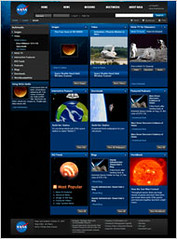
The NASA website has gone 2.0:

The National Aeronautics and Space Administration, concerned that people in the social networking generation have not shown enough interest in its work, has renovated its Web site to appeal more to the 18- to 25-year-old set.

The site, introduced over the weekend, has new blogs and widgets and more ways for people to view and manipulate content. A MyNASA feature has a “top playlist” that lets people watch clips of the space shuttle Discovery’s return to Florida or the California wildfires viewed from orbit.

The site, which has not had major overhaul since early 2003, still has information for policy makers and the media, but also more diversions. It is meant to compete with sites like Space.com (run by a company called Imaginova) and CNN, both of which have had more sophisticated presentations on space exploration.

“Younger folks look at the Web a different way,” said Brian Dunbar, Internet services manager for NASA. “They want to be able to pick and choose.” He estimates that the NASA site gets about a million unique visitors a month.

Many of the new features, like better feeds to users of aggregation sites like Digg, were made with young adults in mind.

NASA’s been providing great content for years now, but the addition of widgets and features like MyNASA will make the site even more user friendly, and allow users to stay abreast of favorite missions or research projects.

The more prominent use of blogs will also make highlighting NASA’s rich history even easier. For example, Shana Dale’s blog post reminds us that the first A in NASA stands for aeronautics:

NASA evolved from its predecessor, the National Advisory Committee for Aeronautics (NACA), which was formed by Congress in 1915 to undertake, promote, and institutionalize aeronautical research.  During the past 50 years, NASA’s aeronautical research has provided breakthrough concepts, tools, and technologies to make air travel more safe, efficient, and environmentally friendly….

Today, NASA’s Aeronautics Research Mission Directorate builds upon this legacy and continues to develop new concepts, techniques, and technologies that will enable revolutionary capabilities for future aircraft as well as the airspace in which they fly.   Much of our focus is on the Next Generation Air Transportation System, or "NextGen," a wide-ranging initiative involving six U.S. Government departments and agencies, as well as numerous industry and academic partners. The goal of NextGen is to transform our nation’s air transportation system so that, by 2025, it can handle the predicted two-to-three times increase in demand while maintaining safety and protecting the environment.  NASA aeronautics programs conduct fundamental research for NextGen in areas of safety, air traffic management and the environment

There is a great link on the NASA aeronautics website where you can click directly on sections of a commercial plane to learn more about NASA’s contributions to aviation design and safety: NASA Aeronautics Research Onboard

SWE-DISH to Help Spanish TV

Friday, November 30th, 2007

Some good news for DataPath’s Swe-Dish portable satellite terminals:

SWE-DISH Satellite Systems AB,a DataPath company, has received an order for up to 20 SWE-DISH Drive-Away 150systems for several Spanish broadcasters, primarily Television Espanola (TVE).The agreement was secured in close cooperation with SWE-DISH’s Spain-basedsales and service partner, Atlas Sistemas. TVE will base 16 of thevehicle-mounted 1.5-meter antenna systems throughout Spain, giving thebroadcaster greater mobility to produce high-quality live broadcasts of localnews and events.

The news comes on the heels of last month’s announcement that the United States Marine Corps has selected Swe-Dish for one of its new programs: 

DataPath, Inc., a leading provider of satellite and wireless communications networks around the world, has been selected by the U.S. Marine Corps to provide an ultra-portable satellite communications (SATCOM) solution for the Support Wide Area Network (SWAN) program, enabling the Marines to extend the network and improve warfighter mobility while they establish and maintain broadband communications on the battlefield.

The DataPath solution will include:

– SWE-DISH IPT Mil Suitcases (AN/USC-68), quick-to-air terminals that are small enough to be carried as suitcases or backpacks.

– Customized, portable baseband kits providing NIPRnet, SIPRnet and voice-over-IP services.

– Technical support services that include training and field engineering from DataPath’s experienced support personnel.

The multi-year contract award, with options, could total up to approximately $30 million, including an initial delivery order of $1 million.

From the Swe-Dish website, in English (da da dum):

SWE-DISH Satellite Systems has developed a new class of groundbreaking small satellite terminals – the Suitcases. It’s a new class of small (suitcase size), hand portable, highly mobile and fully automated satellite terminals. They are used by numerous leading broadcasters, as well as several defense organizations such as the US Special Operations Command.

The Suitcase is recognized for being
• Compact and hand-portable
• Fast, one-person operation with a unique, user-friendly, Graphical User Interface
• Motorized set-up and antenna positioning
• No requirement of specially trained personnel
• LAN standard – working like any LAN through 10/100 base-T interface
• Rugged – used by military units world wide

It’s as light as a bag of cement — watch them lift the suitcase in this video:


DIY Friday: Create Your Own Stroboscope!

Friday, November 30th, 2007

PBS has had some good new programming recently, and among our favorites is Wired Science — whom we turn to for today’s DIY adventure:

The invention of the stroboscope is frequently attributed to Doc Edgerton, but in fact stroboscopes go back to 1832: 

The term "stroboscope" comes from Greek for "whirling watcher".  The "whirling watcher" was simply a disk with slots at regular intervals.  As an observer looked at moving subject through the slots in the spinning disk, he could see successive stages of the subject’s motion.

When Edgerton began his electrical engineering studies at MIT in 1926, his research was focused on the stability of synchronous motors, observing the changes in angular displacement of the rotors as a result of disturbances to the system.  As the story goes, Edgerton noticed that flashes from the mercury arc lamps he was using made the rotor visible without blur.  This gave him the idea to build an electronic stroboscope which could be used to visually observe the changes in the motors angular displacement.

Bre’s instructions on how to build your own stroboscope can save you some serious dough, as professional stroboscopes can get quite expensive.

But when taking macro, still life shots, a stroboscope, whether hand-built or store-bought, is best used in conjunction with a macro studio.

Thankfully, the Strobist offers some tips on creating your very own DIY photography studio for about 49 cents:

 This is one of the most useful DIY gadgets you could make – especially when you consider the single-digit price tag.

What can you use it for? That’s pretty much up to you, and will be limited only by the size of the box you use. Shots of small objects in the studio, on location, items you are selling on eBay, flowers (even still in-the-ground-and-growing ones,) Absolute Vodka bottles for $50,000 ad campaigns, catalog stuff – whatever.

This little thingie does it all in spades – and with a lot of control, too.

Get clicking! 


Car Manufacturers Getting Sirius About Satellite Radio

Tuesday, November 27th, 2007


It’s remarkable to consider that just a few years ago, satellite radio was like cable TV in the earliest days. "Why would I pay for TV?" became "why would I pay for radio?" The answer was clear (pun intended): the broad choice of commercial-free content has become a must-have for any luxury car. Or any car, for that matter — as the latest plans from Ford indicate:

SIRIUS Satellite Radio today announced that Ford and Mercury brands are targeting approximately 70% factory penetration of SIRIUS radios beginning with the 2009 Model Year vehicles, which will be available next year at dealers…

Over 1,000,000 Ford, Lincoln and Mercury brand vehicles have already been shipped with factory-installed SIRIUS radios. Lincoln began offering SIRIUS as standard equipment in 2008 Model Year vehicles. Recently, Ford launched SIRIUS on its new Focus. The addition of the Focus brings to 23 the number of Ford, Lincoln, and Mercury vehicle lines offering SIRIUS as factory-installed equipment. SIRIUS equipped vehicles will be packaged with a six-month prepaid subscription.

Land Rover offers SIRIUS as standard equipment on the Range Rover and the Range Rover Sport. Volvo, Jaguar and Mazda offer SIRIUS as a factory or port installed option on various vehicles.

SIRIUS also announced it has signed an agreement with Ford Motor Company that extends its relationship. All Ford brands, including Ford, Lincoln, Mercury, Land Rover, Jaguar, Volvo, and Mazda, are covered by the agreement.

The growth of satellite radio isn’t the only change to come to car interiors in the last few years. From GPS to bluetooth, our technical gadgets are becoming increasingly integrated with our automobiles.

In fact, Ford’s new "infotainment system" — the FordSYNC — was developed with Microsoft and was selected a top new technical innovation by Popular Science:

Ford SYNC, developed on the Microsoft Auto software platform, provides consumers the convenience and flexibility to bring digital media players – Apple iPods, Microsoft Zunes and other MP3 players – and Bluetooth-enabled mobile phones into their vehicles and operate the devices via voice commands or with the steering wheel’s redundant radio controls.

SYNC is making in-car connectivity more affordable and more widely available than ever before. It will be available on 12 Ford, Lincoln and Mercury products this year and on nearly all Ford, Lincoln and Mercury products by the end of 2008.

FordSYNC is a response to Chrysler’s Siruius-integrated MyGIG system, which we blogged about in June. Though neither system, in our eyes, has quite matched the interface of Volkswagen’s system, which we blogged about just last week

Still, if you like building cars online as a way of passing the time when you should be working, the SyncMyRide site lets you play with more than just rims and interior and exterior colors. But the partnering of Microsoft with Ford probably negates the need for a DIY Friday post on how to build a Zune Buggy (see the image at the bottom of this post).

Ford has placed a demonstration video on YouTube for FordSYNC, and you can learn more by watching this interview with designer Gary Jablonski. Or check out this commercial, if you haven’t seen it already:

CNET and Autoweek have also reviewed the system. 

Can’t afford a whole new car just to get Sirius in your ride? Sirius Satellite Radio was in full swing for Cyber Monday, with special offers expiring tomorrow. 

FCC Moves Favor Inflight Broadband

Monday, November 26th, 2007

You may have missed it in your preparations for Thanksgiving, but last week the FCC made a couple of big moves that favor the deployment of AMSS (aeronautical mobile satellite services) —  better known as inflight broadband in the U.S.

First, the FCC granted ARINC’s request for Ku-Band aeronautical earth stations to communicate with Telstar 14/Estrela do Sul at 63 W.L., which will allow ARINC to deploy its SKYLink inflight broadband product:

SKYLink allows business aviation passengers to stay connected even at 47,000 feet. At speeds in excess of 3 megabits per second (Mbps), it’s about 6 times faster than a high-speed cable modem….

The SKYLink antenna is tail-mounted and fits on larger business aircraft including: Gulfstream GIV, GIV-SP, G400, GV, G500, G550, Cessna Citation X, and Bombardier Global Express/500/XRS and Challengers.

The SKYLink equipment is compact and lightweight. The tail-mounted dish antenna measures less than 12 inches in diameter. The satellite terminal, including antenna, weighs less than 40 pounds. ARINC Direct is currently working with original equipment manufacturers (OEMs) to make SKYLink a standard option on any new aircraft, but will also retrofit the necessary equipment to existing aircraft. 

Second, the FCC granted ViaSat, Inc. blanket authority for domestic operation of up to 1,000 technically identical transmit/receive earth stations aboard commercial aircraft, which will allow ViaSat to bring its ArcLight platform to market, which boasts:

*  More efficient use of bandwidth especially for completely random traffic patterns.
* Full use of bandwidth without loss of data throughput due to reservation schemes or contention-based protocols.
* Less power required through spread spectrum transmissions.
* Encoded signals with a combination of CDMA and PCMA technologies.

ArcLight incorporate two ViaSat-exclusive technologies: Code Reuse Multiple Access (CRMA) and Asymmetric Paired Carrier Multiple Access (A-PCMA). PCMA enables data transmissions coming back to the hub from remote sites to be combined within the same bandwidth as the outbound channel. Rather than requiring additional bandwidth for return channels, ArcLight needs only the space segment required by the outbound broadcast to support two-way satellite services.

We’ve been fans of in-flight broadband for years — especially Boeing’s excellent service. Unfortunately, Boeing decided to shut that service down, partly due to lower-than-expected demand in the U.S. market. For a time, we thought Panasonic Avionics was going to revive it, but that didn’t, er, pan out.

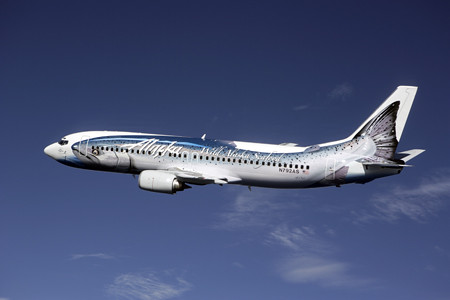
But as we reported this fall, Alaska Airlines seems poised to continue its history of industry-leading innovation (they were the first to move to online ticketing, way back in 1995) with its plans to launch inflight wireless Internet service next year based on Row 44’s satellite-based broadband connectivity solution. The price point for passengers? Latest reports indicate Alaska Airlines is leaning toward making the service free.

Now if the airlines would only bring back actual meals….