Author Archive

A Pan-African E-Network, With India’s Technology

Wednesday, November 21st, 2007
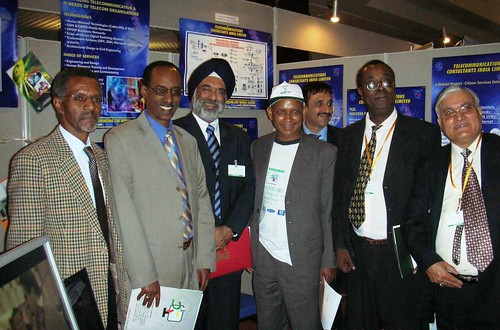
 

The theme of yesterday’s observance of Africa Industrialization Day was "Technology and Innovation for Industry – Investing in People is Investing in the Future."

Thus it’s more than a little fitting to note that InfoWorld yesterday reported that "a critical mass of countries are signing on to a plan for India to invest $1 billion in the Pan-African e-Network satellite project, a joint initiative with the Africa Union aimed at developing the region’s information and communication technology (ICT) infrastructure:"

The African Union last year entered into an agreement that calls for the Indian government to supply funds for the project. The Indian government will finance the project over a period of five years through a grant to the African Union. Ethiopia for example, has been given a grant of $2.13 million from India for the project.

So far, 27 African countries have signed agreements for the project, designed to connect African countries by satellite and fiber-optic network. The countries that have signed for the project include Zambia, Gambia, Ghana, Burkina Faso, Burundi, Mauritius and Tanzania.

The project will include installation of Very Small Aperture Technologies (VSATs) to carry VoIP (voice over Internet protocol) communication. The VSATs will be used for online education and telemedicine programs expected to extend ICT infrastructure to rural areas and other underserved communities. The telemedicine network will be used to share knowledge from Indian doctors with their African counterparts through an online training program.

"The project is significant to African countries because it overcomes limitations that make access to remote areas in most African countries difficulty by using VSATs," said Patrick Sinyinza, Zambia’s ambassador to Ethiopia, where the project is based.


More details of the project can be found here, while the official site is here.

It is hoped that creating the Pan-African e-Network will help ameliorate many of the challenges that individual countries have faced when trying to bring satcom to their citizens. (As an example, see this post which we wrote last year about Kenya’s problems bringing satellite connectivity to its residents.) 

Zeenews.com (the India edition) provides insights into India’s eagerness to pursue relations with Africa, a move that is fueled by China’s increasing investment in oil extraction in the region:


Despite its plethora of problems, Africa is a land of promise and opportunity because of its vast natural resource wealth. It is this reason that India, China, the European Union and the United States have not been able to resist the temptation to form partnerships with African countries that are mutually rewarding. China in particular, has been signing deals after deals with African countries to tap the continent’s natural wealth and, in turn, aid Africa’s industrialisation and development. Of late, Asian trade and investment has been rising in Africa and this is part of the global trend towards South-South co-operation among developing nations….

With China`s influence growing over energy-rich Africa, India has already pressed the alarm button. New Delhi is following Beijing’s path to increase oil and gas imports from the resource-rich continent to reduce dependence on Middle East nations like Iran….

The prospects for partnerships with African countries have also grown in the recent past with a surge in investments by Indian companies in nations like Libya, Sudan, Nigeria, Egypt and Gabon. The co-operation holds significance as Africa has the potential to play an important role in enhancing India’s oil supply security through diversification of its crude oil import sources. Significantly, Africa has 10% of the world’s total oil and gas reserves and its hydrocarbon exploration potential remains relatively untapped.

To give a push to Indo-African ties, Prime Minister Manmohan Singh earlier this year visited Nigeria – Africa’s largest oil producing country. In Abuja, Singh announced a "strategic partnership" with Nigerian President Umaru Yar’Adua and signed four agreements to bolster bilateral relations, including in the energy sector. Singh’s historic visit to Nigeria was the first by an Indian Prime Minister in the last 45 years.

The investments by China and India into African infrastructure, beyond the oil industry, are in sharp contract to the limited investments by American and European companies. Few US companies have invested in the region except for the oil and mining sectors, and official US government figures show that American holdings in the sub-Saharan region total just USD 19.6 billion, according to Zeenews.
MidEast Sees Strong Growth in Satellite TV

Wednesday, November 21st, 2007

In the Middle East, the number of satellite TV channels has more than doubled over the past three years, according to a report in the Saudi newspaper al-Madina.

TVTechnology.com provides a summary:

Currently 370 Arabic satellite TV networks broadcast to the Middle East; 56 belong to private companies, 54 are music channels and 38 are state owned. Since January 2004, the sector has grown some 270 per cent.

Media researcher ĘżYsa Qasusi told al-Madina that about 22 per cent of Arabic satellite networks are based in the United Arab Emirates; 15 per cent are in the Kingdom of Saudi Arabia and 11 per cent are in Egypt.

Among the new networks pushing this incredible growth in satellite TV content: MTV Arabia, which just launched this weekend and features a blend of 60 percent international music and 40 percent Arabic music, with local adaptations of the channel’s popular non-music shows:

By emphasising local music talent and programmes aimed at addressing the concerns Arab youth have, MTV Arabia hopes to set itself apart from the other satellite music channels that saturate the Mideast market.

"We are not only a music channel, we are an entertainment channel where young Arabs will get a voice," programme director Patrick Samaha said. 

The launch of MTV Arabia comes at a time when Dubai is growing as a destination for the international jet set — a trend that MTV Arabia is likely to latch onto. In fact, they’re promoting a big party tonight at Dubai’s Boudoir, the "swanky, wannabe Parisian club [that] ranks as one of the most exclusive venues in the city." According to the MTV Arabia website:

Hip HopNa co-host DJ Fred Wreck. All the way from Hollywood, Wreck has worked with the best in the music bizz including Dr. Dre, Eminem, 50 Cent, Snoop Dogg and X-Zibit.

Hip HopNa co-host and Saudi Arabia’s first Hip Hop artist Qusai, AKA Don Legend

Plus the one and only DJ Dany Neville – Dubai’s Hip Hop Guru

The cameras will roll right through the star-studded night so bling yourself up and come prepared. Get there early to make sure you don’t miss the fun. Don’t say you weren’t warned!

If you’re camera-shy or just can’t make it to Dubai, MTV Arabia can be downlinked from Nilesat 101, located at 7° West (transponder 14; 11,997 MHz V, FEC 5/6, SR 27500) and Arabsat BADR 4 at 26° East (transponder 24, 12,169 MHz V, FEC 3/4, SR 27500).  With any luck you’ll catch a few videos of Lebanese superstar Haifa, who has taken the Middle East pop market by storm and is featured performing next to a 1965 Buick Wildcat in the video above.

Asian Space Race in High Gear

Tuesday, November 20th, 2007

Earlier this month, we wrote about China’s successful placement of a lunar probe into orbit around the moon, and raised the question of whether a new Asian space race could be said to be afoot.

The Los Angeles Times recently went to Asia to investigate that same question, and found that for China, India and Japan, their ambitions in space are fueled by a desire for recognition as global powers — not to mention entry into the growing commercial satellite market and the potential of lunar mining:

A closer look at Asia’s space balance sheet finds China the clear leader in manned space flight. Beijing also boasts the most extensive infrastructure, with three launch sites in place and a just-announced combined pad and theme park on the drawing board in southern Hainan island.

Also working in China’s favor, said Clay Moltz of the Naval Postgraduate School in Monterey, is solid government backing, its pick of the nation’s scientists and close, if far from transparent, links with the military…..

Japan is ahead of China in areas such as deep-space probes and robotics and enjoys a more focused, high-tech approach. But it suffers from relatively limited budgetary and popular support, and almost no help from the military….

Japan now has a relatively reliable launch system, but the program has had trouble attracting engineers given competition from other industries and a small pool of candidates because of the nation’s low birthrate.

India, meanwhile, has a strong grounding in earth sciences and engineering, an ambitious vision and programs that dovetail well with national development plans. But its program may not garner the budget needed to compete longer term with China, some analysts said.

"China’s resources are 10 times more than us," said Dipankar Banerjee, director of the Institute of Peace and Conflict Studies in New Delhi. "Compared to the Chinese, we still have a long way to go."

China and India see a robust space program as an essential step toward recognition as a global power.

"The space program is viewed as an essential prerequisite for India to be counted amongst the developed nations of the world," said Ranjit Singh Nagra, a military expert.

China’s recent great leap forward into space has generated a lot of heated debate among space fans, as this conversation thread over at Daily Tech exemplifies.

Absent from the LA Times summary, however, is South Korea — a nation that isn’t going to sit back and watch while its regional neighbors pursue the heavens: 

Korea plans to develop a powerful two-stage rocket that can send a satellite to the moon by 2017, the government said Tuesday (Nov. 20).

The road map calls for the building and testing of the 300-ton Korea Space Launch Vehicle-1 (KSLV-II) booster rocket so the country can launch its first lunar exploration satellite in 2020, the Ministry of Science and Technology said.

If the plan is successfully carried out, Seoul will launch a lunar probe in 2025, it said…..

It also said efforts will be made to attain technological independence in key rocket systems by 2016 and in commercial satellite production starting in 2020.

Seoul plans to launch a large satellite weighing about 100 kilograms every 3-4 years, and at least two smaller satellites every year.

Even in this new Asian space race, however, there’s no need to fully reinvent the rocket ship. As with India’s lunar ambitions, South Korea has been relying on Russian technology and assistance to develop the Korea Space Launch Vehicle, the two-stage rocket for satellite launches set to debut next year. The 11 satellites South Korea has launched since 1992 for space and ocean observation and communication have all been carried aboard foreign-made rockets launched from other countries.

DIY Friday: Fighting Global Warming

Friday, November 16th, 2007

As we wrote the post below about the Vanco Arctic Expedition, we started to think, what can we do to fight global warming?

Sure, we’ve bought our compact flourescent bulbs and weather stripped our house and turned down the thermostat and at least thought about buying a Prius. But there’s gotta be more that a DIY-inclined person can do, right?

And then Rocco commented, apropos of nothing (as is often the case), that he knew lots of Canadians who had grown up with backyard ice rinks. And we thought, that’s it! If the polar ice caps keep melting, can’t we just create back yard ice caps to reflect the sun’s heat back into space — and get a little puck time in in the process?

Turns out, building your own backyard ice rink is easy from a DIY perspective:

 I built my rink using a garden-variety lightweight tarp as a watertight liner. This method is more expensive than just hosing down a patch of flattened snow and hoping for cooperative temperatures, but it’s also almost foolproof. The rink structure can be built before the really cold weather sets in, and because the water stays put, the rink will withstand a bout of warmish weather without leaking away. Plus, the rink components are reusable, making the amortized cost more agreeable….

 Once your future greats have put their skates to the ice for couple of hours, you’ll want to resurface it. This is best done at night when the temperatures dip. The easiest way to resurface the ice is to spread a thin layer of hot water over the surface. The hot water melts the ice shavings and fills in the blade gouges, and then quickly melds with the existing ice to create a nice flat surface. You could just use a hose to accomplish the resurfacing flood, but a simpler and faster way is to build a Zambini. (My kids started calling it that, and the name stuck.) The Zambini is a T-shaped hose extension made from off-the-shelf underground sprinkler fittings. Just screw all the fittings together and drill a series of holes on the underside of the horizontal part of the contraption.

Attached to your hose, the Zambini is used like a broom. The beauty of the device is that—like its inspiration, the Zamboni—it gets the hot water right down to the ice level without losing too much water to evaporation, and the little holes spread the water out evenly.

Of course, back yard ice rinks only work in the winter. But DIYers can keep cool in the summer by making DIY ice cream in a bag or by building this DIY air conditioner using a simple fan and some ice.

Then again, maybe we should just go turn down the thermostat a few more degrees. 

Ice Ice Baby

Friday, November 16th, 2007

With a stunning website more befitting a reality television show than a scientific expedition, the Vanco Arctic Survey is relying heavily on multimedia web technology to share its expedition with the public:

The Vanco Arctic Survey is a pioneering international scientific endeavour, likely to prove the most ambitious ever undertaken on the North Pole ice cap. The North Pole ice cap, which floats on the Arctic Ocean, is one of our planet’s defining features and is in peril, melting at an accelerating rate. The survey will capture, for the first time, detailed information about the thickness of the ice and snow and help to determine just how long the ice cap will exist in a climate-changing world.

The multimedia gallery can be found here. We particularly like this video (hosted on YouTube) of arctic wolves checking out the team as they drill for ice core samples, transmitted directly from the arctic:

So how does the team deliver their video, audio and images to a global audience? They use the Iridium low-earth orbit satellites for communications and video feeds. Silicon.com has the details:

Satellite coverage of both polar regions is limited to one service – the Iridium satellite network – and these low-orbit sats are designed for speech and low data rate communications, with a maximum data rate of only 2,400 bits per second.

To handle large quantities of data, the expedition will also be using six satellite modems in parallel to allow real-time webcam footage, which is compressed and combined with low frame rates.

The team will be using ‘sledges’ – large floatation devices containing the equipment – to transport the systems across the ice cap.

The onboard sledge computer uses a Linux-based system and consumes only two watts of electricity. Its main functions are to archive data, read data cards from the cameras and bio-data sources, handle compressed webcam images in real-time and feed data files to the six Iridium modems.

The expedition team will carry out tests to see how efficiently the system can transmit data back to the project’s headquarters at Watlington, near Oxford, UK.

The aim is to send back same-day footage which will enable the team’s progress to be followed.

Pen Hadow, who is leading the expedition, recently spoke at the launch of the first World Responsible Tourism Day, saying the day is of "colossal significance" to preserving the polar ice caps. 

To get a better idea of how limited satcom coverage is at the poles — and why — check out this cool flash visualization of orbiting satellites

Qualcomm Wins U.S. Contract to Track Mexican Trucks

Wednesday, November 14th, 2007


"Qualcomm has won a federal contract to provide a satellite-based tracking system for U.S. and Mexican trucks participating in a contentious experiment that opens the border to long-haul commercial traffic," SignOn San Diego reports:

Federal officials said yesterday that the San Diego-based company’s OmniTRACS system will allow the U.S. government to closely monitor trucks from both countries, including compliance with regulations that prohibit truckers from driving more than 11 hours per day.

Although Qualcomm is best-known for its prominent role as a chip-maker in the wireless industry, the company also is a major designer of satellite tracking systems for vehicles.

Qualcomm will provide tracking technology for 100 trucks at a cost of $367,000, officials said.

U.S. transportation officials hope the tracking system will soften congressional opposition to the two-month-old pilot project. Five carriers from Mexico and three from the United States are participating in the program, which is limited to a maximum of 100 carriers from each country.

OmniTRACS uses geosynchronous satellites and "helps fleets improve productivity, reduce operating costs, enhance customer service, and increase security." Features include:

    * Automatic satellite vehicle positioning
    * Two-way text and data communications
    * Highly reliable message delivery
    * Customizable reports
    * AS/400, Windows®, or web-hosted operation
    * Panic Buttons (available option) 

We’re not sure what the Panic Button achieves, but we assume it won’t be ignored like the car alarms that bleet plaintively in our local mall parking lot. 

Qualcomm has a nice flash demo of OmniTracks here. The system predates commercial use of GPS, and its next iteration — OmniVision — will provide real-time directions and maps using Maptuit’s NaviGo to truckers on the move:

Maptuit NaviGo is a real-time, hybrid  in-cab navigation service that provides professional truck drivers and trucking companies with interactive maps for increased routing efficiency and improved driver satisfaction.  QUALCOMM plans to offer NaviGo on the OmniVision platform later this year….

The OmniVision mobile computing platform is an integrated system consisting of hardware, software and network infrastructure, enabling delivery of two-way data communications and value-added services to enterprises in a mobile environment.


NASA “Launches” Dishes, Launch Pad at White Sands

Wednesday, November 14th, 2007

NASA’s been busy at the White Sands Test Facility in New Mexico. Just last week, they unveiled their new 18-meter Ka Band Antenna Network

 “Ka band” refers to a section within the microwave portion of the electromagnetic spectrum. Much like how listeners can’t pick up FM waves on AM radios and vice-versa, Ka band signals require special equipment to receive them.

The three new dishes help meet the growing demand for ground stations to handle high volumes of science data generated by today’s new satellites. The Ka band system allows satellites to transmit more data to the ground than ever before, in the area of 45 terabytes a month. That’s about the equivalent of 1,152 fully loaded 40-gigabyte iPods!…

The network makes use of a two-part epoxy developed at NASA’s Jet Propulsion Laboratory in Pasadena, Calif. Tests have shown the glue and the dishes will last for decades, according to Raymond Pages, chief of Goddard’s Ground System Development Office.

The first missions to use the network will be the Solar Dynamics Observatory (SDO) and the Lunar Reconnaissance Orbiter (LRO). SDO will study solar variations that affect life on Earth. LRO will focus on selecting landing sites, identifying lunar resources and studying how the moon’s environment will affect humans. Both probes are slated for launch in late 2008.

And today, NASA is breaking ground on a new Orion Test Pad at White Sands: 

The pad will be the site of a series of tests of a launch abort system that will help ensure the safety of astronauts aboard the new Orion spacecraft.

NASA’s Constellation Program is developing Orion to carry astronauts to the International Space Station, the moon and beyond. Engineers will use the test results to help design Orion’s launch abort system.

The first of five planned abort tests is scheduled from the new pad on Sept. 23, 2008. Two of the tests will evaluate the performance of the launch abort system at ground level. Three more tests will evaluate its performance at different altitudes.

Although a strong advocate for the space industry in New Mexico, Governor Bill Richardson won’t be attending the groundbreaking today, as he’s having pizza with caucus-goers in Nevada as part of his bid for the presidency. 

In addition to White Sands National Monument (pictured above), the area is home to the U.S. Army’s White Sands Missle Range. Unlike at the Monument, however, visitors to the Missle Range should learn about UXOs before wandering around this beautiful and stunning desert landscape.

The Future of C-Band

Tuesday, November 6th, 2007


In Geneva, Switzerland, the World Radiocommunication Conference 2007 is currently underway — and at the center of the discussions is the future of C-Band (known colloquially as the "compromise band").

C-band is characterized by larger antennas and is preferred by a variety of full-time service providers. C-band is a portion of electromagnetic spectrum in the microwave range of frequencies ranging from 4 to 6 GHz — normally downlink 3.7–4.2 GHz, uplink 5.9–6.4 GHz.  

From Satellite News (subscription required): 

 During the first week of the World Radiocommunication Conference (WRC-07), administrations from Asia, Africa, and Latin America made clear their broad and deep support for keeping the status quo for satellite services by calling for no change to the current use of the C band. This campaign, which exhorts the Conference not to identify international mobile telecommunications (IMT) systems in C-band has been gathering pace throughout the past year, driven by both national policy imperatives and the satellite industry.

In the weeks prior to the meeting, the number of countries expressing positions in support of protecting C-band for satellite use outnumbered those in favor of identifying C-band for IMT. Since the opening of the conference, support for protection of the whole band for satellite services has increased in strength from an already solid base. Governments have been assisted by the argumentation of regional and international satellite operators, spearheaded by SES Global, Inmarsat and Intelsat as well as regional operators such as Arabsat and Rascom, and network integrators such as Schlumberger, which all attended the WRC to rally their constituencies.

Advocates of no change in C-band allocations have come from many parts of the world, each with their particular reasons for supporting the position. These include concerns based on pre-existing interference between IMT-like technologies and satellite services which have, in some examples, ruptured Interpol’s communications in Gambia and caused severe problems to Bolivia’s direct-to-home satellite services during the 2006 FIFA World Cup. African governments have been at pains to emphasise the importance of C-band in areas that experience rain fade and the risk to satellite services if neighboring countries were to implement IMT. Asian governments, in clear allusions to recent tsunamis, have emphasised the role of satellite communications in disaster and emergency circumstances, as well as the growing demand for those services

Archived audio feeds of the discussion can be found here.

Proponents of keeping C-Band as it is have pointed to its value in providing a critical communications link during emergencies:

 During the first week and a half of the 2007 World Radio Conference in Geneva, some 3000 attendees were given an opportunity to see how Radio Amateurs can provide Emergency and Disaster communications. A van, constructed and manned by German Radio amateurs, was parked in front of the main entrance of the conference centre for delegates to visit. IARU Emergency Communications coordinator Hans Zimmerman F5VKP also participated in the demonstration. The IARU flag was flown at the top of van’s extendable mast.

José Albuquerque, the Senior Director of Spectrum Engineering at Intelsat, also makes the case for C-Band:

Currently, there are some 160 satellites in the geostationary orbit using C-band frequencies for their downlink transmissions (see Figure 1). This is the equivalent of more than 3000 satellite transponders with a 36 MHz bandwidth with the potential for transmitting about 180 Gbit/s at any given instant. This infrastructure represents an investment in excess of USD 30 billion in spacecraft and launch costs alone, without taking into account investment in the ground segment made by users and satellite operators.

Deployment of IMT systems in these frequencies would drastically reduce the benefits that these resources have brought to users around the world, because fixed-satellite services and IMT systems cannot share frequencies in the same geographic area.

C-band frequencies are used for downlink satellite transmissions that provide a wide range of services in developed and developing countries, including critical applications such as distance learning, telemedicine and universal access services; backhaul services (telephony, Internet); very small aperture terminal (VSAT) data links such as bank transactions or corporate networks; distribution of television programmes; mobile-satellite service feeder links, and emergency links, including disaster recovery services and meteorological tracking. These services require the high reliability and broad geographic coverage that can only be delivered in the C-band….

It is not feasible to undertake co-frequency operation of FSS receiving Earth stations and transmitting fixed or mobile stations in IMT systems. ITU–R studies have concluded that separation distances of between tens of kilometres and a few hundred are required to ensure protection of FSS Earth stations. Considering that a typical city covers an area with radius of between 15 and 30 km, sharing between IMT systems and FSS receiving Earth stations is not realistic.

In addition, IMT transmitters can also interfere with FSS Earth stations operating in adjacent bands. Unwanted emissions generated by IMT transmitters falling within the FSS desired signal cannot be filtered and will therefore generate interference. Furthermore, signals generated by an IMT transmitter can be strong enough to saturate the low-noise amplifier (LNA) of the FSS receiver. In view of the significant difference between the levels of the desired signal (originating at the satellite transmitter about 36 000 km away) and the interfering signal (originating at the IMT transmitter only a few kilometres away), filtering the IMT signal to the required levels might become unfeasible.

The adjacent-band interference effects described above highlight the fact that identification of a portion of C-band frequencies for IMT systems, while keeping another contiguous portion for FSS use, is not free of interference problems and does not constitute a desirable approach.

The message from SES, in video form:


We’ll keep you updated on the fate of C-Band as it becomes clear (no pun intended).

Carnegie Mellon Wins DARPA Urban Challenge

Monday, November 5th, 2007


Would it be a bad pun to call this a major milestone?

This past weekend, 11 finalists for the DARPA Urban Challenge — a prize competition for driverless cars —  wove their way through a 60-mile course at the U.S. Army urban warfare training center in Victorville, California (formerly the housing area at the now-closed George Air Force Base).

Only 6 teams finished, with Carnegie Mellon’s Tartan Racing Team taking the $2 million development prize. Defense Industry Daily was there, and has some amazing reporting

[DARPA had the] guts to invite in the world press and the general public while trying something new to the world: Turning multiple autonomous vehicles loose on city streets at the same time, interspersed with human drivers. As [DARPA Director Dr. Tony] Tether said at the start of the program, "If anyone tells you he knows what’s going to happen, he’s lying."

Since that test could likely take every bit of a short November day, the teams, staff and press assembled for their briefings at a chilly and dark 0600 hours. The day featured robot traffic jams, the world’s first ‘bot vs. ‘bot collision, and the Terramax robot truck’s attempt to take out the old air base PX.

DID has some great pictures of the event, and video of the bots making their way through the streets can be found on the DARPA website.

Automotive Design Line has additional details on the competition and rules: 

The competitor autonomous vehicles had to obey California traffic laws and were penalized for any violations. The three top teams had no infractions and were thus ranked solely by time in completing each of three "missions"—coming in with total times staggered by intervals of about twenty minutes. In addition to the robots, nearly 50 vehicles with professional drivers were on the course at the same time to simulate traffic situations.

The competition was close — Carnegie Mellon won with an average 14 mph throughout the course, while the second and third place finishers (Stanford and Virginia Tech, respectively) averaged just about and just under 13 mph. All of the top 3 teams finished the course in less than 6 hours. (MIT came in fourth place.)

More from Wired

Tether couldn’t have been more pleased with the race, calling it a "fantastic accomplishment," and saying that the technology for robotic vehicles was now just about ready for other companies and organizations to pick up the work in honing it further. "DARPA is an interesting organization," he said. "We really never finish anything. All we really do is show that it can be done. We take the technical excuse off the table, to the point where other people can no longer say ‘Hey this is a very interesting idea, but you know that you can’t do it.’ I think that we’re close to that point, that it’s time for this technology to [be furthered] by somebody else."

While five teams didn’t make it to the finish of the course (due to several "vehicle vs. building incidents"), there were no reports (that we’ve heard) of bot road rage. 

China: To the Moon!

Monday, November 5th, 2007


A Chinese satellite successfully entered lunar orbit Monday, a month after Japan put its own probe into orbit around the moon, the AP reports:


Chinese space officials said the Chang’e 1 satellite, part of the country’s ambitious space exploration plans, entered lunar orbit after completing a planned braking operation.

China plans to keep the Chang’e 1 – named after a mythical Chinese goddess who flew to the moon – there for one year, about the same length of time as Japan’s probe. China launched its satellite late last month, while Japan put its into space in September.

The timing of the launches raises the prospect of a space rivalry between the two Asian nations, with India possibly joining in if it carries through on a plan to send its own lunar probe into space in April.


We blogged about the Japanese lunar probe when it launched in September. Meanwhile, back at the 73rd annual meeting of the Indian Academy of Sciences, the lunar probe referenced above is indeed planned for April, 2008, with more missions to follow:

Work on Chandrayaan-1, India’s first lunar probe, was progressing, said J.N. Goswami, Director, Physical Research Laboratory, Ahmedabad. The plan was to launch the spacecraft around April 2008.

Planning for the follow-on mission had started, he said. Apart from an orbiter that would circle the moon, Chandrayaan-2 could also have a soft-lander carrying a robotic rover.

A slide projected by Dr. Goswami during his talk indicated that the Chandrayaan-2 mission could take place around 2011-12.

Wikipedia has some good information on Chandrayaan

So is this the beginning of an Asian space race? Here’s an opinion piece from Japan, translated into English and published in the China Daily, which argues that China is way ahead of the game:

China already has a high level of space technology. It has launched more than 100 Long March rockets since 1970, while Japan’s H2-A rocket has been launched only 13 times…..

[Now], China’s space development has drastically accelerated. Starting with the launch of the orbiter, China’s lunar exploration program comprises a moon landing and deployment of a moon rover with the retrieval of lunar soil and stone samples. China also aims to advance its technologies for manned spacecraft.

Further, it is moving forward with projects to launch a reconnaissance satellite and another one for its own global positioning system.

In addition, China is launching communication satellites for Venezuela, Brazil and Nigeria, and also received an order from France to launch a communication satellite, showing the commercial success of its program.

China has voiced a strong desire to participate in the International Space Station (ISS) program in which Japan is involved and the United States and Russia play pivotal roles.

Some observers say that in the near future China will become one of the world’s leading nations in the field of space development, equivalent to the United States and Russia.

In contrast, Japan’s space program, despite its successful development of the H2-A rocket, lacks specific targets – including what type of satellite it will launch in the future – due to budget woes.