Back in August, we reported on the rumor that Hughes was looking to buy Gilat. That rumor (not necessarily our reporting on it) sent Gilat’s stock climbing sharply, from the $8.50 range then to just over $11 per share now.
That deal never happened, but rumors of new suitors are again making the rounds. As Aaron Katsman writes:
Last weekend’s FT article about Gilat Satellite Networks (GILT), and potential suitors has received a lot of attention over the last few days. The article said that the company could fetch upwards of $500 million in a deal. That puts it about 15% above it’s current market value. I would expect a deal to get done, and I wouldn’t be surprised if it was for even more than the predicted $500 million.
Gilat’s business is doing well. Its revenues for Q2 ‘07 were at a 5-year high, and its net income grew strongly. It also continues to sign both extensions, and new deals. On Wednesday, it signed an expansion deal with Russian telecommunications provider North-West Telecom (NWTEY.PK). North-West Telecom is expanding its Gilat SkyEdge satellite network to bring telephony, and broadband Internet services to a growing number of remote communities in northwest Russia. The network expansion will serve many more sites in the Murmansk, Karelia, Komi and Vologda regions. Heck, if can do a deal in Kamchatka, it would win in RISK.
Globes Online reports that William Blair believes Apollo or ViaSat are the likeliest buyers of Gilat, and notes that Mivtach Shamir Holdings Ltd. (TASE:MISH) offered to buy Gilat at $10 per share in the first quarter, but that this was a price that Gilat "deemed too low, but management left open the possibility of being acquired if it found the ‘right opportunity’."
We’ll let you know when and if Gilat finds a suitor (and a price) to its liking.
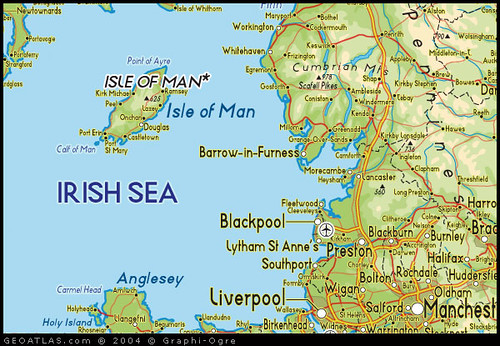
The Isle of Man, the tiny island in the Irish Sea that has been luring space and satellite companies to its shores with the promise of simple regulations and low taxes, has scored another victory:
The International Space University (ISU) has launched the International Institute of Space Commerce (IISC) as the world’s leading authority on space commerce. It is located at the International Business School (IBS) in the Isle of Man to capitalise on the island’s growing importance as a space industry jurisdiction….
By agreement with the ISU, the Isle of Man Government has made a five-year commitment to establish and host the IISC. Both ISU and the IBS are working together to strengthen links between the two institutions with the longer term goal of facilitating both academic and student exchanges to the benefit of both groups.
The decision to locate the IISC in the Isle of Man followed the first-ever board meeting for over a decade of ISU trustees outside their Strasbourg base, and which took place last September on the island. There the trustees saw at first hand the strong commitment and innovation of the Isle of Man space commerce industry.
Isle of Man Minister for Space Alex Downie said, "Welcoming the IISC to the Isle of Man is part of our overall strategy to encourage space innovation."
That strategy seems to be working quite well: Sea Launch Co., Inmarsat and Loral Skynet are among the companies that have set up subsidiaries on the Isle of Man. And it’s a strategy that the Isle of Man is aggressively pursuing; they recently knocked Bermuda out of the competition for a satellite slot worth an estimated $850 million a year in revenue serving the North American market:
The Island’s initial application for the slot, in 2002, was followed by one from Bermuda for a very similar frequency on the radio spectrum that would have caused interference.
The Island’s Communications Commission was granted £500,000 of legal expenses by Tynwald to allow it to argue against conflicting filings of this nature.
A subsequent representation to Ofcom resulted in a consultative document recommending that, in the result of conflicting filings, the party making the first application would have priority, meaning that legal action was not required.
The Isle of Man has long had a reputation as a banking, insurance and shipping center, and the government now is working to become known as an optimal place for other kinds of businesses to set up shop, he said.
"The Isle of Man has been one of the fastest-growing economies in Europe over the last 10 years, and we have a desire to diversify the Manx economy into new and innovative technologies," Ramsey said in a telephone interview from the capital city of Douglas. Manx is the traditional reference to things related to the Isle of Man. "We have a small economy, and we only need a small slice of cake to boost it significantly."
In addition to the space industry, the Isle of Man also is trying to attract the film industry, Ramsey said.
With a population of approximately 76,000, the Island enjoys one of the highest standards of living in Europe, with a higher GDP per capita than the UK. It is recognised by the IMF as a jurisdiction “of the highest standing” and is ‘AAA’ rated by both Standard and Poor’s and Moody’s.
In addition to its focus on space interests, as one of the world’s larger international finance centres, the Isle of Man boasts a thriving captive insurance market, one of the largest shipping fleets (with more tonnage on the Manx registry than the British fleet), a super yacht register, a specialised high tech manufacturing sector and a growing film industry.
Interestingly, as a Crown Dependency, the Island is fully self regulating via its Parliament, the Tynwald, which is the world’s oldest continuous legislature celebrating this year its 1,026th anniversary of democratic home rule. The Isle of Man is neither constitutionally, politically, nor legally part of the United Kingdom, unlike an Overseas Territory or colony of the UK. It benefits from membership of the WTO, the IMF, and the OECD and other relevant international bodies by dint of its relationship with the UK. The Island also has a special relationship with the EU under which it enjoys free movement of goods within the EU but is not subject to the vast majority of EU law (most notably rules governing tax harmonisation).
Local cable franchises, eager to maintain their control over delivery of content to local markets, have been fighting IPTV entrants everywhere.
In response, Verizon has chosen the strategy of pursuing state-wide franchises for a couple of years now. In New Jersey:
Twenty-six communities, business organizations and a county freeholder board are calling on Gov. Richard Codey and state legislators to end the cable industry’s stranglehold on the video marketplace.
The resolutions were issued over the past month, with Howell Township this week becoming the most recent community to support updating New Jersey’s 30-year-old laws to permit state-issued franchises. Under current law, a competitor to the monopoly cable-TV provider must obtain franchises community-by-community, a time-consuming process that inhibits competition.
As a sign of how contentious the introduction of IPTV has become, AT&T recently announced it was going to court in Connecticut to open up the statewide marketplace:
AT&T will file a lawsuit challenging the Connecticut Department of Public Utility Control’s decision not to grant the company a statewide video franchise for its U-verse service, a company spokeswoman confirmed today.
The company admitted surprise Monday when the CDPUC ruling was announced, since the state has a video franchise law, and AT&T expected to be able to continue providing its U-verse IPTV service, which it launched in three Connecticut markets earlier this year, under a statewide franchise. Instead, the DPUC said AT&T’s offering is a cable TV service and therefore requires cable TV franchise agreements with individual municipalities.
AT&T also is threatening to immediately eliminate 300 jobs in the state, cancel plans to fill 1000 other positions, redirect its investment to other states and disconnect its more than 7000 current U-verse customers in the state.
A new FCC rule could change the rules governing the market, however, allowing for easier entrance of IPTV offerings:
The Federal Communications Commission reportedly will end thousands of contracts giving cable companies exclusive service rights in U.S. apartment buildings.
The rule under consideration could stem the rising costs of cable and open markets across the United States to more competition, The New York Times reported.
At the same time, it would be seen as a victory for telecom giants Verizon Communications and AT&T, which have lobbied for the change — with support from consumer groups, satellite TV providers and smaller rivals to large cable companies, the newspaper said.
FCC officials and consumer groups said the new rule — which is set to be approved Wednesday — could result in lower cable fees for millions of subscribers who live in apartment buildings.
Studies have indicated prices can drop by as much as 30 percent when a second cable company enters a market, the Times reported.
Romain Bausch, President and CEO of SES, comments in the report:
"Despite the introduction of additional satellite capacity via the move of ASTRA 2C to 28.2 degrees East, the group fleet utilisation rate has remained high, at 75%. The growth of our operational business, coupled with some financial developments and our ongoing share buyback activities, translates into a strong earnings per share growth through the year.
"This positive trend will continue. We have revised upwards our 2007 guidance for both revenues and EBITDA. In our 2008 guidance, we show revenue growth exceeding 6%. Over the period 2008 – 2010 the revenue CAGR will equal or exceed the growth rate foreseen in the guidance for 2008, with an infrastructure EBITDA margin of over 81%."
Intelsat has yet to report on their Q3 results, though in Q2 they reported EBITDA at just over $410 million.
We recognize the what cup? might be your first response to the title of this post. What is this, as Rocco asked, a geography lesson?
Well, sort of. Malagasy, of course, refers to Madagascar, and the Malagasy Cup is a race from Anakao to Andavadoaka “for traditional Malagasy vessels, boutry and pirogue/lakarna vezo…. with dozens of vessels making the 200 kilometre journey in five stages stopping at: Tulear; Ifaty; Salary; Ambatamilo and finally Andavadoaka.”
Anakoa looks particularly inviting to us on this gray rainy East Coast of America day:
Vizada is helping the general public follow the race:
New video satellite communications will make it possible for the general public to follow the five stages of the Malagasy Cup… occurring along the Madagascar Coast. This is because Vizada (formerly FTMSC) and Satellite Air Time will manage the race communications as well as communicate photos and videos from these remote areas. The BGAN (Broadband Global Area Network) service will allow journalists to follow the race as well as to send video and photo reports from the race’s five, staging point villages. The BGAN laptop sized satellite terminal uses high-speed Internet connections of up to 492 kbps to send large volume of data in areas that lack mainstream telecom networks.
Iridium satphones will allow competitors and organizers the ability to stay in permanent contact with the capital city, Antananarivo, as 200 canoes and 30 dhows cross the staring line of the Malagasy Cup. This is a 200 km race along the world’s third largest reef in southwest Madagascar and offers a unique opportunity to showcase the traditional sailing boats of the Vezo “people of the sea” as well as the preserved landscape of this area of the world.
Vizada is also a reseller of aeronautical satcom services from Inmarsat; two days ago, they announced the release of Swiftbroadband, which is “Inmarsat’s first fully IP-based, high-speed data service offering broadband in-flight connectivity including both cockpit communications and cabin applications.”
But back to Madagascar. Among its many fascinating natural wonders are lemurs; check out this video on YouTube to experience them firsthand.
Longtime readers of Really Rocket Science know we’re huge fans of the X-Prize, and we’ve been especially intrigued by the potential of an automotive X-Prize, whose objective is to promote the design of "viable, clean and super-efficient cars that people want to buy."
But what about design viable, clean and super-efficient cars that people want to DIY?
Jory Squibb of Camden, Maine put together Moonbeam (both pictured above), "a three-wheeled microcar that he built with $2,500 in parts and 1,000 hours of his labor, product of a mechanical engineering degree at Yale and a childhood growing up in Detroit as son of a General Motors man," according to the Nashua Telegraph:
Squibb says Moonbeam gets 85 mpg in the city and 105 mpg on the open road (it’s not fast enough for the interstate), despite the lack of a high-tech power plant.
It’s powered by an ordinary four-stroke, water-cooled engine, taken from a 150CC Honda motorscooter. He attributes the mileage largely to minimalism: Moonbeam only weighs 400 pounds, barely more than a decked-out Hummer’s hubcaps.
Squibb… knows Americans won’t abandon their F-150s for something that looks like a gunner’s ball turret from a World War II bomber. He regards Moonbeam as inspiration for other tinkerers, and perhaps a bit of comic relief in the important job of remaking our transportation system….
[A]s Squibb acknowledges, it will be just about impossible to give up oil, he thinks technology can greatly cut our use of it.
That’s why he has also joined the hunt for the Automotive X Prize.
This is an Earthbound version of the $10 million contest that prodded the first private spaceflight in 2004. (The X Prize Foundation also has a $10 million genomics contest for the first team to sequence 100 human genomes in 10 days.)
Details are still being worked out, but the idea is that a big-bucks Automotive X Prize will spur invention of a super-efficient, super-clean and super-marketable car – no concept vehicles, please.
Squibb is psyched, and he’s also psyched by signs the major companies are getting seriously involved in electric and alternative-fuel vehicles.
Luckily for us DIY fanatics, Squibb has his own website in which he describes how an average Joe (or Joette) can build their very own Moonbeam, and explains the reasoning behind some of his decisions in the design of the car — including the question of why three wheels instead of four, which we found rather edifying:
We pioneers and prototype makers are, to some degree, trapped with three wheels. We want to go beyond two wheels for reasons of stability, enclosure, year-round use, and user friendliness. Yet we are blocked from four wheels by the large amount of safety regulations of such cars. And yet, for a prototype to be tested, seen, and thereby enter vehicle evolution, it needs to roll on the roads, and therefore be licensed, insured, and inspected. A four wheel car will need dual brake systems, safety glass windows, air bags, impact bumpers, etc.
These requirements are based on safety, which is good. It’s not that we are sleazes who want to build death-traps! Rather, we need a little slack to try something new, something which in eventual production will have more safety refinements. Building three wheelers, which are classified as motorcycles, we have that breathing space.
There are also links to some cool videos of the Moonbeam in action, er, motion:
Squibb and about 20 of his fellow visionaries from Down East have formed a team to compete in the Automotive X-Prize — but Moonbeam is not among them. Still, for $2,500 and 1,000 hours of labor, you can be cruising on in your very own Moonbeam by this spring. And with oil at $91 a barrel and rising, you can recoup that cost quickly!
Digiturk, Turkey’s largest digital television broadcaster, plans to raise as much as $550m in an IPO of 25 per cent of its business, MSNBC reports:
The company is controlled by Istanbul-based conglomerate Cukurova and Providence Equity Partners, a private equity group specialising in media, entertainment, communications and information services. The pair are selling down their holding from 100 to 75 per cent.
The Turkish media sector is experiencing a boom as the country’s strong economic performance drives up advertising revenues. Last year Turkish companies spent 3.7bn lira ($3bn) on advertising, a 23 per cent jump from 2005.
A banker familiar with the situation said: "Advertising spend per capita is still comparatively low in Turkey, at $15 per capita compared to $43 per capita in eastern Europe. This is an under-penetrated market with a relatively young population and these things together add up to good prospects [for Digiturk]."
In the six months to June Digiturk derived 73 per cent of its revenues from subscription fees and 19 per cent from advertising and sponsorship.
Founded in 1999, Digiturk is run by its original management team. It broadcasts 151 Turkish and international channels, 99 of which are exclusive to the provider, and has 1.77m subscribers, having achieved compound annual growth of approximately 40 per cent since 2000.
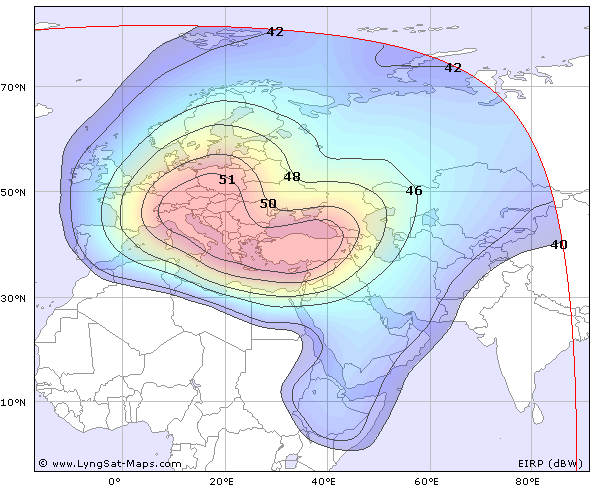
Digiturk’s programming is carried by Eutelsat’s W3A satellite at 7 West, whose coverage area can be seen here. Digiturk also provides a crucial cultural link back home for the estimated 3 million Turks living as expatriates in Europe. Eutelsat’s sales jumped 6.2% in Q1 of this year.
Also check out this commercial for Digiturk, courtesy of Youtube:
Here’s an interesting proposal to meet our future energy needs, perfectly timed with Al Gore’s receipt of the Nobel Peace Prize and the heightened awareness that brings to the need for clean, non-carbon energy:
A futuristic scheme to collect solar energy on satellites and beam it to Earth has gained a large supporter in the US military. A report released yesterday by the National Security Space Office recommends that the US government sponsor projects to demonstrate solar-power-generating satellites and provide financial incentives for further private development of the technology.
Space-based solar power would use kilometre-sized solar panel arrays to gather sunlight in orbit. It would then beam power down to Earth in the form of microwaves or a laser, which would be collected in antennas on the ground and then converted to electricity. Unlike solar panels based on the ground, solar power satellites placed in geostationary orbit above the Earth could operate at night and during cloudy conditions.
"We think we can be a catalyst to make this technology advance," said US Marine Corps lieutenant colonel Paul Damphousse of the NSSO at a press conference yesterday in Washington, DC, US.
The NSSO report recommends that the US government spend $10 billion over the next 10 years to build a test satellite capable of beaming 10 megawatts of electric power down to Earth.
For today’s DIY project, we’re going to flip the plot of the film. Instead of Borat visiting America to understand the country better, we’re going to visit Kazakhstan (virtually, of course), to get a better understanding of the homeplace of the Baikonur Cosmodrome.
Five star it is not: few creature comforts await the tourists who trickle to the birthplace of modern space flight for launches such as this week’s Soyuz blast-off.
But for some that is all part of the mystique.
Dotted with camels and the paraphernalia of half a century of space travel, the Baikonur cosmodrome on the arid plains of Kazakhstan has already been used to launch space tourists to the International Space Station (ISS) for as much as 30 million dollars (21 million euros) per person.
Now this once top secret installation is expecting its own tourist boom.
Ahead of a rocket launch on Wednesday, a group of visiting Britons, all male and laden with camera gear, appreciated the sight of soldiers with automatic weapons, full combat gear and visors guarding the astronauts’ send-off.
It added to the atmosphere, they said.
"We actually like that," said one middle-aged tourist from the English town of Hyde, referring to the soldiers.
We blogged about that security earlier this week. You can "tour" a map of Baikonur here, or check out the other tourist attractions through this travel bureau. If you want to get a better understanding of what it’s like to travel in Kazakhstan, check out this video of a visit to an iron mining camp:
A visit to Kazakhstan isn’t all space and mining facilities, however. Kazakhstan is actually rich in history and natural wonders, from the Silk Road to the Land of Seven Rivers. Check out this list to continue your DIY travels….
Here’s some big news from the world of direct-to-consumer satellite broadband marketing:
Hughes Network Systems, LLC (HUGHES) today announced that consumers across North America will be able to purchase HughesNet®, the leading satellite broadband Internet access service, from Wal-Mart, giving customers in rural areas the opportunity to experience the benefits of high-speed Internet access. The HughesNet service will be sold in 2,800 Wal-Mart stores across the U.S., including locations throughout most of rural America where terrestrial broadband services, such as cable and DSL, are often not available.
With HughesNet, consumers in any region in the continental U.S. need only a view of the southern sky to have access to high-speed Internet. And with millions of Americans shopping at Wal-Mart each week, being able to purchase HughesNet at the stores makes broadband more accessible in many more areas across the country than ever before.
[T]he market for satellite broadband is small, given the widespread availability of digital subscriber line access from phone companies and cable modem services from cable operators. Currently, satellite service tends to be more expensive and it’s available mainly in hard-to-reach rural areas. Fewer than 500,000 Americans subscribe to satellite broadband access, according to consultancy Parks Associates. "It’s still mainly for people who don’t have a choice," says Michael Cai, an analyst at Parks. Only about 10% of Americans have no access to DSL or cable broadband.
But Wal-Mart, which will provide satellite broadband in 800 stores, could make the service more appealing—and give existing providers cause for concern. Whenever Wal-Mart enters a new market, it tends to push down prices and squeeze out competition. Consider what happened when Wal-Mart began offering sub-$1,000 flat-panel TVs. After trying to match these prices, rival Circuit City (CC) had to close 70 stores (BusinessWeek.com, 4/23/07) and lay off 3,400 employees earlier this year. CompUSA had to shutter more than half of its stores.
Wal-Mart could have a similar impact on sellers of broadband services, especially if the Hughes deal presages a bigger push into services related to high-speed Internet access. Retailers are stepping up their emphasis on services, partly in response to Wal-Mart’s penchant for bargain-basement prices.
Broadband Reports says Walmart is "working on a tech support service akin to Best Buy’s Geek Squad," in order to support the new offerings as well as to combat the high return rates that tend to accompany the sale of new technology to consumers who still haven’t figured out how to program their VCR DVD.


 The company is controlled by Istanbul-based conglomerate Cukurova and Providence Equity Partners, a private equity group specialising in media, entertainment, communications and information services. The pair are selling down their holding from 100 to 75 per cent.