Author Archive

Using Satellites to Study Whales

Wednesday, October 10th, 2007
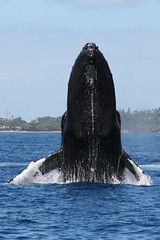
For decades, Japan’s scientific whaling program has killed thousands of whales as part of what it calls necessary research.

Needless to say, Japan’s whaling program has been a point of contention with the environmental group Greenpeace for just as long.

Now, however, Greenpeace is leading the fight against whaling a different way — by example:

Greenpeace announced a satellite-based tracking system to monitor endangered South Pacific humpback whales, saying it is not necessary to kill the animals as Japan does to study them…

Humpback whales from Rarotonga and New Caledonia have been satellite tagged and are "now being tracked in order to produce vital data on their movements, habitat use and population structure," said Greenpeace New Zealand’s oceans campaigner, Mike Hagler.

"The tagging program is producing real scientific results" on whale migrations from breeding grounds in the South Pacific to feeding grounds of the Southern Ocean "without firing a single harpoon," he said.

Tracking whale migration is critical to developing plans and policies to preserve the species; satellite tracking is a natural solution to the problem of tracking big mammals in an even bigger ocean. Whalenet has a good description of how satellite tracking works for whales:

  WhaleNet uses satellite transmitters that send signals to satellites maintained by the ARGOS System in Largo, Maryland and Talouse, France. A number of the U.S. National Oceanographic and Atmospheric Administration’s (NOAA) weather satellites, circling the earth, have ARGOS instruments attached. These instruments collect, process and disseminate environmental data relayed from fixed and mobile transmitters worldwide. What makes ARGOS’s system unique is the ability to geographically locate the source of the data anywhere on the Earth.

Data is collected by the tag while the marine animal is underwater and then transmitted when the animal surfaces. The tag has an antennae which is used to send a signal each time the animal surfaces. Information relayed includes time, date, latitude, longitude, dive depths, dive durations, amount of time at the surface in the last six hours and quality of the transmission. The ARGOS instruments detect the tag’s signal when the satellite passes overhead.

The location fix of the animal in relationship to the track of the satellites, with ARGOS instruments, affects how many satellites passes are made over the animal’s tag in a 24 hour period. Each pass may last between 2 and 12 minutes, depending on the location of the satellite in relation to the animal. The animal must be at the surface at the time of the pass for a successful transmission to take place. Therefore, each day there are a limited number of short opportunities, or maybe no opportunities, for a signal to be transmitted from an animal’s tag to a satellite.

How are they attached?

 With whales the tag is attached by partially implanting a barb into the blubber layer at a slight angle, to a depth of approximately 10 cm. Ideally it is placed high on the back of the whale, directly behind the blow hole. These tags are deployed using a compound crossbow. A study by the Minerals Management Society determined that this does not cause serious stress or pose a health risk to the whale. The tagging team goes out in a 4 meter rigid-hull inflatable equipped with an outboard motor in order to get close enough to the whale to implant the tag.

There’s no relation, we hear, between the satellite tracking of whales and the chip implants for your pet.

 

Upcoming Launches

Tuesday, October 9th, 2007


Taking a look (and translating) the Proton launch manifest, we see that the Sirius 4 satellite (pictured above) is set to lift later this month, pending review of the causes behind the launch failure of the JCSAT 11 satellite from Baikonur:

SIRIUS 4 is a multi-mission Ku/Ka-band satellite. It is built on Lockheed Martin’s reliable A2100AX platform. SIRIUS 4 will be deployed at orbital position 5 degrees East.

SIRIUS 4 will be the biggest satellite and a welcome addition to the SIRIUS satellite fleet. The satellite is intended to meet today’s growing demands and tomorrow’s new challenges. SIRIUS 4 will enhance capacity and widen the coverage of Eastern Europe.

Following Sirius 4 on successive Proton launches will be Telenor’s THOR 5 bird, which has 24 transponders with three times more payload power compared to the current THOR II  satellite that it replaces, as well as the AMERICOM-14 satellite.

Sirius is in competition with Telenor for not only the Scandinavian market (where the Thor 5 delay may be impacting the introduction of a new children’s channel, NRK Super) but for Central and Eastern Europe as well.

But Telenor is expanding. They just ordered Thor 6, which will launch aboard Ariane, about six months ago from Thales Alenia Space

THOR 6 will be based on Thales Alenia Space Spacebus 4000B2 platform and fitted with 36 active Ku-band transponders. 16 transponders will point to the Nordic countries, and 20 transponders will be positioned to serve the growing broadcasting demands within Central and Eastern Europe. With the launch of THOR 6, the 1° West will have a total of 71 transponders providing capacity to facilitate both organic growth and expansion for Telenor.

Already, Intelsat has ordered 10 transponders on the THOR 6 bird.

Telenor is also in the phone business, of course, and does business all over the world. In Asia, they’ve experienced some rough patches of late.

Dishes Galore in Tahoe! (And Reno, Too!)

Monday, October 8th, 2007

Call it serendipity: as members of the satellite industry prepare to attend the Satellite and Broadcast Expo West  in Reno at the end of this week, the Tahoe Daily Tribune observes that there are a heck of a lot of dishes in the area:

More and more, satellite dishes are becoming a fixture in the South Shore scenery, in a sign that satellite providers may be gaining ground in the battle for pay-TV subscribers.

Although cable and satellite providers are shy about revealing raw data concerning subscribers, it seems that satellite TV is becoming the choice of more South Shore residents.

Frank Giardina, owner of Frank’s TV and Electronics on Lake Tahoe Boulevard, estimates that he has installed 1,600 satellites dishes in the area. Frank’s serves as an independent contractor for Dish Network, making them the only "local" satellite provider in the area.

SBE West has a number of great special events at the show. We’re particularly intrigued by the John Hack Technician Challenge:

 Imagine digging through a bucket full of change, connectors, bolts and washers just trying to find enough money to buy $5.00 worth of gas to get to your first install of the day!  That task and more is what contestants in the John HackTechnician Challenge will be facing at SBE 2007 in Reno. Consider it a fun and exciting, timed obstacle course for satellite technicians.   How long would it take you to put 50 pages of work orders in the correct sequence for faxing at the end of the week? We will know at the end of the Technicians challenge.

We think John Hack is a great name for a technician. For those unfamiliar with "him," he started as a column in Transmitter News. You can find his full bio and news about his exciting projects here.

Soyuz Liftoff to Make Double History

Monday, October 8th, 2007


The liftoff of the Soyuz-FG rocket from the Baikonur cosmodrome in Kazakhstan later this week is set to make history — twice.

On board will be Malaysia’s first astronaut and an American who will become the first woman to command the international space station.

The AP reports: 

The Soyuz-FG rocket is scheduled to blast off from the Central Asian steppe on Wednesday night to take Malaysia’s Sheikh Muszaphar Shukor, Peggy Whitson of Beaconsfield, Iowa, and Russian Yuri Malenchenko into orbit.
During his 12-day space trip, Shukor is to study of the effects of microgravity and space radiation on cells and microbes, as well as experiments with proteins for a potential HIV vaccine.

The rocket — adorned with a Malaysian flag and coat of arms and carrying a Soyuz TMA-11 spacecraft — was moved Monday to the launch pad from its assembly site at the Baikonur cosmodrome, which Russia rents from Kazakhstan.

"It’s too exciting to be cold," said Shankini Dovaisingam, a Malaysian aerospace engineer observing the final preparations. "It’s amazing to see the Malaysian flag on a Soyuz spaceship."

The mission coincides with the last days of Ramadan, the holy month when Muslims fast from dawn until sundown, but Malaysian clerics decreed that Shukor will be excused from fasting while in space.

We wrote about how Shukor will adhere (or be excused) from his religious customs here

Also be sure to check out the AP slideshow on the left of this page for more photos of the rocket rollout and the security at Baikonur. 

Satellites, 50 Years On

Friday, October 5th, 2007

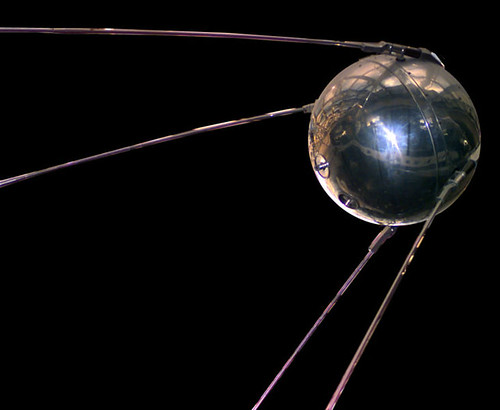
Fifty years ago yesterday, the rather-inauspicious metal ball pictured above changed history and launched the space age — and the satellite industry.

If you’re still guessing, that’s Sputnik 1,  the first artificial satellite to be put into geocentric orbit by the Soviet Union on October 4, 1957.

Scott LaFee at the Union Tribune observes that Sputnik launched an idea that’s still sky high

By current standards, it was crude: a 184-pound, basketball-sized sphere that contained only a radio transmitter, batteries and a thermometer. In orbit, the only thing Sputnik, which means “traveler” in Russian, did as it whirled around the world, one revolution every 98 minutes, was beep.

But that signal had a singular strength. It heralded a new era….

At last count… there were at least 863 active satellites, according to the Union of Concerned Scientists, each circling or hovering somewhere between 49 and 22,356 miles above the Earth’s surface.

Unlike Sputnik, these modern working satellites are marvels of technology and purpose. Two-thirds are involved in communications, some military, others civilian, handling everything from phone calls to television to the Internet….

In 1998, the satellite industry boasted revenues of about $38 billion, according to a Merrill Lynch study. Projected revenue for 2008 was $171 billion. Advocates say the sky’s the limit.

A concerned scientist wonders if a new new era is upon us, however: 

Bruce Dorminey describes how the International Space Station (ISS) has been a successful collaboration between the US, Europe and the Soviet Union and is giving us insights into how the human body reacts to long periods in orbit.

But the ISS has swallowed such vast sums of money (NASA alone has contributed $100m) that many have questioned if the scientific pay-back from the 200 or so experiments carried out on the station in low-gravity conditions have been worthwhile.

Another concern, as Laura Grego from the Union of Concerned Scientists points out, is the potential weaponization of space. Satellites are sitting ducks for enemy nations, who might find it tempting to use a missile to knock out, say, a crucial military spy satellite.

Moreover, when China destroyed an ageing weather satellite earlier this year in a test of its nascent anti-satellite weapon system, the explosion created some 2500 new trackable pieces of "space junk", ranging from spent rocket stages and disused satellites to smaller items like astronauts’ rubbish bags, and immediately increased the chances of a low-Earth-orbiting satellite colliding with another object by up to 30%. As Edwin Cartlidge reports, many observers think that more needs to be done to persuade nations to prevent further space junk being created in the first place.

For a preview of what may lie in the future, check out the day the heavens opened up

DIY Friday: Find a New Galaxy

Friday, October 5th, 2007

You don’t necessarily have to go to Kitt Peak (pictured above) to spot galaxies these days, though it helps; according to Science Daily, we’ve entered a new era in galaxy hunting: 

Astronomers using ESO’s Very Large Telescope have discovered in a single pass about a dozen otherwise invisible galaxies halfway across the Universe. The discovery, based on a technique that exploits a first-class instrument, represents a major breakthrough in the field of galaxy ‘hunting’.

The team of astronomers led by Nicolas Bouché have used quasars to find these galaxies. Quasars are very distant objects of extreme brilliance, which are used as cosmic beacons that reveal galaxies lying between the quasar and us. The galaxy’s presence is revealed by a ‘dip’ in the spectrum of the quasar – caused by the absorption of light at a specific wavelength.

The team used huge catalogues of quasars, the so-called SDSS and 2QZ catalogues, to select quasars with dips. The next step was then to observe the patches of the sky around these quasars in search for the foreground galaxies from the time the Universe was about 6 billion years old, almost half of its current age….

This is where observations taken with SINFONI on ESO’s VLT made the difference. SINFONI is an infrared ‘integral field spectrometer’ that simultaneously delivers very sharp images and highly resolved colour information (spectra) of an object on the sky.

With this special technique, which untangles the light of the galaxy from the quasar light, the team detected 14 galaxies out of the 20 pre-selected quasar patches of sky, a hefty 70% success rate.

Ok, so you don’t have access to a Very Large Telescope? Here’s a great introduction on how to observe galaxies, including a table summary of galaxies for the amateur astronomer. Also be sure to check out this great interactive sky map to peruse the night sky from your desktop, and take a moment to watch this video on how to observe galaxies from Astronomy magazine.

Satellite Images Confirm Human Rights Abuses in Myanmar

Tuesday, October 2nd, 2007

The brutal crackdown of nationwide protests in in Myanmar last week has led to strong international condemnation of the military junta in Burma, while images and video of Burmese soldiers attacking Buddhist monks, who led many of the demonstrations that grew to as many as 100,000 before the crackdown began, have gripped the world media.

But the public dispersions of the protests haven’t been the junta’s only violent attempts to crack down on dissent. A new analysis of high-resolution satellite images completed by the American Association for the Advancement of Science (AAAS) "pinpoints evidence consistent with village destruction, forced relocations, and a growing military presence at 25 sites across eastern Burma where eyewitnesses have reported human rights violations," according to the AAAS website:

The research by AAAS, a non-profit, non-partisan organization and the world’s largest general scientific society, offers clear physical evidence to corroborate on-the-ground accounts of specific instances of destruction. It is believed to be the first demonstration of satellite image analysis to document human rights violations in Burma, also known as Myanmar.


AFP has additional details:

Patches of scorched earth corresponding to settlements reportedly destroyed are visible in the high-definition photographs taken by satellites zooming in on the secretive state in late April and analyzed by the Washington-based American Association for the Advancement of Science (AAAS).

Now the group has trained the satellites on Myanmar’s main cities to try and peer through the clouds and see military deployments amid the current unrest, as the crackdown on pro-democracy protests led by monks has turned bloody.

In Karen areas of eastern Myanmar, the group used three commercial satellites to focus on 31 "attack sites" of reported rights violations from mid-2006 to early 2007, AAAS project director Lars Bromley told reporters Friday.

In one picture, a satellite spotted foundations and fence lines with all the structures gone, where a village had stood two years earlier.

The area photographed was the site of a reported military raid on April 22, on Karen villagers accused by the regime of supporting armed rebels. Bromley estimated a dozen people were killed there and the rest fled.

The image on the left, above, shows a settlement adjacent to rice paddies in 2000. The image on the right shows the same area in December 2006. This area was reported attacked in April 2006. Check out this ABC News slideshow for additional photos from AAAS.

Sunita Williams Honored in India

Monday, October 1st, 2007

U.S. Naval officer and NASA astronaut Sunita Williams (pictured at left) is revered in India for her accomplishments and Indian American heritage. The depth of that reverence was apparent in a visit she made to India last week.
First she called on Prime Minister Manmohan Singh, who called her a "source of inspiration" for youngsters in India as he announced special scholarships named after her for space studies:

Manmohan Singh told Williams that India was "truly proud of her achievements" and that she was a "source of inspiration for all our young people".

Expressing her gratitude, she said she was overwhelmed by the love and affection she received in India and by the interest of young Indians in aeronautics and space exploration.

According to a Prime Minister’s Office (PMO) statement, Manmohan Singh announced that the "Government of India will finance 10 scholarships, five for girls and five for boys, to promote the study of outer space. These scholarships will be called the Sunita Williams Scholarships for Higher Education in Space (SWISHES)."

Williams also received a "rousing reception" from hundreds of delegates participating in the 58th International Astronautical Congress (IAC), which met last week in Hyderabad:

As soon as the US naval officer and NASA astronaut entered the precincts of the Hyderabad International Convention Centre, where the IAC is being held, there was a round of applause and a bit of commotion with television crews and paparazzi vying for a better glimpse of Sunita. She was welcomed by the hosts with a traditional aarti and vermillion (bindi) mark on her beaming face.

Among the first to meet Sunita was Indian cosmonaut Rakesh Sharma. They exchanged notes on their respective trips to space.

About 2,000-odd Indian and overseas delegates from 45 countries and hundreds of school and college students from the twin cities eagerly waited to listen to Sunita share her experiences of spinning in the earth orbit for over six months on board the International Space Station (ISS).

A security ring around the venue guarded her movements.

Here’s an image of the tight security that surrounded Williams’ rock-star visit. And Google Video has a 23-minute video of her presentation: 


Germs from Space!

Tuesday, September 25th, 2007

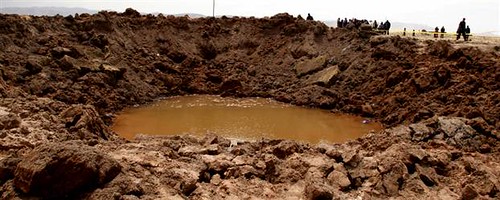
You may have heard about the meteorite that recently fell near Puno, Peru (the impact crater is pictured above), and about the rash of illnesses that have occurred among locals following the crash:

According to Peru’s La Republica newspaper, due to the high number of illnesses, district authorities are considering placing the town of Carancas, Puno, Peru in a state of emergency. It has been reported that at least 600 people have been affected by the meteorite.

Puno, Peru’s Regional Health Director, Jorge López Tejada, reported yesterday that at least 150 people had been seen after having stated they had dermal injuries, were dizzy, nauseous or vomiting.

According to the townspeople, the illnesses began after the meteorite crashed and they began to touch the glowing rock believing it had some type of monetary value. Aside from the hundreds of townspeople that were affected, Tejada reported that 8 police officers had to be hospitalized after having taken samples of the meteorite.

Scientists have confirmed that the meteorite is a chondrite meteorite, meaning it likely originated in the asteroids that orbit the Sun between Jupiter and Mars.

The stories out of Peru along with a story out of the Toronto Globe and Mail have us thinking about the Andromeda Strain.

First, the Globe and Mail:

Bacteria that cause food poisoning on Earth get stronger in space, says a team of researchers that sent dozens of carefully packaged vials of salmonella on a 2006 shuttle mission.

After 12 days in orbit, the shuttle bugs were nearly three times more deadly to mice.

The researchers, who are reporting their findings this week in the Proceedings of the National Academy of Sciences, were able to zero in on the protein that caused the increased virulence. They say their work may one day lead to a vaccine to protect against Salmonella typhimurium, or a new antibiotic to keep an infection in check – both in space and on Earth.

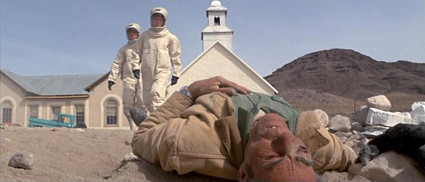
Next, the Andromeda Strain. You remember this, don’t you? It’s the story of a U.S. Army satellite that returns to Earth and lands in the small town of Piedmont, New Mexico. The satellite "brings a mutant living being and all the population, except a crying baby and an old man with ulcer, dies with clotted blood. A team of five scientists are summoned and gathered together in the top secret Wildfire facility" to identify the virus before it’s too late.

Well, that’s not what’s happening in Peru. So what is? Here’s one theory:

"The meteor that crashed in Peru caused a mystery illnesses. The cause of the illness has been found. The meteor was not toxic. The ground water it contacted contains arsenic. The resulting steam cloud is what caused the mystery illness. "The meteorite created the gases when the object’s hot surface met an underground water supply tainted with arsenic, the scientists said." There is a very good photo of the impact crater in the article. The rim of the crater is lined with people for a size comparison."

We’ll undoubtedly learn more about the source of the illnesses in Peru (check out this comprehensive analysis of the various theories). But for now, we want to share a bit of local advice that we kept close to heart during our years living on the Colorado Plateau, where uranium is found in abundance: Don’t touch glowing rocks. Nothing good ever comes of it.

Loral’s Acquisition of Telesat Canada Approved

Monday, September 24th, 2007

Loral and its Canadian partner, the Public Sector Pension Investment Board (PSP Investments), have gained approval from Industry Canada for its acquisition of Telesat Canada.
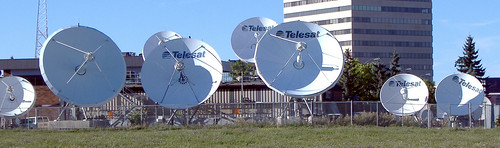
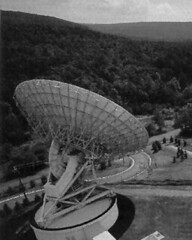
We already heard that Loral is closing the Hawley Earth Station in Pennsylvania (pictured at left), moving all those functions "elsewhere." Does this approval mean "elsewhere" is north to Canada, perhaps? 

"On December 16, 2006, the joint venture company formed by Loral and PSP Investments entered into a definitive agreement with BCE Inc. to acquire 100 percent of the stock of Telesat Canada from BCE for CAD 3.25 billion," according to the PR Newswire release.

The open question is what this new deal means vis a vis Loral’s reetnry in the U.S. market. (Loral, struglling under the weight of high debt, sold their U.S. space assets to Intelsat in 2004. As part of that agreement, Loral agreed to not compete in the U.S. satellite services market for a couple of years.)

Telesat has been an active player in the U.S. market. Portions of  Anik F2’s Ka-band payload was leased to WildBlue two years ago, and Anik F3 is leased to Echostar for Dish Network services.

Incorporated in 1969, Telesat made history with the launch of its Anik A1 satellite in 1972 – becoming the first commercial company in the world to operate a domestic geostationary communications satellite. These days they’re pushing consumer-oriented satellite broadband via resellers:

Telesat’s Anik F2 is the first satellite to fully commercialize the Ka frequency band – a breakthrough satellite communications technology for delivering cost-effective, two-way broadband services. The two-way capability means customers do not need an additional phone or cable line or the expense of a traditional dial-up ISP in order to receive high-speed Internet access. This state-of-the-art development enables dramatic improvements in access to two-way, high-speed Internet services for consumers and businesses in rural and remote areas.

(The picture below is of Telesat’s Edmonton facility.)