Author Archive

Muszaphar to be First Malaysian in Space

Monday, September 24th, 2007

Because many of us in America (as well as Russia and many European countries) have become a bit jaded by more than four decades of space travel, it’s always interesting to see the excitement in other countries as they send their first astronauts into space, usually on a mission bound for the International Space Station.

The next country to send a first astronaut into space is Malaysia:

Malaysia’s astronaut candidates Dr Sheikh Muszaphar Shukor and Kapt Dr Faiz Khaleed have passed their training programme successfully and have qualified to become astronauts.

Both the medical officer and army dental surgeon are equally eligible to be sent to space on Oct 10, but if all goes according to plan, it will be Dr Sheikh Muszaphar making history as the first Malaysian in space.

Dr Sheikh Muszaphar, 35, has been named as part of the three-member first crew for the Soyuz 15-S mission alongside Yuri Malechencko from Russia and American Peggy Whitson, while Kapt Dr Faiz, 27, is a member of the second crew with Michael Fincke from the United States and Russian Sharizan Sharipov. 


Both Muszaphar and Khaleed are keeping a blog about their efforts to "realize the country’s dream." The two beat out a large number of aspirants who went through rigorous training for the honor of becoming Malaysia’s first astronauts. 

It’s also interesting to note how different cultures face different questions as they send their first members into space. For example, Muszaphar’s October 10th launch will take place at the tail end of the Muslim holy month of Ramadan, when practicing Muslims fast and pray five times per day. Being in space might make such acts of devotion difficult, however, so what are Muszaphar’s obligations as a Muslim while in zero gravity?

The International Herald Tribune gives us the answer: 

Malaysia’s first astronaut will not be required to fast while in space even though he is a Muslim and the flight will be during Ramadan, a government minister said Monday….

Sheikh Muszaphar, who has been fasting during training along with his backup Faiz Khaleed, can postpone the fasting until after he returns.

The fasting month of Ramadan started on Sept. 13 and is expected to end on Oct. 12, which means Sheikh Muszaphar will have to fast for only two or three days if he insists on not eating from dawn to dusk, an Islamic religious requirement….

Jamaluddin also said he expects Sheikh Muszaphar to pray only three times a day instead of the obligatory five to reduce the inconvenience of going through prayer rituals in the gravity-free atmosphere….

Malaysia’s National Fatwa Council has ruled that the astronaut will not be required to kneel to pray if the absence of gravity makes it too hard, nor will he have to wash hands and face with water as required — a simple wet towel will do.

Russian television has also filed a report on Malaysia’s first foray into space:
WiMAX is Easy as ABC

Friday, September 21st, 2007


We’ve been writing about "wifi on steroids" — or WiMAX — since the earliest days of the Really Rocket Science blog, when it was but a dream on the technological horizon.

These days, understanding the deployment and growth of WiMAX  is as easy as A-B-C.

A is for Alaska, where AT&T Alascom, which has been using satellites to deliver telecom across Alaska since 1974, is rolling out WiMAX using  Alvarion Ltd.’s BreezeMAX 2.3 GHz TDD equipment:

 Alvarion’s solution is capable of delivering flexible and enhanced coverage even in difficult terrain, such as the hilly and wooded areas. In addition, Alvarion’s nomadic self-install Si CPE can incorporate a patent-pending fast-switching algorithm with six integrated antennas. The Si can is available with a wide variety of options, from multiple POTS interfaces to built-in Wi-Fi.

To deliver WiMAX, AT&T Alascom utilizes SES-Americom’s AMC-8 satellite (also known as Aurora III) exclusively.

Rumors also have AT&T deploying WiMAX in the South soon:

AT&T Inc. is preparing to launch WiMax services during the second quarter of 2008, Unstrung has learned from an industry source. The services will likely be in the South of the U.S. where the operator has suitable licenses for broadband wireless services.

The cellular giant is planning to deploy limited WiMax services in the 2.3 GHz band that could be used as a fixed-wireless alternative to DSL or cable offerings, the source says. AT&T is said to have its suppliers for the service lined up now.


B is for Breezemax; Alvarion of Israel is making real progress in selling their BreezeMAX system for WiMAX apps:


Commercially available since mid 2004, deployed by over 150 operators in more than 30 countries, BreezeMAX is the most advanced, field proven commercial WiMAX solution and the first to offer CPE powered with Intel PRO/Wireless 5116 broadband interface WiMAX chip.


Built from the ground up based on the IEEE 802.16-2004 standard, BreezeMAX supports fixed, nomadic and portable services with a clear path for the emerging WiMAX mobile industry based on the IEEE 802.16e standard. BreezeMAX is designed for a variety of frequencies in both licensed and license-exempt bands from 2GHz to 6GHz spectrum, and operates in both FDD and TDD duplex modes.

Check out this long list of PDF case studies to see how Breezemax is deployed worldwide.

But C isn’t for "check out" — it’s for the Caribbean, where Digicell is rolling out WiMAX using Alvarion products, most recently in Cayman Islands using AMC-6.

Given the continuing rapid growth in WiMAX deployment, we could probably go all the way to Z….

t2

Friday, September 21st, 2007

DIY Friday: A Hard Drive Clock

Friday, September 21st, 2007

Hack a Day points us to today’s DIY Friday project: a hard drive clock that uses the actual drive mechanism and heads to keep track of time (as opposed to simply a regular clock mechanism with a recycled hard drive face).


Instructions can be found here. Don’t sprechen Deutsche? Google can translate:

The synchronous motor, which propels the magnetic disks, engages in 16 positions per revolution dead magnetically. 12 positions are used thereby as hour announcement, after 12 o’clock must run the engine of 5 steps further, in order to continue again with 1 o’clock. The write/read head, which is propelled with a stepping motor, engages likewise dead magnetically. It is used, in order to indicate the minutes within one hour. Beginning of the internal point it moves within one hour to the outside edge of the magnet disk.

Since it’s German, you can rest assured that your DIY project will run on time, but you’ll want to use the atomic clock at Fort Collins to set the clock correctly. (Consistency with errors creates consistent error.) 

Also be sure to check out this very cool video of another hard drive clock. (It’s available on YouTube, but embedding is disabled for this particular video.) 

If all of this seems a bit too complicated for you, for $5 you can make a Salvador Dali melting clock — but obviously, without hard drive parts.

SeaMobile Testing VSAT Over Atlantic

Wednesday, September 19th, 2007

We’ve written before about the growing market for maritime satcom for large ships. Now, SES NEW SKIES is teaming up with SeaMobile’s Maritime Telecommunications Network (MTN) product group for extensive field tests of new miniaturized VSAT antennas, which will enable an array of satellite-based communications services for small vessels:

SeaMobile and SES NEW SKIES will test two new 60cm VSAT antennas, that set new standards with respect to size and weight of VSAT installations: the heavy-duty “Ruggidized” for fishing, work boats and oceangoing support vessels, and the lighter “Sure Lock”, which at less than 90lbs addresses more specifically the sailing, yachting and power boat markets. Both antennas use iDirect Spread Spectrum technology, allowing for small-sized, lightweight antennas which are effectively shielded against adjacent satellite interference. SES NEW SKIES is providing Ku-band capacity for the Spread Spectrum Technology demonstrations on its NSS-7 satellite at the orbital location of 338° East….

States Scott Sprague, Senior Vice President Global Sales of SES NEW SKIES: “Small-sized and light-weight VSAT antennas open up completely new markets for small vessel broadband connectivity, be it for professional use, navigation support, safety services or pure leisure/entertainment. The SES NEW SKIES global satellite fleet is particularly well positioned to support communications on the move, be it maritime, land- or air-based.”


As you can see from this map, SeaMobile currently has extensive MTN satellite coverage, and they’ve just signed their first commercial shipping customer:

SeaMobile Enterprises, a provider of at-sea communications and connectivity, announced Tuesday that it has reached a service agreement with Global Marine Systems, an independent, undersea cable installation and maintenance company. Terms of the three-year contract were not disclosed. SeaMobile said it will provide its Maritime Telecommunications Network satellite services aboard three Global Marine vessels. SeaMobile said it has already installed its MTN VSAT satellite services on two of the ships and expects to address the third later this month. Global Marine Systems is based in Chelmsford, England. SeaMobile is headquartered in Seattle and provides broadband and satellite services for more than 300 maritime vessels.

Stratos has also recently entered the maritime satcom marketplace, while Schlumberger is working to build a model that integrates land and sea.  


Delta Launches WorldView-1

Wednesday, September 19th, 2007

Google Earth users may soon be enjoying higher-resolution images of our little blue planet, thanks to yesterday’s launch of the Worldview 1 satellite.


The AP gives a summary: 

The WorldView 1 satellite, built for DigitalGlobe, which supplies much of Google Earth’s imagery, was lofted into space aboard a Delta 2 rocket [from Vandenberg Air Force Base]. The satellite separated from the rocket about an hour after liftoff and was circling 300 miles (480 kilometers) above Earth.

WorldView 1 was designed to collect up to 290,000 square miles’ (750,000 square kilometers’) worth of imagery a day — an area about the size of Texas. Information gathered by the 5,000-pound (2,270-kilogram) probe can be used by governments and companies to assess damage after a natural disaster or plan escape routes before a catastrophe, the company said.

Images and details about the bird can be found on the DigitalGlobe website. Features include an "ultra-stable platform, high-precision attitude sensors and GPS" that "allows the creation of accurate maps in remote areas, maximizing the utility of whatever resources are available," as well as the "highest commercially available" resolution, with direct downlink of those images available to customer sites using a high-speed 800 Mbps X-band downlink.


The Worldview 1 satellites was built by Ball Aerospace. Check out their online media kit, including high-resolution photos of the satellite.

Worldview 2, also being built by Ball Aerospace, is slated for completion in late 2008. 

Com in Africa: A Changing Marketplace

Wednesday, September 12th, 2007

Here at the Americom Business Network Blog, we’ve written about expanding telecom needs in Africa and about the role satcom plays in furthering the development of Africa’s oil reserves.

African development continues to be a hot topic in the world of sat- and tele-com, with a debate currently taking place about Telkom’s SAT-3 undersea cable and the countries it does (and doesn’t) serve: 

The biggest problem with Telkom’s SAT-3 undersea cable is that it never went bankrupt, said Johan Meyer, Telkom’s group executive for global capacity service.

Meyer, who has been intimately involved in the SAT-3 West Coast cable, which is SA’s primary undersea link for telecommunications and Internet connectivity with the rest of the world, said: “If SAT-3 had gone bankrupt, then we would have had a very different scenario to what we have today, and may even have found ourselves in a similar position to the North Atlantic cables.”

He was responding yesterday to comments made during a debate on pan-African connectivity at the Capacity Africa 2007 Conference, in Cape Town.

Wessel van der Vyver, GM of international business for Telecom Namibia, opened the discussion by saying that Telkom was one of the key impediments to his company lowering its own broadband and interconnectivity costs.

“Essentially, Nambia is a landlocked country in terms of undersea cable because SAT-3 lands in Angola and in SA. We were hoping to get a landing in Namibia, but this hasn’t happened.”

Later, Van der Vyver said Telecom Namibia was also “disappointed” that the proposed undersea cables being planned by the South African government’s new broadband infrastructure supplier, Infraco, was also ignoring his country.

“It would be a pity if another cable is built and it leaves us in the same situation.”

During the discussion, the lack of satellite capacity came under the spotlight.

Pedro Camacho, CEO and owner of Blue Sky Satellite Communications, said satellite capacity was at a premium, with a long waiting list.

Need some background on the SAT-3 cable? Look here:

SAT3/WASC/SAFE is a historic Achievement made possible by the participation of 36 nations, the majority of the landings are in African states. Together they have fully funded the undersea cable system costing more than US$600 million and will own and operate it for the next 25 years. This results in much of the revenue it generates being ploughed back into the continent. This is a major departure from the current scenario, where many African countries rely on foreign operators to route their international traffic which results in revenue generated in Africa, leaving Africa. 

Meanwhile, Telkom and HCI are expanding South Africa’s pay TV market:

South Africa’s communications authority granted fixed-line operator Telkom’s media unit, Telkom Media, and leisure and media group Hosken Consolidated Investments licences along with two smaller operators — On Digital Media and Walking on Water.

Entry of new operators is expected to stimulate the market, with more money being pushed to marketing pay-TV services, portfolio manager Khulekani Dlamini at Renaissance Specialist Fund Managers said.

Chief Executive Officer Nolo Letele of Naspers’ local pay-TV operation MultiChoice SA said the unit had been gearing up for competition.

"We will have to fight that much harder for the disposable rand in people’s pockets," Letele said after the announcement of the winning bidders.

With increasing demand continent-wide for better broadband, television, and voice connections, the communications landscape in Africa is sure to remain fluid for many years. We’ll keep you updated on the latest developments. 

Penn State and NASA Join in Education Program

Wednesday, September 12th, 2007

If you see a shiny new Airstream trailer in front of your local school, it’s not necessarily because of classroom overcrowding: it’s likely part of the "NASA to the Schools, Penn State" program, a new 5-year cooperative program that’s putting the Big Ten athletic conference school forward as the face of NASA’s K-12 educational outreach.


EarthTimes.org reports: 

 The $27 million agreement comes under NASA’s Aerospace Education Services Program, one of the oldest National Aeronautics and Space Administration programs now in its 35th year.

Penn State took over Sept. 1 from Oklahoma State University.

"This is the only program in the United States that can put professional science educators on the ground in 50 states and territories," said Penn Sate Professor William Carlsen, director of the university’s Center for Science and the Schools.

The Penn State program will shift the existing emphasis from one-time school visits and short teacher seminars to university-based, space-oriented summer courses for teachers.

School visits will continue, but rather than emphasizing auditorium presentations, NASA education specialists will work closely with teachers and school administrators to infuse cutting-edge science content into extended instructional units, officials said.

Penn State’s Center for Science and the Schools website can be found here. They’ve got some innovative plans for curriculum development and teacher training:

A meeting at Cornell University with scientists who study Mars will kick off development of the first course for teachers. To supplement instruction by classroom teachers who have enrolled in summer courseware, the six Airstream “NASA to the Schools” vehicles will crisscross the country with a scaled-down version of a Martian Rover. Just like a real Rover, these half-pints will sport cameras that enable them to monitor their environment in 3-D. In a novel twist, the educational rovers will also have the capability of projecting images in 3-D using "GeoWall" technology, letting students see exactly what the Rovers saw on Mars.

NASA to the Schools will use many new instructional technologies, developing continuing education content for delivery through NASA’s Digital Learning Network. Education specialists will get in on the ground floor of new NASA projects to aid them in their continuing education components as well.

For a preview of what the tots might experience as part of their "Rover" education, check out this video of the latest Rover Flight Director’s report

Télécoms Sans Frontières Reconnects Areas Affected by Disaster

Tuesday, September 11th, 2007

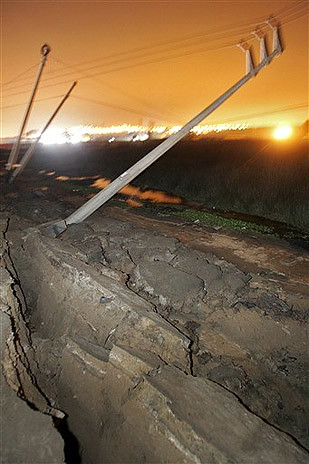
Last month’s devastating magnitude-8 earthquake in Peru killed more than 500 people and knocked down or damaged thousands of buildings in Peru’s southern desert cities of Ica and Pisco.

In the midst of such devastation, conditions are exacerbated by lack of communications with the outside world, as landlines are inevitably severed by falling debris.

That’s why satcom plays such a critical role in disaster recovery. In the days following the earthquake in Peru, engineers from Télécoms Sans Frontières leaped into action. The BBC reported on August 17th: 

The five-strong team will deploy satellite telephone and internet access in three centres – at Pisco, where the quake hit hardest, Ica and Chincha.

Julie Cazenave, who is leading the team, said: "There is a lot of confusion right now because there is little information from the areas hit."

The priority will be to establish telecoms at the airport in Pisco.

Telecoms Sans Frontieres (TSF) is charity that works with the United Nations and the European Commission’s Humanitarian Aid Office (ECHO) to restore communications in disaster-hit areas and the developing world.

"There are no power lines to charge phones. In the affected areas there are no landlines, no internet," said Ms Cazenave.

TSF was critical in reconnecting families that had lost track of each other following the quake:

The relief team from TSF’s Americas base, composed of 5 specialist in emergency communications transports satellite communication equipment (Inmarsat BGan terminals, RBGan, GAN M4 and Mini M) as well as computer equipment to provide internet connections, telephone lines and fax….

During a calling operation on Tuesday, Carmen Hernandez called her son who lives in Spain and testified on the violence of the quake:

"- Mom, where are you calling from? Your voice is trembling, are you sure everything is alright?

"Don’t worry, please keep talking, it’s so good to hear your voice. We’re lacking everything here but we’re alive. When you come back, you won’t recognize Pisco. I’m calling from a satellite phone, a free called offered by an international NGO. Don’t worry son, stay where you are."

The Peruvian earthquake isn’t the only recent natural disaster where TSF has lent a hand:

Still in operation in Pisco following the earthquake which stroke Peru, Télécoms Sans Frontières intervenes in the area of the RAAN (North Atlantic Autonomous Region) from its Latin America base taking care of the victims of the Felix Hurricane.

Tuesday, the Felix cyclone (category 5) devastated Northern Nicaragua, involving the increase of human losses and the number of disaster victims which could exceed 500 000 people. Facing this disaster, the President of Nicaragua invited the international community to provide a humanitarian aid for the victims.

From their base in Managua, 5 logisticians of Telecoms Sans Frontieres arrived on the ground by helicopter, providing assistance to the relief organizations and United Nations agencies by deploying communication centers in Puerto Cabezas. These installations include Inmarsat terminals, BGan, Gan M4, Minis M  and laptops. Efficient telecommunications infrastructure plays a crucial role ensuring the success of emergency coordination. Additional TSF centers will be installed in Sandy Bay and Waspan from today.

At the same time, the TSF teams will offer to each disaster affected family a free call to a relative, which could provide them psychological assistance as well as immediate response to their needs.

ITU has also played a critical role in restoring vital communications to Peru, deploying 50 satellite terminals in remote and underserved areas.

For more information on Télécoms Sans Frontières, click here

inv

Tuesday, September 11th, 2007