Author Archive

DRS Systems Awarded $50 Million to Bring VOIP to DoD

Wednesday, September 5th, 2007

Defense Industry Daily reports that the DoD has awarded a contract to bring Voice Over IP services to military personnel in the field:

DRS Systems, Inc. in Parsippany, NJ received a $50 million indefinite-delivery/ indefinite-quantity, firm-fixed-price contract for a satellite-based internet-broadband service and Voice over Internet Protocol (VoIP) network in support of deployed military personnel. Locations include Iraq and the Balkans, as well as other non-Global Information Grid (GIG) operations in the European Command, Central Command, Pacific Command, and African Command Areas of Responsibility as well as the British Indian Ocean Trust Authority (Diego Garcia), and other unidentified locations per tasking received by the Space and Naval Warfare Systems Europe office. M.C. Dean has also received some contracts along these lines.

The terms of the deal include options that could bring the total value of the contract to $250 million. Approximately 75% of the work will be performed in Iraq, and the project is expected to be complete by August 2008 (or August 2012 if all options are excercised).

Defenselink also has the details (see the Navy section).

JCSAT-11 Set to Launch Tonight

Wednesday, September 5th, 2007

The Japanese telecommunications satellite JCSAT-11 was rolled out over the weekend to launch pad No.200 at the Baikonur cosmodrome. Liftoff of the Proton-M launch vehicle with a Briz-M upper stage is scheduled for 6:43 p.m. EDT tonight.

Built by Lockheed Martin, JCSAT-11 is a hybrid satellite, equipped with Ku-band high-power transponders and C-band medium-power transponders. For the time being, JCSAT-11 will be reserved entirely in orbit as a back up satellite for other JCSAT satellites as part of JSAT’s efforts to build a seamless global network.

ILS is lifting the bird. They’ve set up a launch blog, though the most recent post is a few days old:

 Bright and early Friday morning (well, not that bright, as the sun was just rising), the entire launch vehicle was rolled out to the Breeze M fueling station, where its propellants (fuel and oxidizer) were loaded into the upper stage over a two-day span. These operations are entirely in the hands of our partners at Krunichev and the Russian Space Forces, so our team had a little bit of time to catch up on administrative tasks. In the meantime, the Russian state commission arrived on the second day of fueling and gave the go-ahead for the integrated launch vehicle to roll to the pad with the JCSAT-11 satellite.

During these two fueling days, our team had a chance to sneak in a quick tour of the launch pad, which was used for the Russian N-2 Moon Booster and Energia boosters in years past. These were truly massive rockets, with a lift capability of over 100 metric tons (220,000 pounds) to Low Earth Orbit! The sheer scale of the pad was equally large and impressive.

On a related note, JSAT is helping the Widely Integrated Distributed Environment (WIDE) Project, which is seeking to produce the next generation of communications and broadcasting based on the IPv4 and IPv6 multicast technology. WIDE recently announced an IPTV partnership with the Open Student Television Network (OSTN), which we recently blogged about here.

As always, we’ll update you on the launch in the comments below. 

Two More to Enter Mile(s) High Club

Tuesday, September 4th, 2007

With all the talk and anticipation lately about the nascent space tourism industry, it’s easy to forget that actual travel in space to this day remains one of humanity’s most exclusive clubs.

But soon, two more people may be able to add their name to the (estimated) 400 to 700 people who have truly slipped the surly bonds of earth.

First up is a Russian grocer who made his money with the Seventh Continent grocery chain: 

A grocery tycoon and politician who planted a flag on the North Pole’s seabed last month will now go into orbit as the first Russian space tourist, leading business daily Vedomosti says.

Vladimir Gruzdev, aged 40, underwent medical tests in June and had been formally approved for a flight on board a Soyuz-TMA spacecraft in September 2008, the newspaper quoted an unnamed source from the Russian space company Energia as saying.

He was one of three submariners who on August 2 planted a rust-proof titanium Russian flag at the North Pole, 4,300 metres under water, in order to boost Russia’s claim for a larger chunk of resource-rich Arctic seabed.

The kid-faced Gruzdev can be seen on the left in this photo from a news report about his exploits at the North Pole last month. 

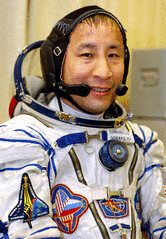
Next up is Korea’s first astronaut, to be announced later today from two remaining candidates: 

 South Korea’s first astronaut who will fly to the International Space Station early next year will be named Wednesday from two candidates, Ko San and Yi So-yeon.

The Ministry of Science and Technology said that a seven-person committee will pick one name this morning after assessing the scores from their six-month training program in Russia.

Ko and Yi, both with outstanding intellectual and physical abilities, were selected from more than 36,000 applicants last year through a series of rigorous tests and a TV popularity poll. They have been receiving spaceman trainings in Russia’s Gagarin Cosmonaut Training Center near Moscow since January.

The ministry said the result will be announced around 10 a.m.

Regardless of who is named by the Ministry of Science and Technology, it’s clear from the numbers that the era of mass space travel is not quite at hand.

Which Satellites Aid Oil Exploration in Africa?

Tuesday, September 4th, 2007


Close observers of the oil industry have been noting for some time now that oil reserves in West Africa are going to play an increasing role in meeting the world’s energy needs in the coming years. That observation is no longer merely predictive; it’s evident in the financial press.

The Financial Times reports that Tullow is expanding its operations in West Africa: 

Tullow Oil told investors to prepare for a significant increase in investment and drove the point home by saying it would maintain, rather than increase, the interim dividend.

It has increased its exploration spend to 45 per cent of a forecast 2007 capital expenditure of £415m. Last year exploration accounted for 30 per cent. More than £100m will go towards accelerating appraisal work in Ghana and Uganda.

Earlier this year the company skewed its capital expenditure away from the North Sea and towards Africa, underlining its reputation as an exploration-driven company. Discoveries in Ghana and Uganda each have the potential to double Tullow’s reserve base, according to Aidan Heavey, chief executive.

India’s Bharat is also looking for a stake, according to Reuters

State-run Bharat Petroleum Corp (BPCL) plans to spend up to 15 billion rupees ($370 million) on exploration over two to three years and is scouting overseas for development or producing fields, its chairman said on Tuesday.

India’s third-largest refiner sees exploration and production as growth drivers and is looking for assets in West Africa, Brazil, South America and Australia, chairman Ashok Sinha told Reuters in an interview.

Offshore, Anadarko has hit paydirt (again) in the waters off Ghana:

Anadarko Petroleum Corporation (NYSE:APC) today announced its second oil discovery offshore the Republic of Ghana. The Hyedua-1 well is located on the Deepwater Tano license in approximately 5,020 feet of water, 3.3 miles southwest and down dip from the Mahogany-1 discovery well, which Anadarko announced in June 2007. 

And, of course, China continues to position itself in an attempt to gain access to Africa’s oil reserves: 

HONG KONG, Aug 30 (Reuters) – China’s top offshore oil and gas producer CNOOC Ltd (0883.HK: QuoteProfile , Research) has defended its search for new acreage in Africa against critics who say China is desperate to secure oil reserves at any price to fuel its roaring economy…

Chief Financial Officer Yang Hua told Reuters that there was one criterion for investments: "Value. If there’s no value, no deal," he said.

CNOOC is already in Nigeria, Kenya and Equitorial Guinea.

The Nigerian presence includes a 45 percent interest in the OML 130 block operated by Total (TOTF.PA: QuoteProfile , Research), which Yang said had been appraised at 1.2 billion barrels of proved and probable reserves by energy consulting firm Wood Mackenzie.

While there’s no doubt from the news that oil exploration in Africa is booming, how do all these companies connect their new drilling platforms once they enter the extraction stage?

The answer, of course, is satellites. Three birds in particular help bring African crude to the global marketplace: SES’s NSS-10Intelsat’s IS-1R, and Eutelsat’s W Series.

Killer Space Rocks!

Wednesday, August 29th, 2007

Two weeks ago the Perseids lit up the night sky, delighting astronomy buffs with a fireworks display of meteors.

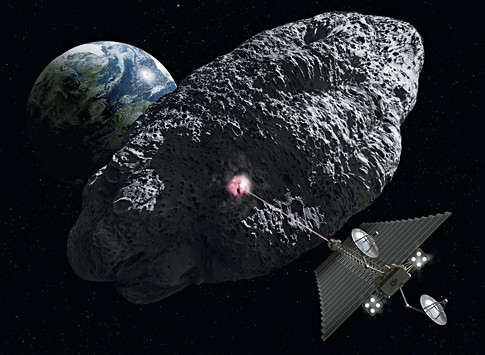
But what would happen if a true grand finale was coming our way in the form of an asteroid that could change life on Earth as we know it?

That’s a question posed in the latest issue of Popular Science.  


From the article

There are between one and two million near-Earth objects (NEOs)—chunks of space rock whose orbits may pass within 30 million miles of Earth—that pose a significant impact threat to the planet. Of the 4,535 NEOs detected and tracked (704 of which are real whoppers), none are on a definite collision course, but there could be millions more, many of them potentially lethal, lurking in the cosmos.

Detection
Who’s Watching? Most spotting is done by half a dozen optical telescopes in the U.S., Italy, Japan and Australia, coordinated by such programs as the Lincoln Near-Earth Asteroid Research (LINEAR) project, a NASA-funded collaboration between MIT’s Lincoln Laboratory and the U.S. Air Force tasked solely with the detection and cataloging of potential NEOs. Amateur astronomers worldwide also aid the effort. Collectively, the programs discover a new NEO every few days.

What’s the Plan? Since 1998, NASA has funded Spaceguard, a consortium of observatories working to find 90 percent of the half-mile-plus NEOs by 2008; the group has found three quarters of the predicted 1,100 NEOs in this size class. Spaceguard’s next step is to find 90 percent of NEOs measuring 460 feet or larger—potentially up to 12,000 objects—by 2020, but funding has not been secured. Larger wide-field scopes should come online in Hawaii, Arizona and Chile in the next decade, greatly speeding detection.

Our knowledge of asteroids and the early formation of our solar system is likely to increase dramatically in the coming decade, thanks to this fall’s launch of NASA’s Dawn mission

[T]he Dawn mission will study the asteroid Vesta and dwarf planet Ceres, celestial bodies believed to have accreted early in the history of the solar system. The mission will characterize the early solar system and the processes that dominated its formation…

Vesta is a dry, differentiated object with a surface that shows signs of resurfacing. It resembles the rocky bodies of the inner solar system, including Earth. Ceres, by contrast, has a primitive surface containing water-bearing minerals, and may possess a weak atmosphere. It appears to have many similarities to the large icy moons of the outer solar system.

By studying both these two distinct bodies with the same complement of instruments on the same spacecraft, the Dawn mission hopes to compare the different evolutionary path each took as well as create a picture of the early solar system overall. Data returned from the Dawn spacecraft could provide opportunities for significant breakthroughs in our knowledge of how the solar system formed.

Where’s the best place to watch the Dawn, er, rise? Apparently, Australia:

A team of four personnel from the United States Air Force will visit Tennant Creek in the Northern Territory to monitor the launch …

The US team will arrive at Alice Springs and travel to Tennant Creek where they will establish a small temporary ground station. Tennant Creek was selected as it affords the best view of the crucial booster separation phase of the launch. As part of the same mission a United States Air Force NKC-135 aircraft will be operating out of Perth International Airport from mid-September and flying over northwest Australia. The launch from Cape Canaveral is planned for between 19 September and 15 October depending on weather and atmospheric conditions.

If you’re more interested in dusk, as it were, be sure to check out Popular Science’s excellent slideshow of past asteroid collisions with our home planet.


Google Continues Foray Into Space

Wednesday, August 29th, 2007

Last week, we told you about Google Sky, which is the Internet company’s effort to point the gaze of its incredibly successful Google Earth platform out into space.

But that’s not Google’s only foray into space:

Google and NASA have worked next to and with each other for a number of years; I’ve never been bothered by this fact, and I’m not complaining now.  Yet the lines are getting even more blurred as former astronaut Ed Lu has gained a job with the search engine giant.

“Lu, who has a doctorate in astrophysics from Stanford University and a strong background in the academic research environment, will have a lot to offer to GoogleSky as well as to GoogleScholar and GoogleBooks,” writes Loretta Whitesides in an article for Wired….

[Lu] "may also play a role in the NASA-Google Space Act Agreement projects, announced in December 2006,” Whitesides continues.  “Lu even has an article published in Nature on his idea for a ‘Gravity Tractor’ mission that could gently pull an asteroid off course over time.”

As WiredPro’s David Caverly points out, Google seems to be intent on covering its lunar bases.

(Hat tip to Wired.

Taxi!

Monday, August 27th, 2007

We’ve written before about plans to use satellite tracking technology to follow the progress of New York City Transit buses.

No one seemed to complain about that idea, since being able to see exactly where the bus you’re waiting for is on its route is of undeniable benefit to the riders, and at worst makes no difference to a bus driver.


But a plan to put GPS in New York City taxis has cabbies screaming and honking like — well, like New York City cabbies:

The New York Taxi Workers Alliance — which accounts for more than 8,000 city drivers — is threatening to curb their cabs on Sept. 5 if the Taxi and Limousine Commission does not get rid of their GPS system, which the union says invades a driver’s privacy….

The issue over a driver’s privacy is the driving issue in the debate, with a driver’s location being tracked no matter where he or she goes.

"The Taxi & Limousine Commission wants to spy on drivers and they want drivers to pay for it," argues Desai.

Both sides agree the TLC uses satellite GPS technology to track everywhere a taxi cab goes and keeps a log of that information. The dispute is over how that information will be used and just who will have access to it.

Mateo says it’s understandable that the taxis are fitted with the technology and adds it’s even advantageous to each driver. "It indicates where you’re located, you can see where you’re going," he says.

But Desai says there is a different motive for the TLC to install the satellite. "They will use this information to decide on drivers’ incomes," she says.

Sources within the TLC and individual taxi drivers tell CBS 2 that the GPS fears have nothing to do with privacy and everything to do with money. Many drivers fear the IRS will use the data to audit drivers and alert the INS about illegal immigrants driving cabs.

Could this be the first strike ever started by GPS? 

A.P. Looks at Virgin Galactic’s Lowered Profile

Monday, August 27th, 2007

Few space stories have captured the public’s imagination (and the press’ attention) more than the efforts of Virgin Galactic to bring the nascent space tourism business to the (well-heeled) masses via the Burt Rutan-designed SpaceShipTwo.


While the attention is surely a boon to Virgin Galactic (and probably a source of resentment for its competitors), it can be problematic when things go wrong, as when an explosion at the factory of Scaled Composites (which made the first private trip into space with SpaceShipOne) killed three people in July during testing of a propellant system.

Today, the Associated Press looks at how the accident has impacted Virgin Galactic’s public profile: 

The accident at the remote site run by famed aerospace designer Burt Rutan rattled the fledgling space tourism industry, which has enjoyed a honeymoon period since 2004 when Rutan launched SpaceShipOne, the first private manned rocket into space.

It also offered insight into how two pioneering companies that forged an unlikely partnership two years ago to fly civilians to space reacted to the tragedy. In a reversal of roles, Richard Branson’s publicity-seeking Virgin Galactic kept a low profile while its usually silent partner, Rutan’s Scaled Composites LLC, took to the Internet to mourn its workers.

Some space experts believe Virgin Galactic is following the right strategy because the accident was of an industrial nature and not directly related to spaceflight. But eventually customers and the public will demand answers, they say.

While Virgin Galactic kept a low public profile after the accident, the company did reach out privately to reassure its "founding" customers, who have already paid $200,000 to be the first to go up in SpaceShipTwo, according to the AP report.

It was Virgin Galactic’s partner, Scaled Composites, that was forced into the limelight following the accident:

Before the accident, hardly anything was known about Scaled’s progress on its suborbital spaceship program. Afterward, Rutan acknowledged for the first time the company was testing a propellent system for SpaceShipTwo, the successor to SpaceShipOne. Many details about the program are still unknown, including how far along Scaled is….

Scaled has since shed some of its stoic image. Its technical Web site was transformed into a virtual shrine for the three rocket workers killed in the line of duty. It set up a memorial fund, posted poignant online remembrances and gave updates on funeral arrangements and conditions of the injured, who are expected to survive.

Scaled also sought outside experts to determine what went wrong and vowed to share lessons learned with the industry to prevent another accident.

"Burt is taking it hard because it’s the first time he’s lost people. There is a feeling of shock that some of his friends died," said space business consultant Thomas Matula.

The Personal Spaceflight Federation, made up of more than a dozen private space companies, has vowed to plow ahead despite the tragedy in Mojave, according to the article. 

In UK, 3 Launches Highspeed Mobile Broadband

Wednesday, August 22nd, 2007

I’ve been a big fan of my Verizon National Broadband Access plan since I picked it up back in February. For a little over $60 per month (with taxes), I’m able to connect my laptop to the Internet no matter where I am. No hunting for Wifi, no searching futilely for a nearby Starbucks, no dropping an extra $10 in a $300 hotel room just to check my email. If I’m in a reasonably civilized location (which is not always the case, to be sure), then it’s just a matter of opening the laptop and connecting at speeds between 400 and 700 kbs.

But if I lived in the UK, I’d be mighty tempted to switch to 3’s new Mobile Broadband service, which is offering speeds up to an astounding 2.8 mbs

3 has launched its new Mobile Broadband service, offering HSDPA speeds of up to 2.8Mbps on the go for laptop users, via a USB modem. It’ll use 3’s new ‘Turbo’ network that starts rolling out nationally from 4th September.

There’s three pricing options. Broadband Lite costs £10 a month with a 1GB allowance. Broadband Plus is £15 a month with a 3GB allowance, while Broadband Max is £25 a month with a 7GB allowance. In all cases, if you go over your data limit, you start paying 10p per megabyte. The modem is £0-£99 depending what tariff and how long you sign up for.

Meanwhile, back in Japan — where life is apparently even better — DoCoMo is looking at 300 Mbps with their "Super 3G" service:

 NTT DoCoMo, Inc. announced today that this month it began testing an experimental Super 3G system for mobile communications. With this experiment, DoCoMo will seek to achieve a downlink transmission rate of 300Mbps over a high-speed wireless network.

Super 3G features low-latency data transmission and improved spectrum efficiency. It is a highly advanced version of High-Speed Downlink Packet Access (HSDPA) and High-Speed Uplink Packet Access (HSUPA), which have been evolved from W-CDMA packet transmission technologies standardized by the 3rd Generation Partnership Project (3GPP). The 3GPP, a telecommunications standards organization, is currently discussing standardization of Super 3G under the name Long Term Evolution (LTE).

DoCoMo will begin with an indoor experiment to test transmission speed using one transmitting and one receiving antenna. The company will then expand the experiment to examine downlink transmission by employing up to four Multiple-Input Multiple-Output (MIMO) antennas for both the base station (transmission side) and mobile station (receiving side); the goal is to achieve a downlink transmission speed of 300Mbps.

Wireless Watch Japan has some video of the DoCoMo phones. But there are, of course, satcom options to compete with faster mobile telecom offerings — such as the GLOBETrekker from Norsat or BGAN from Inmarsat — with the added benefit that you don’t necessarily have to be anywhere near someplace civilized to use them.

Whether via mobile telecom or satcom, however, one thing is clear — the race for mobile internet market share is at least partly a race for connection speed. 

Googling the Universe

Wednesday, August 22nd, 2007

Without a doubt, Google Earth has put the functional utility of satellite imaging at the fingertips of millions, rekindling for many the shear wonder of what satellites can do to improve our lives.

Now Google’s virtual "satellites" (which aren’t really satellites, of course, but rather "the superimposition of images obtained from satellite imagery, aerial photography and GIS 3D") are doing what no single satellite has yet been designed to do: they’re turning their gaze from the Earth to the Heavens with today’s release of Google Sky:


With Sky, users can now float through the skies via Google Earth. This easy-to-use tool enables all Earth users to view and navigate through 100 million individual stars and 200 million galaxies. High resolution imagery and informative overlays create a unique playground for visualizing and learning about space.

To access Sky, users need only click "Switch to Sky" from the "view" drop-down menu in Google Earth, or click the Sky button on the Google Earth toolbar. The interface and navigation are similar to that of standard Google Earth steering, including dragging, zooming, search, "My Places," and layer selection….

"Never before has a roadmap of the entire sky been made so readily available. Anyone interested in exploring the wonders of our universe can quickly see where the stunning objects photographed by Hubble actually dwell in the heavens. Sky in Google Earth will foster and initiate new understanding of the universe by bringing it to everyone’s home computer," said Dr. Carol Christian of STScI, who co-led the organization’s Sky team with Dr. Alberto Conti.

Google Sky features seven layers, including Hubble Space Telescope Imagery, Constellations, the Moon and Planets, a "Users Guide to Galaxies" and a "Life of a Star" layer, as well "The Backyard Astronomer," which "is useful for the amateur astronomer who may benefit from a comprehensive, organized way to reference fragments of the night sky."

"The Sky imagery was stitched together from more than one million photographs from scientific and academic sources, including the Sloan Digital Sky Survey, the Palomar Observatory at the California Institute of Technology and the NASA-financed Hubble," according to the New York Times.

The BBC also has some good video of the new release. 

To get Google Sky, simply download the latest version of Google Earth.